A basic grave clean in Ireland usually starts around €60 to €180 for a single upright headstone in an accessible cemetery, and re-lettering plus full restoration are priced separately. The honest answer is that the final bill depends on stone type, access, cemetery rules, and whether the job is a simple wash or a proper repair.
Families usually get caught out by the extras, not the brushwork. A quote for grave cleaning cost Ireland should spell out the clean, the lettering, any cemetery-side fees, and whether the work needs permission before anyone touches the stone. post a grave cleaning task
What Grave Cleaning Costs in Ireland Right Now
A sensible starting band for a basic grave clean in the Republic of Ireland is €60 to €180 for a single upright headstone that's easy to reach and not badly damaged. The plain job includes washing off surface dirt, lichen, algae, and light organic growth on the face of the stone. Anything beyond that, especially re-lettering or full restoration, is a separate line item.
Practical rule: if a quote bundles cleaning, lettering, repairs, and cemetery fees into one number, it's harder to judge value and easier to miss a charge.
A weathered inscription is a different job again. Re-lettering or repainting worn gold leaf, paint, or cut lettering often adds €80 to €250 per inscription, depending on the size, the finish, and how much of the lettering has to be revived. A family shouldn't expect a cleaner's fee to cover that automatically.
Full restoration sits in another bracket entirely. Once the work moves into repointing, structural repair, deep stain removal, or resetting loose memorial parts, the price is quoted on inspection and can run from €300 into four figures. That's not greed, that's labour, materials, access, and risk.
A stone that just needs washing is cheap. A stone that needs stabilising, lettering, and careful treatment is a different trade job.
The cemetery itself can also add costs on top of the cleaner's labour. In Dublin, cemetery pricing published by Dublin Cemeteries Trust shows that burial-related charges include a 12-month grave maintenance component, and the same published schedules also set ongoing maintenance after the first year for single and double graves. The important point for families is simple, the memorial-care quote isn't always the whole bill, because cemetery-side permissions and reinstatement can sit outside it. Dublin Cemeteries Trust cemetery prices
Basic Clean, Re-Lettering, and Full Restoration Compared
A family can save time by matching the job to the right tier before comparing quotes. The wrong comparison is a cheap wash versus a full repair. The right comparison is a like-for-like scope, with cemetery fees and lettering shown separately.
| Service tiers at a glance | What is included | Typical one-off range (€) |
|---|---|---|
| Basic clean | Water wash, soft brushing, removal of moss, algae, lichen, and dirt, plus a tidy finish around the stone | €60 to €180 |
| Basic clean plus re-lettering | Clean plus repainting or re-leafing of worn inscription where the stone is sound | €150 to €400 |
| Full restoration | Structural repointing, lifting and re-bedding, deep stain or biological remediation, specialist treatment where needed | €300 to €1,200+ |
Those bands are the practical Irish market picture, not published tariffs. Irish memorial-care providers tend to sell these jobs as separate services or packages, and that matters because a family can't judge value if one quote only covers the wash while another includes the inscription and surround tidy.
The middle tier is the one clients ask about most often, because it looks like one job but usually isn't. Re-lettering is labour-intensive, especially if the lettering has faded unevenly, the stone has old fill, or the inscription needs careful paint or leaf work. On a sound stone, it makes sense to combine the wash and the lettering if the memorial already looks tired.
Full restoration is the one to treat with caution. Once the stone is loose, leaning, badly stained, or suffering from material decay, the work is no longer just cleaning. It's repair, and it should be priced that way.
What Changes the Price of a Grave Clean
Stone type changes the method
Granite is usually the easiest material to clean because it tolerates more surface work than softer stones. Marble, limestone, and sandstone need gentler, non-acidic treatment, and older memorials are especially fragile. Donegal County's guidance for historic graveyards warns against power washers, sand blasters, and chemical cleaners, and Cork County Council recommends manual cleaning with low-pressure water, warm soapy water, a bristle brush, and plastic or wooden tools instead. Donegal graveyard guidance Cork County Council headstone care leaflet
That's why a quote for a soft stone costs more. It takes more care, more time, and better judgement. A hard polished granite headstone can often be cleaned faster than a weathered limestone memorial with delicate lettering and porous edges.
Access and soiling drive the labour
A neat rural cemetery with easy parking costs less than a busy burial ground where the cleaner has to carry kit a long way or work around restricted access. Older cemeteries can also add awkward footing, tight plots, or uneven ground, all of which slow the job down. The same goes for tall uprights, kerbed plots, and family memorials with ornaments or vases that must be moved carefully and replaced properly.
Soiling matters too. Light dust and early lichen are one thing. Heavy biological growth, rust staining from old fixings, or discoloured lettering can turn a quick wash into a repeat-treatment job. That's where phone quotes fall apart and a written site visit starts to matter.
Cemetery rules can add separate charges
Some of the price has nothing to do with cleaning skill. Dublin Cemeteries Trust states that monument application fees apply to cleaning and restoration works, and extra charges may be needed for resetting headstones, kerbing, box foundations, and related work. That means the cleaner's number may be only part of the final spend, because the cemetery can require its own paperwork or approvals before work starts. Dublin Cemeteries Trust help and questions
The clean itself may be straightforward. The quote gets bigger when access, stability, or reinstatement enters the job.
A written visit beats a verbal estimate every time. A good provider will want to see the memorial, note the material, and check whether the cemetery expects a permit or reinstatement charge before giving a proper price.
DIY Cleaning Versus Hiring a Professional
A competent DIY clean can work on a modern granite memorial in fair condition. It's the wrong choice for fragile, leaning, or heavily weathered stones, especially marble, limestone, or sandstone. The damage from the wrong method can be more expensive to fix than the original clean.
| DIY versus professional grave cleaning in Ireland | DIY | Professional |
|---|---|---|
| Tools | Soft natural-bristle brush, clean water, non-abrasive cloths, pH-neutral stone-safe cleaner | Specialist cleaning products, soft tools, stabilising kit where needed |
| Time | Often a half-day once travel, parking, and access are counted | Usually less disruptive for the family, but still depends on site conditions |
| Risk | Higher risk of scratching, etching, or stripping old lettering | Lower risk on older or softer stone if the cleaner knows memorial work |
| Best fit | Modern granite, light dirt, simple plot | Fragile stone, heavy biological growth, lettering, or repairs |
DIY also isn't as cheap as people think once the bits and pieces are bought. Brushes, sponge, cleaner, and water containers can easily add up, even before the family gives up a half-day and the travel to the cemetery. For a simple memorial, that may still be worth it. For anything old or delicate, it usually isn't.
The safest method is the boring one. Don't use pressure washers, bleach, metal brushes, or strong household chemicals. Don't try to force off growth that's bonded to soft stone, because that's where the surface starts to break down.
Best fit rule: DIY suits a sturdy modern granite headstone. Anything older, tilting, or stained should be priced by a memorial-care specialist.
How to Compare Two Quotes and Hire Locally
Start with names that work in the Irish memorial trade. Large cemetery authorities and local stonemasons often know who does memorial-care work properly, and parish or family recommendations still matter because this is a trust-heavy job. The question is not who sounds cheapest, it's who can explain the scope cleanly.
The quote itself should answer a few blunt questions.
- What cemetery and what plot? The provider needs the cemetery name, plot reference, headstone dimensions, current condition, and a clear photo.
- What is included? Ask whether the price covers the clean only, or also re-lettering, surround weeding, planting, or vase replacement.
- What cemetery charges apply? Any monument application fee, access fee, or reinstatement charge should be listed separately.
- What method will be used? The cleaner should say how the stone will be treated and what biocide or cleaning product will be used.
- Who is covered by insurance? Ask for proof of Public Liability cover and, where relevant, any subcontracting detail.
- Is VAT included? Some small operators may not be VAT registered, so the quote should say whether tax is included or not.
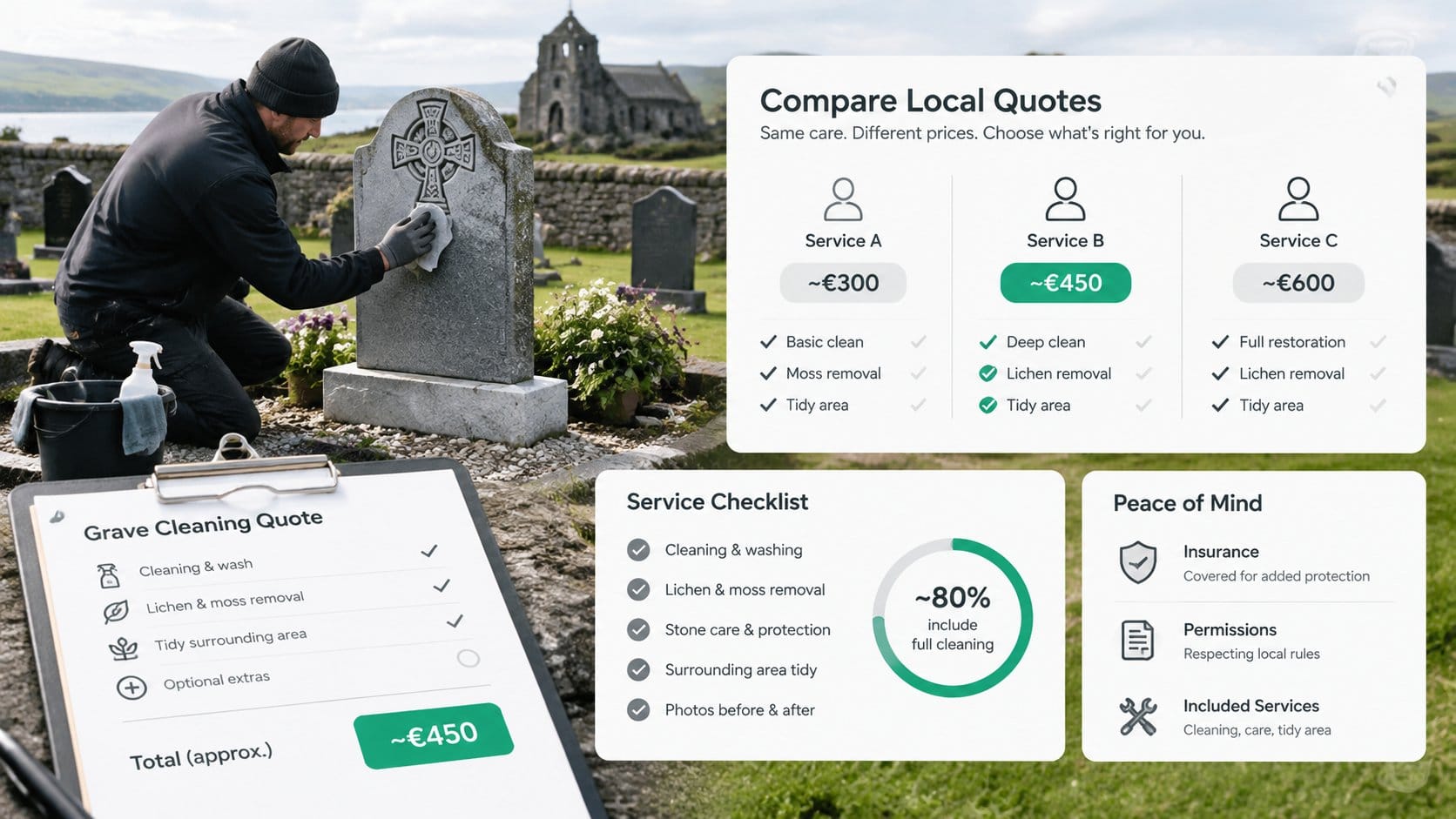
Comparing like-for-like totals matters more than chasing the lowest headline number. A cheap quote that omits cemetery fees isn't cheaper, it's incomplete. The same applies if one provider includes re-lettering and another has priced only the wash.
Cash-only operators without a clear Irish address or landline deserve caution. A proper memorial-care quote should be written, itemised, and easy to refer back to when the work is finished.
Budgeting Over One to Three Years
The clean is only cheap if it stays clean long enough to justify the spend. A one-off wash can look sensible in year one, but if the stone goes back to the same condition within a season or two, the annual equivalent rises fast. That's why a family should compare the one-off quote against a steady upkeep plan over the same period.
For a modern granite memorial in a maintained cemetery, a basic clean every few years is often enough. For an older limestone or marble headstone, a regular professional clean protects the surface better than waiting for a heavy restoration job later. For a large kerbed family plot, a recurring visit can be the sensible option because there's more surface and more upkeep.
A simple budgeting rule helps. Divide any one-off quote by the number of years the family can realistically wait before the stone needs attention again, then compare that annual figure against an annual-plan quote from the same provider. If the annual plan is close, the recurring route usually makes more sense because it keeps the memorial in steady condition.
A family shouldn't overpay for maintenance that the stone doesn't need. But they also shouldn't let a delicate memorial go until dirt, lichen, and weathering force a much bigger repair bill. The cheapest answer is the one that matches the stone, not the one with the lowest initial figure.
Budgeting rule: if a memorial is already fragile, spending a little each year is usually smarter than paying for a major repair later.
Quick Answers on Permissions, VAT, and Written Quotes
Most cemeteries and local authorities have their own rules, and many registered Irish cemeteries require a permit or approved contractor for re-lettering, raising, or restoration. A basic wash may be allowed without the same paperwork, but that depends on the cemetery, so the office should be checked before any work starts.
VAT isn't the main question here, the written invoice is. Small grave-care businesses may not be VAT registered, so the quote should say clearly whether tax is included. If a business customer is paying, or if a larger job is being handled, a written invoice matters either way.
A reputable provider should give a written quote that itemises the clean, materials, travel, and any reinstatement fee. A verbal price isn't enough, and a quote with no cemetery fee line is incomplete. If no reliable figure is available, the right answer is a site visit and a written quote, not a guess.
If anything feels unclear, phone the cemetery office first. An operator with no Irish landline, no address, and no written scope is a red flag, not a bargain.
Are You a Grave-Care or Memorial Provider in Ireland
Families increasingly want a clear, itemised quote that separates the clean, any re-lettering, cemetery fees and reinstatement. A provider who spells that out competes better than one offering a single vague number.
ShamFix connects memorial-care and grave-cleaning businesses with families across the Republic of Ireland. Listing on ShamFix is free and there's no commission; a subscription is planned for the future. ShamFix does not vet or verify providers, so families check credentials, insurance and reviews themselves.
Providers can list a grave-care service on ShamFix, ideally showing public liability cover and a sample itemised quote.