A standard 6ft timber panel fence in Ireland commonly costs €40–€65 per metre installed, putting a 15-metre boundary at about €600–€975 and a 30-metre boundary at roughly €1,200–€1,950. Composite fencing costs considerably more, at about €120–€200 per metre, so the material choice can more than triple the final bill.
That headline range is a useful starting point for the garden fencing cost in Ireland, but it isn't a complete quote. Posts, gravel boards, concrete, access, ground conditions and removal of the old fence can all change the total. The figures above relate to standard overlap timber panels and should be treated as a market guide rather than a fixed price.
What Garden Fencing Costs in Ireland Right Now
The most practical benchmark for a straightforward domestic job is €40–€65 per linear metre for a standard 6ft overlap timber panel fence, including professional installation, on aggregate Irish market estimates. On that basis, a 15-metre garden boundary works out at approximately €600–€975, while a 30-metre boundary comes to about €1,200–€1,950.
These totals assume a relatively clean installation with level ground, reasonable access and no old fence to dismantle or dispose of. A supply-only price will be lower because it excludes the labour involved in setting posts, mixing concrete, cutting panels and clearing the site. The homeowner should ask whether a quoted per-metre figure covers supply and fit or materials only.
| Garden Size |
Approx. Length |
Supply Only (per metre) |
Supply & Fit (per metre) |
Typical Installed Total |
| Small urban garden |
15 metres |
Get a written materials quote |
€40–€65 |
€600–€975 |
| Medium suburban garden |
30 metres |
Get a written materials quote |
€40–€65 |
€1,200–€1,950 |
A separate Irish guide gives a broader range of €40–€70 per metre for basic timber overlap fencing, reflecting differences in specification and installation conditions. It places timber fencing with concrete posts and gravel boards at €70–€100 per metre, which shows why two quotes for apparently similar panels can differ substantially. Basic timber is generally associated with a lifespan of about 8–12 years, compared with 25–30+ years for full concrete post-and-panel systems.
For homeowners comparing prices in Dublin, Cork, Galway or rural counties, the standard timber range is a useful sanity check, not a promise. Labour, travel, access and soil conditions can move a job outside it.
For local written quotes based on the actual boundary, find fencing contractors and post your job.
Fence Type Price Comparison
The cheapest fence isn't always the cheapest boundary over its useful life. A low-cost timber panel can suit a sheltered suburban garden, while a more durable post system may make better sense on exposed ground where replacing failed panels would be disruptive.
The most reliable comparison is the combination of installed price, post construction, privacy and expected service life. The available Irish guides don't publish a complete like-for-like installed range for every fencing style, so the table separates sourced market bands from options that need a written quote.
| Fence Type |
Installed Price (per metre) |
Typical Lifespan |
Best For |
| Standard timber overlap panel |
€40–€65 |
About 8–12 years |
Budget-conscious domestic boundaries |
| Closeboard or featheredge |
€55–€85 |
Get a written specification |
Privacy and exposed gardens |
| Timber panels with concrete posts and gravel boards |
€70–€100 |
Longer-lasting than basic timber |
Timber appearance with stronger supports |
| Concrete post-and-panel |
€90–€140 |
About 25–30+ years |
Long service life and low timber exposure |
| Composite fencing |
€120–€200 |
Get a written manufacturer specification |
Low-maintenance modern gardens |
| Post-and-rail |
Get a written quote |
Get a written specification |
Rural boundaries and open gardens |
| Metal, palisade or railings |
Get a written quote |
Depends on metal and finish |
Security or decorative front boundaries |
| Hit-and-miss or mesh |
Get a written quote |
Depends on construction and treatment |
Wind exposure or open screening |
Closeboard and featheredge fencing sits above standard lap panels because it's usually built from individual boards, rails and posts rather than slotted into place. It can offer a more substantial privacy boundary, and individual boards can be replaced without necessarily changing a complete panel, but the installation is more labour-intensive.
Concrete systems cost more at the outset. Aggregate Irish market estimates place full concrete post-and-panel systems at €90–€140 per metre, while composite fencing sits around €100–€160 per metre, with some estimates as high as €120–€200 per metre. The difference reflects the exact product, post system and installation specification, so a written quote should identify the manufacturer and finish.
Metal and palisade fencing shouldn't be compared with timber on price alone. Security rating, coating, fabrication, foundations and panel height can all alter the cost. Post-and-rail is often appropriate where privacy isn't required, but it isn't a substitute for a solid garden fence.
What Is in a Fencing Quote
A proper fencing quotation should allow the homeowner to follow the job from the ground upwards. The panels are only one part of the installation.
The materials beneath the visible panels
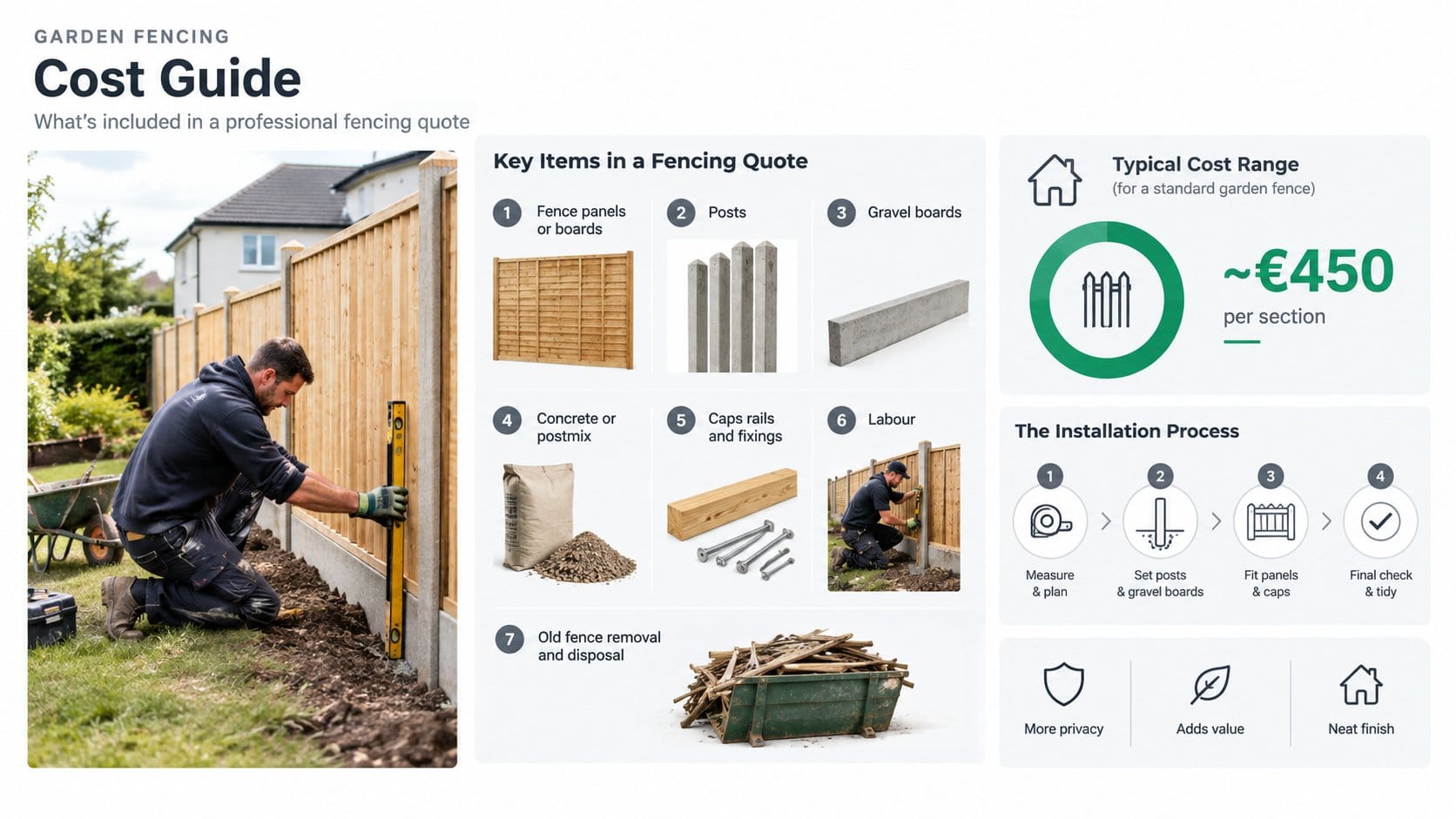
A line-by-line quote commonly includes:
- Panels or boards: The visible fencing, such as treated overlap panels, featheredge boards, composite slats or metal sections.
- Posts: Timber, concrete or metal supports. Concrete posts usually raise the initial price but can support a longer-lasting system.
- Gravel boards: These sit beneath timber panels and keep the main panel away from wet soil, reducing direct ground contact.
- Concrete or postmix: The material used to secure each post. A quote should make clear whether this is included or treated as an extra.
- Caps, rails and fixings: Post caps, arris rails, brackets, screws and other small components can be omitted from a headline figure.
- Labour: Setting out the line, digging holes, levelling posts, securing concrete and fixing panels or boards.
The final lines matter just as much. Old-fence removal and disposal should be listed separately, including whether posts, concrete footings and broken panels will be taken away. If a skip is required, the quote should identify that cost rather than leaving it to appear after the work starts.
A slope may require stepped panels, raking cuts or additional support. A long run might need an extra post because the boundary doesn't divide neatly into standard panel widths. Gates are separate work and should be priced separately, including hinges, latches and posts, rather than folded into a fencing rate.
Practical rule: A per-metre figure is only comparable when the height, panel type, post type, base detail, removal and VAT treatment are the same.
The safest approach is to insist on an itemised written scope before work begins. That document should state what will be installed, what will be removed and which conditions could trigger an agreed variation.
Cost Drivers That Move the Price
Length is the first variable, but it isn't the only one. Fencing contractors usually measure the running metre because the length determines the number of panels, posts, gravel boards and holes. A boundary measured by panel count can miss the extra materials needed at corners, ends, changes in direction and awkward returns.
Height changes the amount of material and the structural demand on the posts. A taller solid fence catches more wind and may require a stronger support arrangement. The homeowner should specify the finished height from the ground level on each side, especially on sloping sites where a fence can appear higher from one garden than the other.
Posts and ground conditions
Post choice often explains a large difference between two otherwise similar quotes. Timber posts generally keep the initial cost lower, while concrete posts and panels sit in a higher price bracket. Metal posts or reinforced arrangements may be appropriate for security fencing or difficult exposure, but they need a written specification.
Ground conditions affect labour rather than just materials. Rocky ground, buried concrete, old tree roots and hidden debris make digging slower. Waterlogged ground can complicate post setting, while a slope may require stepped sections, raked panels or retaining boards.
- Level, clear ground: Usually the simplest installation.
- Rock or buried foundations: May require additional breaking-out and disposal.
- Sloping ground: Can require more measuring, cutting and support.
- Restricted access: Can increase handling and preparation where materials can't be carried directly to the boundary.
- Old fencing: Removal, concrete footing break-out and disposal should be separately itemised.
A boundary beside a narrow passage, shed or mature hedge can also require more labour. Spring and summer demand can affect availability, while wet winter ground may slow post-setting. That doesn't create a universal seasonal price, so the written scope remains more useful than a claimed fixed saving.
For related outdoor works such as a boundary wall, driveway or landscaping construction, consider how adjacent surfaces may affect access and reinstatement.
The most commonly missed item is old-fence disposal. A cheap-looking installation rate may exclude dismantling, concrete removal and waste handling entirely. The quote should state whether the site will be left clear and whether making good around posts is included.
Boundary Rules and Planning Permission in Ireland
Before ordering a tall fence, the homeowner should check the boundary position and the planning threshold. In the Republic of Ireland, a fence or wall up to 1.2 metres high at the front of a property facing a road and up to 2 metres high at the side or rear generally doesn't need planning permission. Anything above those limits should be checked with the relevant local authority before installation.
The measurement should be considered carefully on sloping ground and near a public road. A front boundary that affects visibility at a junction or entrance may face additional practical restrictions even where the general height threshold appears to be met. Protected structures and properties in areas with special planning controls can also require closer examination.
| Situation |
Threshold or Rule |
Action for Homeowner |
| Front boundary facing a road |
Up to 1.2 metres generally falls within the stated exemption |
Check the local authority before exceeding the threshold |
| Side boundary |
Up to 2 metres generally doesn't need permission |
Confirm the fence isn't affected by another planning condition |
| Rear boundary |
Up to 2 metres generally doesn't need permission |
Check height from the relevant ground level |
| Shared boundary |
Agreement with the adjoining owner is advisable |
Confirm line, height, finish and payment before ordering |
| Protected or restricted property |
Additional controls may apply |
Contact the local planning authority |
A shared boundary deserves a written agreement, even where the relationship is straightforward. Both neighbours should agree where the line runs, which side receives the finished appearance, what height is acceptable and how the cost will be handled. A neighbour's consent doesn't replace planning permission where permission is required.
If the adjoining edge meets a public footpath or road, the owner should also consider pedestrian visibility, access and local authority requirements. A boundary dispute isn't something a fencing contractor or marketplace can settle. Mediation or a solicitor may be more appropriate if ownership or responsibility is contested.
Before booking work, confirm three points: who owns the boundary, who pays, and whether the local authority has any property-specific height restriction. Those checks can prevent a completed fence from becoming an expensive alteration.
Comparing Quotes and Reducing the Bill
Compare fencing quotes against the same finished specification, rather than choosing the lowest headline rate. A complete quote should state the finished height, fence type, running metres, number and material of posts, and how each post will be installed. Height and post type can change the total substantially, even where the per-metre figure looks similar.
The written-quote checklist
- Same fence specification: Match timber treatment, board thickness, panel construction and finish.
- Posts and base: Confirm whether timber, concrete or metal posts are included, together with gravel boards and postmix.
- Removal and waste: Check for removal of the old fence, concrete footings, loading and disposal.
- Ground conditions: Look for allowances or exclusions covering rock, roots, slopes, buried foundations and restricted access.
- Finish and making good: Clarify cutting, caps, site clean-up and reinstatement along the fence line.
- VAT: Construction, renovation and repair work generally uses the reduced 13.5% rate, subject to the applicable rules. Confirm whether VAT is included in the quoted total, and check Revenue's VAT guidance for the work involved.
The lowest per-metre figure may leave out the materials and labour that keep a fence stable. Compare the complete cost for the same result, including concrete, gravel boards, removal and waste. Supply-only prices are not directly comparable with supply-and-fit quotes.
Savings usually come from making the job simpler, not weakening the structure. A straight boundary takes less setting out than one with several changes of direction. Existing arrangements may be reusable if they are sound, but rotten posts and unstable concrete should not be retained just to lower the initial bill.
Ask each contractor to confirm exclusions in writing. A quote that omits old-fence removal, difficult ground or additional posts can become more expensive after work starts. It also helps to request comparable scopes from several local providers.
For wider outdoor work, such as gates, a boundary wall, driveway preparation or landscaping, for wider outdoor and landscaping construction work, find tradespeople and post a task. Coordinating access may reduce repeated disruption, while each trade's scope and price should remain separate.
How ShamFix Works and a Note for Tradespeople
ShamFix provides a marketplace route for homeowners who want to describe a fencing task and connect with local providers in the Republic of Ireland. A request can include the boundary length, finished height, preferred fence type, post specification, access details and whether old-fence removal is required. That information gives providers a clearer basis for responding, although matching an enquiry doesn't guarantee workmanship, availability or a particular price.
The platform's stated principle is a two-sided reputation system, where customers and providers can review one another after a completed job. Homeowners should still check insurance, written scope, VAT treatment and any relevant credentials directly with the provider. General fencing is not a regulated trade in Ireland, so those checks matter.
For tradespeople, a clear listing can explain the fencing systems supplied, counties covered, ground conditions handled and whether removal is offered. Listing on ShamFix is free and there's no commission; a subscription is planned for the future.
Garden fencing costs are easier to control when the specification is precise before work begins. Homeowners can use how ShamFix connects Irish homeowners with local providers to describe the boundary, request relevant responses and compare written scopes for the fencing work.