
ShamFix
Back to insights

Garden Fence Repair: A Practical Irish Homeowner Guide

Learn what garden fence repair involves, when to repair or replace, who is responsible, costs, storm damage and how to hire help safely.

9 min read
Garden Fence Repair: A Practical Irish Homeowner Guide

Garden fence repair means restoring a boundary fence that has become loose, broken, rotten, leaning or storm-damaged without automatically replacing the whole run. The most common jobs are replacing a board or panel, re-fixing rails, re-setting posts, treating rot and repairing a sagging gate. A homeowner should normally repair when damage is local and the posts and rails are sound, and plan replacement when rot, movement or breakage runs along several bays or the fence is at the end of its working life.
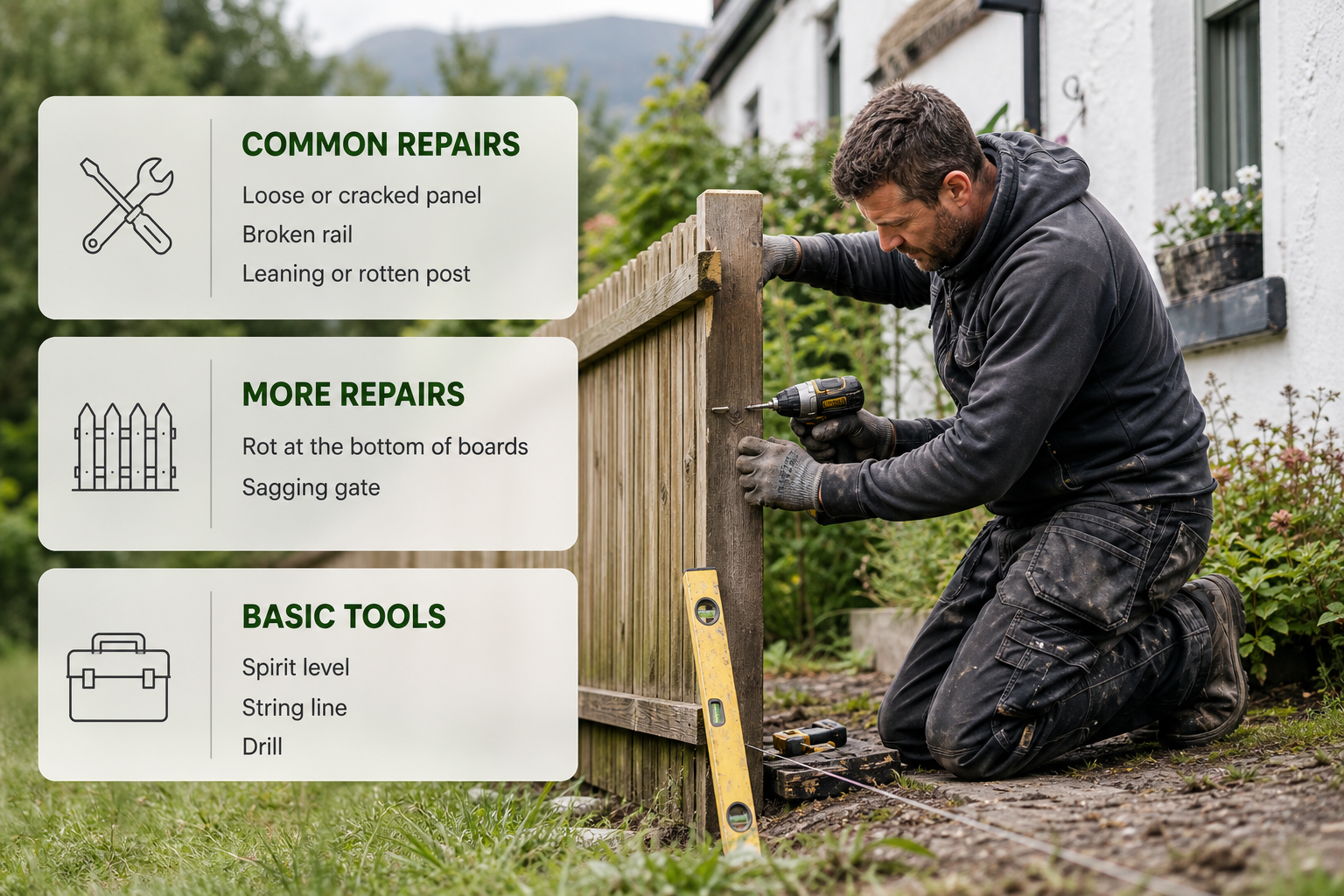
A tradesperson repairs a timber fence in an Irish garden while frosted cards summarise the main repair types and tools involved.

What garden fence repair involves

The first step is to identify what has failed. A fence usually fails at the base, at the fixing points or where a panel meets a post. Common repairs and how they are tackled include:

  • Loose or cracked panel: support the panel, remove the old fixings, take out the damaged panel or boards, fit a like-for-like replacement, and re-fix with corrosion-resistant fixings. Check the post and rail for movement before closing up.
  • Broken rail: cut back the damaged section, replace the rail or splice in a new piece, and fix it securely to the posts. A spirit level and string line help keep the run straight.
  • Leaning or rotten post: dig around the base, remove the old concrete and post, set a new treated post in concrete, brace it and leave it undisturbed until the concrete has set before re-hanging panels.
  • Rot at the bottom of boards: cut out the soft timber, treat the sound timber with a wood preservative, and replace the affected boards with treated timber.
  • Sagging gate: tighten or replace hinges and screws, replace damaged braces, and check that the gate frame is square.

Basic tools include gloves, eye protection, a dust mask when cutting or sanding treated timber, a saw, hammer, drill, spanner, clamps, a spirit level and a string line. Replacement panels, posts, fixings, concrete mix and wood preservative should match the existing fence as closely as possible. For boundary hedges and fences, a local hedge cutting and boundary maintenance service can handle trimming, clearance and repair work that runs along a boundary.

Repair one section or replace the whole fence?

The decision usually comes down to how far the damage spreads and whether the main structure is still sound. Repair is often the better route when one or two panels are broken, a single post is loose, fixings have failed, or a gate has dropped. Replacement is usually more sensible when several posts are rotten at ground level, the fence leans along a long run, panels are brittle and crumbling, or repairs have already been carried out in the same area more than once.

Matching matters. If the existing fence style is still available, a section repair can blend in. If not, a homeowner may choose to replace a whole run for a consistent look. Access also matters: a repair in a tight side passage or over a planted border takes longer and may need more preparation. Finally, the age of the fence and the cost of repeated call-outs can make replacement better value, even when the first repair looks cheaper.

Who is responsible for garden fence repairs?

Responsibility for a garden fence usually follows ownership, the lease or tenancy agreement, and the title documents for the property. An owner-occupier generally deals with repairs to a fence on their own land. A tenant should check the tenancy agreement and raise the issue with the landlord or managing agent in writing, keeping a note of the date and the damage. In broad terms, a landlord is more likely to deal with structural or external boundary repairs, while a tenant is more likely to deal with damage caused by negligence or a minor household fix, but the agreement is the first place to check.

Where a fence sits on a boundary, it may be owned solely by one side, shared, or simply mark the dividing line without either side owning the structure. The title documents, a map or a boundary survey can clarify this. If responsibility is unclear, a homeowner should avoid carrying out work on a neighbour's side or removing a shared fence without discussion. A short written note, photographs and a quote can help resolve the matter before it becomes a dispute.

Boundaries, disputes and overhanging growth

Boundary disputes are best handled with evidence rather than assumptions. Useful records include the property title, maps, photographs, dates of any previous repairs and written messages between neighbours. If an agreement cannot be reached, legal advice may be needed. A homeowner should not move or remove a boundary marker, and should not enter a neighbour's land without permission.

Overhanging hedges and trees are a common source of friction. A homeowner can usually cut back growth that overhangs their own side, but the cut material should be offered back or disposed of correctly, and the neighbour's tree or hedge should not be damaged. Roots can be more complicated: cutting roots can destabilise a tree, so it is wise to take advice before digging near a mature tree. For rural boundaries, field fences, shelter belts and larger land maintenance, the wider agriculture and rural services category covers related outdoor work.

Planning permission and boundary works

Planning permission for boundary works depends on the type, height, location and setting of the fence, and on whether the property is a protected structure or in a sensitive area. This guide does not set out current thresholds because they can change and can vary by local authority area. The body responsible for planning permission is the local planning authority, and a homeowner should confirm the current steps with it before starting work. If a fence is being replaced like-for-like, that may still need a check. If the work is on a boundary with a public road, a protected structure or a special area, the local authority should be asked directly.


Grants and supports for garden fence repair

No grant or support is assumed in this guide for garden fence repair. Where a scheme is advertised, the homeowner should confirm eligibility, the work covered and the application steps with the public body running that scheme. A fence repair is normally a private maintenance cost, and a quote should not be treated as grant-funded unless the scheme rules confirm it. Homeowners should be cautious of any offer that promises a grant without a written scheme reference.

A repaired fence line in an Irish garden is shown with frosted cards summarising typical repair cost estimates and price drivers.

Aggregate Irish market estimate for garden fence repair

The table below is an aggregate Irish market estimate for common garden fence repair line items. A typical single-section repair falls within €150 to €800, with the lower end covering a panel or rail fix and the upper end covering a post plus several panels.

Line item Typical range
Labour only €40–€70 per hour
Replacement panel or boards €35–€90 per panel
Replacement post with concrete and fixings €25–€70 per post
Ground preparation and access €30–€100 per job
Removal and disposal of old panel or post €20–€50 per item
Waste and contingency allowance 10–15% of the repair total

The main price drivers are the number of panels and posts, the material and finish, how easy it is to reach the fence, the condition of the ground, the amount of old material to remove, and whether the new parts need to match an old style. Labour is usually charged at the €40–€70 per hour range shown in the table. Removal and disposal is charged per item, at the €20–€50 per item range. A job that needs more than one post, a new concrete base or a run of panels will move towards the upper end of the €150 to €800 estimate. A simple board or rail repair with good access will sit nearer the lower end.

Storm damage, insurance and repair timing

Storm damage often looks different from ordinary wear. Signs include panels lifted out of their fixings, posts snapped or pulled out of the ground, rails broken in a line, fence sections pushed over, and debris wedged against the fence. A fence that was already loose or rotten may fail in a storm, and an insurer will usually look at the age and condition of the fence when assessing a claim.

In general terms, a homeowner should check the policy wording and excess before assuming that storm damage to a garden fence is covered. Photographs should be taken before any temporary repair or clearance, and receipts should be kept. If a claim is likely, the insurer should be contacted before the old fence is removed or disposed of, because it may want to inspect the damage. A temporary make-safe repair can prevent further damage, but the insurer's instructions should be followed first.

Repair timing depends on the damage and the weather. A single panel or rail fix is often a short visit. A post replacement takes longer because the new post must be set in concrete and left undisturbed before the fence is loaded again. A run of several panels can take more than one visit, especially if materials need to be ordered or the ground is wet. Wind and rain can delay work, and a homeowner should allow for drying or setting time before the fence is fully usable.

What to look for in a tradesperson

A homeowner should ask for proof of public liability insurance and, where helpers are employed, employer's liability insurance. The certificate should be current and should match the name of the person or business quoting for the work. It is reasonable to ask how the waste will be disposed of, whether the quote includes materials and removal, and what happens if hidden rot or a broken post is found once the fence is opened up.

Relevant experience matters more than a long list of unrelated services. A tradesperson who regularly repairs garden fences will understand posts, panels, rails, gates and ground conditions. A homeowner should ask for a written quote that sets out the work, materials, access, disposal and the price. Any registration that applies to the trade should be checked directly, and a homeowner should not rely on a profile alone. A short list of recent local work and a clear answer on insurance are useful signs.

FAQ

Does garden fence repair always need planning permission?

No, not always. Planning permission depends on the fence type, height, location and whether the property is protected or in a sensitive area. The local planning authority confirms the current requirements, so a homeowner should check before work starts. A like-for-like repair may be straightforward, but a taller or more prominent boundary fence may need a different answer.

Will home insurance cover a storm-damaged fence?

It depends on the policy, the excess and the cause of the damage. A homeowner should photograph the damage, avoid disposing of the old fence if a claim is likely, and contact the insurer before repair. Wear and tear, poor maintenance and old age are often treated differently from a single storm event. The insurer's decision should be confirmed in writing.

How can a homeowner tell whether to repair or replace?

Local damage with sound posts and rails points towards repair. Rotten posts at ground level, widespread leaning, brittle panels or repeated repairs in the same run point towards replacement. Access, matching parts and the cost of repeat visits also affect the choice. A written quote for both options makes the comparison clearer.

Posting a garden fence repair job

Homeowners can post a garden fence repair job on ShamFix. Posting a job and listing on ShamFix is free and there is no commission. A subscription is planned for the future. ShamFix does not check or certify tradespeople; profiles are filled in by tradespeople themselves, so homeowners should check registrations themselves and read reviews.

Keep reading