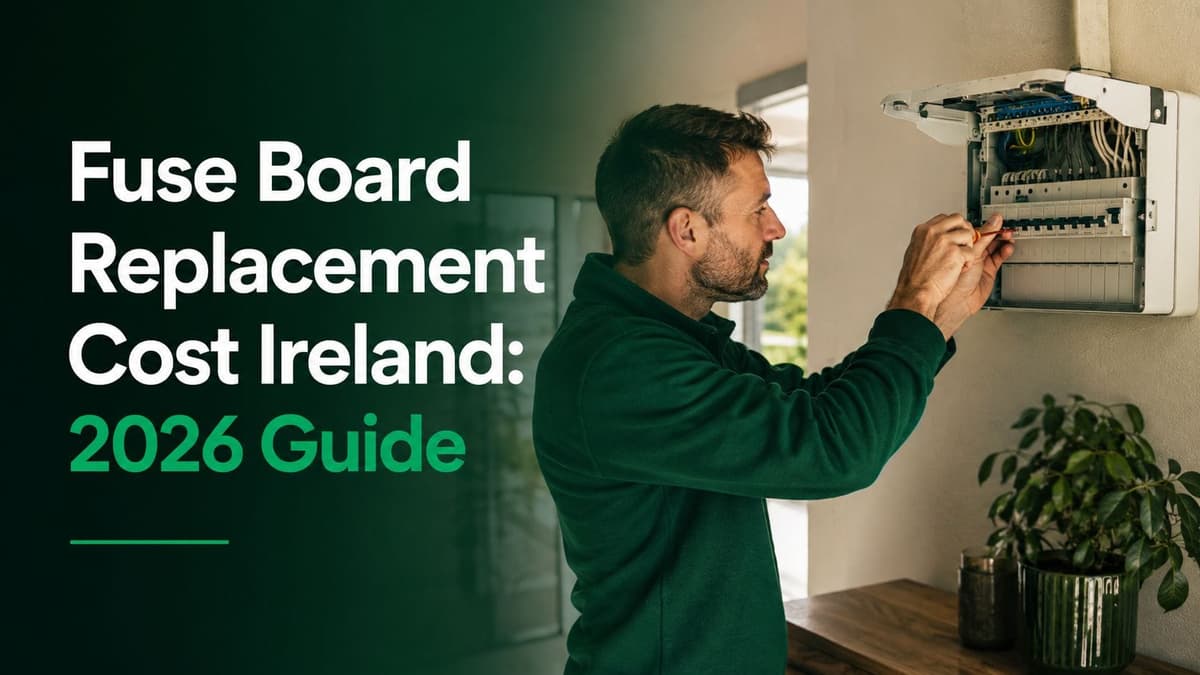
A standard domestic fuse board replacement in Ireland typically costs €350 to €600 for a clean swap, while remedial earthing, bonding, tails or hidden circuit faults can push the bill to €900 to €1,400. The difference is rarely the box alone. It comes from whether the existing installation is safe to connect to, test and certify under current Irish requirements.
The homeowner usually asks the question after seeing an old board in the hall, receiving a short quote by text, or planning an EV charger and wondering whether the existing installation can handle it. The honest answer is that the headline price only means something when the scope is clear. A low figure may cover a straightforward replacement, while a higher figure may include work that an older house needs before a modern consumer unit can be signed off.
What a Fuse Board Replacement Is
The question usually comes after an electrician quotes €350 to €600 for a board swap: does that cover the proper job, or is something missing? That figure can be reasonable for a sound, like-for-like domestic replacement, but the written scope matters more than the headline price.
The modern term is consumer unit, although homeowners still commonly say fuse board. It is the enclosure where the electricity supply divides into circuits for lighting, sockets, the cooker, shower, immersion and other fixed equipment. Replacement means removing an older rewireable fuse box or early circuit-breaker board and installing a modern unit with RCD or RCBO protection.
A clean replacement generally takes from half a day to a full day. If the installation needs earthing, bonding, work in an awkward location or repairs to circuit faults, the cost can rise to €900 to €1,400. The published figures from J. Cowman Electrical show why a low quote and a wider upgrade should not be compared as if they cover the same work.
Three common reasons for replacement
Age is the first. Ceramic rewireable fuse carriers indicate an older installation design. Fuse wire can be replaced with an unsuitable rating, and these boards usually lack the residual-current protection expected in a modern domestic installation.
Missing RCD protection is the second. RCDs and RCBOs disconnect a circuit when current leaks to earth. That protection matters where sockets or equipment serve outdoor areas, kitchens, bathrooms or other places where an electrical fault could expose someone to shock.
Warning signs are the third. Frequent tripping, scorching, a hot or burning smell, loose covers, missing circuit labels and visible damage call for an inspection. A BER assessment or pre-sale survey may also flag an outdated board, but replacing the board does not make unsafe wiring elsewhere safe.
A board swap is therefore a safety upgrade, not a cosmetic improvement. Use ShamFix Insights for general Irish home-service guidance, then have the individual installation assessed on site before accepting the quote.
The Safe Electric Rules Every Homeowner Should Know
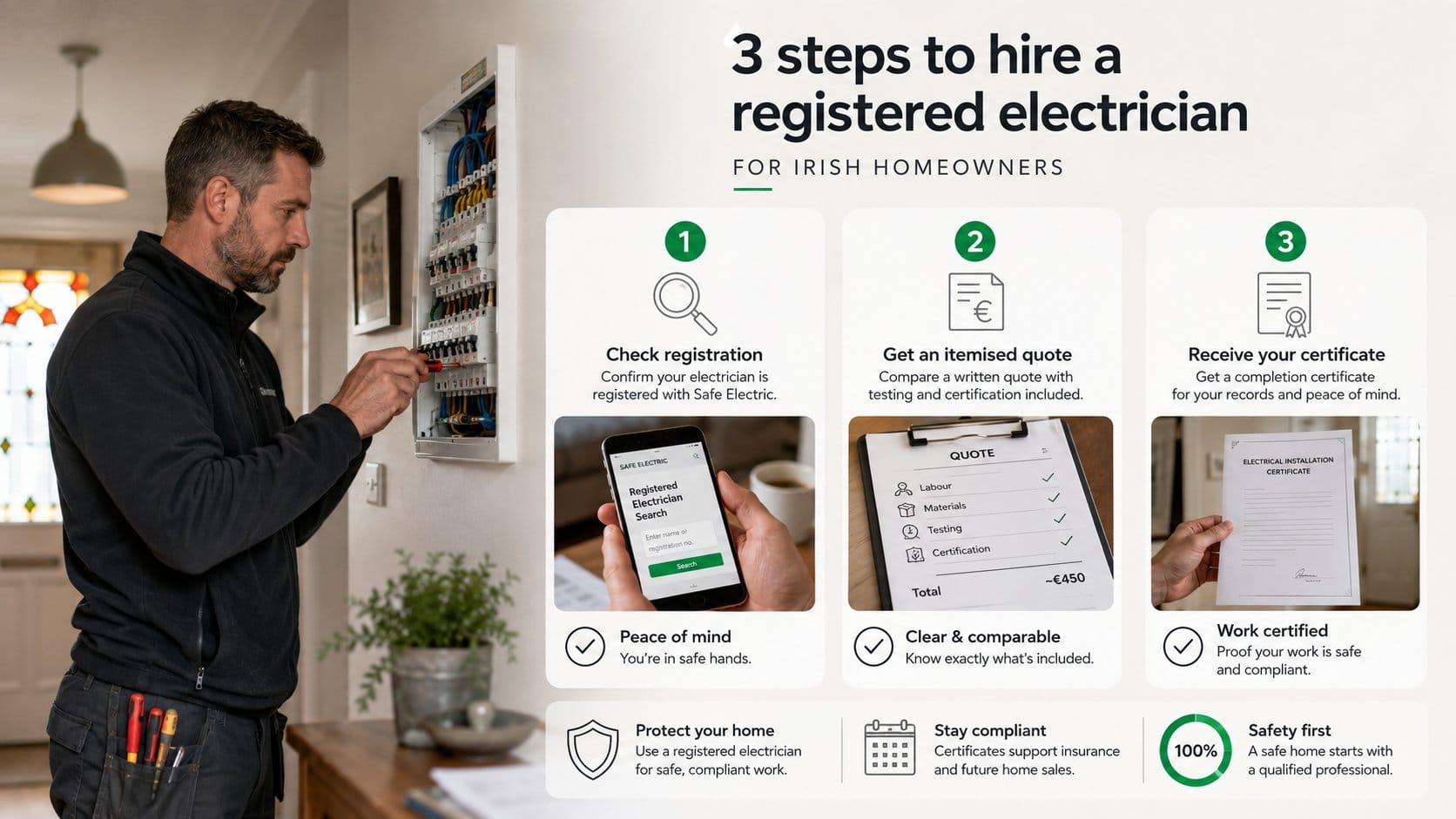
A consumer unit replacement is controlled electrical work in the Republic of Ireland. It must be carried out by a Registered Electrical Contractor, commonly called a REC, registered with Safe Electric. The contractor is responsible for completing the work, testing the installation and issuing the required Completion Certificate.
The installation must comply with I.S. 10101, the Irish national rules for electrical installations. Irish electrical guidance says a modern domestic consumer unit should include an isolation switch and RCD or RCBO protection, with surge protection fitted as standard unless a risk assessment justifies another approach. The requirements are set out in guidance from GW Electrical's Irish rewiring guide.
What the homeowner can and can't do
A homeowner can identify warning signs, clear access to the board, ask questions and compare written scopes. The homeowner can't replace the board and then sign off the installation personally, even if they have technical knowledge. Testing and certification need to come from the appropriately registered contractor.
The certificate matters because it records that the completed work was tested and certified by the REC. It should be retained with the house paperwork, alongside documents such as the BER and records of later electrical alterations.
Practical rule: A quote for a new board without a clear statement about testing and the Safe Electric Completion Certificate isn't a complete quote.
RECI and ECSSA are the main registering bodies associated with electrical contractors whose registration appears through Safe Electric. Registration should be checked independently on the Safe Electric register before work starts. Homeowners looking to find an electrician should still confirm the specific electrical registration themselves, because a marketplace listing isn't a substitute for regulatory verification.
What a Proper Consumer Unit Swap Should Include
A proper board replacement starts with the existing installation, not with a catalogue choice. The electrician should inspect what enters the old enclosure, establish how the circuits are arranged, and test whether the system can safely accept modern protective devices.
The checks that belong in the scope
Main earthing: The electrician should confirm that the main earth is present, intact and adequately connected at the consumer unit. The earthing arrangement may rely on a supplier earth or an electrode, and its condition affects whether the replacement can be certified.
Main protective bonding: Bonding to incoming services, including water, gas and oil where applicable, should be checked. Missing, damaged or inadequate bonding can turn a simple replacement into remedial work.
Meter tails and main earth: Older installations may have tails that are unsuitable, too short or in poor condition. The main earth conductor also needs to be adequate for the installation and properly terminated.
RCD or RCBO protection: The protective arrangement should suit the circuits. Individual RCBOs can limit disruption by allowing a fault on one circuit to disconnect that circuit rather than a wider group.
Surge protection: Irish guidance says surge protection should be fitted as standard unless a risk assessment justifies otherwise. The quote should state whether the board includes it.
Circuit testing: Testing should cover each connected circuit, including checks such as insulation resistance, polarity, earth fault loop impedance and RCD operation. A visual inspection alone isn't enough.
Clear labelling: The finished board should identify each protective device accurately. Labels must match the circuits, not just repeat vague descriptions such as “downstairs”.
Completion Certificate: The REC should issue the Safe Electric Completion Certificate after testing and certification. It is part of the delivered job, not a favour added only when requested.
A written quote should identify which of these items are included and which could become provisional remedial work. Homeowners arranging work should still check the contractor's registration and proposed scope separately.
What Moves the Price
The biggest price difference usually comes from the condition of the existing installation. Earthing, bonding and tails determine whether the work stays a board replacement or becomes corrective electrical work. A €350 quote may cover a clean swap, but the homeowner needs to check what the electrician has allowed for under I.S. 10101 and Safe Electric.
| Cost driver | Typical impact on quote | Why it moves the price |
|---|---|---|
| Number of circuits and ways | Moves the job from lower to higher published bands | Each circuit needs suitable protection, testing and accurate labelling |
| Earthing and bonding | Can turn a replacement into remedial work | Missing or inadequate connections require investigation and correction |
| Tails and main earth | May add significant labour | Older cables can need replacement, extension or better termination |
| Board type | Changes the equipment specification | Split-load, RCBO and surge-protected arrangements have different costs |
| Access | Adds labour where the board is obstructed | A clear hallway position is simpler than a boarded-in cupboard |
The number of ways should match the existing circuits and any planned additions. A home being prepared for an EV charger, extension or other electrical alteration may need a different specification from a straightforward replacement. The electrician should state whether the work needs a new circuit, longer tails or bonding upgrades, rather than leaving these items vague.
The board itself is only part of the quote. Confirm that the price includes suitable RCD or RCBO protection, surge protection where required, testing of every connected circuit, accurate labels and the Safe Electric Completion Certificate. Testing should cover insulation resistance, polarity, earth fault loop impedance and RCD operation. A visual inspection does not complete the job.
Access, older wiring and the condition of the existing connections can add more labour once the old board is removed. Dublin and larger urban areas may also carry different labour and travel charges from rural locations, but installation complexity remains the main question when judging whether a quote is complete.
A €350 quote can be reasonable for a clean swap. It can be incomplete if testing, certification or remedial work has been left out.
VAT should appear clearly on the written quote. Residential electrical work generally carries 13.5% VAT, so confirm whether every quoted figure includes it. Ask the electrician to separate included work from provisional remedial items before agreeing the price.