ShamFix
Back to insights

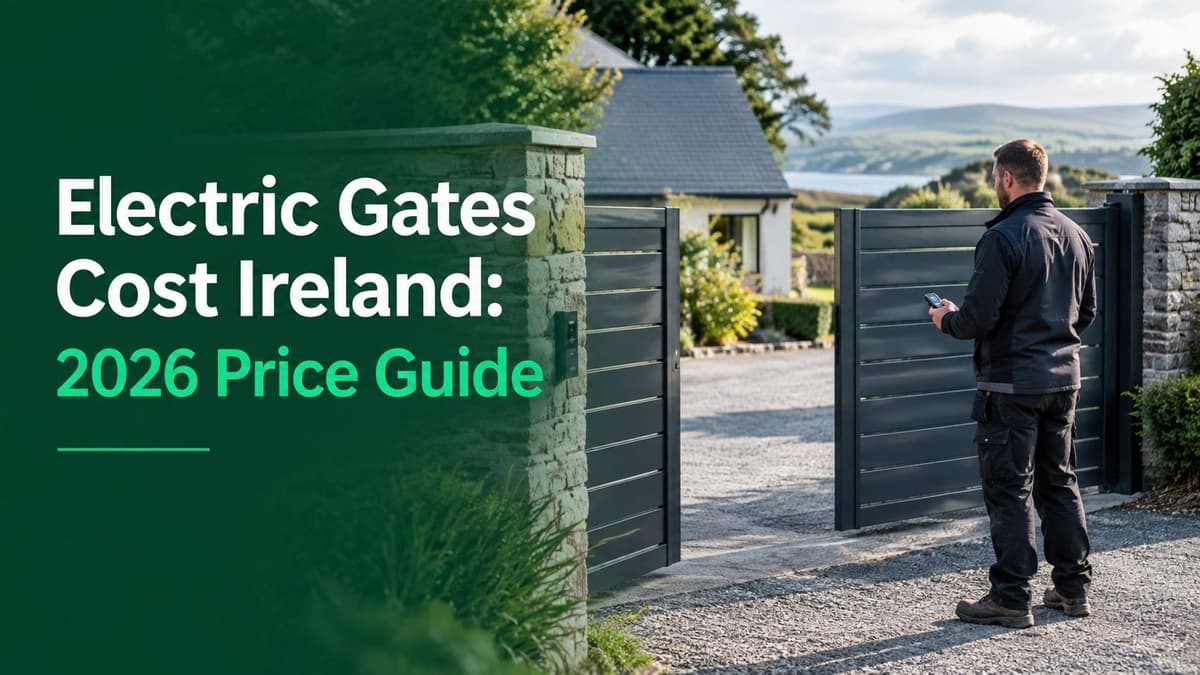
Electric Gates Cost Ireland: 2026 Price Guide

Electric Gates Cost Ireland. Electric gates cost in Ireland explained: typical €1,500–€6,000+ installed ranges, cost drivers, automation premium, VAT notes

16 min read
Electric Gates Cost Ireland: 2026 Price Guide

Electric gates in Ireland typically cost about €1,500 to €6,000 installed, with the final figure driven by the gate type and material, automation package, access control, safety equipment, electrical connection and site works. A straightforward swing gate can sit near the lower end, while a sliding system on a difficult rural entrance can move well beyond the headline range.

The mistake is to price only the gate leaf or motor. A proper quote also has to account for posts, piers, foundations, tracks, cabling, controls, photocells and commissioning. Aggregate Irish market estimates put the broad installed range at €1,500 to €6,000, with basic automatic swing gates often around €2,500 to €3,500, sliding systems roughly €3,000 to €5,000, and professional installation frequently separated at about €500 to €1,500.

For a homeowner comparing prices, the useful question isn't just “what do electric gates cost in Ireland?” It's “which parts of this quote apply to this entrance?” Find gate automation installers and post your job when the specification is clear enough for providers to price the same work.

What Electric Gates Cost in Ireland Right Now

The €1,500 to €6,000 installed range is a useful starting point for residential electric gates in the Republic of Ireland. It is not a fixed price for every driveway. The final quote is built from separate lines: gate type and material, automation, access control and safety devices, plus site-specific groundwork and electrical work.

A low-complexity installation can sit near the lower end when the gate opening is ready, the existing piers are sound and power is close by. A sliding system generally needs more supporting work, including a track or cantilever arrangement, suitable foundations, rack and a motor sized for the gate. That extra structure can matter more to the quote than the gate finish.

What pushes the quote higher

Gate type and material affect weight, fabrication and motor requirements. Timber, steel, aluminium and wrought iron each bring different fabrication and finishing needs. A wide opening, double-leaf arrangement or heavy hardwood gate can require stronger hinges, posts and drives than a small lightweight gate.

Automation covers more than the motor. The quote may include control boards, brackets, sliding-gate rack, remotes, safety settings and commissioning. Aggregate Irish market estimates place automation alone at roughly €1,200 to €3,500 or more when added to the gate price.

Access control and safety equipment add hardware and installation time. Remote fobs are straightforward. Keypads, GSM access, audio intercoms and video entry require extra equipment, wiring and programming. Access control and intercom equipment is typically about €400 to €1,500. Photocells and other safety devices should be listed separately, not hidden inside a vague “automation” line.

Groundwork and electrical work often explain the difference between two otherwise similar quotes. Sloping ground, poor soil, new foundations, long cable routes, trenching, drainage, removal of an old gate and a distant power supply all increase labour and materials. Ask whether the electrical connection is included and whether the work requires a Safe Electric-registered contractor.

Practical rule: A low headline price may cover only a kit, gate or automation package. Require a written quotation showing the gate, motor, controls, safety equipment, electrical work, groundwork, installation and commissioning.

When the headline range isn't enough

Premium aluminium or hardwood sliding systems can reach €8,000 to €12,000 where fabrication, coating, substantial groundwork, access equipment and higher-spec controls are included. Older mechanism-and-install figures do not map neatly onto a modern, fully specified installation. A quote should be judged line by line, not against one headline band.

Breaking Down the Components of an Electric Gate Quote

A proper electric-gate quotation should read like a small construction schedule, not one unexplained total. Require separate lines for the gate, automation, access control, safety equipment, electrical connection, groundwork, installation and commissioning. That breakdown shows why one Irish quote lands higher than another.

The gate and supporting structure

The gate leaf is the most visible item, but its price depends on weight, dimensions, fabrication and finish. Timber, steel, aluminium and wrought iron all bring different structural and finishing requirements. Swing gates may use a single or double leaf. Sliding gates need enough structural length to clear the entrance and suitable hardware beneath or beside the gate.

The quotation should state whether it includes:

  • Gate fabrication, including material, finish, dimensions and opening direction.
  • Posts or piers, where existing supports are unsuitable.
  • Hinges, rollers, stops and locks, where required.
  • Track or cantilever hardware for a sliding system.
  • Removal and disposal of an old gate or fencing, if applicable.

There is no reliable supplied figure for gate-only prices by material, so ask for each gate element as an itemised amount. Do not infer it from an installed headline range.

Automation and controls

The automation line may cover the control board, motors, brackets, sliding-gate rack, remotes and commissioning. Aggregate Irish market estimates place automation hardware at approximately €1,200 to €3,500 or more above the gate price. A basic swing mechanism sits at the lower end, while a larger sliding or higher-spec system can push beyond it.

Access control should appear as its own line. The broad range is €400 to €1,500 for access control and intercoms. Keypads, GSM controllers and video intercoms can require separate cabling, mounting and programming, particularly when the control point is away from the gate. Remotes alone are a simpler installation.

Groundwork and electrical work

Ground conditions often decide whether a quote stays near the headline range. A sliding gate may need a prepared track or reinforced foundation. New piers require excavation and concrete, while long runs between the house, consumer unit and gate add cable, ducting and reinstatement work. Include removal of an existing gate, drainage and difficult access where those apply.

Component Basic swing range Mid-range sliding range Premium aluminium sliding range
Gate and supporting structure Itemise material and size Itemise material, length and support Itemise design, finish and fabrication
Automation €1,200 to €3,500 or more €1,200 to €3,500 or more €1,200 to €3,500 or more
Access control €400 to €1,500 €400 to €1,500 €400 to €1,500
Safety equipment Photocells and required protection Photocells and movement protection Safety equipment matched to the system
Electrical supply and cabling Quote the connection separately Include ducting and long cable runs Include connection, cabling and testing
Foundations, piers or track Existing supports may reduce work Track and foundation preparation Groundwork may form a major line
Indicative installed position Around €2,500 to €3,500 Around €3,000 to €5,000 Can reach €8,000 to €12,000

The installed markers above show why the gate type affects the total, but they do not replace a site survey. A quote that excludes cable runs, foundations or removal work is not comparable with one that includes them.

When the headline range is not enough

Premium aluminium or hardwood sliding systems can reach €8,000 to €12,000 where fabrication, coating, substantial groundwork, access equipment and higher-spec controls are included. Historic figures do not map neatly onto a modern, fully specified installation. Judge the quotation line by line, and confirm which items sit outside the headline figure.

Swing Gates Versus Sliding Gates and Motor Choice

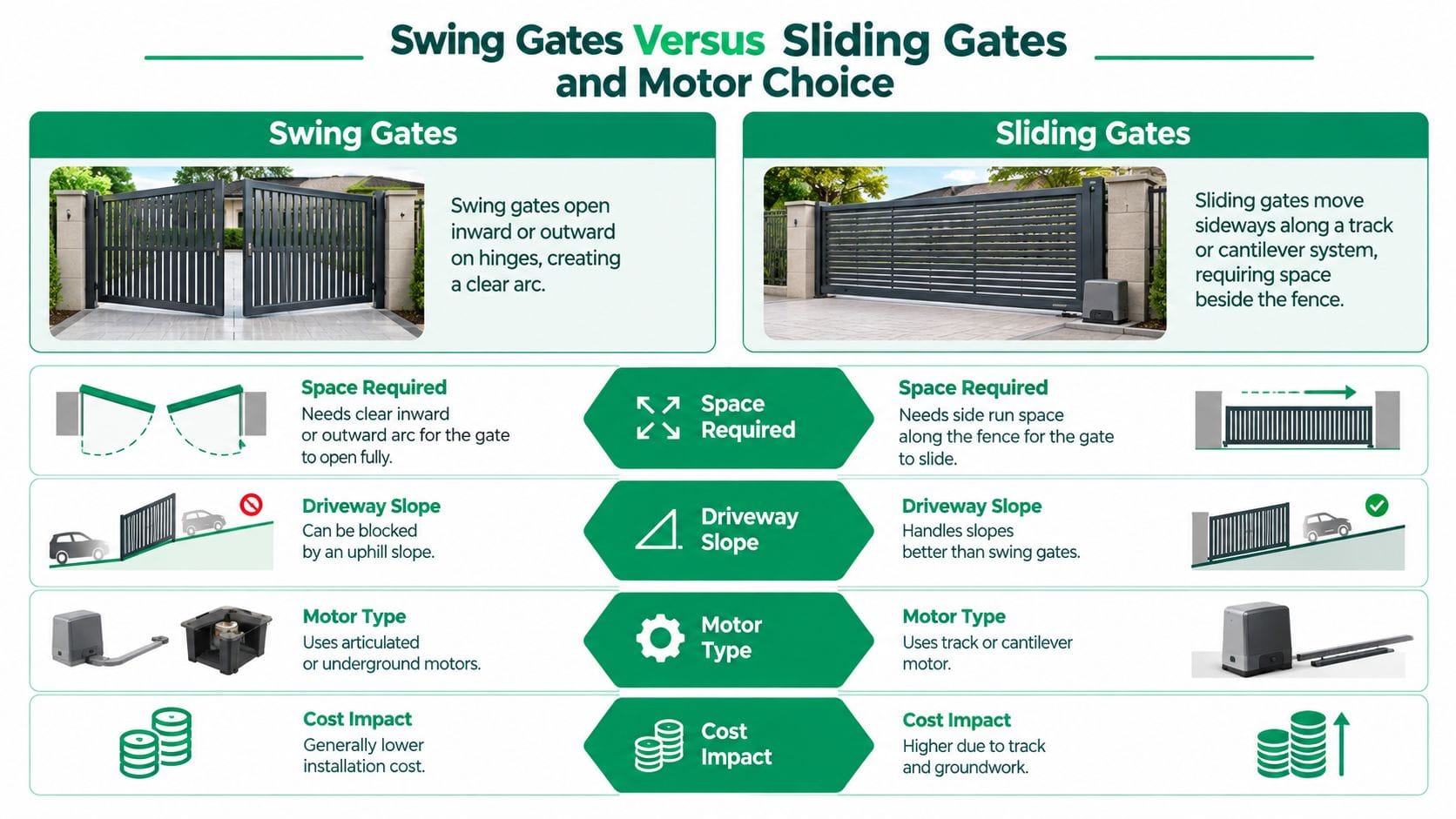
Start with the driveway, not the gate style. A swing gate needs enough clear space for its opening arc, including room for vehicles and pedestrians. It can be a poor choice on an uphill approach or where cars park close to the entrance. A sliding gate avoids that arc, but needs a usable run along the boundary, plus room for the track or cantilever mechanism.

The earlier price bands show the general difference between the two options. Sliding installations cost more when they require new foundations, track or cantilever hardware, a rack, and extended boundary preparation. A site with sound piers and a level entrance may keep the swing option straightforward. Poor ground, a slope, restricted access or a long sliding run can move the quote higher.
A comparison infographic between swing gates and sliding gates regarding space requirements, slope suitability, motor types, and costs.

Matching the motor to the gate

Swing systems commonly use ram motors, articulated-arm motors or underground motors. Ram and articulated mechanisms remain visible and are generally easier to reach for servicing. Underground motors preserve a cleaner appearance, but need careful drainage and accurate below-ground installation.

Sliding systems use a dedicated sliding-gate motor with a rack-and-pinion drive. The installer must match it to the gate's weight, length, gradient and expected daily use. Wind exposure, hinge condition and track alignment also affect the specification.

Choose the motor for the gate's load and movement, not its appearance. An unsuitable motor can increase wear, servicing needs and installation problems.

A narrow, level entrance with sound piers usually favours swing gates. A wide entrance without room for an inward arc can justify sliding hardware, even when the groundwork is more involved. The lowest-priced mechanism is a false saving if the gate design fights the driveway.
Access Control and Safety Devices That Change the Price

Access control decides who can open the gate and how. Remote fobs suit straightforward vehicle access. A keypad removes the need for a transmitter, while GSM, audio and video intercoms let residents identify or speak with visitors before releasing the gate.

The device choice matters more than a vague access-control allowance. Ask the provider to list the make, model, quantity and installation work for each item.

Device What it does What to check in the quote
Remote fobs Opens the gate from a vehicle or nearby position Number of fobs supplied and programmed
Keypad Allows entry using a code Keypad model, weather protection and mounting
Audio or GSM intercom Allows communication or remote release Handset or phone connection and wiring route
Video intercom Shows the resident who is waiting Camera, handset, connectivity and night visibility
Photocells or infrared detectors Detects an obstruction in the gate path Position, quantity and connection to the controller
Safety edges Reduces crushing and impact risk Whether the risk assessment requires them
Warning or indicator equipment Signals movement and operating status Equipment included and its position

Use the quote to compare like with like. A cheaper system may omit a second detector, proper cabling, commissioning or a suitable warning device. Unverified device-by-device figures should not be inserted into a quotation comparison.

Safety isn't an optional upgrade

The Health and Safety Authority's powered-gate guidance covers specification, design, purchase, installation, maintenance, inspection and use. The HSA warns that electrically powered gates can create entrapment and crushing hazards for adults and children, with the potential for serious injury or death.

Protective measures identified in the guidance include pressure-sensitive strips, safety sensor flooring, light barriers and infrared detectors. The installer must assess the gate's movement, nearby access points and surrounding risks, then commission protection suited to that arrangement.

Ask who completed the risk assessment, which safety devices are fitted, and how the system was tested. A low quote that removes required protection is not a genuine saving. It leaves the homeowner with a gate that may be unsafe, difficult to insure, and more expensive to correct later.

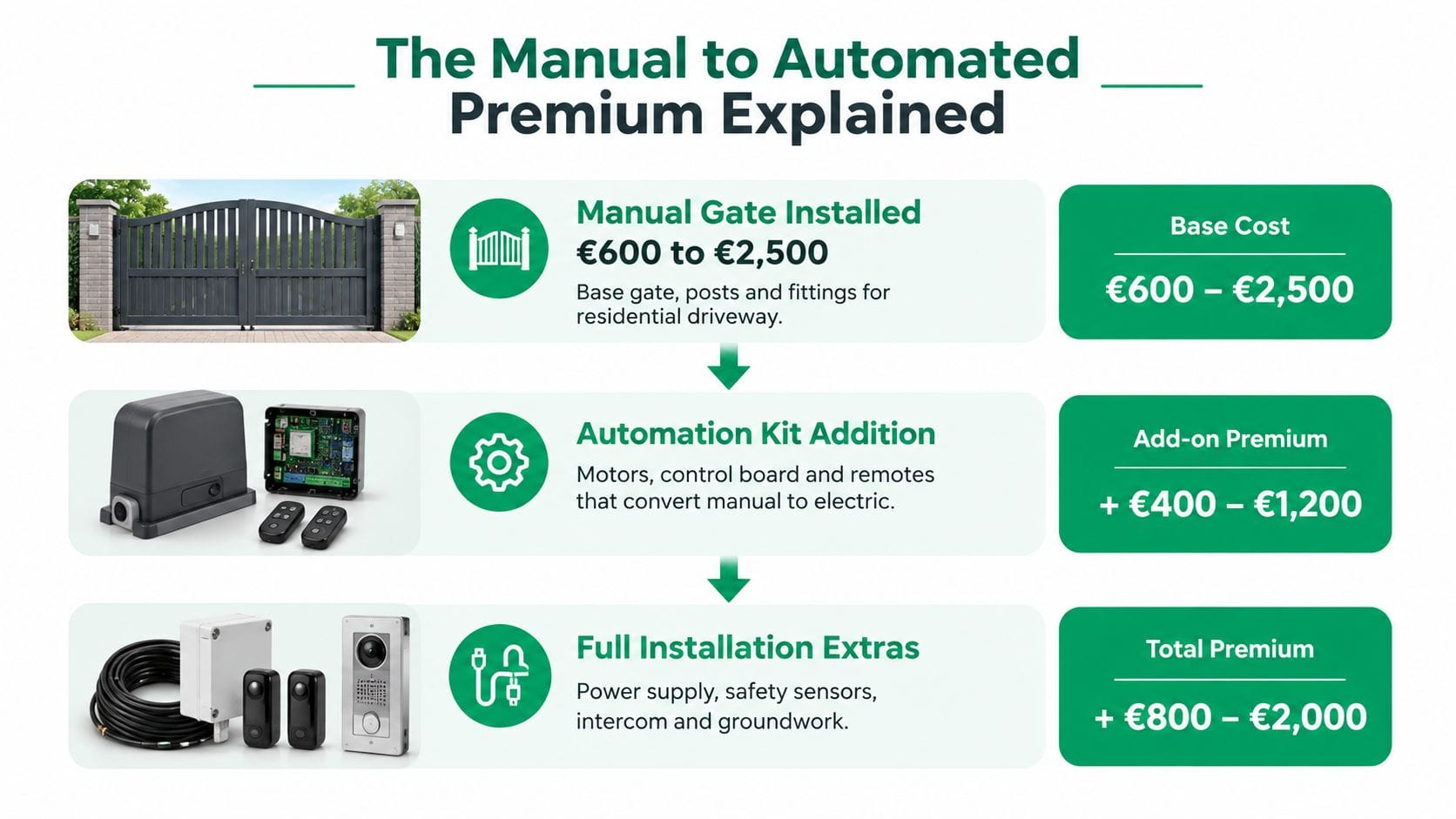
The Manual to Automated Premium Explained

Automation is an added specification, not a single mysterious surcharge. Aggregate Irish market estimates suggest a basic single-leaf electric swing gate starts from about €2,000 including fitting in Dublin, while full access control and intercom systems can reach €3,500 to €6,000 or more.

As noted earlier, the €1,200 to €3,500 or more automation uplift applies to the automation package added to the gate. That figure makes sense only when the quotation shows what it includes. Motors, the control board, safety equipment, access control, cabling and electrical work can all sit inside the automated premium, or appear as separate lines.

An infographic detailing the breakdown of costs for installing automated premium electric gates for residential driveways.

What the premium covers

A manual gate usually consists of the leaf, hinges, posts and latch. Automation adds the drive system, control board, remote or keypad, obstruction protection and a suitable electrical route. Sliding gates also require the correct rack, track or cantilever arrangement.

The existing entrance can push the price higher. A heavy gate, worn hinges, moving piers, exposed position or damaged sliding track may need correction before a motor is fitted. A light gate on level ground presents a simpler installation.

Dublin fitting conditions can also change the quote through access, cable routes and site preparation. Ask for two written options, one manual and one fully automated, with each added component listed separately. Compare the specification, not just the final total. A second quote is worthwhile because installers may allow for different groundwork, electrical routes or control equipment.

Running Costs, VAT, Planning Rules and Safe Electric

Annual maintenance for an electric gate is typically €150 to €400 on aggregate Irish market estimates. Budget for inspections, cleaning and adjustments to hinges, tracks, rollers, drainage and safety sensors. Electricity use and repair bills depend on the operator, weather exposure and how often the gate opens, so get those points confirmed in writing rather than assuming they are included.

VAT and the written quotation

Residential installation labour generally falls under the reduced 13.5% VAT rate where the work qualifies as construction, renovation or repair. Supply-and-fit work may also qualify under the two-thirds rule, depending on the contract and the balance between materials and labour. Ask the installer to show the VAT rate and confirm whether the quoted total includes VAT.

A proper quote separates the gate and automation package from access controls, spoil removal, making good, long cable routes, driveway cutting and boundary-wall work. These extras can materially change the final bill. Compare like with like, and reject any quotation that hides them under a vague installation allowance.

Planning and electrical responsibility

A front boundary gate or wall over about 1.2 metres fronting a public road can require planning permission under exempted-development limits. Check the proposal with the relevant local authority before fabrication begins. Visibility from the entrance, the appearance of the boundary and the gate design can all affect the planning position.

The mains connection must be completed by a Safe Electric registered electrician. The gate installer may arrange this subcontractor, but the quote should name who handles the connection, testing and certification. A motor installation is not a substitute for properly specified domestic electrical work.

Item Typical € or rule Notes
Residential electric gates About €1,500 to €6,000 installed Depends on gate, automation and site
Professional installation About €500 to €1,500 often estimated separately Confirm whether groundworks and electrical work are included
Annual maintenance About €150 to €400 Ask what inspection and parts are covered
VAT Reduced 13.5% rate may apply to qualifying residential works Confirm inclusion and treatment in writing
Front boundary height About 1.2 metres can trigger a planning check where the gate fronts a public road Ask the local authority before work begins
Mains connection Safe Electric registered electrician required Confirm responsibility for the connection and certification

For piers, driveway work, a boundary wall or associated groundworks, use find tradespeople and post a task. An electric gate needs its own cable route, protection and certification, separate from any other domestic electrical work.

Hiring Local Providers and Next Steps to Get Quotes

The quality of your electric-gate quote depends on the information you give before the site visit. Photograph the entrance from the road and inside the property, measure the opening, note the driveway gradient, and identify the nearest suitable power supply. This lets providers price swing clearance, sliding-track preparation, new piers and cable length instead of guessing.

The quotation checklist

Give each provider the same written brief and require every quote to list:

  • Gate specification: Material, dimensions, finish, leaf arrangement and opening direction.
  • Automation equipment: Motor type, controller, rack or underground hardware, remotes and commissioning.
  • Access control: Fobs, keypad, GSM, audio intercom or video intercom, including quantities.
  • Safety protection: Photocells, safety edges, force limitation and other protective measures.
  • Electrical work: Cable route, ducting, connection and the Safe Electric registered electrician responsible.
  • Groundworks: Foundations, piers, tracks, drainage, excavation, spoil removal and making good.
  • Aftercare: Motor warranty, finish warranty, servicing arrangements and call-out terms.

Use the HSA powered-gate guidance cited earlier during the safety discussion. The installer should explain how the gate detects a person, child, vehicle or obstruction. If that answer is vague, the quotation lacks information needed for a sound decision.

Compare like for like

Get at least three written quotations. Compare whether each total includes the track, electrical certification, safety devices, foundations and other groundworks. Homeowners should check each provider's insurance, references and registration details independently.

A low price can be reasonable, but an unexplained total is a warning sign. Choose a correctly sized motor, suitable safety protection, sound foundations and clear aftercare terms before chasing the cheapest figure. Ask the provider to identify exclusions, possible variations and the person responsible for electrical testing and certification.

ShamFix lets homeowners describe the entrance, gate and automation requirements, then receive responses from local providers. It does not vet or verify providers, so check credentials, insurance, written scope and Safe Electric responsibility directly. Learn how ShamFix connects Irish homeowners with local providers and post the electric-gate project to start comparing replies against the same specification.

Keep reading