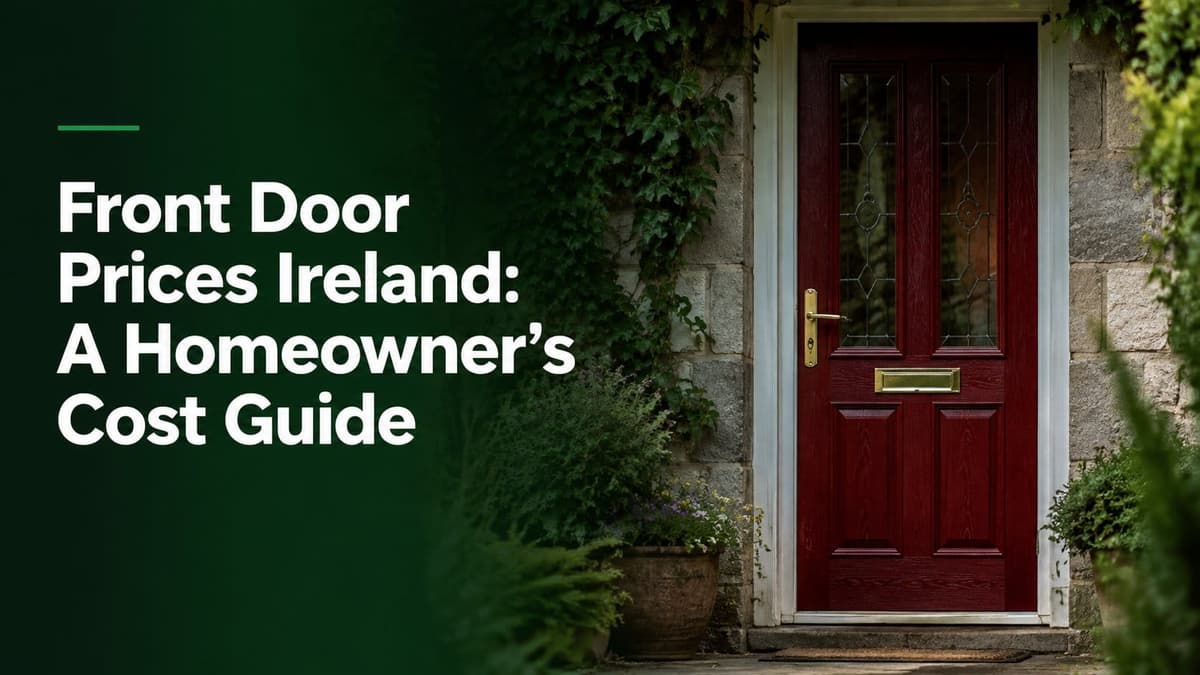
A typical uPVC front door installed in Ireland sits around €900–€1,500, a composite door usually lands in the €1,400–€2,500 band, and an SEAI grant of up to €800 per door can knock the net cost down in a meaningful way. That's why front door prices in Ireland look messy at first glance, but get a lot clearer once the grant and the spec are both on the table.
A homeowner staring at two quotes on the kitchen counter often isn't comparing like with like. One price may be for a bare door swap, while the other includes the frame, sill, hardware, disposal, and the patch-up work that keeps the hall from looking half-finished.
Why Two Front Door Quotes Can Differ by €1,500
The first quote looks friendly enough. It says €1,050, it mentions a door, and it sounds local. The second lands at €2,600, and suddenly the same front step feels like a different property altogether. That gap is usually not a scam, it's a sign that the two papers are pricing different jobs.
A proper front-door quote is rarely just the leaf. It often includes the frame, sill, threshold, locking gear, removal of the old unit, making good around the reveals, and sometimes timber repairs that only become visible once the old frame is out. A cheap number can be real and still be incomplete, which is why it looks attractive right up to the day the fitter starts naming extras.
What the cheaper quote is probably leaving out
The silent savings usually come from omission, not magic. If the quote skips draught sealing, uses a thinner frame, or ignores the need to rebuild the opening cleanly, the door may sit there and function, but it won't perform like a modern replacement should. In plain terms, that's how a bargain quote ends up behaving like an old 1980s door with a new handle on it.
That's also why headline prices in adverts can mislead. National-style display prices often talk about supply only, while the invoice bundles fitting, VAT, waste disposal, and the awkward bits around the opening. For a homeowner who wants to compare properly, a better reference point is a UK installation guide such as door replacement, because it shows how much the frame, hardware, and install scope can affect the final price.
Practical rule: if a quote looks unusually low, ask what's excluded before discussing the price. The missing line is often the expensive one.
For buyers in Ireland, the lesson is simple. The spread between quotes is usually a reflection of scope, not luck. Once the reader starts reading front-door quotes line by line, the number on the page stops looking random and starts looking like a breakdown of materials, labour, and finish quality. ShamFix publishes this guide.
uPVC, Composite and Timber Compared
uPVC, composite, and timber each solve a different problem. The cheapest option is not always the sensible one, and the most expensive one is not automatically overkill. In Ireland, the decision usually comes down to weather resistance, energy performance, appearance, and how often the homeowner wants to maintain the door after it's fitted.
The simple Irish price ladder
Irish pricing guides put uPVC front doors around €900–€1,500 installed, composite doors at €1,400–€2,500 installed, and timber at a higher premium once custom joinery and finish are involved, with quoted ranges often pushing well above the middle bands for bespoke work. That gap makes sense. Composite construction usually carries stronger insulation and security hardware, while timber brings a level of appearance that many period homes still demand. See the Irish material comparison in front door material guide for a broader product-level overview.
Composite has become the obvious middle ground for a lot of Irish housing. It gives the cleaner look homeowners want, without the constant upkeep timber asks for, and it usually feels more substantial than basic uPVC. Timber still has a place, especially where the house itself sets the tone, but it needs more care and a higher tolerance for repainting and maintenance cycles.
| Material |
Installed Price Range |
Lifespan |
Maintenance |
Thermal Performance |
| uPVC |
€900–€1,500 |
Around 20 to 25 years |
Low |
Decent |
| Composite |
€1,400–€2,500 |
Around 25 to 30 years |
Very low |
Strong |
| Timber |
Higher, often bespoke |
Varies by build quality |
Higher, regular repainting |
Good when well specified |
What Irish homeowners usually value
The sensible choice depends on the house, not the brochure. A draughty semi-detached home near the coast gets more value from a tighter-sealing composite than from a cheaper door that looks fine in a showroom. A terrace in a conservation area may need timber because that's the only finish that fits the street and the rules.
For an everyday Irish estate home, composite is usually the best balance. For a rental, a quick cosmetic refresh, or a budget-sensitive replacement where the frame is already sound, uPVC still makes sense. Timber is the specialist option, not the default one.
door fitting ShamFix is the relevant service page for homeowners who want to compare fitting enquiries in one place.
What Actually Sits Inside an Irish Front Door Quote
A front-door quote looks simple until the installer breaks it into parts. Then the invoice starts making sense. The door itself is only one piece of the job, and the opening around it can be just as important as the slab on display.
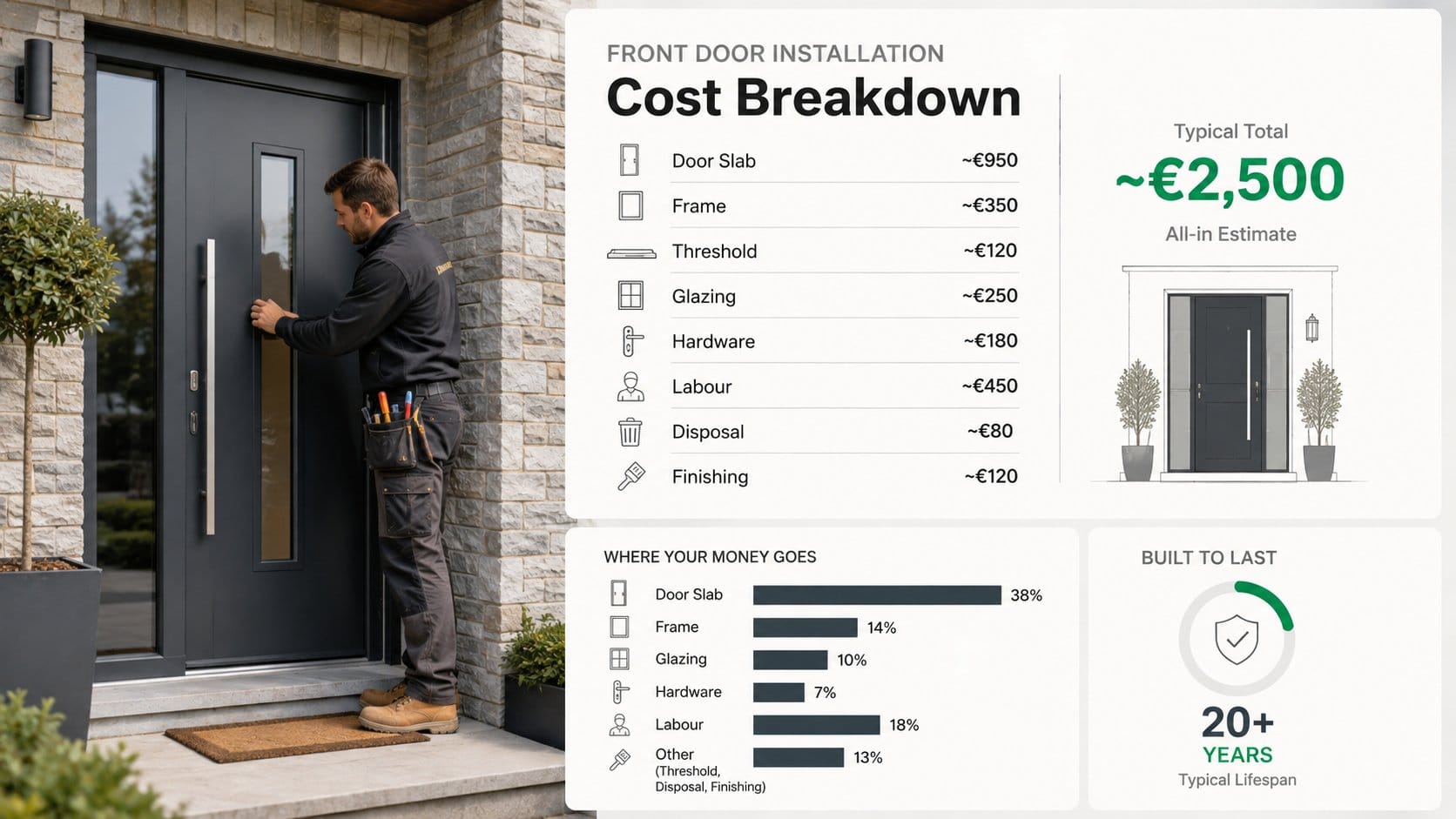
The main cost lines
The door slab or panel usually takes the biggest share of the budget. On a composite job, that part costs more than on uPVC because the construction is thicker, better insulated, and fitted with stronger locking hardware. The frame, sill, and threshold come next, especially where the old opening is uneven or the new unit needs a better thermal break.
Glazing pushes the number up faster than expected. Even a small vision panel adds cost, and a more demanding glass spec increases it again. Hardware is where quotes often split sharply, because a plain handle and letterplate are a different thing from a multi-point lock, a better cylinder, and heavier hinges designed for security and long-term use.
Good comparison starts with the same specification. If one quote quietly upgrades the locks and the other doesn't, the cheaper paper isn't the better deal.
Labour and finishing matter too. On a straightforward swap, installation work in Ireland is often a clear part of the bill, but once brickwork, lintels, or sub-sills need repair, the job stops being a simple replacement and becomes a mini build project. Disposal of the old door also belongs on the quote, not in a vague promise.
For a fair reading, a homeowner should ask for each line item separately. That means the door, the frame, the hardware, the glass, labour, VAT, and making good. Without that breakdown, two quotes can look comparable while hiding very different scopes, which is exactly how the cheapest paper ends up being the costliest job by the time the hall is finished.
Ask for these lines in writing
Door supply: confirm the exact material and finish.
Frame and threshold: check whether replacement is included.
Glazing and hardware: confirm the lock and glass spec.
Removal and making good: make sure both are priced.
VAT and waste: ask if they're already included.
The shortest route to a sensible comparison is an itemised quote, not a shiny total.
How Location and Access Move the Price
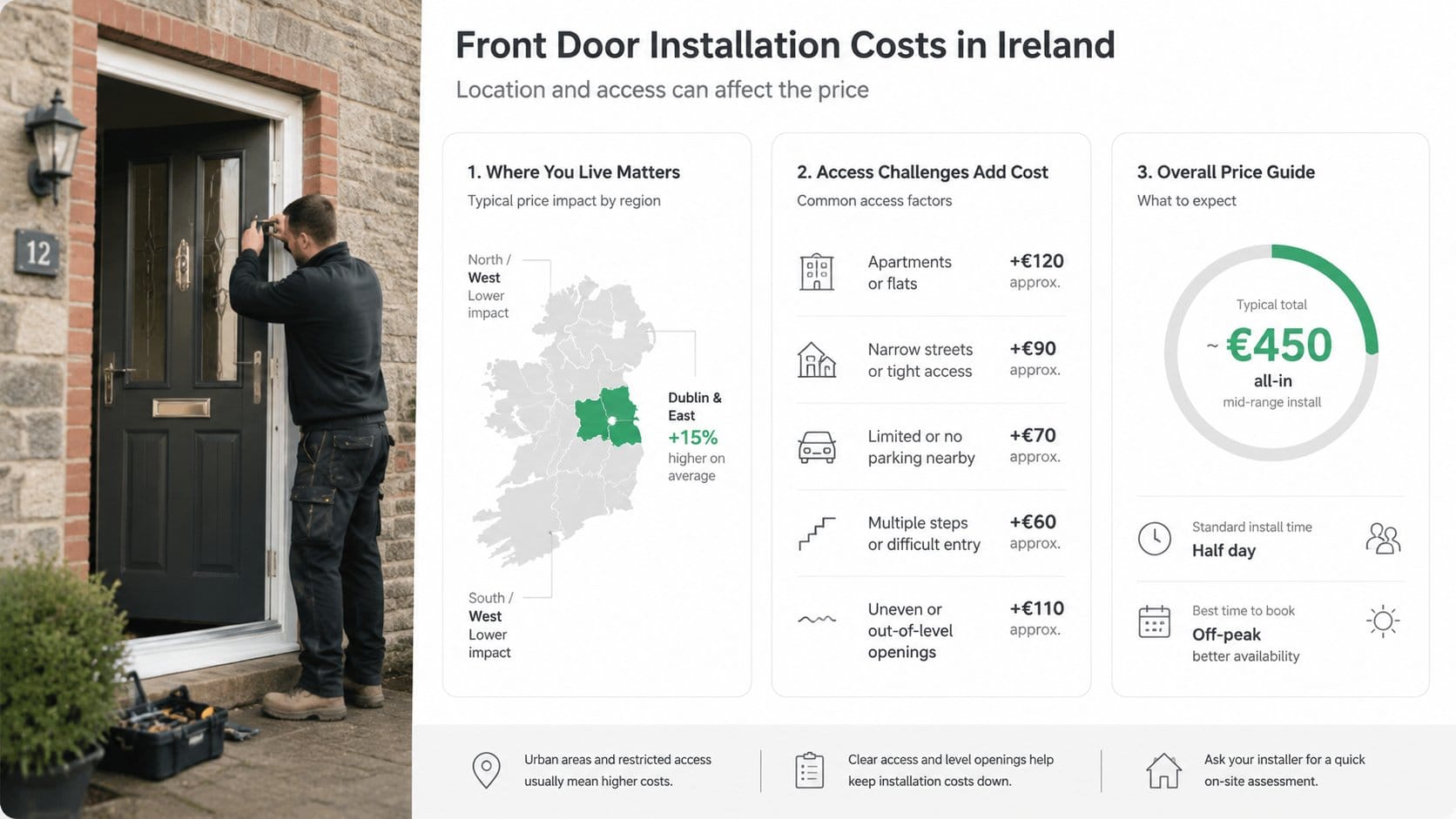
Ireland does not price front doors the same way everywhere. A quote in Dublin can land differently from one in the west or south-west, and that difference is not always about the door itself. It's about labour, overheads, local competition, and how awkward the property is to work on.
Where the number moves up
Dublin, Kildare, Meath, and Wicklow tend to sit nearer the top end of the market because installer overheads and labour rates are usually higher there. In more rural parts of the midlands, west, or south-west, pricing often eases because call-out costs and subcontracted fitting tend to be less demanding. That said, geography is only part of the story.
A difficult entrance changes the job fast. A flat with no nearby parking, a frame that's badly out of square, a stone lintel that needs swapping, or a threshold that needs rebuilding can all make the final figure climb. The cheapest door in the brochure may be irrelevant once the installer sees the actual opening.
When the property, not the county, drives the bill
Some homes need more work before the new door can go in. Conservation-area properties in older parts of Dublin or Cork can force more careful compliance work, better finish standards, and more time on site. A plain ground-floor suburban replacement is a different job entirely.
A sensible homeowner reads regional differences as a starting point, not a verdict. The quote still has to reflect access, structure, and finish. A local installer can be cheaper on paper and dearer on the day if the opening needs extra carpentry or the old frame comes out in worse condition than expected.
The sharpest price jumps come from work you can't see in the showroom. That's why access is as important as material. A simple front door on a simple opening is one price. A front door on a difficult opening is another job altogether.
The SEAI Door Grant and What It Offsets
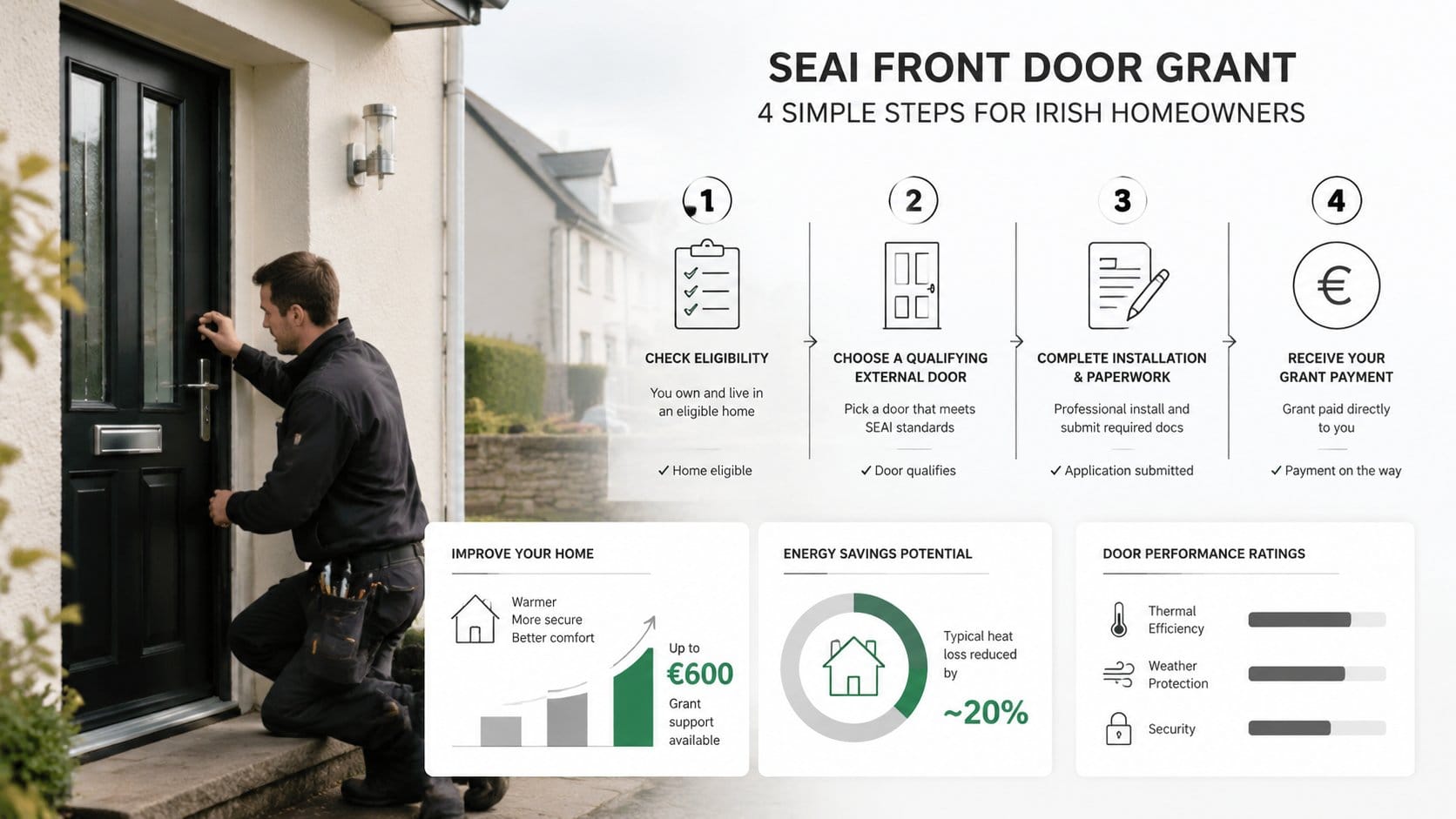
The SEAI Better Energy Homes route changes the economics more than many homeowners realise. Current Ireland-specific guidance says homeowners can receive €800 per external door, capped at two doors per home, for a maximum of €1,600 in doors-only support. That doesn't make the door free, but it does shift a serious chunk of the invoice off the homeowner's side.
What qualifies and what doesn't
The grant is tied to eligibility, paperwork, and the right standard of installation. The new door needs to meet the relevant thermal requirement, and the work has to be handled through the SEAI route properly. The homeowner also needs to front the full invoice first, because the grant is paid back after the job is completed and signed off.
That's where many jobs get slowed down. If the dates don't line up, or the documentation doesn't match the installed specification, payment gets delayed. A quote that looks dear at the start can still be the better purchase if it qualifies cleanly and reduces the net spend by the full amount.
Why the grant changes the real price
A €2,200–€2,600 front door becomes a very different proposition once €800 comes off the bill. The net outlay lands around €1,400–€1,800 before any side panels or upgrade items are added. That is the key number, not the headline sticker.
Paperwork is the part homeowners underestimate. The installer has to handle the registration and submission steps correctly, and the owner needs the right paperwork trail to keep the claim moving. ShamFix Insights is a useful starting point for homeowners who want general guidance before gathering quotes.
Best practice: get grant eligibility confirmed before signing a final spec sheet. The wrong door, even if it looks similar, can turn a grant-friendly job into a full-price one.
The point is simple. The grant does not just reduce cost, it changes which quote is better value. A slightly dearer, better-performing door can become the smarter buy once the rebate is taken into account.
How to Read and Compare Front Door Quotes Fairly
Two quotes for the same front door can be hundreds of euro apart and still both be honest. The problem is that “same door” usually means different things to different fitters. One quote may include a proper threshold, upgraded hardware, and internal finishing, while the other just prices the outer shell and hopes the rest won't be noticed until install day.
Build the comparison line by line
The cleanest approach is to standardise the scope before comparing totals. The same door slab, the same frame material, the same colour, the same glazing spec, the same lock standard, the same removal and disposal, and the same making good should all be listed clearly. If one quote includes a threshold tray and the other doesn't, the lower number isn't cheaper, it's incomplete.
A proper comparison should also check the performance details. The same U-value matters, because thermal efficiency changes the long-term value of the job. The same security spec matters too, because a front door is one of the most obvious weak points in the house if the locking gear is light or basic.
the ShamFix process is the relevant guide for homeowners who want to see how enquiries are handled before they start lining up local quotes.
The classic omissions to watch for
No threshold tray: the quote looks neat until water or draughts become a problem.
No internal trim: the hall ends up with visible rough edges.
No waste removal: the old unit still has to go somewhere.
No making good: plaster and reveal repairs appear as extras later.
The cheap quote is often missing one of those pieces. That's why it wins the first glance and loses the final invoice.
A fair front-door comparison is not about picking the lowest total, it's about making sure the lowest total includes the same job.
One more point matters here. If a quote says little about the glass, the lock, or the frame, it's probably not detailed enough to compare properly. A homeowner should ask for the same scope in every version, then compare like for like instead of guessing what's hidden inside the price.
Budgeting Smartly and Knowing When to Hire a Pro
The right budget depends on the house and the purpose of the door. A basic uPVC front door at €900–€1,200 installed makes sense when the job is mainly cosmetic, the existing frame is sound, and the property doesn't need a premium finish. That's a practical choice for rentals and quick turnarounds, not a status purchase.
When composite earns its keep
Composite is the better buy when the homeowner wants stronger thermal performance, a more solid feel, and a door that looks more at home on the street. It usually suits properties where lower heat loss and better security matter more than the cheapest possible invoice. For owners thinking beyond the next winter, it's the option that most often justifies the extra spend.
Timber belongs in a narrower lane. Heritage houses, conservation settings, and homes that need the right look for the façade are where timber still makes sense. It's the door that can be repaired and refreshed, but it asks for more ongoing attention, and the owner needs to accept that from the start.
DIY, pro fitting, and the sensible line
A competent DIYer can handle a straightforward fit into a sound existing frame with standard clearances. Once the job involves structural rework, sill replacement, electrical side-lights, or grant paperwork, the sensible move is a professional installer. Homeowners comparing who to hire can also use ShamFix for tradesmen to understand how installer enquiries are handled. That's not snobbery, it's risk control.
A workable budget also needs slack in it. A homeowner should keep room for making-good and any hidden rot that appears after the old door is lifted out. A clean quote is good. A realistic quote is better.
ShamFix connects Irish homeowners with local providers across the Republic of Ireland, so it suits people who want to compare options without pretending every front-door job is the same. For this kind of work, that comparison matters more than the prettiest headline price, because the cheapest quote is often only cheap on paper.