Most Irish flood restorations split into an emergency drying phase of roughly €400–€3,000+ and a reinstatement phase that can push a whole-house job into €2,500–€5,000+. The first bill is for stopping the spread of water, the second is for putting the home back together properly.
A flooded hallway, soaked kitchen, or water coming up through a ground-floor room often looks like one problem, but the money splits into two separate budgets. The emergency side covers call-out, extraction, dehumidifiers, and monitoring, while the restoration side covers strip-out, replastering, flooring, decorating, and electrical checks, with the final amount usually driven by how much of the building fabric got wet.
What a Flood Restoration Job Actually Costs in Ireland
A flooded house in Ireland rarely comes with one neat number. The quote usually starts with emergency drying, then grows into reinstatement, especially if the water got into floors, plaster, or electrics. For a homeowner trying to make sense of a first estimate, the cheapest line is often only the first line.
| Flood Restoration Cost Ranges in Ireland (2026) | Emergency Phase | Reinstatement Phase | Typical Total |
|---|---|---|---|
| Light, single-room water damage | €400–€800 | modest repairs, if any | €400–€800+ |
| Moderate multi-room damage | €800–€2,000 | strip-out and room repairs | €1,500–€3,500+ |
| Whole-house flood | €2,000–€3,000+ | replastering, flooring, decorating, electrics | €2,500–€5,000+ |
Those ranges line up with Irish restoration pricing guidance that puts professional water-damage work at €400–€3,000+ overall, with a single-room event often at €400–€800, and a whole-house flood at €2,500–€5,000+ before mould treatment (Irish restoration pricing guide). A separate Irish hire source also shows that drying equipment is a measurable cost on its own, with a large dehumidifier listed at €25 for day 1, €50 for 2 days, €70 for 3 days, €70 for a week, plus a €150 deposit (Irish dehumidifier hire prices).
Practical rule: the first emergency invoice is not the full flood bill. If plaster, insulation, flooring, or joinery stayed wet, the reinstatement line usually becomes the larger one.
The Central Bank's flood protection gap report gives the wider context. It estimates the average annual cost of inland flooding at about €101 million, with around 89% of that linked to higher-risk buildings with limited or no flood insurance cover, and severe inland losses could reach about €510 million in a once-in-25-years event (Central Bank flood protection gap report). That matters because the restoration bill depends less on the rain and more on how much of the damage is insured, uninsured, and hidden inside the structure.
The Two Phases of a Flood Restoration Quote
A proper flood quote in Ireland should separate emergency response from reinstatement. If those two parts are blended together, the homeowner can't see what was done immediately to stop further damage and what is being charged later to rebuild the room.
Emergency drying phase
The emergency phase is the fast work. It normally includes 24/7 call-out, pumping or extraction, initial cleaning, dehumidifier hire, air movers, and moisture checks to see whether walls and floors are drying properly. Irish market guidance commonly puts the overall water-damage restoration bill at €400–€3,000+, with the lower end often covering a single room and the higher end covering larger or more complicated losses (Irish restoration pricing guide).
The drying kit itself is not the whole bill, but it matters. The Irish hire price for a large dehumidifier is modest enough on day one, yet the cost grows when the machine stays on site for days, sometimes longer, while the property is monitored and adjusted (Irish dehumidifier hire prices).
Reinstatement phase
The reinstatement phase begins after the structure is dry enough to work on safely. That can include strip-out, plaster replacement, flooring, redecoration, cabinet repair, and electrical inspection before anything is put back in service. This is the part homeowners often under-budget, because the first extraction quote can look manageable while the rebuild quote arrives later.
A dry-looking room isn't always a finished room. If the base layers were saturated, the cost of putting the room back together usually overtakes the drying bill.
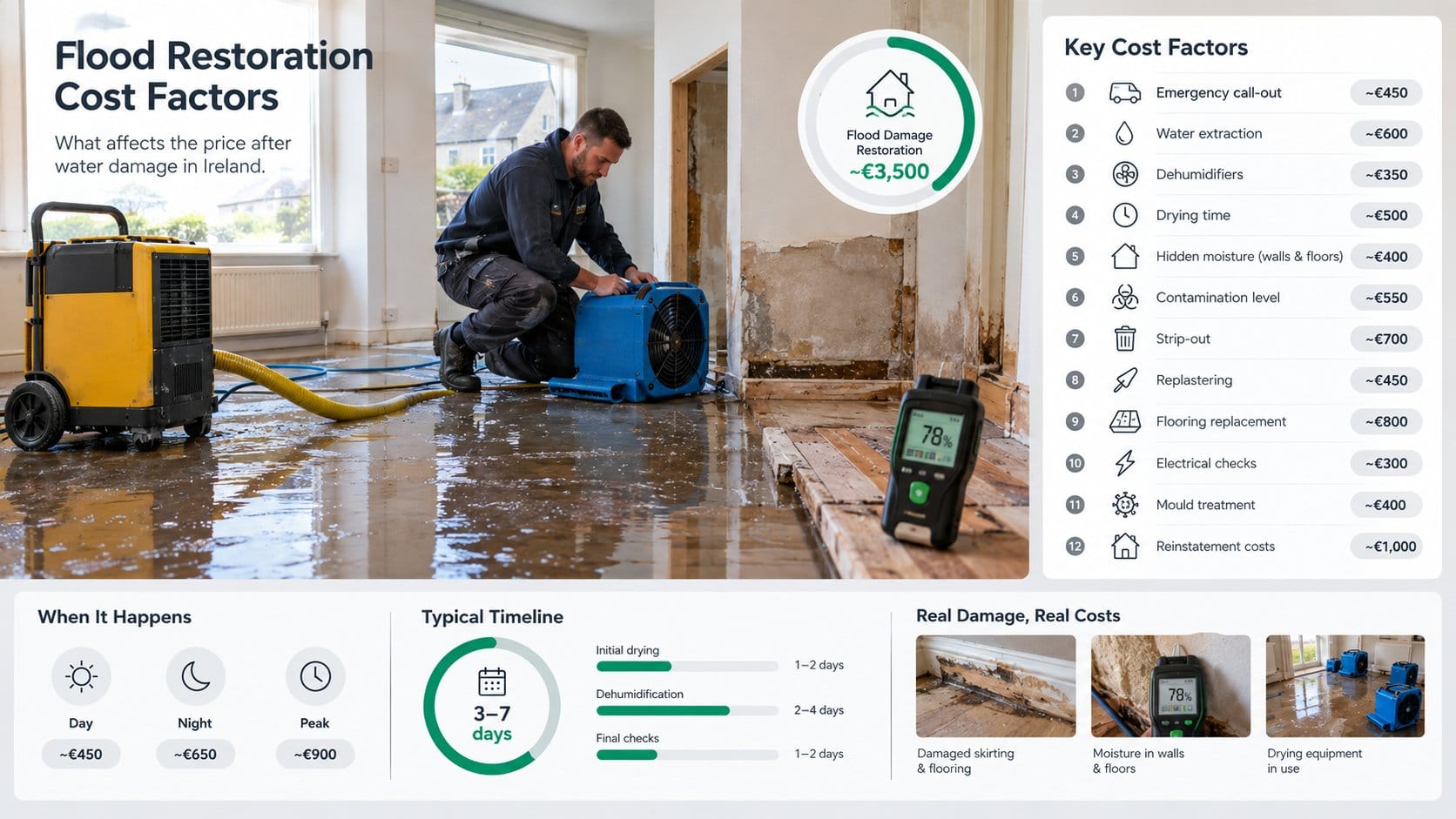
Hidden moisture is what pushes many Irish jobs up the ladder. Water can sit under floors, inside wall cavities, or in insulation long after surface drying looks complete, and that is where mould and structural issues begin to show up later. The Irish cost guide notes that mould treatment can add another €500–€2,000+ if moisture remains trapped (Irish restoration pricing guide).
What Drives the Price Up or Down
Flood restoration quotes move for reasons that aren't obvious on a first walk-through. Two homes on the same street can end up with very different bills because one had clean water and the other had contaminated water, one was dried quickly and the other sat wet, or one had only carpet damage while the other had soaked insulation and plaster.
Contamination and depth
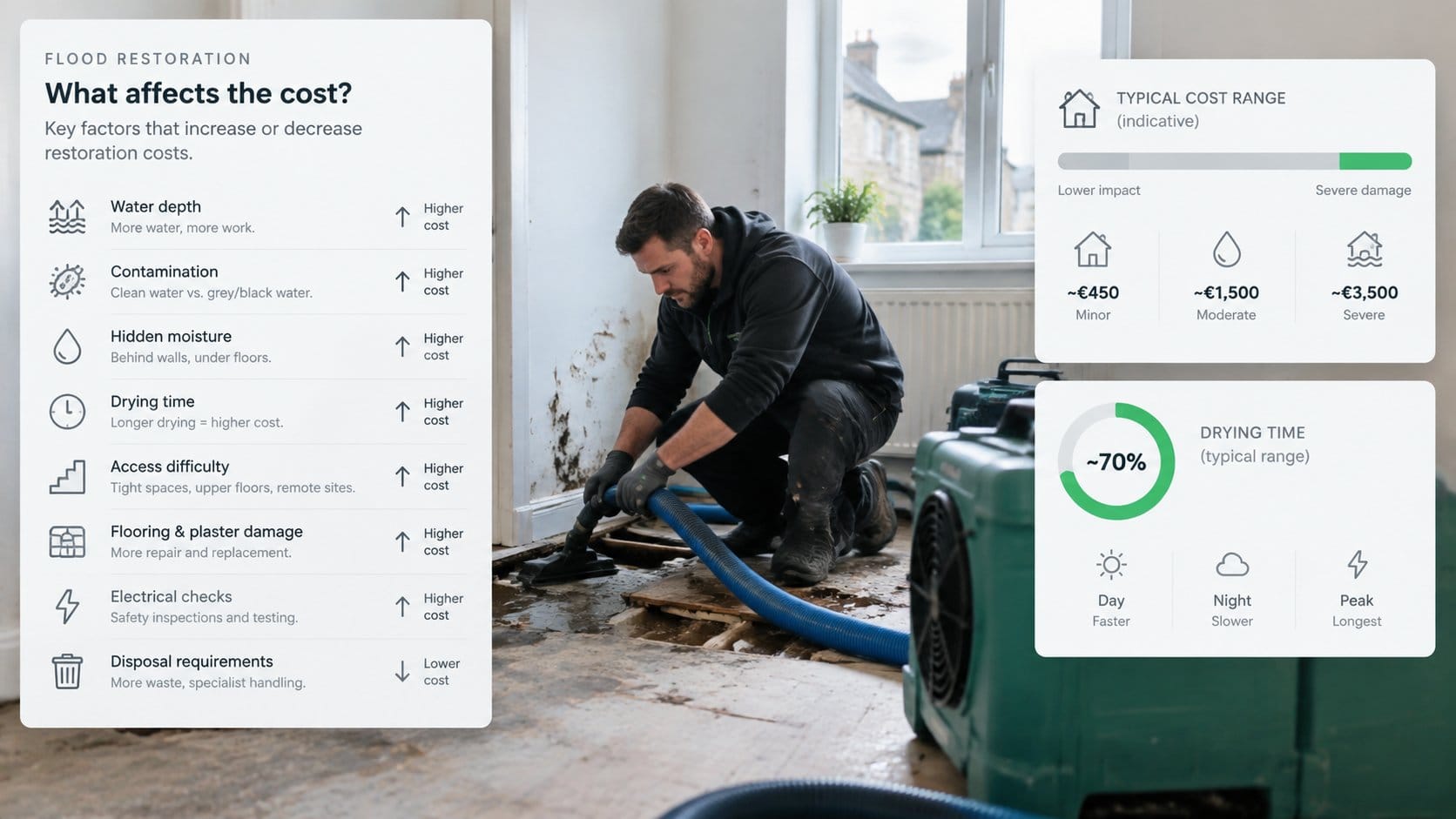
Clean water is simpler to handle than water contaminated by sewage or polluted floodwater. Once contamination is involved, the job needs more stripping, more protective handling, and more disposal, which is why the price rises quickly. Depth matters too, because the deeper the water sat, the more likely it reached skirting, plasterboard, floors, and low-level electrics.
Hidden moisture and drying time
The big cost trap is hidden moisture. Water can track into floors, wall cavities, and insulation, then stay there while the room looks almost fine on the surface. That is when a homeowner gets an apparently modest bill and later faces a second round of work once damp patches or mould begin to appear.
Good quotes measure the dry-out, they don't guess it. If a contractor can't show moisture readings, the drying phase is being priced with too much optimism.
The same logic applies to access. A ground-floor room with clear access for kit is simpler than a tight hallway, a room with built-in joinery, or a property where equipment has to be carried a long distance. On Irish flood jobs, the quote goes up when drying takes longer, because more labour time, more equipment hire, and more follow-up checks are needed.
A flood bill is rarely just one trade; it's usually a stack of small repair decisions - plastering, flooring, decorating and electrical checks - each with its own line.
Emergency Call-Out Pricing Versus Planned Restoration
The same flooded room can carry two very different price tags depending on when the work is booked. Emergency call-out pricing is about speed and damage control, while planned restoration pricing is about measured repair work done in normal hours.
| Emergency call-out vs planned reinstatement pricing in Ireland | Emergency call-out phase | Planned reinstatement phase |
|---|---|---|
| Attendance | urgent, out-of-hours response | scheduled site visit |
| Water removal | immediate pumping or extraction | usually not needed unless water remains |
| Drying setup | dehumidifiers and air movers deployed fast | drying already complete or close to complete |
| Pricing style | attendance fee, hourly rate, or day rate | fixed scope or itemised quote |
| Labour cost | higher because it's urgent and unsociable hours | lower because it's planned and ordered |
| Outcome | stop secondary damage | rebuild the room properly |
A genuine emergency response often costs more because the contractor is responding outside normal trading time, mobilising kit fast, and preventing further damage. The planned quote is usually more economical task by task because labour is scheduled, materials can be ordered cleanly, and the contractor isn't charging for the disruption of a late-night run.
That difference is important for homeowners who feel tempted to combine both stages into one lump sum. Separate invoices are normal. In many Irish flood claims, the emergency work buys time and limits the spread, while the reinstatement work is priced later against a clearer scope and better measurements.
Simple test: if the quote reads like one flat number without a split for extraction, drying, and reinstatement, the homeowner should ask what has been left out.
The best comparison is not “cheap versus expensive”, it's “urgent work versus planned rebuilding”. A quote can look small at the start and still be incomplete if it ignores electrical checks, flooring replacement, or redecoration.
Insurance, Grants and the OPW Flood Context
Most flood restoration in Ireland is not a retail purchase, it's a claim conversation. That means the homeowner has to think about cover, evidence, and who the insurer wants to inspect the damage before any major strip-out begins.
Insurance comes first
Household flood claims in Ireland have been substantial. Insurance Ireland estimated the household share of the November floods at €77 million, with the wider 2024 flood bill estimated at €244 million overall, including €159 million for commercial property and €8 million for motor claims (Insurance Ireland flood estimate). Those figures show that household restoration is its own cost bucket, not just a side note to storm damage.
The practical step is simple. Ring the insurer early, photograph everything before the contractor strips out damaged material, and keep receipts for drying kit, skips, and temporary measures. In many cases, the insurer will want its own loss adjuster involved before the final scope is agreed, especially where there's a risk of hidden damage.
Relief schemes and flood context
The Department of Social Protection's Emergency Response Payment is income-tested support for homes damaged by flooding or severe weather. It helps with essential needs and household items, and in some cases structural repair, but it is not a full compensation scheme and it excludes costs that insurance already covers or should reasonably cover (Emergency Response Payment). The OPW also sits in the wider flood-prevention picture, but emergency household finance usually lands through insurance first and humanitarian support second.
The gap homeowners sometimes miss is coverage in flood-prone places. The Central Bank's flood protection gap report points to a heavy concentration of cost in higher-risk buildings with limited insurance access, which is why some households face much more out-of-pocket exposure than others (Central Bank flood protection gap report).
What to Check Before Hiring a Restoration Company
Flood restoration is an unregulated trade in Ireland, so the homeowner has to do the vetting. A good contractor should be able to show insurance, explain drying properly, and give a written scope that separates emergency work from reinstatement.
The paperwork that should be ready
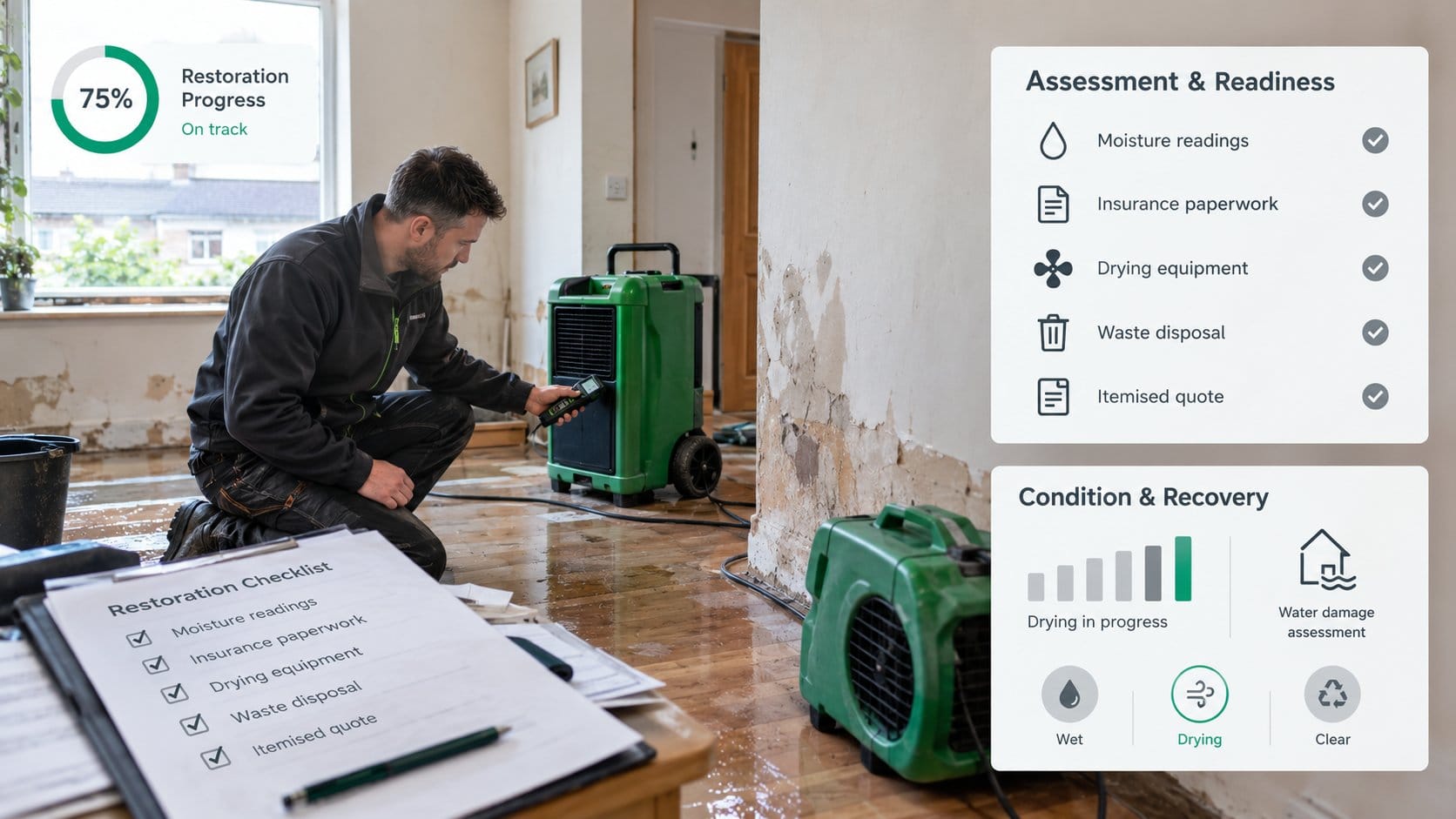
Ask for public liability insurance, and ask for the policy number and insurer name so the cover can be checked in date. A proper quote should also spell out whether dehumidifiers, air movers, moisture readings, and daily checks are included, because drying without monitoring is just guessing with expensive kit.
Contaminated waste matters too. If carpet, plasterboard, timber, or insulation has been affected by polluted floodwater, the contractor should explain who removes it, where it goes, and whether a waste-transfer docket is issued. That detail is not admin fluff, it is part of proving the job was done correctly and legally.
Do not sign a vague flood quote. If the contractor cannot show the drying plan, the waste route, and the reinstatement scope in writing, the homeowner is carrying too much risk.
What should be on the quote
- Written scope: emergency drying and reinstatement listed separately.
- Moisture readings: a daily record, not a casual visual check.
- Equipment detail: dehumidifier and air mover numbers, plus how long they're expected on site.
- Waste disposal route: who lifts damaged material and where it goes.
- Insurance details: liability cover and a business address that matches the paperwork.
In flood work, the cheapest quote can be the one that leaves out monitoring, disposal, or the final making-good stage, so ask what each line includes before any work starts.
Flood Restoration Questions Irish Homeowners Ask
The first question is usually how long drying takes. In a straightforward job, it can run for days, but a heavier soak or hidden moisture in floors and wall cavities can stretch the process into weeks, which is why the emergency phase and the rebuild phase are budgeted separately.
The next question is whether the homeowner has to move out. Not always, but if several rooms are wet, electrics are unsafe, or mould risk is high, temporary relocation can become part of the claim conversation. The final reinstatement bill is usually the bigger one, because putting the home back together properly costs more than pumping water out of it.
A lot of homeowners also ask whether mould always follows a flood. It doesn't always appear straight away, but if moisture stays trapped, it can become a serious problem later, especially in plaster, insulation, and joinery. That is why a quote without moisture monitoring is weak, even if the headline price looks attractive.
Public help versus insurance has a simple answer. The Emergency Response Payment is for essential needs and selected repairs, while the private claim still has to deal with the restoration quote. If the insurer disputes the amount, the homeowner should lean on photos, receipts, drying logs, and the written scope.
For anyone at the start of the process, the practical move is to compare local quotes before signing a full strip-out. Homeowners can post the flood restoration job on ShamFix to request itemised responses from local trades, alongside the normal insurer and contractor contact.
Are You a Flood Restoration Specialist in Ireland
Flood and water-damage firms can list on ShamFix with no commission, and the marketplace is built for local Irish work rather than pay-per-lead pressure. Listing on ShamFix is free and there is no commission; a subscription is planned for the future.
Specialists who take flood jobs should be ready to show public liability cover, proof of monitored drying equipment, and a clear waste-disposal process. Homeowners in Ireland still have to check credentials, insurance, and reviews themselves, because ShamFix does not vet or verify providers.
Create a provider profile on ShamFix, describe the restoration work you handle, and make it easy for homeowners to contact you about extraction, drying, strip-out, and reinstatement. If flood work is part of your service area, add your details on ShamFix and make sure local customers can find you when the next flood job lands.