Irish demolition costs vary widely, and landfill disposal in Ireland can exceed €170 per tonne. At the top end of overall project exposure, the Society of Chartered Surveyors Ireland has reported high demolish-and-rebuild totals for mica-affected homes, which shows how structural complexity, waste tonnage, access and hazardous materials can change the cost completely.
A Dublin homeowner removing a kitchen wall often starts with a simple question: how much will the knock-through cost? The answer depends less on the swing of a sledgehammer than on what the wall is made of, whether it carries a floor or roof, how the debris leaves the property, and what happens to the waste after it reaches the skip. The same principle applies to a garage, outbuilding or complete house.
All prices below are in euro. Where a figure is used, it is tied to the Irish source linked in the relevant passage. Residential demolition work generally falls under the 13.5% reduced VAT rate, so every quote should state whether VAT is included. The practical way to assess demolition cost in Ireland is to examine the job type, identify excluded items and compare the waste arrangements line by line. ShamFix Insights also provides related information for homeowners comparing local services.
Why Demolition Pricing in Ireland Is Not What It Looks Like
A Dublin couple asking for a kitchen wall removal may receive very different quotes. The difference does not automatically mean the cheaper contractor is cutting corners. One price may cover a non-load-bearing plasterboard partition, while another includes a block wall, concealed plumbing, electrical cables, floor protection and disposal. To see what your own job would cost, compare demolition quotes on ShamFix.
The labour figure rarely gives a like-for-like comparison. Demolition works as a waste-disposal job with structural removal attached. The contractor must break out the material, move it through the property, load it, transport it, pay the receiving facility and leave the remaining surfaces safe for the next trade. A quote that omits any of those steps may look cheaper before the work starts.
Irish planning documents cited in an Irish demolition cost guide place typical Leinster landfill charges at about €130 to €150 per tonne, including a €75 per tonne landfill levy under Ireland's waste regulations. A 2024 Irish environmental impact assessment recorded landfill disposal costs above €170 per tonne, with hazardous waste from €350 per tonne. The Irish demolition cost guidance discusses these figures and shows how quickly disposal charges rise as rubble volume increases.
Practical rule: “Demolish and remove” leaves a major risk unresolved. The quote should state who pays if the waste is heavier, mixed, contaminated or sent to landfill instead of recovery.
The cost guide covers internal strip-outs, internal wall removal, garages and outbuildings, plus full-house demolition. It separates structural work from disposal and identifies extras that contractors often leave outside the headline price. A low labour figure can be outweighed by haulage, handling, storage, permits, surveys and making-good.
ShamFix Insights provides related information for homeowners comparing local services. Use it alongside a written quote that lists each removal, disposal and finishing allowance separately.
What Drives the Final Bill on an Irish Demolition Job
The final price follows the physical route from the building to an authorised waste facility. The EPA states that waste receiving facilities in Ireland must hold the appropriate permit or licence, and construction and demolition debris must be directed to approved facilities under the relevant waste authorisation framework. The EPA guidance on waste permits and certificates of registration explains the authorisations that apply.
Wall type and structural duty
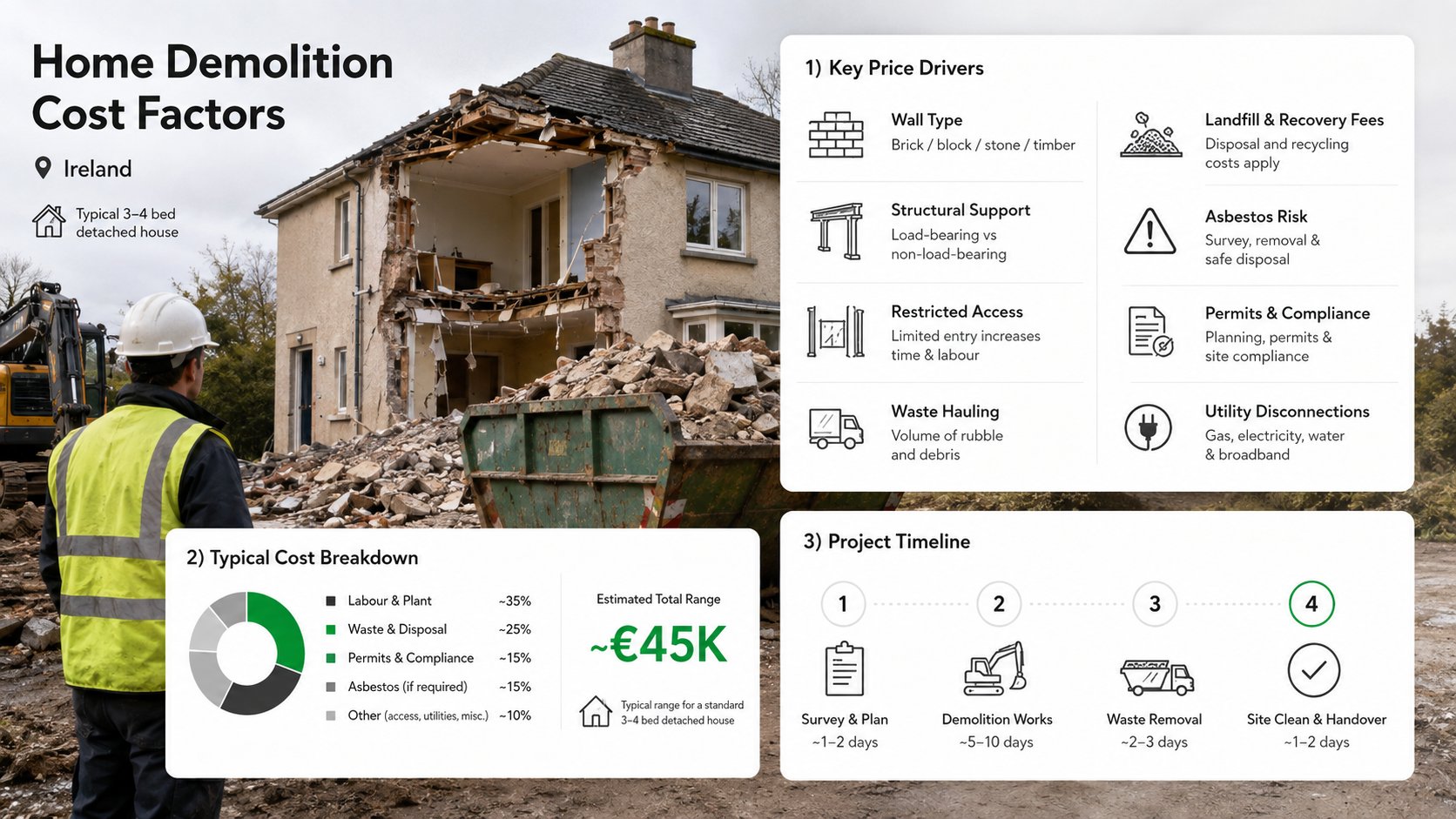
A non-load-bearing plasterboard partition can often be stripped, cut down and removed with limited structural preparation. A block wall supporting floor joists, a roof, or masonry above needs a different sequence. The contractor may need temporary propping, a structural engineer's design and a steel or RSJ beam before the wall is taken out.
Party walls and walls close to adjoining buildings carry additional risk. The quote should state whether the work is a soft strip, a full structural opening or removal down to the foundations.
Access and logistics
A terraced Dublin house, a narrow Cobh lane and a rural property with good hard-standing create very different working conditions. Restricted access can prevent an excavator or mechanical breaker from reaching the work area, leaving a crew to move debris by hand. That adds handling time and may require smaller plant, protective sheeting, temporary storage or more vehicle movements.
Material and waste classification
Concrete, brick, plaster, timber and mixed household contents don't behave alike in transport or disposal. Clean segregation of concrete, brick, plaster and timber can protect the disposal budget, while mixed waste increases handling and routing costs. See the EPA construction and demolition waste guidance and the EPA asbestos handling guidance.
Asbestos and hazardous material
Asbestos changes the sequence before structural demolition starts. A refurbishment or demolition survey is required for planned work where asbestos could be present, and the HSA requires competent handling, with higher-risk notifiable work subject to specialist controls. The Health and Safety Authority asbestos guidance sets out the survey, plan-of-work and competence requirements.
Budgeting for an internal wall removal
There is no published national benchmark for a standard internal wall job in Ireland, but for early budgeting an aggregate Irish market estimate is still useful before quotes come in. For most homes, the biggest price shift comes from whether the wall is light and non-structural, or whether the opening needs engineering and permanent support.
| Internal wall job |
Aggregate Irish market estimate |
What usually drives it |
| Light non-load-bearing stud partition |
€600 to €1,500 |
Faster strip-out, lighter waste, shorter labour time |
| Non-structural block wall |
€1,000 to €2,500 |
Heavier rubble, more handling, higher disposal cost |
| Load-bearing wall opening with support |
€2,500 to €6,500+ |
Structural engineer input, temporary propping, permanent support, demolition and waste removal |
The lower end usually applies where the wall is light, access is straightforward and the job ends at demolition and removal. A quote tends to rise quickly where the wall is masonry, where pipes or cables are likely to be hidden in or around it, or where the contractor must protect adjoining finishes carefully.
A practical clue is the wording of the quote itself. If the price mentions a structural engineer, temporary propping or a steel beam, the wall is being treated as a structural opening rather than a simple knock-through. If those items do not appear, the quote may only cover break-out and cart-away.
These ranges usually exclude plastering, flooring repairs, skirting, rewiring and repainting unless those items are named separately.
Typical Demolition Cost Ranges by Job Type in Ireland
The requested job-type figures often circulated online for kitchen strip-outs, wall removals, garages and houses aren't backed by reliable Irish data, so they shouldn't be presented as dependable national benchmarks. A responsible budget needs to distinguish published Irish benchmarks from an individual contractor's site-specific quotation.
For full-house demolition paired with reconstruction, the Society of Chartered Surveyors Ireland estimated €145 to €164 per square foot in 2022 for demolishing and rebuilding mica-affected homes. That isn't a simple demolition-only rate. It includes the scale of the wider rebuild project and is therefore useful as a warning about total exposure, not as a price for knocking down a vacant house.
The same SCSI figures put total demolish-and-rebuild project costs at approximately €149,688 for a two-bedroom terrace estate house, €165,620 for a three-bedroom semi-detached estate house, €200,688 for a four-bedroom detached estate house, and €432,470 for a five-bedroom-plus rural two-storey home. Rural access, larger floor area and site complexity can push the overall project well beyond the cost of a straightforward urban clearance.
| Job type |
Typical Irish benchmark |
Usually includes |
Common exclusions |
| Internal kitchen, bathroom or room strip-out |
No reliable national figure |
Removal of specified fixtures and finishes |
Structural work, service alterations, final making-good |
| Non-load-bearing internal wall |
No reliable national figure |
Agreed break-out and removal of identified wall material |
Structural engineer, steel, concealed services, extensive repairs |
| Garage or outbuilding |
No reliable national figure |
Scope agreed after inspection |
Asbestos roofing, slab and foundation removal, restricted access |
| Full-house demolition |
Site-specific quotation required |
Structure and waste scope if expressly listed |
Rebuild, planning matters, hazardous-material work, abnormal haulage |
| Demolish and rebuild benchmark |
€145 to €164 per square foot in the SCSI 2022 mica-affected-home assessment |
Demolition plus complete reconstruction context |
It isn't a demolition-only rate |
Every figure in a quote should state whether it is ex-VAT or VAT-inclusive. It should also identify whether skips, haulage, foundations, slabs, asbestos, utility disconnections, permits and making-good are included. A homeowner comparing a strip-out quote can also review the practical distinction between skip hire vs man-with-a-van Kildare, while remembering that disposal responsibility still needs to be written into the contract.
Hidden Costs Homeowners Underestimate
A demolition quote can look complete while leaving the most variable items outside the headline sum. Waste, structure and compliance should be treated as separate cost questions rather than bundled into a vague “clearance” allowance.
Road space, access and temporary support
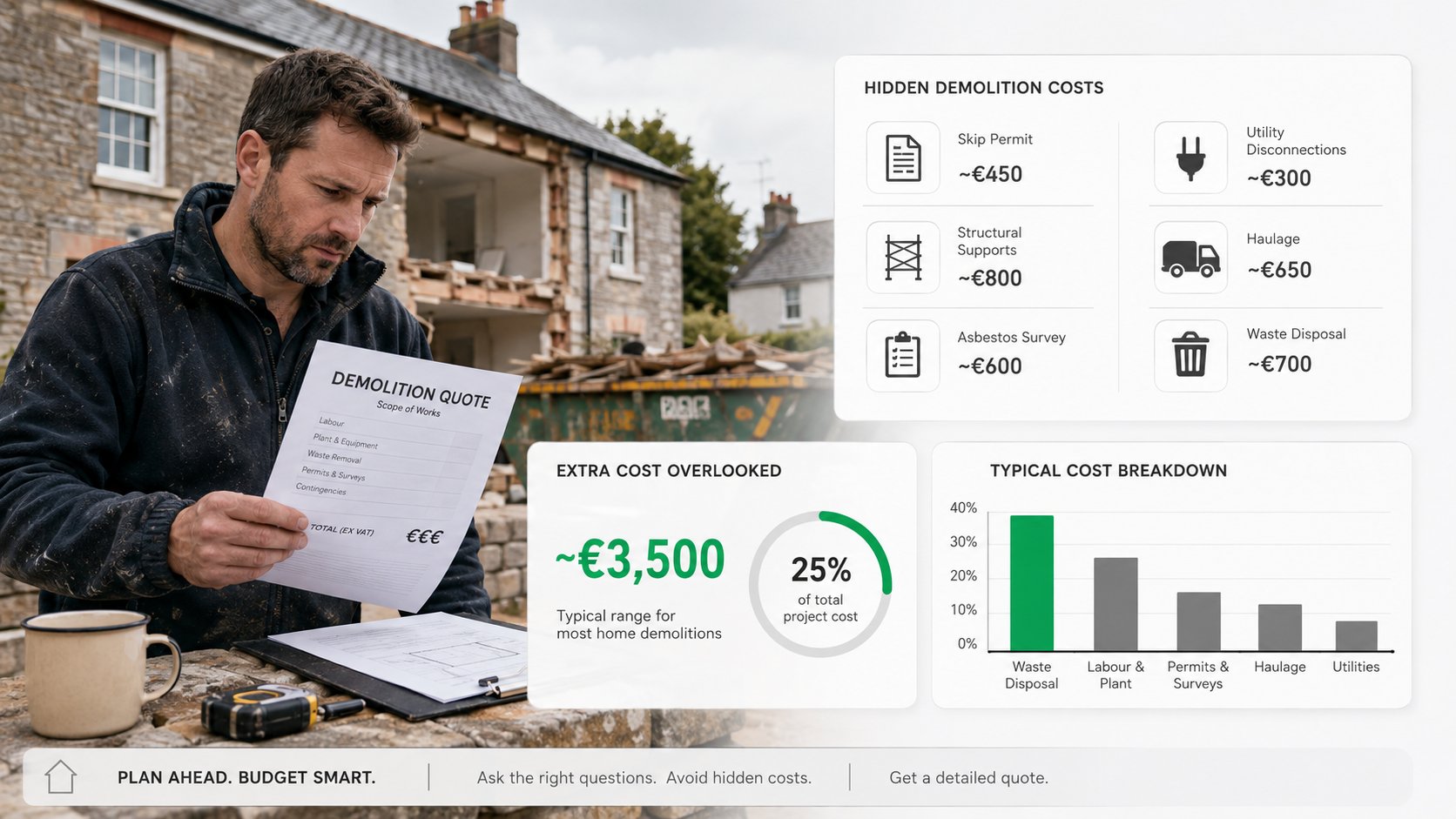
A skip placed on a public road may require a permit from the relevant local authority. The fee and application process depend on the authority and location, so a quote should identify whether the contractor or homeowner applies and pays.
Removing a load-bearing wall can add a structural engineer's inspection, temporary propping and supply and installation of a steel or RSJ beam. None of those items belongs in a basic non-structural strip-out allowance. The quote should name them separately instead of hiding them in a provisional total.
Asbestos surveys and controlled removal
Older homes can contain asbestos in boards, coatings, ceilings, roofs, pipe insulation or other products. The HSA requires a suitable refurbishment or demolition survey before planned work, and asbestos waste must be handled through authorised channels. Ireland's asbestos permitting requirements include pre-notification to the HSA within the statutory period before notifiable work begins, as explained by Mason Hayes Curran on new asbestos permitting requirements.
A contractor may reasonably add a management margin to specialist coordination, plant, labour and administration. A buyer should still receive a clear description of the survey, removal method, waste carrier and disposal route. “Asbestos allowance” without a scope isn't enough.
Services and making-good
Electrical, gas and water services may need to be disconnected, capped or diverted before demolition. Hidden pipes and cables can also stop the work after opening-up. Plastering, flooring repairs, ceiling replacement, skirting, rewiring and redecorating the adjoining areas are usually separate from demolition unless expressly included.
Ask for the finish line: The quote should say whether the contractor leaves a safe exposed opening, a structurally supported opening, or a fully plastered and finished room.
Landfill and recovery costs should reflect the waste classification. Clean inert rubble may follow a different route from mixed, contaminated or hazardous material. Buyers should be wary of duplicated charges, such as a general disposal allowance plus a separate unexplained landfill line, but a contractor is entitled to charge for genuine haulage, handling, sorting, administration and risk.
For gas-related service work, homeowners should also recognise the red flags in gas work contractors and confirm the relevant registration directly with the authority.
How a Demolition Quote Is Normally Itemised in Ireland
A useful quote follows the work sequence. It starts with mobilisation and site protection, then identifies the crew and expected labour, plant, waste movements, specialist surveys and reinstatement. If the document contains only “labour” and “waste”, the buyer can't tell whether the contractor has measured the work properly.
The lines a buyer should expect
Preliminaries and mobilisation: Site set-up, protection of retained areas, dust control, access arrangements and removal of equipment.
Labour: Crew size, expected working hours or a defined lump-sum scope, with exclusions for hidden conditions.
Plant and machinery: Excavator, breaker, crusher, lifting equipment or smaller tools, including transport and operator costs where relevant.
Haulage: Skip, tipper or grab-lorry arrangements, with the expected number of loads or a stated tonnage basis.
Waste routing: Material classification, recovery or landfill destination, gate fees and documentation.
Specialist work: Asbestos survey and removal, structural engineering, propping, utility disconnections and traffic or road-space arrangements.
Making-good: Repairs to floors, ceilings, walls, services and finishes, or an explicit statement that these aren't included.
Provisional items: A clearly defined allowance for hidden services, extra shoring or unexpected contaminated material.
A quote should show VAT separately or clearly state that the total includes it. The reduced rate for qualifying residential construction services is generally 13.5%, but the buyer should confirm the treatment with the contractor and check that the displayed total isn't an ex-VAT figure presented as the amount payable.
A simple comparison can expose the difference between a vague and useful document:
| Quote line item |
Vague quote (€) |
Itemised quote (€) |
| Labour and removal |
One lump sum |
Crew and defined scope |
| Plant |
Included without description |
Equipment, operator and mobilisation |
| Waste |
“Waste included” |
Material type, loads, haulage and gate fees |
| Structural support |
Not stated |
Engineer, propping and steel shown separately if required |
| VAT |
Not stated |
Rate and treatment identified |
The table deliberately avoids invented totals. A proper itemised quote supplies the euro amounts after a site inspection, while the vague version conceals the assumptions that create disputes.
How to Hire a Demolition Contractor Safely in Ireland
The safest appointment process is documentary, not based on the cheapest headline figure. A buyer should obtain at least three written itemised quotes, ensure each contractor has inspected the same areas and give every contractor the same information about access, structure, services and suspected hazardous material.
Checks before appointment
Confirm insurance. Ask for current public liability insurance and check that the indemnity is appropriate to the property's value and the proposed work. If the contractor uses subcontractors, ask how their cover is arranged.
Check waste authorisation. The EPA says waste can only be received by appropriately licensed or permitted facilities. Confirm the contractor's waste collection authorisation through the National Waste Collection Permit Office and ask who will receive the debris.
Request disposal records. The contract should identify who owns and controls the waste after it leaves the property. Ask for a waste-transfer docket or equivalent receiving record when the work is complete.
Clarify asbestos competence. If asbestos is suspected, ask whether the survey and removal are being subcontracted. The named specialist should be identified, along with the proposed notification and disposal arrangements.
Check site-safety arrangements. Ask about the crew's relevant construction safety training, method statement, exclusion zones, temporary works and protection of neighbours. Safe Pass and Construction Skills Certification Scheme cards may be relevant to the people carrying out the work.
Take up references. Request examples of similar Irish projects, particularly party-wall removals, restricted-access demolition, garage clearance or full-house work. References should relate to the same type of risk, not just general building work.
A contractor shouldn't demand the entire payment before work begins. Staged payments tied to agreed milestones give both sides a clearer record, especially where a survey, structural support or waste disposal stage must occur before final clearance. Homeowners comparing local options can compare tradespeople quotes, but the final checks remain the homeowner's responsibility.
Putting It All Together Before You Sign a Quote
Three anchors make demolition cost in Ireland easier to assess. Waste disposal affects the bottom line, structural complexity controls the labour and engineering requirement, and the headline figure means little without a line-by-line scope. A full-house demolition and rebuild can reach the high project totals recorded by SCSI, while a small strip-out needs a site-specific quote rather than an unsupported national average.
For a residential demolition service, VAT is generally charged at the 13.5% reduced rate, and the buyer should check whether the advertised amount includes it. Before signing, obtain at least three written quotes, confirm insurance, check the contractor's waste collection authorisation, identify the receiving facility and agree who remains responsible for the waste until it is accepted.
The practical sequence is simple: survey first, quote second, sign third, tip fourth. Homeowners who want to understand the matching process can see how it works.
ShamFix connects homeowners with demolition providers listed for the Republic of Ireland, without carrying out demolition itself or supplying in-house crews or quotes. Homeowners can visit ShamFix to find a local provider and should still verify insurance, waste authorisation, asbestos competence and the written scope before appointing anyone.
Are you a demolition contractor in Ireland?
Demolition contractors can list their business on ShamFix's Ireland-only marketplace. Visit the tradesperson listing page for current terms.
FAQ
Is skip hire on a demolition quote taxed the same as the demolition work?
If skip hire, haulage or disposal is shown as a separate line, the safest approach is to ask for the VAT treatment beside each item rather than assume every waste charge follows the same treatment as the demolition line. The written quote should show either a VAT-inclusive total or VAT listed separately.
Does an upstairs wall removal usually cost more than a ground-floor one?
Often yes. Even where the wall itself is similar, upstairs work can mean more manual handling, more stair and floor protection, slower rubble removal and tighter dust control in occupied rooms. That usually increases labour time and disruption.
How can a homeowner tell whether a wall quote allows for structural work?
A structural opening is usually priced with separate lines for engineering, temporary propping and permanent support. If the quote only says "remove wall and dispose of waste", it may not include what is needed if the wall is carrying load.
Why can the waste line differ so much between two internal wall quotes?
One contractor may be pricing clean separated rubble, while another is allowing for mixed waste handling and a less efficient disposal route. The EPA says separating construction and demolition materials at worksites or waste facilities is the necessary first step for recycling or other recovery, so the way debris is sorted can materially affect the waste part of the bill.