
A curtain rail keeps falling down because the fixing is wrong for the wall behind the plaster, because brackets are spaced too widely for the weight of the curtains, or because screws have been driven back into holes that already failed. The rail itself is rarely the culprit: the weak link sits somewhere between the curtain, the bracket and the wall, and it has to be found before another screw goes in. Homeowners who would rather not patch the same hole a fourth time can post the job and compare a local curtain and blind installation service instead.
Why a curtain rail keeps falling down
Five causes explain almost every case, and they tend to arrive in the same order.
The fixing does not match the wall. A screw and plug chosen for solid blockwork will spin uselessly in plasterboard, and a hollow-wall anchor chosen for plasterboard has nothing to grip in a solid wall. When the fixing and the wall disagree, the bracket shifts a little with every pull of the curtain until the screw works free. This is the single most common reason a rail comes away.
Brackets are spaced too widely. Most rails are supplied with only the brackets needed for a short, light window. On a long span the rail bows in the middle, the curtain drags along it, and the end brackets take a load they were never designed to carry. A centre support is often missing entirely.
Fixings have been pulled out of plasterboard. Plasterboard holds well when a load pulls downwards and poorly when a load pulls straight out. A curtain pulled sideways every morning is exactly the wrong kind of load, so the anchor gradually enlarges its own hole.
The rail is overloaded or spans too far. Lined, interlined and blackout curtains are heavy, and a pair on one rail doubles the weight again. A slim decorative rail bought for light voiles will sag under thermal curtains.
Screws have been refitted into damaged holes. Each refit crumbles a little more board or block, and eventually the hole is too wide for anything except filler.
What is behind the plaster, and what holds there
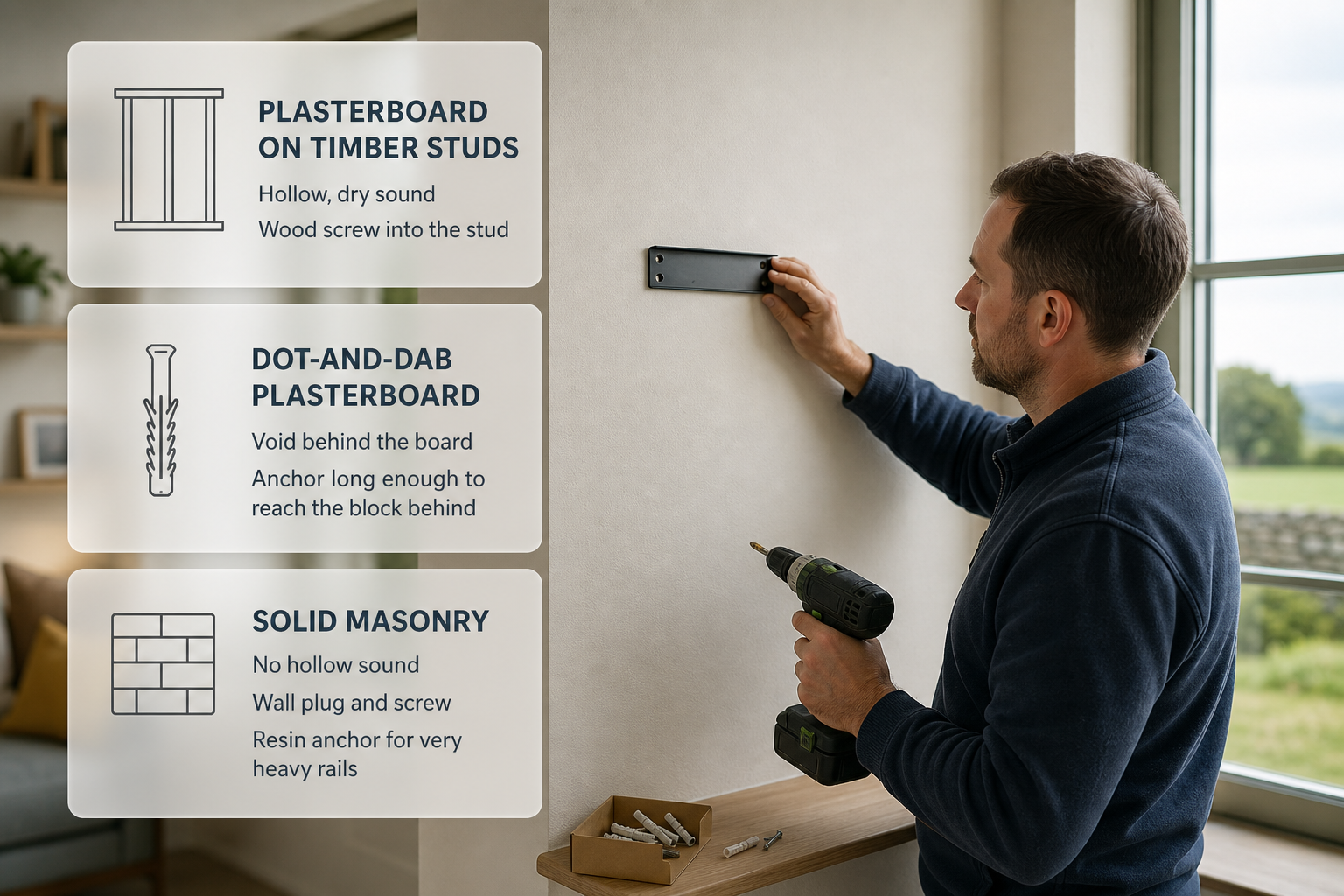
Diagnosis starts with the wall, not the rail. Irish homes are a mix of solid blockwork, brick, stone, timber stud partitions, lath-and-plaster, and plasterboard either screwed to studs or dot-and-dabbed onto blockwork. Each takes a different anchor.
| Wall behind the bracket | How to recognise it | Fixing that holds |
|---|---|---|
| Plasterboard on timber studs | Hollow, dry sound; a stud finder or a magnet locates vertical timber | Wood screw straight into the stud; a hollow-wall anchor only where no stud is available |
| Plasterboard dot-and-dabbed over blockwork | Sounds hollow in patches, with a void behind the board | An anchor long enough to reach the block behind, or a bracket moved to a point that can be fixed solidly |
| Solid masonry: block, brick or stone | No hollow sound; drilling produces dust and real resistance | Masonry bit, correct-diameter wall plug and screw; a resin anchor for very heavy rails |
| Timber stud or lath-and-plaster partition | Common in older homes, thin timber or timber laths behind the surface | Screw into the stud; specialist plasterboard anchors elsewhere |
| Tiled or glazed wall | Bathroom or shower surrounds | Small tile bit with no hammer action, and a fixing that reaches the wall behind the tile |
The practical rule is simple: fix into timber or solid masonry wherever the bracket lines up with it, and use a proper hollow-wall anchor only where it does not. A bracket held by a screw and a plug pressed into bare plasterboard will fail again, however tight it feels on the day.
Stopgaps that buy a day, not a season
A larger screw driven into the same hole feels firm for an evening, then fails again because the hole is now wider than before. Adhesive squeezed behind a bracket rarely bonds to dusty plaster or painted block, and it hides the problem rather than solving it. Simply tightening the bracket and hanging the curtain straight back up transfers the load to the neighbouring fixing, which then fails next. None of these are wrong as an emergency measure when a rail is hanging over a walkway, but none of them is a repair. The reliable approach is always the same: take the load off the wall, deal with the wall, then rebuild the fixing.
The durable repair, step by step
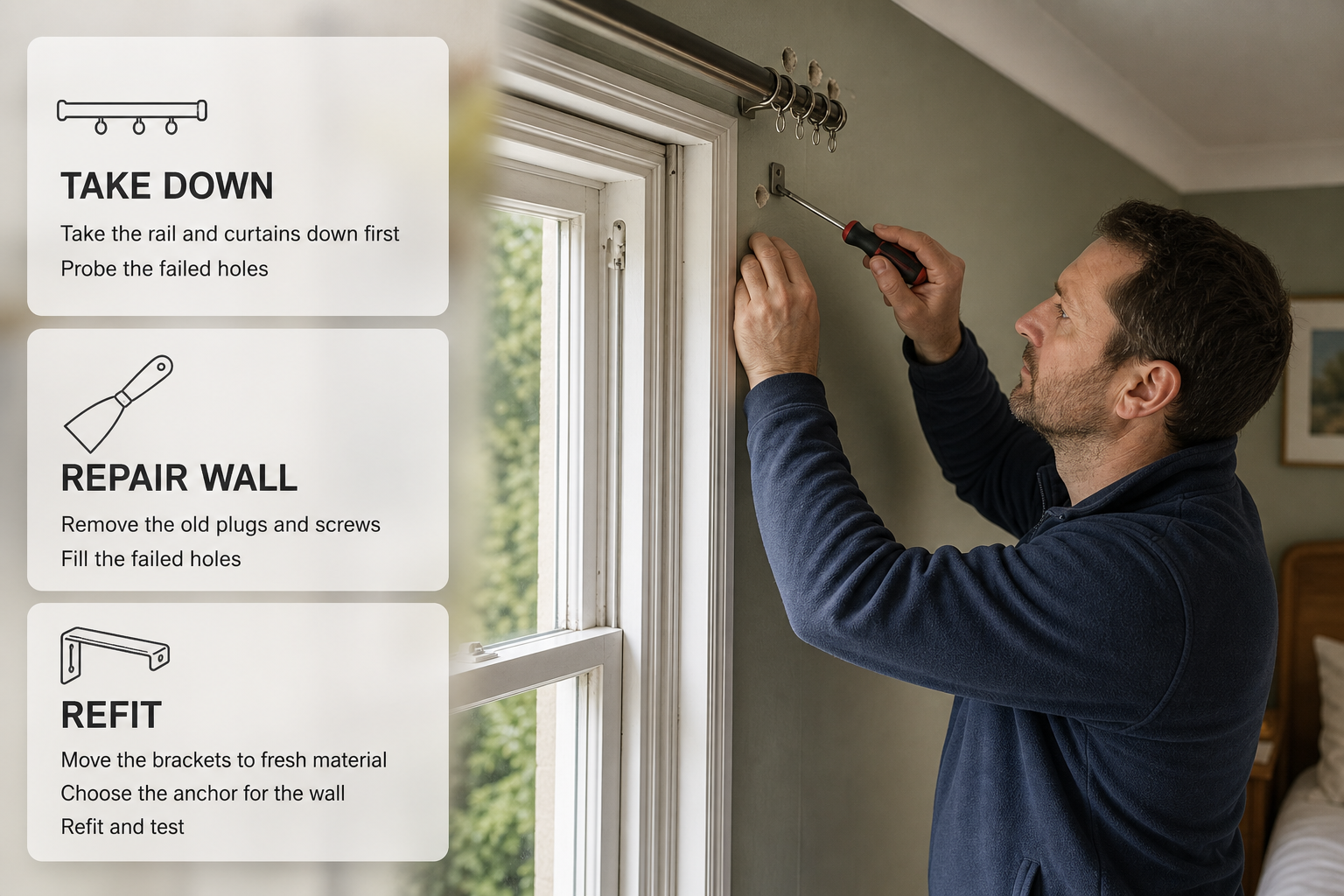
Take the rail and curtains down first. Working around a hanging curtain means the bracket is loaded while it is being fixed, and nothing sets or tightens properly.
Probe the failed holes. A thin screwdriver shows whether the hole is in hollow board, crumbled block or solid material. Note where the bracket sat, because that position is part of the problem.
Remove the old plugs and screws. They cannot be reused, and leaving them in place prevents a new anchor from seating.
Fill the failed holes. A two-part filler or a strong interior filler pressed in firmly and left slightly proud will set hard. It should be left to cure for the full time stated on the pack, then sanded flush and touched in with paint. Filler restores the surface; it does not restore strength, so the rail should not go back into the same spot.
Move the brackets to fresh material. Shifting each bracket along to undamaged board, or up or down where a pelmet, valance or curtain heading will hide the old marks, is the difference between a repair and a repeat. Where the rail is wide, adding a centre bracket removes the sag that pulls the end fixings loose. Homeowners who would rather hand over the whole job, including the filling and painting, can compare a general home services provider to take it on.
Choose the anchor for the wall, not for the rail. Into a stud or solid masonry, an ordinary wood or masonry screw is enough. Into hollow plasterboard, a proper hollow-wall anchor rated for the load is required, and it must be long enough to clear the board and any dab void. Into tile, the fixing has to reach whatever sits behind the tile.
Refit and test. Bracket first, then rail, then a gentle sideways pull before the curtains go back. If the rail still bows when the curtains hang, the rail, and not the wall, is now the weak point.
Heavy curtains, wide spans and awkward windows
The heavier the curtain, the more fixing points the rail needs. Lined and interlined curtains are the usual reason a rail that held for years suddenly gives way. Reducing weight, by swapping a heavy lining for a lighter one or replacing a single wide curtain with two narrower ones, lowers the load on every bracket. Where the curtain must stay heavy, a track with more fixing points along its length is a stronger choice than a slim decorative pole.
Bay windows are the classic trouble spot. The angled returns at each end pull differently from the straight run, so each section needs its own solid fixing, and short lengths of rail or a bendable track suit these corners better than one long pole forced around them. Awkward windows with deep reveals or little wall above the frame can leave nowhere obvious to fix, and in that case a ceiling-fixed track or a bracket set further back against the reveal is often the answer.