
ShamFix
Back to insights

Courier delivery cost in Ireland: what households pay

A one-off parcel in Ireland costs about €6 to €300, with most small and medium sends landing between €6 and €20. Here is what moves the price.

9 min read
Courier delivery cost in Ireland: what households pay

For a household sending a single parcel inside Ireland, an aggregate Irish market estimate puts most one-off courier sends at €6 to €20, with same-day delivery at €25 to €300. A small parcel up to about 2 kg dropped at a counter or parcel locker is typically €6 to €12 for next working day delivery, a medium parcel up to about 10 kg is €10 to €20, and having that same parcel collected from the door instead of dropped off adds roughly €3 to €8. A same-day courier within one city or town runs about €25 to €60 and a dedicated same-day run across the country is €120 to €300, which are the kinds of one-off prices quoted for local courier services rather than discounted business shipping contracts.
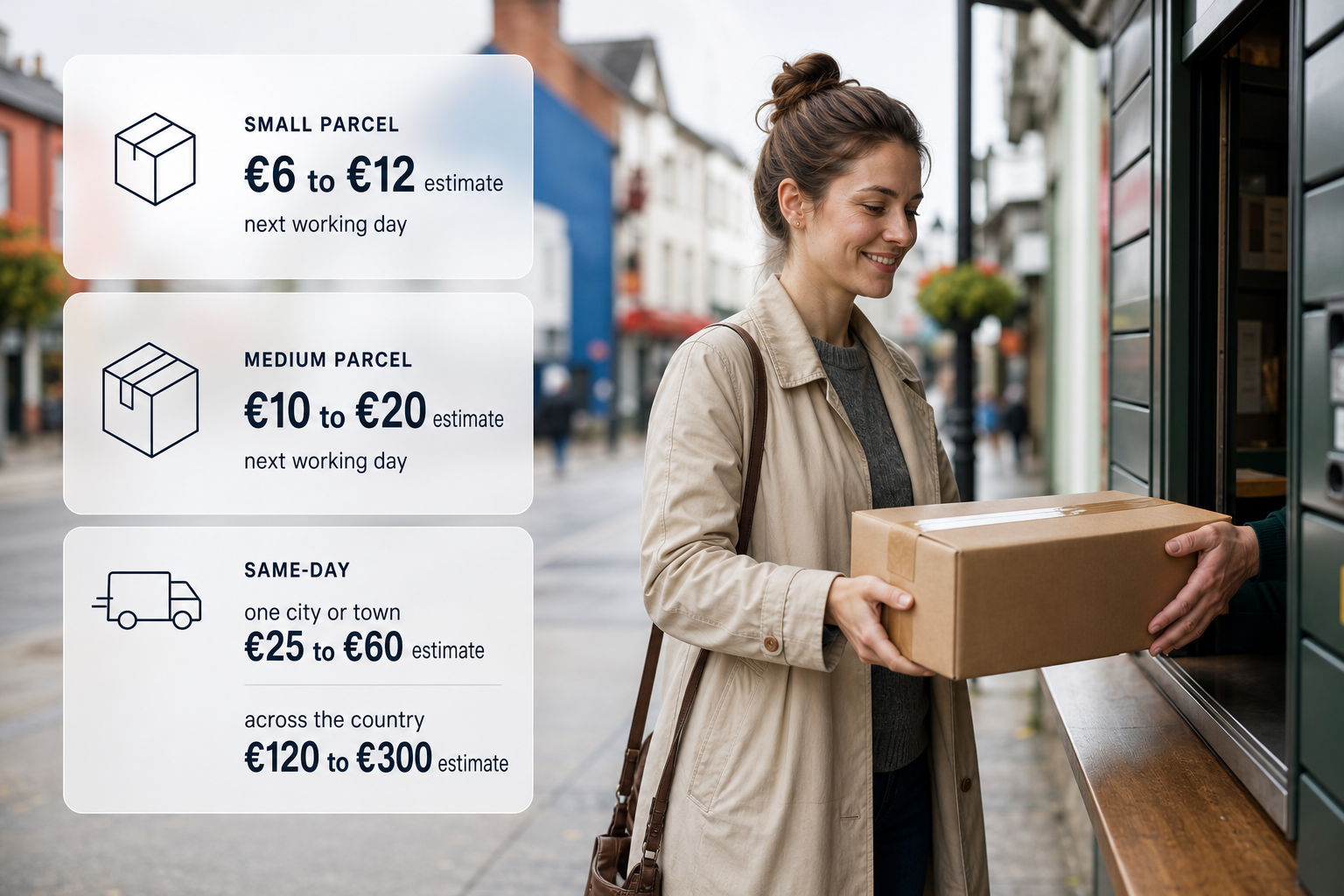
Infographic showing a courier parcel drop-off scene in Ireland with cards summarising one-off delivery price bands and same-day costs.

What a one-off courier delivery costs in Ireland

The figures below are an aggregate Irish market estimate for household, one-off sends. They assume a standard cardboard box, a weekday booking made the day before, and a drop-off or collection point in a town or city rather than a rural or island address.

Service type Typical price band Delivery time Best for
Small parcel up to about 2 kg, dropped at a counter or parcel locker €6 to €12 next working day documents, small boxes, spare parts
Medium parcel up to about 10 kg, dropped off €10 to €20 next working day the typical one-off household send
Small parcel up to about 2 kg, collected from the door €9 to €20 next working day households with no car or no time to queue
Medium parcel up to about 10 kg, collected from the door €13 to €28 next working day heavy or awkward boxes
Same-day courier within one city or town €25 to €60 same day, often within a few hours keys, forgotten items, urgent paperwork
Same-day or dedicated delivery across the country €120 to €300 same day, direct point to point one time-critical item that cannot wait

The gap between the top and the bottom of that table is not about weight alone. Speed, and whether a driver calls to the door, are worth more than a few kilos, which is why the bands for a 2 kg and a 10 kg parcel sent the same way overlap.
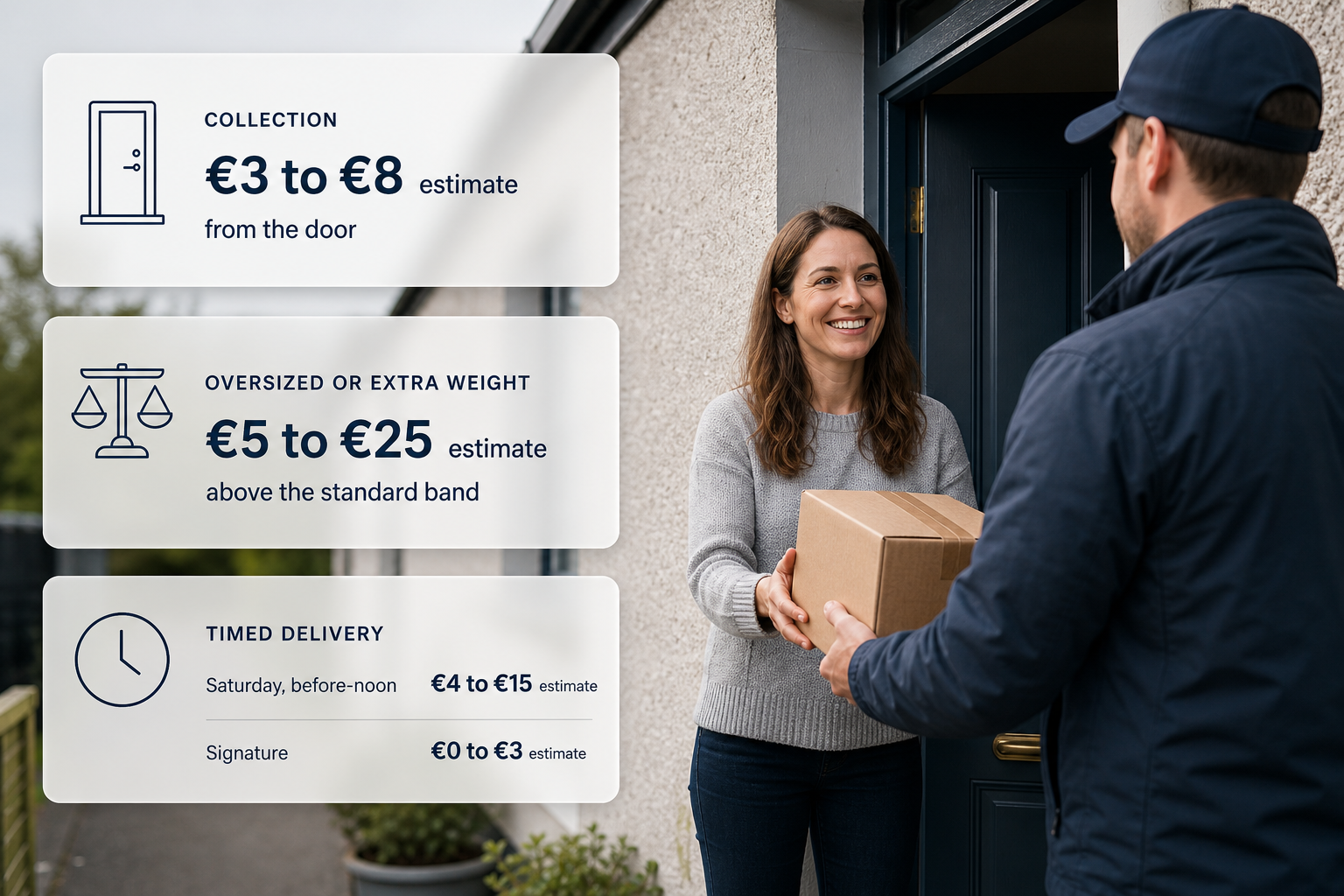
Infographic showing a courier collecting a parcel from an Irish home with cards explaining common quote extras and their price bands.

The extras that appear on a courier quote

Prices below are an aggregate Irish market estimate for the add-ons a household is most likely to see on a one-off quote.

Extra Typical price band What it covers
Extra weight, or an oversized light-but-bulky box €5 to €25 going above the standard weight band, or being charged on volume
Collection from the door instead of drop-off €3 to €8 a driver calls to the house, sometimes inside a time window
Signature on delivery €0 to €3 proof of handover, frequently included at no charge
Declared value cover above the standard limit €3 to €15 extra compensation if the item is lost or damaged
Saturday, before-noon or other timed delivery €4 to €15 a slot outside the standard next-day run
Re-delivery after a failed attempt, or return to sender €5 to €12 the courier's second visit or the trip back

Worked example: a 5 kg box from Galway to Dublin. A 5 kg box sits inside the medium band, so next working day delivery with a drop-off costs €10 to €20. Ask for collection from the door and the same box costs €13 to €28. If it has to be in Dublin the same day it stops being a network parcel and becomes a dedicated run, and same-day delivery across the country falls in the €120 to €300 band. The box is identical in all three cases; only the speed and the collection change, and the same-day option costs several times the next-day price.

What moves the price: size and volumetric weight

A light but bulky box is charged by size, not by the number on the scales. Couriers apply a divisor to the length x width x height of the parcel to produce a volumetric weight, then charge on whichever is greater, the actual weight or the volumetric one. That is why a duvet, a lamp with a wide shade, or a box of empty storage containers can cost more to send than a tightly packed toolbox of the same weight.

Practical steps help. Use the smallest box the item fits into with padding, avoid sending air, and consolidate two half-empty boxes into one if the combined size still fits a single band. If the parcel is over the standard size for the chosen service, expect the €5 to €25 oversized charge from the table above rather than a surprise at the counter.

Distance, rural addresses and island Eircodes

Distance matters less than the route. Networks price on the lane between two depots, so a parcel travelling between two well-served towns is often no dearer than a shorter urban trip. The rural factor is the depot gap: an address far from a sorting hub, an Eircode in a sparsely populated routing key, or an offshore island can add a surcharge, a day, or both.

Which addresses carry an extra charge is set by each courier in its own published terms, so a household should confirm the exact figure for its own Eircode before booking rather than assume the headline price applies. Offshore islands in particular may be served on certain days only, and oversized items to islands are sometimes refused outright.

Collection from the door versus dropping it off

Dropping the parcel off is the cheapest option in almost every case. A small parcel is €6 to €12 dropped off and €9 to €20 collected; a medium parcel is €10 to €20 dropped off and €13 to €28 collected. The €3 to €8 difference buys a driver's time and a printed label, and it is worth paying when the box is heavy, when there is no car, or when the nearest drop-off point is a long round trip. It is also worth asking whether the collection window is a full day or a timed slot, because a full-day window is common at the lower end of the range.


Speed: next day, timed and same day

Standard next working day is the default and the best value. Before-noon or a named time slot typically adds €4 to €15. Same-day work is a different service: a courier within one city or town costs €25 to €60, while sending the same item across the country the same day costs €120 to €300, because a driver and a vehicle are committed to that one job and nothing else. For anything that can wait 24 hours, the next-day band is the sensible choice.

Bulky items: when a courier network is the wrong choice

Furniture, appliances, a sofa, a washing machine, a mattress or a flat-pack wardrobe should not go through a parcel network. These items exceed the size limits most couriers publish, they are priced heavily on volume, and the risk of damage in a sorting hub is high. A household is usually better off with a man with a van job (see man with a van prices), where a moving and transport provider quotes for the item itself, loads it by hand and delivers it direct, often for less than the oversized surcharges plus the replacement cost of a damaged appliance.

Signature, tracking and declared value cover

Tracking is standard with nearly every network service, and signature on delivery is often free, though some couriers charge €0 to €3 for it. What matters more is cover. Standard compensation is usually modest and frequently tied to the weight of the parcel rather than to what is inside it, so a laptop and a pair of boots can attract a similarly small payout if things go wrong. Declared value cover, typically €3 to €15 on top of the carriage for ordinary household items, is worth taking for anything expensive or hard to replace, and the contents should be described accurately when the job is booked.

Couriers also refuse or restrict whole categories. Liquids, aerosols, batteries, glass, ceramics and high-value items such as jewellery, watches and electronics are commonly excluded or capped, and if an item is on that list the cover may be nil no matter what was paid for carriage.

Packing so a claim is not refused

Most refused claims come down to packing rather than handling. Use a rigid double-walled box in good condition, wrap the item in bubble wrap or foam, and fill every gap so nothing shifts when the box is shaken; a box that rattles is a box that invites a refusal. Seal all openings and seams with strong packing tape, and tape the address label to the outside rather than tucking a note inside. Keep liquids upright inside a sealed bag with absorbent material around them, mark the box fragile and this way up, and photograph the packed box and its contents before it leaves the house, because photographs settle most disputes about what was sent and how it was packed.

Sending outside the EU

Sending a parcel outside the EU is a different exercise: the sender needs a customs declaration describing the contents and their value, and the price rises steeply because the parcel leaves the domestic network and enters a system with duties and clearance. For items bought from outside the EU and delivered into Ireland, Revenue states that the delivery company may require payment of €3 customs duty per item before delivery, and that VAT on the import can also apply. That charge is separate from whatever the courier charges for carrying the parcel.

FAQ

Is it worth paying for collection instead of dropping the parcel off?

Only when the trip is awkward. Door collection adds €3 to €8, so a small parcel moves from €6 to €12 up to €9 to €20, and a medium parcel moves from €10 to €20 up to €13 to €28. If a drop-off point is a ten-minute walk, the cheaper option wins; if it is a long round trip in traffic with a heavy box, collection usually earns its keep.

Why was I charged more for a large box that weighed very little?

Because the price was calculated on volumetric weight rather than on the scales. A courier measures the box, converts the volume into a chargeable weight and bills whichever figure is higher, so a bulky, light parcel can cost more than a small, heavy one. Packing tighter, or splitting a load into a shape that fits a standard band, is the usual remedy.

Does a courier cover the full value of my parcel automatically?

No. Standard compensation is normally limited and often linked to weight rather than value, so it rarely matches what a valuable item is worth. Extra declared value cover is a modest add-on, and it only pays out if the contents were described honestly on the booking and the parcel was packed to the courier's published standard.

Can a courier take a fridge, a bike or a wardrobe?

Usually not, or only at a price that makes little sense. Those items sit outside the size limits most parcel networks publish and are charged heavily on volume. A van job quoted for the item itself is the more practical route, and it also removes the risk of damage in a sorting hub.

Booking a one-off courier job

For a single parcel, the cheapest route is almost always a drop-off before the daily cut-off, with the €3 to €8 collection add-on reserved for heavy boxes or awkward journeys. Posting a job and listing on ShamFix is free and there is no commission; a subscription is planned for the future. ShamFix does not check or certify tradespeople, and profiles are filled in by tradespeople themselves, so homeowners should check registrations themselves and read reviews before hiring. One-off courier, same-day and van jobs can be posted on the ShamFix home page, where local providers respond with their own quotes.

Keep reading