The cost to tile a bathroom in Ireland is usually quoted as an aggregate Irish market estimate that depends on how big the room is: a small bathroom (up to 4 m² of floor, up to 15 m² of wall) at €1,200–€2,400, a medium bathroom (4–6 m² of floor, 15–25 m² of wall) at €2,400–€4,200 and a large bathroom (6–10 m² of floor, 25–40 m² of wall) at €4,200–€7,500. Those aggregate Irish market estimate figures are inclusive of VAT and assume standard ceramic or porcelain tiles, adhesive, grout, trims and labour, and they exclude structural repairs, replacement sanitaryware, underfloor heating, natural stone, and any plumbing or electrical alterations. Where a real quote lands within those bands depends on the tiles chosen, the condition of the walls and floor, and how much preparation the room needs before the first tile is fixed.
The same aggregate Irish market estimate ranges, inclusive of VAT and covering materials and labour, are set out below by room size.
| Bathroom size | Floor area | Tiled wall area | Aggregate Irish market estimate (inclusive of VAT, materials and labour) |
|---|---|---|---|
| Small | Up to 4 m² | Up to 15 m² | €1,200–€2,400 |
| Medium | 4–6 m² | 15–25 m² | €2,400–€4,200 |
| Large | 6–10 m² | 25–40 m² | €4,200–€7,500 |
What changes the cost to tile a bathroom?
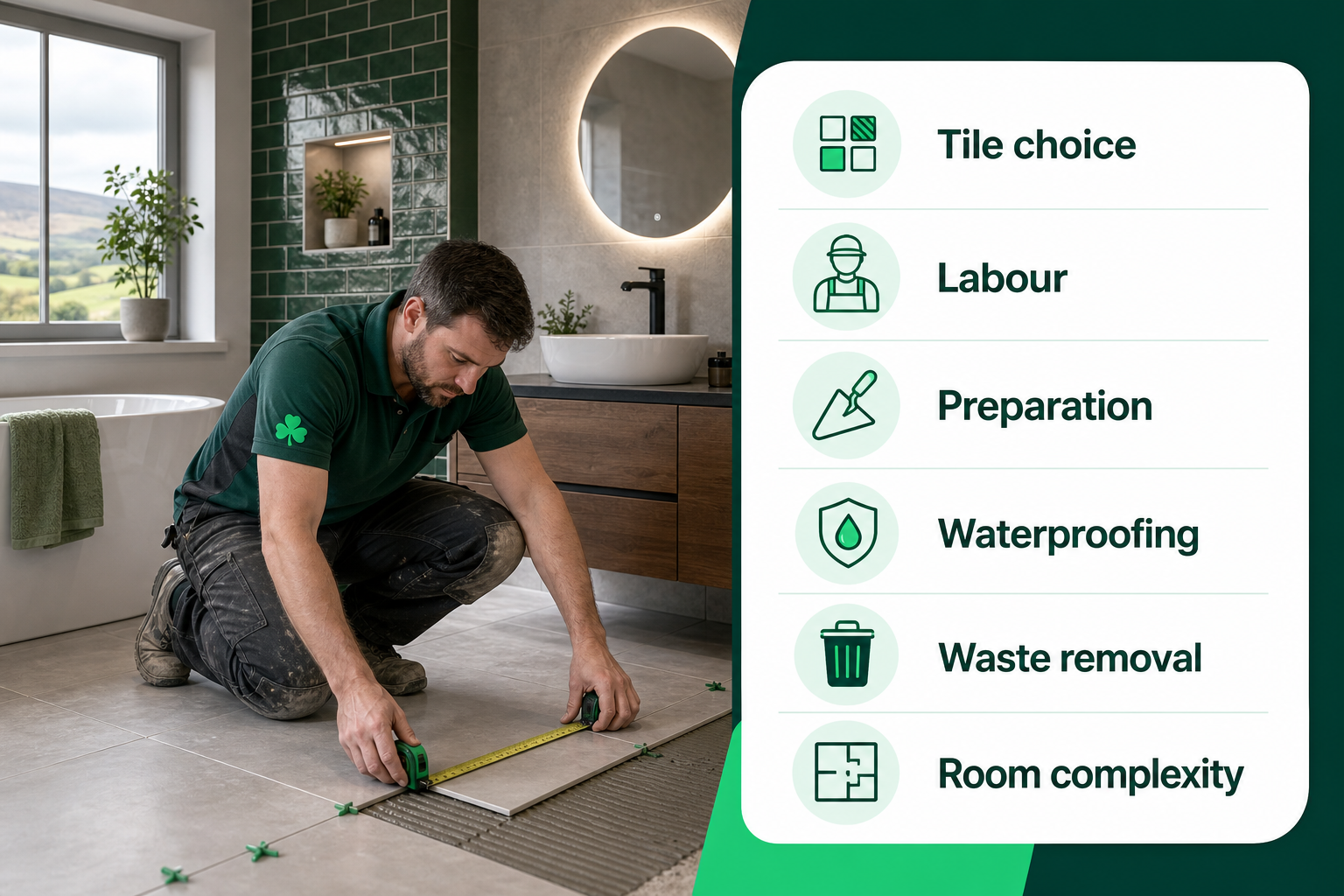
Tile choice, labour, preparation, waterproofing, waste removal and the shape of the room all move the total. Two bathrooms of the same floor area can be priced very differently once those six factors are compared side by side.
Because the work has to be seen to be priced properly, most homeowners start by getting the room looked at. Posting a request for bathroom tiling services on ShamFix lets local tradespeople respond to the job with their own scope and price.
Tile choice affects both the materials bill and the time on site. Ceramic, porcelain, natural stone, large-format sheets, mosaic sheets and patterned layouts are cut, fixed and finished at different speeds. A tile that needs dozens of cuts around a shower, a window or a run of pipework takes longer to set out and fit than a plain square tile on a flat wall. Large-format tiles can need two people to handle them and a different adhesive, while mosaics and herringbone patterns need more setting-out time. The quote should name the tile type, size and finish so the homeowner knows what is being priced.
Labour covers setting out, cutting, fixing, grouting, silicone and clean-up. The figure rises when the tiler has to work around awkward pipework, windows, niches, recesses or uneven walls, and when access is difficult because the bathroom is upstairs or the building has lift or parking restrictions. Labour is not only the visible tiling; it includes the setting out and finishing that decide whether the job still looks right years later.
Preparation is the single most common reason a final bill moves above the original number. Removing old tiles, repairing plaster, replacing plasterboard, levelling a floor or rebuilding a shower area all add time and materials. If a quote says nothing about preparation, the homeowner should ask what happens if the surface behind the old covering turns out to be damaged or uneven.
Waterproofing matters in every wet area. A shower enclosure, a wetroom or a bath surround may need a tanking membrane, jointing tape, primer and sealant behind the tiles. That work is hidden once the tiles are on, but it adds a separate stage and specialist materials, so a quote that leaves it out is not directly comparable with one that includes it.
Waste removal also changes the final figure. Old tiles, adhesive, plasterboard and packaging are heavy and bulky, and disposing of them through a skip or a waste collection service adds a line to the bill. Some quotes include removal and some expect the homeowner to arrange it, so this should be confirmed before totals are compared.
Room complexity covers the shape of the room and the number of trades involved. Multiple corners, sloped ceilings, boxed pipes, small cuts and separate wall and floor areas all take longer than a plain rectangular room. Moving sanitaryware, a radiator or electrics adds cost and may bring other trades onto the job, and each extra stage widens the gap between the first estimate and the final invoice.
What should an Irish bathroom tiling quote contain?
Irish consumer law is clear about what a homeowner should receive before work starts. The CCPC states that traders in home building and improvement services must provide clear pre-contract information, including the total price inclusive of VAT or how the price will be calculated if it cannot be determined in advance (CCPC). A tiling quote should be detailed enough that a different tiler could price the same job from it without asking questions.
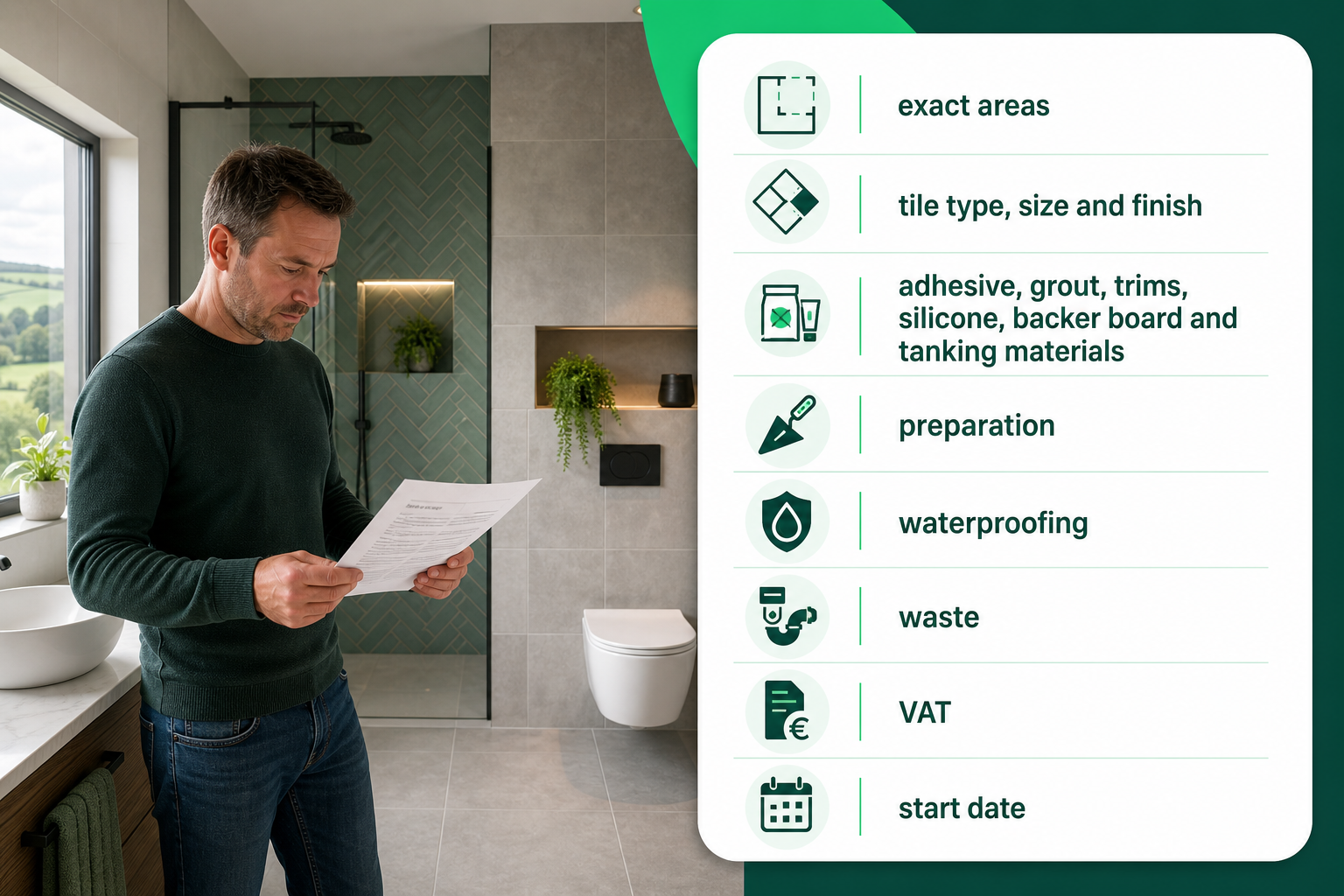
A useful quote should set out:
- the exact areas to be tiled, measured in square metres for walls and for the floor;
- the tile type, size and finish, or a note that the homeowner is supplying the tiles;
- whether adhesive, grout, trims, silicone, backer board and tanking materials are included;
- the preparation allowed for, such as stripping old tiles, patching plaster or levelling the floor;
- whether waterproofing is included and which areas it covers;
- how waste will be removed and who pays for disposal;
- whether VAT is included, and if so, the amount or rate shown separately;
- the start date, the completion date and the payment schedule;
- access arrangements, protection of other rooms and final clean-up.
How to compare bathroom tiling quotes like-for-like
Bathroom tiling sits inside the wider construction and home renovation services market, so the same comparison rules apply here. The lowest number is not automatically the best value if it leaves out preparation, waterproofing or waste removal, and the highest is not automatically the most thorough.
Start with the areas. A quote for walls only cannot be compared with one for walls and floor, and a price based on the homeowner's own measurements may change once the tiler measures the room. Next, compare the tile specification, because large-format porcelain, mosaic sheets and natural stone can need different adhesive, cutting tools and finishing time. Then compare the preparation list. If one quote includes stripping the old tiles and another assumes the walls are ready to tile, the two totals are not describing the same job.
Waterproofing is the fourth check. A wetroom, a shower enclosure or a bath surround may need tanking, while a splashback behind a basin may not. Waste removal is the fifth. If one tiler includes a skip and another leaves the old tiles for the homeowner to deal with, that difference should be added to the cheaper total before it is judged. VAT is the sixth. A figure that looks lower may be quoted excluding VAT while another includes it.
Finally, ask for a written scope with a breakdown rather than a single figure. An itemised quote shows what happens if hidden damage is found once the old covering comes off, and it makes it far easier to see whether two prices are really comparable.