Grass cutting in Ireland costs about €30–€50 for a small lawn and €70–€120 for a large garden. What is included, extras and how to compare quotes.
/9 min read
The cost to cut grass in Ireland is commonly in the region of €30 to €50 for a small urban lawn and €70 to €120 for a large garden, as an aggregate Irish market estimate for a single visit. Homeowners buying regular visits usually pay less per cut than for a one-off job, because an operator returning to a known garden does not have to price travel, set-up and uncertain growth into a single booking. This guide sets out the aggregate Irish market estimate ranges, the factors that move a quote, what a standard mow normally includes, what is usually charged as an extra, and how to compare written quotes for grass cutting and hedge trimming before any work begins.
What the cost to cut grass is in Ireland
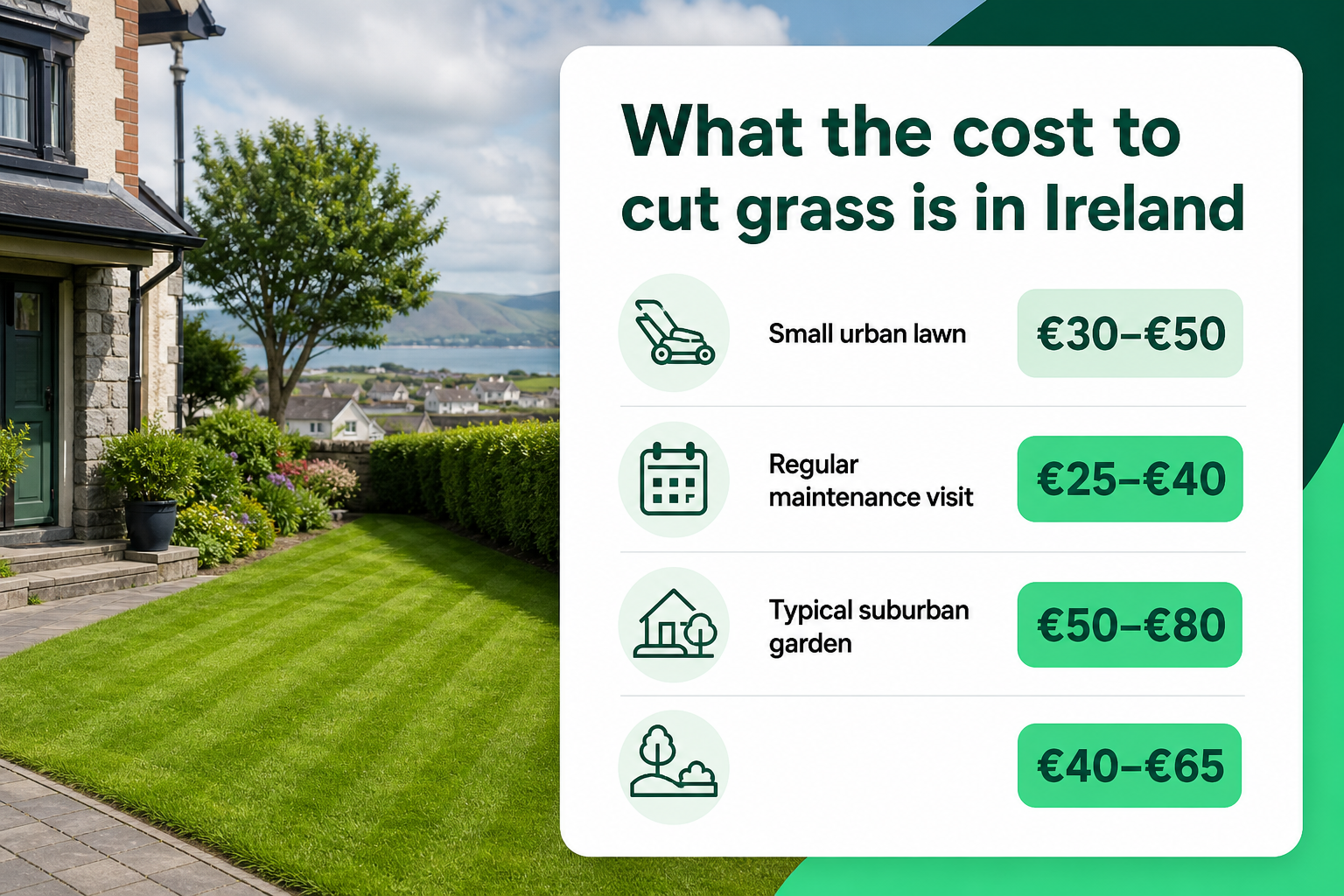
Every figure below is an aggregate Irish market estimate: a broad range based on what homeowners across the country typically pay. It is not a quotation, a fixed rate or any individual operator's price list, and a written quote may sit above or below it.
Small urban lawn, front and back, up to about 60 sq m
€30–€50
€25–€40
Typical suburban garden, about 60–150 sq m
€50–€80
€40–€65
Large garden, about 150–400 sq m
€70–€120
€60–€95
Very large garden, paddock or site, over 400 sq m
€100–€200 or more
€90–€170
Where a job is priced by time rather than by the visit, hourly rates generally fall in the region of €25–€45 per hour as an aggregate Irish market estimate. Many operators also apply a minimum call-out charge, often in the region of €40–€60, because the journey and the equipment cost the same whether the mowing takes fifteen minutes or an hour. A minimum charge matters most on small lawns: a front garden that takes ten minutes may still be quoted at the minimum.
Single cut versus regular maintenance pricing
A one-off cut is almost always the most expensive way to buy grass cutting by the visit. The operator carries travel, set-up and machine time with no confidence of a return, and a lawn left for several weeks usually needs two slower passes rather than one quick one. A single tidy-up ahead of a family occasion, a viewing or a house sale is typically priced at or near the top of the single-cut aggregate estimate range.
Repeat visits change the economics rather than the standard of work. The same operator knows the layout, the gate and the awkward corner, and can group several gardens in the same estate into one working day. Where a customer books regular visits, the per-visit price generally sits towards the lower end of the aggregate estimate band rather than the top.
Some operators quote a season price instead of a per-visit price. That can work well, but the written quote should state how many visits it covers, what happens when a visit is rained off, and whether the figure holds if growth is heavier than expected. A season price assuming a fixed number of visits is a different product from a per-visit price, and the two should not be compared as if they were the same.
Dublin versus rural: why the same lawn quotes differently
As an aggregate Irish market estimate, a Dublin premium of roughly €10–€30 per visit is common against a similar-sized lawn in a rural county. The reasons are practical rather than arbitrary: heavier traffic, longer journeys between jobs, tighter parking and narrow or gated access in older estates all reduce the number of gardens that fit into a working day, so each one has to carry more of the cost.
Rural pricing behaves differently. Lawns are often larger, which lifts the price per cut, but travel and overheads per job can be lower and local competition sharper, so the price per square metre tends to fall. Rural work is also more likely to be quoted by the hour, particularly where ground is rough or the area includes a paddock or a site rather than a lawn. Suburbs and commuter towns usually sit between the two, and can drift towards Dublin pricing where the same operators cover a wide radius.
What moves the price up or down
Size and shape. A long, narrow or L-shaped lawn takes longer per square metre than a simple rectangle of the same area.
Access. A standard side gate suits a standard mower. Steps, gravel paths, a locked side entrance or a lawn reached only through the house all add time.
Ground conditions. Slopes, banks and soft patches slow the work and may rule out a ride-on mower.
Length and condition. Grass over about 15 cm generally needs two passes, and wet or tussocky grass needs more again.
Obstacles. Trees, poles, planters, washing lines, trampolines and toys all have to be worked around, and some moved first.
Edging and strimming. Strimming boundaries is usually included; neat edging along paths and beds often is not.
Clippings. Leaving clippings on the lawn is the default. Taking them away is normally an extra charge.
Travel and minimum charges. Distance from the operator's usual area adds cost, and a minimum call-out charge can dominate the price of a very small lawn.
Bundling. Combining grass cutting with other home services such as hedge trimming, gutter clearing or pressure washing can reduce the total, because the operator is already on site with the equipment unloaded.
What a standard mow includes — and what is usually extra
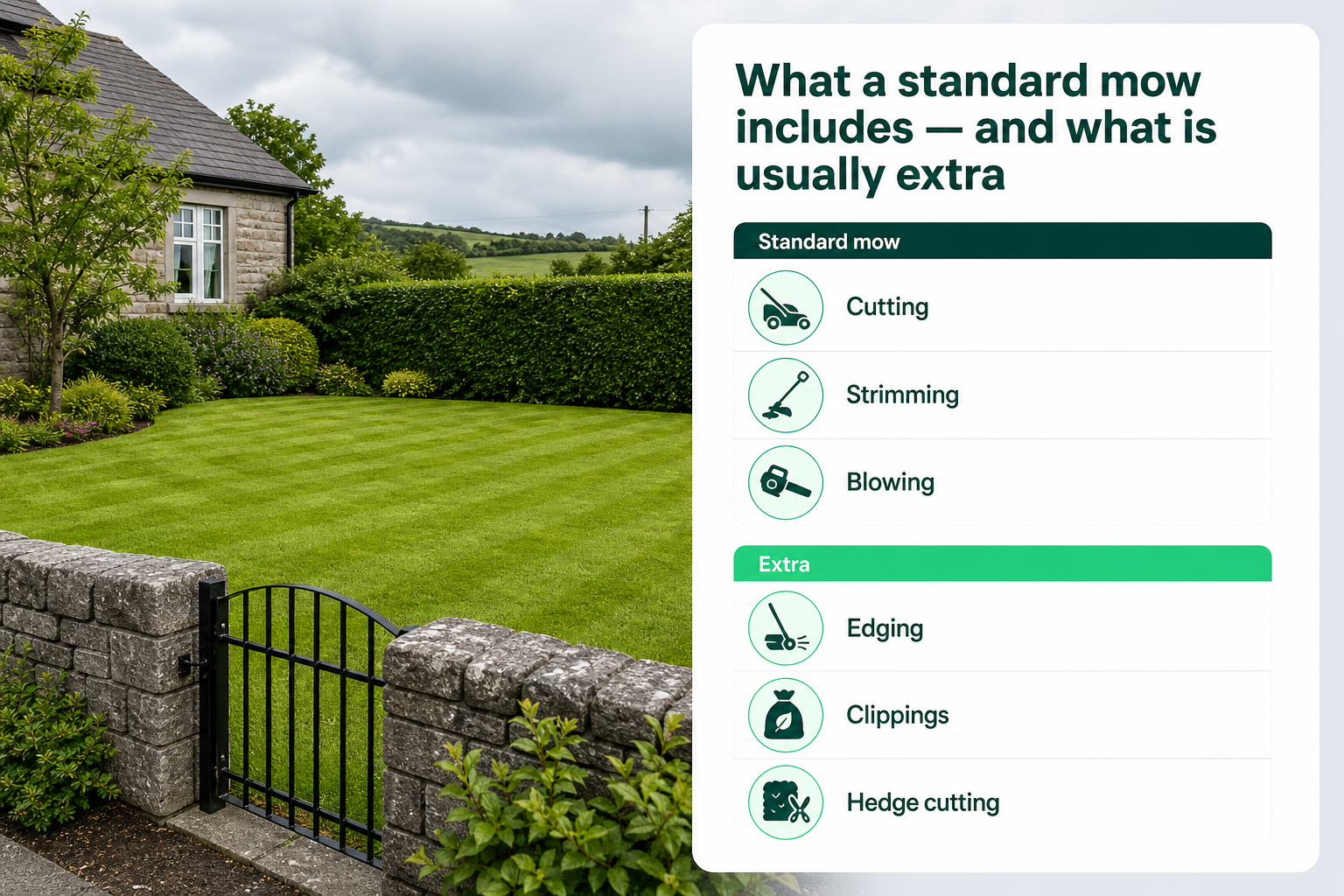
A standard mow normally covers cutting all accessible grass at an agreed height, one or two passes depending on growth, strimming around trees, poles, fences and walls where the mower cannot reach, and blowing or sweeping paths, driveways and patios clear of clippings. Unless collection has been agreed, clippings are left on the lawn.
Often quoted as an extra:
Edging along kerbs, paths, driveways and flower beds
Strimming steep banks, ditches and ground under hedges
Collecting and removing clippings
Scarifying, moss removal, aeration, top dressing, weedkiller or fertiliser
A second cut where grass has been left too long
Moving furniture, trampolines or planters before cutting
Hedge cutting, weeding, leaf clearing and general tidy-up work
The phrase "a cut and a tidy" means different things to different people. The only reliable way to avoid a surprise on the day is to have the scope written down before the first visit.
Clippings, green bins and garden waste
If clippings are being removed, it is reasonable to ask where they go. The EPA advises that garden waste should not be put in the green bin as compostable material (EPA waste guidance). The EPA also publishes national waste statistics on biodegradable municipal waste, including data on waste disposed to landfill (EPA national waste statistics), a reminder that clippings taken out of a garden still have to be dealt with properly somewhere.
Leaving clippings on the lawn is the cheapest option and normal practice on a routine cut, provided the grass is not so long that the clippings smother it. Where collection is chosen, expect it to be charged separately — as an aggregate Irish market estimate, often €5–€20 per visit, depending on volume and how far the waste has to travel.
How to compare written quotes safely
Ask for the price in writing before work starts. For certain off-premises repairs or maintenance contracts, the trader must provide specified pre-contract information, including the main characteristics of the service and the total price or how it is calculated, under the Consumer Rights Act 2022. Irish consumer law also requires a business to supply the service as outlined in the contract, as the CCPC explains for businesses selling services.
When quotes arrive, compare them on the same basis:
Scope. Check that every quote covers the same areas, the same strimming and the same treatment of clippings. A cheap quote for the back lawn only is not cheaper than a quote for the whole garden.
Price basis. Per visit, per hour or per season? A per-hour quote with no estimate of hours is not comparable with a fixed price.
Minimum charge and travel. Ask whether a call-out charge applies and whether travel outside a certain radius is billed separately.
Extras. Get extra rates in writing, especially for edging, clipping removal and hedge work, so a low headline price cannot grow on the day.
Missed visits. Confirm what happens when a visit is rained off and whether a missed visit is carried over or refunded.
Equipment, fuel and payment. Confirm who supplies the mower, strimmer and fuel, and be cautious about paying the full amount up front for routine mowing.
Written record. Keep the quote, any messages and a note of dates. That makes a problem far easier to deal with later.
Rights when a service falls short
If a service does not meet expected standards, the trader should resolve the issue within a reasonable period, free of charge and without significant inconvenience to the consumer, according to the CCPC's guidance on buying services. If a problem arises and the business cannot or will not resolve it, the consumer has the right to cancel the contract under the CCPC's consumer rights guidance. A written quote, the messages around it and a note of dates make that process much easier to run.
Finding someone to cut the grass
Posting a job and listing on ShamFix is free and there is no commission, and a subscription is planned for the future. Homeowners describe the lawn, the access, the finish wanted and whether clippings need to be removed, and local tradespeople respond with their own prices. Because replies arrive as written prices rather than one take-it-or-leave-it figure, the aggregate market estimate ranges above become a practical benchmark for judging which quote is reasonable and which one is missing half the job. ShamFix does not check or certify tradespeople, and profiles are filled in by tradespeople themselves, so homeowners should check any relevant registrations themselves and read reviews left by other homeowners before agreeing a price.
FAQ
What should a written quote for grass cutting include?
A written quote should state the areas to be cut, the height or finish agreed, whether strimming and edging are included, whether clippings are left or removed, the price basis (per visit, per hour or per season), any minimum call-out charge, travel charges, extra rates for clipping removal or hedge work, and how missed or rained-off visits are handled. For certain off-premises repairs or maintenance contracts, the trader must provide specified pre-contract information, including the main characteristics of the service and the total price or how it is calculated, under the Consumer Rights Act 2022.
Why do two quotes for the same lawn differ so much?
The gap is usually scope and access rather than profit margin. One quote may include both lawns, edging and clipping removal; another may cover mowing only. Travel distance, a minimum call-out charge, steep ground, a narrow side gate and grass left long all add real time to the job. Comparing the quotes line by line usually explains the difference.
Is removing grass clippings charged separately?
Usually, yes. Leaving clippings on the lawn is standard practice on a routine cut, so collection is normally treated as an extra rather than part of the headline price. As an aggregate Irish market estimate, removal often adds in the region of €5–€20 per visit depending on volume. Where clippings are taken away, ask where they go, because the EPA advises that garden waste should not be put in the green bin as compostable material (EPA waste guidance).
What can a homeowner do if the work falls short?
Raise it with the trader first and keep a written record. If the service does not meet expected standards, the trader should resolve the issue within a reasonable period, free of charge and without significant inconvenience to the consumer, according to the CCPC's guidance on buying services. If the business cannot or will not resolve it, the consumer has the right to cancel the contract under the CCPC's consumer rights guidance. Irish consumer law also requires a business to supply the service as outlined in the contract (CCPC guidance for businesses).