Best Time to Trim Hedges in Ireland: A Homeowner Guide
Most hedgerow cutting is allowed only from 1 September to the end of February, so here is how Irish homeowners can time the work well.
/8 min read
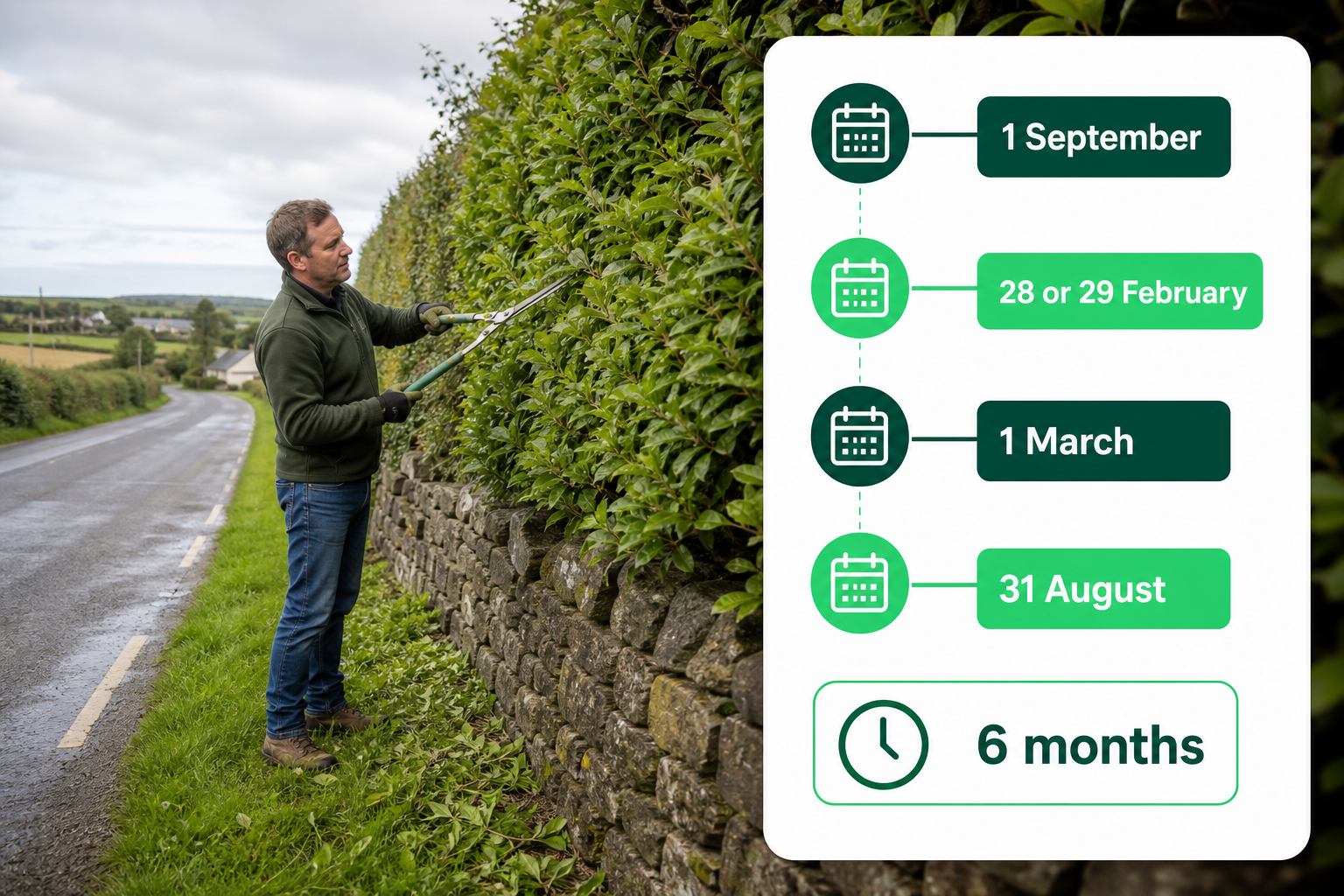
The best time to trim hedges in Ireland is generally between 1 September and 28 or 29 February, because most hedgerow cutting is restricted from 1 March to 31 August. That one window shapes the whole year of hedge work on a private property, whether the hedge is a clipped garden boundary or a long run of native species along a road or field edge. Where a hedge has grown too tall or too wide to cut safely by hand, homeowners can look for grass cutting and hedge trimming help.
The legal season runs from 1 September to the end of February
Most hedge cutting in Ireland is generally allowed only from 1 September to 28 or 29 February. From 1 March until 31 August every year, it is illegal to cut, grub, burn or otherwise destroy most hedgerows in Ireland (Local Government Ireland). The closed months cover spring and summer, which is precisely when birds nest and when hedgerow wildlife is at its busiest.
Teagasc sets out the same practical rule, advising that hedge and vegetation work is generally only permitted between 1 September and 28 February (Teagasc). Tipperary County Council confirms that hedgerows can only be maintained between 01 September and end February each year, with exemptions for health and safety (Tipperary County Council).
In a leap year the open season runs to 29 February rather than 28 February, so the final day shifts by one. Either way, the permitted period is six months long: September, October, November, December, January and February.
The health and safety exemption is narrower than it sounds. It exists for situations where vegetation creates a real risk, such as a hedge hiding a road sign or blocking sightlines at a junction or a bend. It is not general permission to cut any hedge that has become untidy in May or June, and where the exemption is relied on, the work should be limited to what removes the danger itself.
Garden hedges and native hedgerows are not the same thing
The restriction is written for hedgerows rather than for every clipped shrub in a garden. A native hedgerow is a line of trees and shrubs forming a field boundary, a roadside margin or a property boundary, usually built from species such as hawthorn, blackthorn, hazel, holly or ash. A formal garden hedge, such as box, privet, yew, beech or laurel clipped to a neat line, is a different proposition, grown and shaped for design rather than for a field edge.
That difference matters when a homeowner is deciding what to do in June. A formal garden hedge may sometimes need light, routine trimming outside the main season, but only where the work is ordinary garden maintenance and does not damage nesting birds or amount to destroying a hedgerow. Taking shears to a few stray shoots that block a path is not the same act as cutting a hedge hard, grubbing it out or burning the cuttings afterwards.
Where a garden hedge sits on a boundary that could reasonably be read as a hedgerow, such as a long line of native species along a field margin or a public road, the safer approach is to treat it as a hedgerow and wait for September. The cost of waiting is a slightly shaggier hedge for a few weeks. The risk of getting it wrong is disturbing wildlife that the closed season exists to protect.
What counts as routine garden maintenance
Homeowners often ask where the line falls between ordinary upkeep and prohibited destruction. A few markers help.
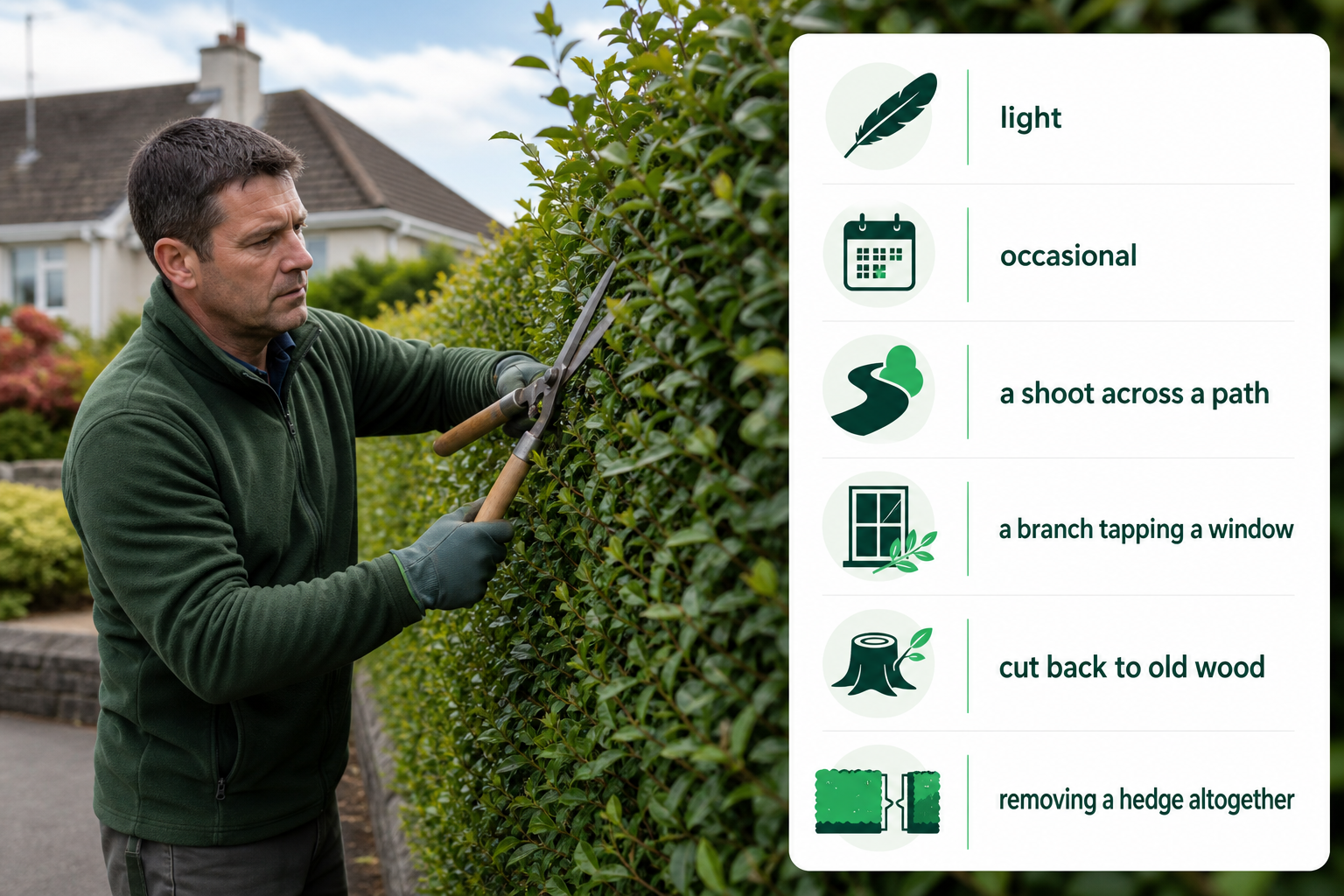
Work is easier to describe as routine garden maintenance when it is light, occasional and limited to growth causing a genuine nuisance, such as a shoot across a path, a branch tapping a window or a small amount of growth obscuring an entrance. It is also easier to defend when it is done with hand tools rather than heavy machinery, and when it stops immediately if a nest turns up.
Work moves away from routine maintenance when it becomes structural or heavy: cutting a hedge back to old wood, removing a hedge altogether, burning cuttings during the closed season, or reshaping a long native line in the middle of the breeding months. Those acts sit much closer to the destruction the closed season is designed to prevent.
Some homeowners would rather hand the shaping work to someone else, and outdoor tasks of this kind sit under home services on ShamFix.
How to trim tidily without disturbing nesting birds
Even in the open season, tidiness and wildlife care go together, and a few minutes of checking saves trouble later.
Walk the hedge from end to end before starting. Look for nests, old and new, and watch for birds carrying food, calling in alarm or slipping in and out of the foliage. Birds do not all follow the same timetable, and some species will nest earlier or later than the main season, so a hedge that looks quiet from the kitchen window may not be quiet at all.
If an active nest turns up, stop work on that section and leave a generous buffer around it. Trim elsewhere if the rest of the hedge needs attention, then return to the section once the young birds have fledged and the nest is empty. Hand shears and loppers are quieter and more precise than a powered trimmer, which makes them the better choice close to a nest.
For a tidy finish, work in stages rather than trying to bring the whole hedge down to its final line in one pass. Cut the top first and then the sides, keeping the base slightly wider than the top so light reaches the lower growth. Step back every few metres to check the line. Avoid cutting into old wood on species that do not regrow from it, and leave trimming on frosty days for another time, when cut stems are less exposed.
Leave a section or two of a native hedgerow uncut where space allows. A mix of heights and densities gives birds, insects and small mammals food and shelter, and it costs nothing in tidiness. Clean tools between hedges to reduce the risk of spreading disease, and dispose of cuttings responsibly rather than burning them during the closed season.
Shared boundary hedges: check ownership before cutting
A hedge on or near a boundary may not belong to one household alone. It could be owned outright by one neighbour, held jointly, or planted on the neighbour's land. Before any work starts, ownership should be checked. Title deeds, land registry maps and the documents from the purchase are the usual starting points, and if they are unclear, the neighbour is the next step.
Cutting a hedge that belongs to someone else without agreement can turn a small gardening job into a long-running dispute, and the roots and main trunk may belong to the neighbour even where the growth leans into another garden. Where a hedge is genuinely shared, it is worth agreeing what will be cut, when it will be cut and who will carry out the work, and putting that agreement in writing if the job is a substantial one.
The legal season does not change because a hedge sits on a boundary. If the hedge runs along a public road and there is a risk to road users, the health and safety exemption may come into play, but that is a reason to deal with a specific danger rather than a reason to skip the ownership question. Checking first protects both sides of the boundary.
Planning the hedge trimming year
A simple plan keeps a hedge in order without running into the closed season.
For native hedgerows, late winter is the most useful slot. Cut before the end of February to remove the previous year's growth ahead of nesting, or use early September once the breeding season has passed. Avoid March through August unless a genuine health and safety risk has to be dealt with. A native hedgerow usually does not need cutting every single year, and cutting sections in rotation leaves flowers, berries and shelter in place for wildlife.
For formal garden hedges, the calendar is more flexible, but the same caution applies. Light tidying of a garden hedge can be done outside the main season where it is ordinary maintenance and does not disturb nesting birds, while a harder cut is best kept for the open season. Little and often is easier than letting a hedge grow out of shape and then cutting it back hard.
A quick check for nests should come before every session, whatever the month, and any work that turns up an active nest should pause until the hedge is quiet again.
Keeping a boundary neat within the rules
Trimming at the right time of year keeps a boundary tidy and leaves nesting wildlife undisturbed. The open season from 1 September to the end of February is the safe default, with light routine attention to a formal garden hedge possible in between only where the work is genuinely ordinary maintenance and no birds are nesting. Homeowners who want to see how hedge work fits alongside other household jobs can start from the ShamFix home page.
FAQ
What should a homeowner do if a hedge has to be cut in June for safety reasons?
Deal with the specific danger and nothing more. A sightline blocked at a junction, or growth that creates a real risk on a public road, is the kind of case the health and safety exemption is aimed at, but the work should be kept to the minimum needed to remove that risk. Reshaping or reducing the whole hedge can wait until September.
Can a formal garden hedge be trimmed in spring?
Light tidying can sometimes be done outside the main season, but it should be genuinely routine and it should never disturb a nest. Any heavier cut, and any work on a line of native species, is better left for the open season. Five minutes of watching the hedge from a distance will usually show whether birds are using it.
Who is responsible for a hedge on a shared boundary?
Responsibility follows ownership, and ownership is not always obvious from which side the growth leans. One household may own the hedge, or it may be jointly owned, or it may sit on a neighbour's land entirely. Where the position is unclear, the sensible order of events is to read the title documents, speak to the neighbour, and only then decide who cuts what.
How can a hedge be checked for nests without disturbing anything?
Watch from a few metres away for several minutes rather than pushing hands into the foliage. Look for birds entering the hedge with nesting material or food, listen for alarm calls, and note any dense patches of growth where a nest could be hidden. If there is any doubt at all, delay the work rather than risk the nest.