Best Time to Prune Shrubs: An Irish Month-by-Month Guide
Prune at the right time and shrubs flower better and stay healthy — a plain guide to old wood, new wood, evergreens and deciduous shrubs.
/8 min read
Most garden shrubs in Ireland are pruned at one of two times, and the shrub itself decides which. Spring-flowering shrubs are cut back straight after they finish flowering, while shrubs that flower on growth made in the same season are pruned in the dormant period or in spring and early summer. Evergreens sit slightly apart, trimmed once the risk of hard frost has passed rather than in midwinter. Where a shrub has grown too large to manage by hand, a landscaping and garden design service can take on the reshaping.
When to prune: the rule that decides everything
Two questions settle the timing of every shrub in an Irish garden: does it flower on wood grown in a previous season, or on shoots that grow in the same year?
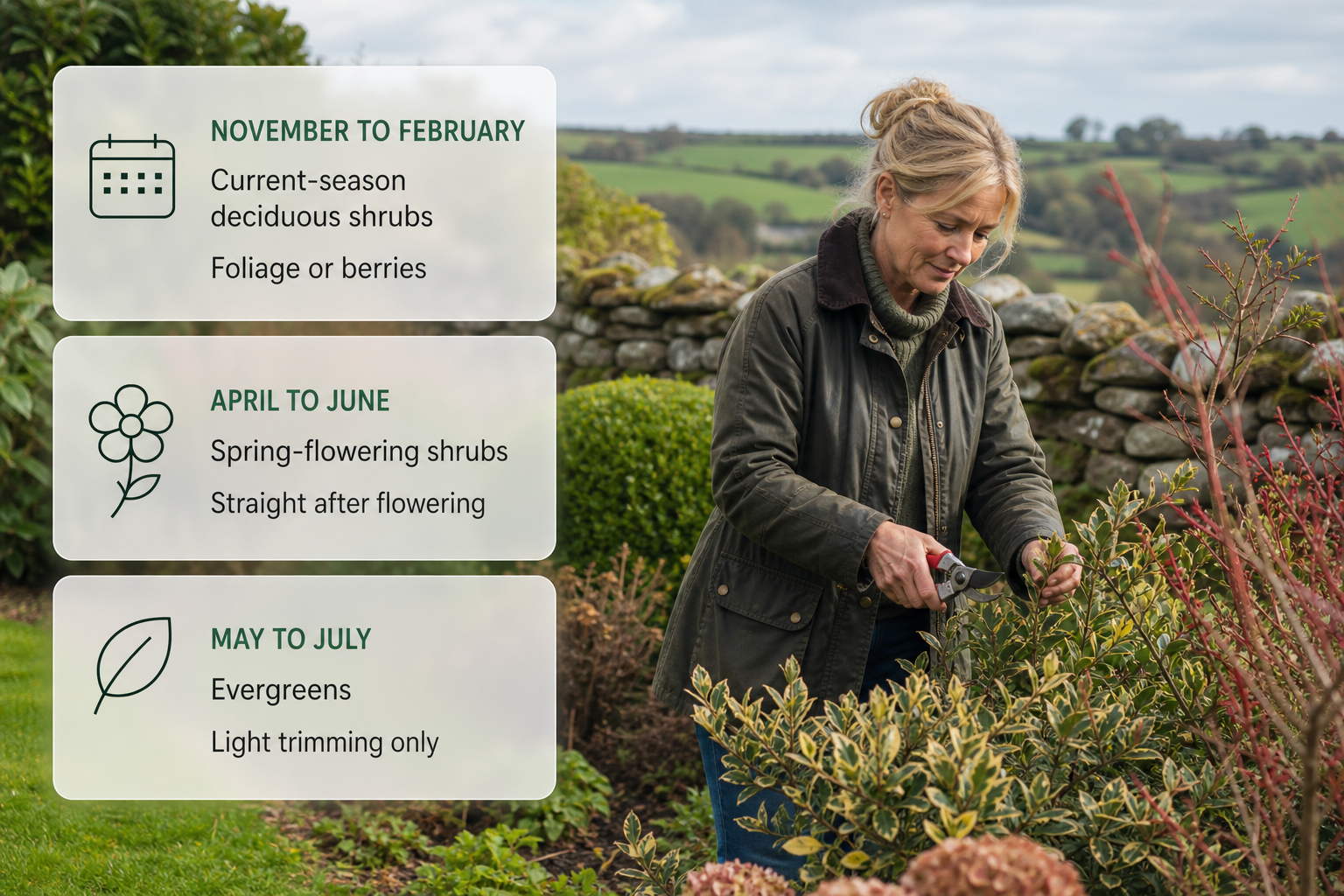
For shrubs flowering on current-season growth, pruning can be done during the dormant or spring/early summer period, but the later the cut, the more flowering is delayed (Teagasc). Shrubs that usually flower in spring should not be pruned in the dormant season from November to February, because the flowering shoots would be removed along with the cut growth (Teagasc).
Shrubs grown mainly for foliage or coloured stems follow the same logic as current-season flowerers: cut them while dormant, when the shape of the plant is easy to read and there are no buds to lose.
A month-by-month pruning guide for Irish garden shrubs
The table below assumes a mixed garden of ornamental shrubs. Gardens on high ground, in frost pockets or along the coast run a week or two behind the milder south and east, so treat these months as windows rather than fixed dates.
Time of year
What to prune
Why it works
November to February
Deciduous shrubs that flower on current-season growth — buddleja, Hydrangea paniculata, caryopteris, summer-flowering spiraea, potentilla and hypericum — plus deciduous shrubs grown for foliage
The plant is dormant and holds no flower buds from the previous year
March
Finish dormant-season cuts before the buds break; cut dogwood and willow hard for the coloured stems that show next winter
Growth is slow, so the shrub rebuilds quickly
April
Spring-flowering shrubs the moment the flowers fade — forsythia, flowering currant, kerria and chaenomeles
Next year's flowers form on the shoots made this summer
May
Light trimming of evergreens such as box, euonymus, hebe and lavender, once the last hard frost has passed
New growth knits over the cuts well before winter
June
Philadelphus, weigela, deutzia and lilac as the flowers go over; deadhead repeat-flowering roses
The shrub gets a full season to build flowering wood
July
Deadhead and tidy summer shrubs; trim lavender after flowering, staying within the leafy growth
Keeps the plant compact without pushing soft growth into autumn
August
Light shaping only; remove faded flower heads
A hard cut now pushes tender growth that frost will scorch
September
Final tidy — long whips, dead wood and spent flower stems
The shrub needs time to harden off before winter
October
Only dead, damaged or diseased wood
Wounds heal slowly and new growth will not harden
How to tell whether a shrub flowers on old wood or new wood
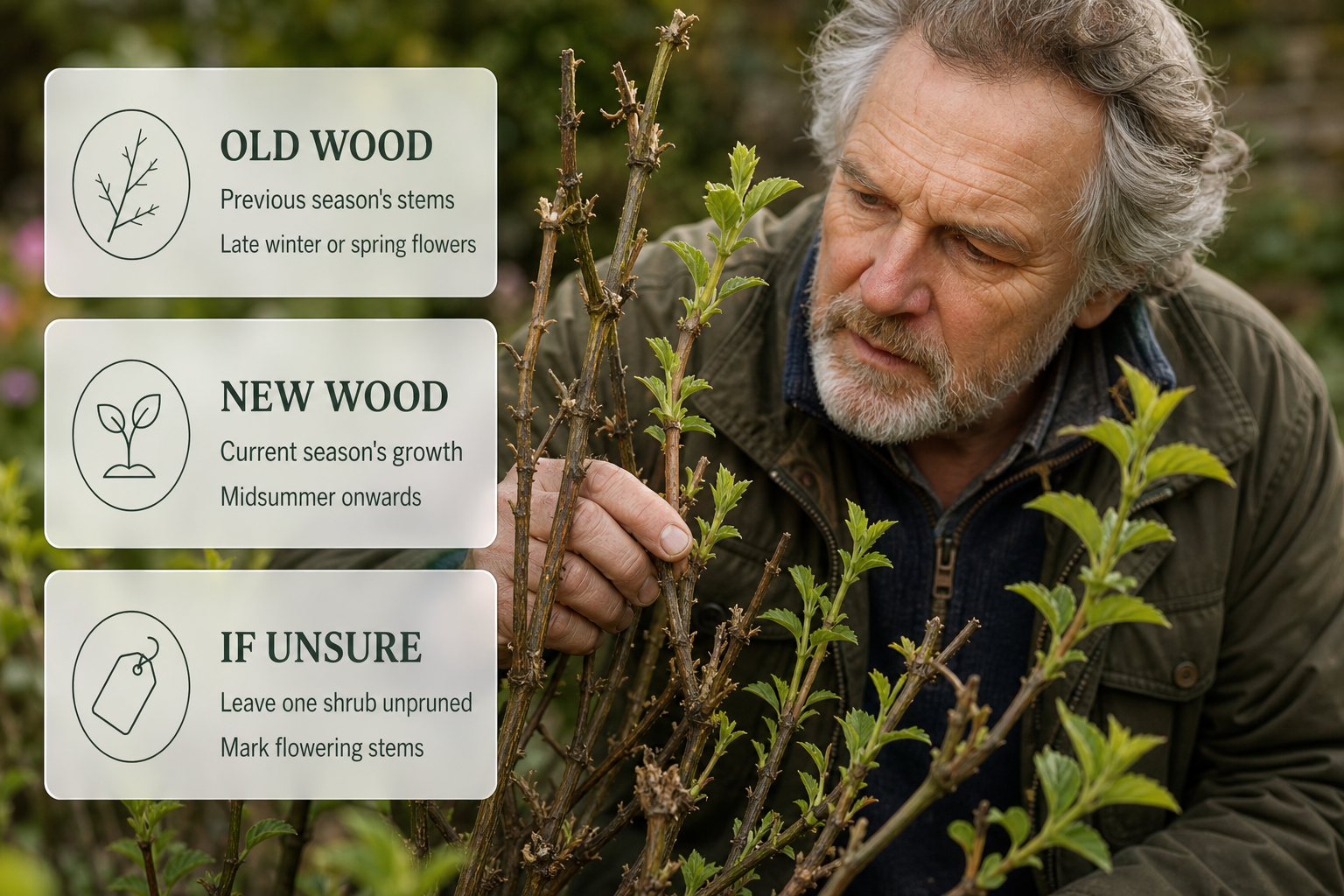
Old wood means stems grown in a previous season. The clearest sign is timing: flowers open on bare stems in late winter or spring, before or around the same time as the leaves, and the buds are visible along the older stems through the winter months. Those stems are thicker, duller and rougher than last summer's soft green shoots.
New wood means growth made in the current season. Flowers appear from midsummer onwards at the tips of shoots that only grew that spring, and those shoots are thin, flexible and green when the flowers open.
If you are unsure, leave one shrub unpruned for a full year and watch it. Mark the stems that carry the flowers with a twist of garden string. If those stems were already on the plant in January, the shrub flowers on old wood and should be pruned straight after flowering. If the flowering stems did not exist until April or May, it flowers on current-season growth and can be cut while dormant, accepting that a late cut delays the flowers.
Shrubs that should not be cut in the dormant season
Spring-flowering shrubs hold next spring's buds on the stems all winter, so the pruning window is the four to six weeks after flowering, once the old blooms have gone over but before the new shoots harden. In an Irish garden that group includes forsythia, lilac, philadelphus (mock orange), flowering currant, kerria, chaenomeles (Japanese quince), deutzia and weigela, as well as evergreen and semi-evergreen flowerers such as camellia, rhododendron, azalea, pieris and magnolia.
A light tidy of dead, damaged or broken stems is safe at any time of year; it is the removal of healthy flowering wood that costs a season of colour. If a spring-flowering shrub has been cut by mistake, leave it alone for the rest of the year and prune it in the weeks after flowering the following spring.
Evergreen versus deciduous: why the timing is different
Evergreens keep their leaves and keep working through the winter, healing more slowly than deciduous shrubs. Trimming them in the cold months can leave foliage scorched and the cuts open to frost damage, so the work belongs in late spring or early summer, once growth is moving. Trimming an evergreen is slow, careful work, and it is one of the jobs that sits alongside the wider home services Irish households arrange around the house and garden.
Deciduous shrubs lose their leaves, which gives the clearest possible view of the branch structure in winter and is why so much pruning happens then. There is a second difference worth remembering: most deciduous shrubs break again from old wood and come back strongly after a hard cut, while conifers and many evergreens will not reshoot from bare, leafless stems, so they must never be cut back beyond the green growth.
Winter: the easiest window for most deciduous shrubs
Winter is a good time to prune most deciduous trees and shrubs because the leaves have fallen and the canopy is easier to see (Teagasc). In practice, work through a deciduous shrub in a set order: dead, damaged and diseased stems first, then any stems that rub or cross, then the oldest and thickest stems cut back towards the base to open up the centre of the plant. Choose a dry, mild spell rather than a hard frost, and leave tender shrubs such as fuchsia until growth restarts in spring.
Bird nesting season and biodiversity
Vegetation cutting is strongly encouraged outside bird nesting season, because nesting birds, their nests and their eggs are legally protected (Department of Housing, Local Government and Heritage). Before any sizeable shrub cut, look inside the branches for an active nest. If you are unsure how current guidance applies to your garden, confirm it with the responsible Irish authority.
There is a biodiversity dividend too. Seedheads left on a shrub over winter feed birds, berries disappear by February if nothing else is available locally, and a plant cut back hard in autumn offers nothing at all. Stagger the work across beds and across years rather than cutting everything in one tidy sweep, and leave one or two shrubs loose and open enough for birds to move through.
Overgrown and neglected shrubs
A shrub that has not been touched in years can usually be brought back, but the approach depends on what it is. Renovate in stages over two or three years: take out roughly one third of the oldest stems at the base in the first year, another third in the second, and the remainder in the third, thinning rather than shearing the whole plant at once. Feeding and mulching after each cut helps the shrub push new growth from the base.
For evergreens, renovate lightly and gradually, and never cut into old bare wood on conifers, which will not green up again. If the shrub is too large or too tangled to cut safely, or the volume of material is more than a household can handle, it is sensible to hand the job to someone used to working with overgrown planting.
Getting a large shrub back into shape
Where a border has become a wall of tangled growth, help is worth considering. Posting a job and listing it on ShamFix is free and no commission is charged. A subscription is planned for the future. ShamFix does not check or certify tradespeople, and profiles are filled in by tradespeople themselves, so homeowners should check registrations themselves and read reviews before agreeing any work.
FAQ
Can I prune shrubs in October in Ireland?
October is a month for restraint. Remove only dead, damaged or diseased stems, and leave structural cutting until the leaves have fallen and the plant is fully dormant. Evergreens in particular should wait for late spring. Any soft growth pushed by an October cut is unlikely to harden before the first hard frost.
Do all shrubs need pruning every year?
No. Many shrubs are better left alone for two or three years and given only a light tidy in between. Young plants in particular need little beyond the removal of dead or crossing stems. Frequent light trimming keeps an evergreen dense, whereas a hard annual cut on a flowering shrub usually reduces the flowers.
Is it safe to cut a shrub right down to the ground?
Some deciduous shrubs, buddleja and dogwood among them, come back well from a hard cut. Most flowering shrubs are better renovated in stages over two or three years. Evergreens and conifers generally will not reshoot from bare wood, so they must not be cut back beyond the green growth, and any hard cut should wait until nesting season is over.
What is the worst time to prune a shrub?
Mid-autumn and the middle of a hard frost are the two times to avoid. An autumn cut pushes soft growth that winter will damage, and frozen stems shatter and tear rather than cutting cleanly, leaving a wound that heals badly. A mild, dry spell in the dormant season, or the weeks straight after flowering, is far kinder to the plant.