Best Time to Lay Turf in Ireland: A Homeowner Guide
Early autumn suits most Irish gardens, with spring a close second — here is how weather, soil and aftercare decide when new turf takes hold.
/8 min read
For most Irish homeowners the best time to lay turf is early autumn, when soil that has been warmed through summer is still workable and rainfall turns more dependable. Spring is the next best window and suits gardens that lie wet through the back end of the year, though it is the slower of the two because cold soil slows rooting. The deciding factor is rarely the date itself: new turf needs warmth below it and moisture above it, and where preparing or re-levelling a garden is more than a weekend job, homeowners can bring in help with landscaping and construction services to get the ground right first.
Why early autumn usually suits Irish gardens better than spring
Autumn gets the edge for three practical reasons. The soil still holds summer heat, so roots move into it quickly. The air has cooled, so the leaves lose far less moisture than they would in high summer. And rain tends to arrive more often just as new turf needs it most, which takes the pressure off watering.
A lawn laid in early autumn also has mild growing weather ahead of it before growth slows for winter, so it knits into the soil and comes into spring already anchored. The broad seasonal rhythm behind that is the same one Teagasc describes for grassland: reseeding is planned so that by the spring of the first year after sowing there is a full, dense ground cover (Teagasc). A garden lawn is smaller and finished to a different standard than a paddock, but the aim is identical — roots in the ground before winter, a full lawn the following spring.
Spring is not a bad choice, only a slower one. Soil that has been cold for months warms slowly, so rooting is sluggish, and a dry, breezy spring can dry new turf out before it has taken hold. The payoff is that a spring lawn has the whole growing season in front of it, which suits homeowners who want the garden in use that summer. Where autumn ground is waterlogged or shaded and stays wet, spring is usually the better bet.
The weather and ground conditions that decide the day
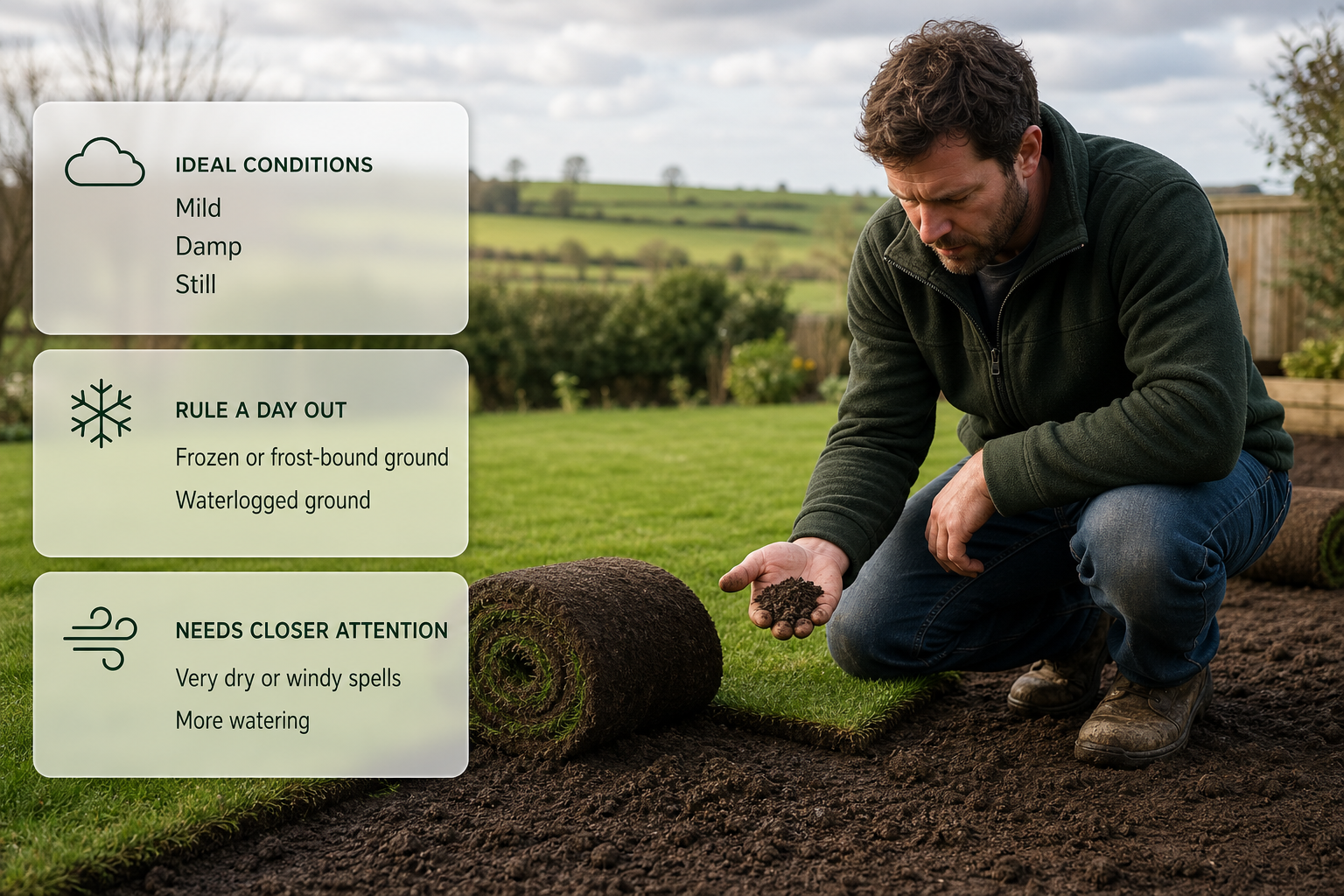
Ideal laying conditions are mild, damp and still. Light drizzle, soft cloud and little wind are close to perfect, because turf stays moist from the moment it is unrolled.
Cool temperatures are an advantage rather than a problem. A mild, damp day suits new turf far better than a hot, bright one, and what happens under the turf matters more than what happens above it.
Conditions to avoid:
Frozen or frost-bound ground. Turf laid on frozen soil cannot root, and the surface shifts as the ground thaws.
Waterlogged ground. If footprints fill with water or soil smears into a paste, working it damages the structure and the turf sits in a puddle. Waiting costs less than laying into a swamp.
Very dry or windy spells. Sun and wind pull moisture out of turf quickly and dry the exposed edges first. Exposed coastal and hillside gardens, where wind is constant, dry out fastest and need the closest attention.
Frost and waterlogging are the two conditions that genuinely rule a day out. Dryness and wind do not, but they mean more watering and a closer eye on the new lawn.
Irish weather varies more by week than by county, so the practical approach is to watch the forecast rather than the calendar. A damp, mild week within the autumn window is a better laying day than a bright, breezy one, wherever in the country the garden sits.
Preparing the ground before the turf goes down
Ground preparation decides whether the lawn knits together or stays lumpy, and it is where most of the work sits.
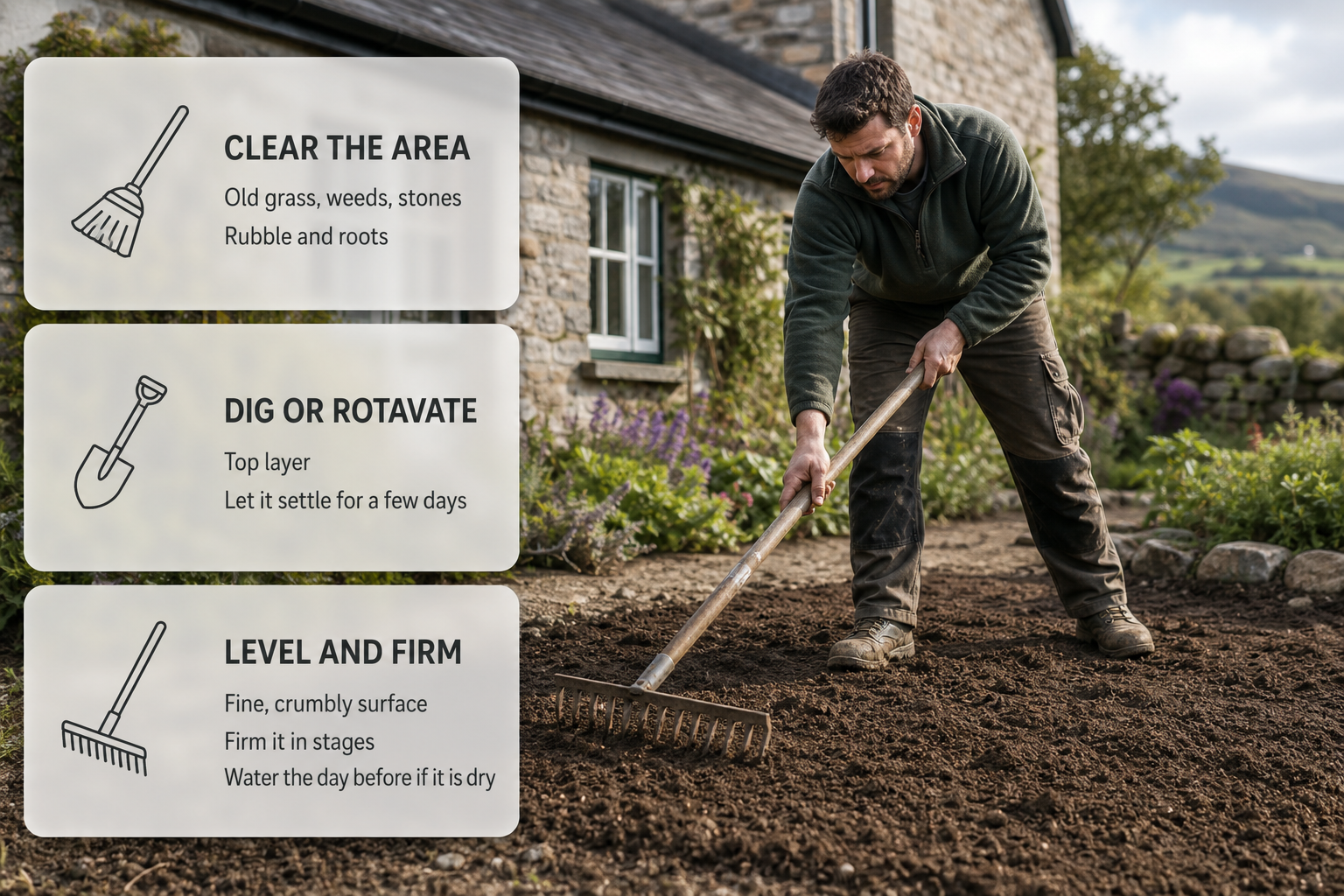
Clear the area of old grass, weeds, stones, rubble and roots. Perennial weeds left in place will push back through new turf.
Dig or rotavate the top layer, then let it settle for a few days.
Level and firm. Rake to a fine, crumbly surface, then firm it in stages, by heel or roller, so the finished surface is even and does not sink later.
Water the prepared ground the day before laying if it is dry. Damp soil under the turf helps roots move into it.
For larger jobs such as stripping an old lawn, importing topsoil or re-levelling a sloped garden, homeowners often bring in help with construction and home renovation rather than doing it all by hand.
Laying the turf itself
Lay the first roll along a straight edge, such as a path or a board, and work across the area. Butt the joints tightly together without stretching or overlapping them, and stagger the joins between rows like brickwork so long seams do not line up. Trim the edges with a sharp knife or half-moon edger as you go.
Work from a plank laid over finished turf rather than walking on it. Once a section is down, firm it gently with a light roller or the back of a rake so the underside of the turf makes contact with the soil. Water as the rolls go down, particularly in warm or breezy conditions, so the turf never sits dry between laying and the first proper watering.
When the turf cannot be laid straight away
Rolled turf is living grass and starts to suffer once it is cut and stacked. It is best to have the ground ready before delivery so the rolls go down as soon as they arrive rather than sitting around.
If a delay is unavoidable:
Keep the rolls in shade, in a single layer rather than a tall stack, and never on a hard, hot surface such as paving or tarmac.
Stand the rolls on their edges, loosely, or unroll them loosely so air can move through. A tight, warm heap heats up and yellows quickly.
Keep them damp, checking the underside of the rolls as well as the top.
If the delay stretches over several days, unroll the turf on the prepared ground or another shaded, flat, damp surface and keep it watered until it can be laid properly.
Turf that is unrolled, shaded and kept damp is far more tolerant of a wait than turf left rolled in a stack.
Watering and aftercare until the lawn is established
Water immediately after laying, and keep the soil beneath the turf damp until roots have grown down into it. The test is simple: lift a corner of turf gently. If it grips and resists, it is rooting; if it peels away easily, it needs more water. Early morning or evening is the best time to water, because less is lost to evaporation, and on exposed or windy sites it is worth checking the edges and joins first, as they dry out soonest.
Keep foot traffic off the new lawn while it establishes. Children, pets, furniture and footballs should wait until the turf grips when lifted. In mild, damp growing conditions that takes a matter of weeks; in a cold spring it takes considerably longer.
Mow for the first time once there is clear new growth, with the mower blades set high and sharp and only when the surface is dry. Take a little off at a time rather than scalping the new lawn.
Once a lawn is established, the advice changes. The Government of Ireland's climate action guidance for homes says not to water a lawn, because grass survives long dry spells and recovers quickly with the next rainfall (Government of Ireland). That applies to a mature lawn with a deep root system, not to new turf, which has no established roots to fall back on.
Turf or reseeding: two different jobs
Laying turf is not the same as sowing seed, and the two run to different timetables. Turf is already-grown grass lifted in rolls: it needs moisture and firm contact with the soil, but it does not have to germinate. Seed has to sprout, which takes time and leaves it exposed to birds, washout and drying out.
Seed also has a narrower window. Teagasc notes that most grassland reseeding in Ireland traditionally takes place in autumn, mainly in August and September, and that the aim is to have ground reseeded before the first week in September (Teagasc). That is farm grassland advice about sowing seed rather than laying turf, but it is a useful reminder of how quickly the growing season closes. Rolled turf can be laid later in the year than seed can be sown in a garden, provided the ground is not frozen or waterlogged and the weather stays mild, though late laying leaves less growing time before winter and a thinner-looking lawn the following spring.
Getting the timing right
The short version: early autumn is the best time to lay turf for most Irish homeowners, spring is a solid alternative, and the soil and the forecast should decide the exact day rather than the calendar. Ground that is frozen, waterlogged or blowing a gale is worth waiting out, because a short delay costs far less than a lawn that never knits.
For homeowners who would rather hand the job over, posting a job and listing on ShamFix is free and there is no commission, with a subscription planned for the future. ShamFix does not check or certify tradespeople; profiles are filled in by tradespeople themselves, so homeowners should check registrations themselves and read reviews before hiring.
FAQ
Is autumn really better than spring for laying turf?
For most gardens, yes, mainly because the soil is already warm while the air has cooled. That combination lets roots grow without the leaves losing much moisture. A spring-laid lawn can catch up fully by summer, but it needs more watering early on and is more exposed to a dry, breezy spell before it has rooted.
Can new turf be laid over an old lawn?
Not for a lasting result. Old grass, thatch and weeds left underneath compete with the new turf for water and can push through it, and the surface stays uneven. Stripping the old lawn and preparing the soil first gives a far better finish, even though it adds time to the job.
Is late autumn too late to lay turf?
It is the riskiest part of the season. Once growth slows and frosts arrive, turf roots very little and sits through winter on soil it has barely gripped. A garden laid very late in the season may look thin and patchy until growth restarts, whereas the same garden laid a few weeks earlier in mild, damp weather would be anchored before winter.
How long before the new lawn can be walked on?
Judge by the turf rather than the calendar. Once a corner lifts with resistance and the seams have closed over, light foot traffic is generally fine; heavier use, pets and furniture should wait until the lawn is fully knitted. Cold weather slows rooting, so a spring lawn may need longer than an autumn one.
Should new turf be fed straight away?
Feeding is best left until the turf has rooted and is growing strongly, because early on the priority is moisture rather than growth. Once the lawn is established, a balanced feed at the start of the growing season is the usual approach.