ShamFix
Back to insights

Artex Removal Cost Ireland: What Homeowners Pay

Artex removal cost Ireland guide with per-room and per-m² ranges, asbestos testing, the three removal routes, and how to compare written quotes.

14 min read
Artex Removal Cost Ireland: What Homeowners Pay

For an Irish home, interior Artex removal is commonly priced around €1,650 to €3,850 per room, but the asbestos test result, not the texture itself, sets the final bill. Bonded asbestos cement work may sit around €35 to €90 per m², while interior asbestos board work can reach €120 to €250 per m², on aggregate Irish market estimates.

The homeowner facing a dated swirl ceiling usually wants a simple answer: scrape it, skim it, cover it, and paint it. That approach is unsafe if the coating contains asbestos. Before anyone disturbs an older textured ceiling or wall, the sensible first step is testing, followed by a written quote that separates preparation, removal, disposal and making good.

What Artex Removal Costs in Ireland

A dated swirl ceiling can look like a straightforward plastering job. In Ireland, the bigger cost question is whether the coating contains asbestos and whether licensed removal is required. For a room with suspected asbestos-containing textured coating, a useful budgeting figure is €1,650 to €3,850 per room. The range covers interior ceiling removal and reflects the effect of survey findings, access, material condition, containment, clearance and disposal. Treat any headline price as an indicative estimate only, not a firm quote.

The three practical routes are different cost-and-risk decisions:

  • Skim over: suitable only when testing and the ceiling's condition support it. It avoids removal and disposal costs, but preparation and repairs still affect the price.
  • Full removal: the highest-risk route financially because confirmed or suspected asbestos can bring controlled work, containment, disposal and clearance requirements.
  • Overboarding: covers the existing finish and may reduce disturbance, but it adds board, fixing, jointing and finishing work. The ceiling height, access and condition of the structure still matter.

A bathroom with awkward access may cost more per square metre than a large, clear room because protection and setup take time regardless of area.

Practical rule: Compare quotes only when they state the area, chosen method, finish, testing arrangements and asbestos assumptions.

The restoration bill must be separated from the removal figure. Reboarding, plastering, stain treatment, waste handling, painting and inspection or clearance may sit outside the first price. Older ceilings may also need a structural assessment, with Irish guidance citing €300 to €600. Asbestos surveys are typically around €150 to €300 on aggregate Irish market estimates.

For local plastering and textured-coating specialists, homeowners can find plastering and Artex specialists and post your job.

Job scope Per room Per m² Notes
Interior removal where asbestos risk is confirmed or cannot be ruled out €1,650 to €3,850 Quote-specific Enclosure, controls, disposal and clearance can affect the total.
Bonded asbestos cement removal Not stated €35 to €90 Usually lower than licensed board or lagging work.
Interior asbestos board work Not stated €120 to €250 May involve containment, air monitoring and hazardous-waste disposal.

Until testing is complete, scrape-only prices are not a reliable comparison. The result determines whether the cheapest-looking route is available.

The Asbestos Question You Must Answer First

Artex and similar textured coatings can contain asbestos, particularly in older Irish properties. Sight alone can't confirm the material. A ceiling that looks harmless may still release hazardous fibres if it is sanded, drilled or scraped dry.

The Health and Safety Authority's guidance says wettable materials may be scraped only after soaking with water containing detergent. Other materials may require paint stripper before wetting and scraping. The guidance also states that sanding and grinding aren't permitted for textured coatings, while coatings on plasterboard may sometimes be cut out in sections with minimal deterioration. HSA asbestos guidance sets out these different approaches.
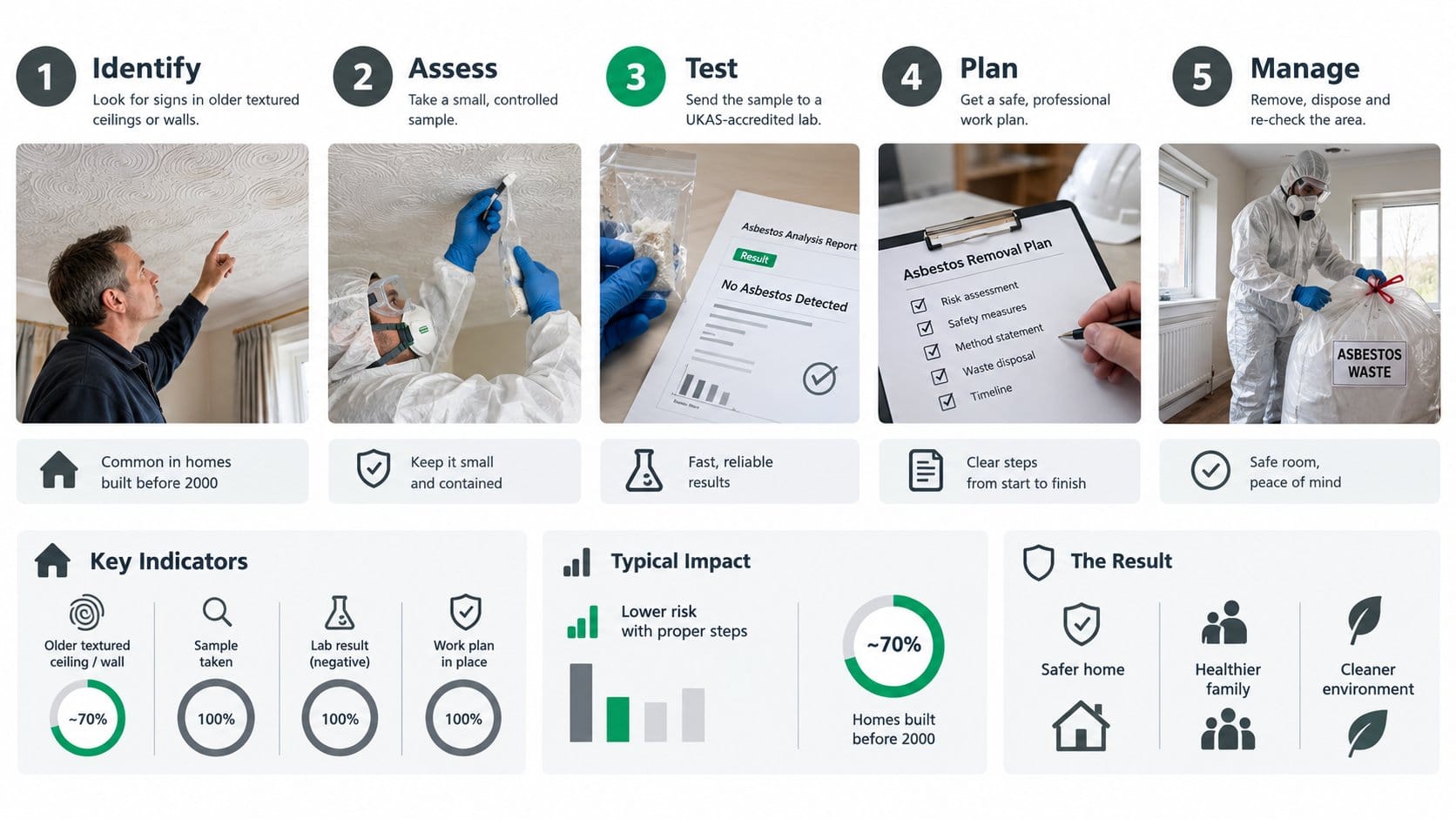
A clear five-step visual showing how homeowners safely identify, assess, test, plan, and manage possible asbestos in an

Test before the surface is disturbed

The safe sequence is straightforward:

  1. Stop work on the coating. Don't sand, scrape, drill or power-tool the surface.
  2. Arrange competent sampling. A suitably competent person should take the sample using controlled methods.
  3. Wait for the result. The contractor should quote against the result, not guess from the appearance.
  4. Choose the correct route. A sound, non-asbestos surface may be skimmed or overboarded. A positive result requires a controlled asbestos work plan.
  5. Keep the paperwork. Test results, waste records and clearance documents should stay with the property records.

Irish rules require a written plan of work before asbestos-related demolition or other work begins, and the work must be carried out by competent persons with suitable training, experience and knowledge, under the Irish Statutebook asbestos regulations. The HSA also requires advance notification for certain asbestos works.

Removed asbestos can't go into an ordinary skip. It must be placed in double plastic sacks or a suitable UN-approved asbestos waste bag, then sent through a licensed facility or authorised waste collector, as described in HSA waste-handling guidance.

A plasterer who offers to scrape an untested older ceiling has missed the most important part of the job. The homeowner should pause the work and arrange testing first.

Three Routes From Textured Ceiling to Smooth Finish

There are three practical ways to deal with an Artex ceiling or wall. They aren't interchangeable line items. Each option changes the amount of disturbance, preparation, finish work and asbestos risk.

Skim over the coating

Skimming leaves the existing texture in place and applies a new plaster finish over it. It can work where the coating is firmly bonded, the surface is stable and testing has ruled out asbestos or the contractor has selected a suitable controlled approach.

This route usually has the lowest labour requirement, but it can fail where the pattern is heavy, the surface is loose or previous water staining has weakened the substrate. The quote should state the preparation, bonding material and number of finish coats. It shouldn't say “skim ceiling”.

Remove and re-skim

Full removal takes the textured coating back to the underlying plasterboard or plaster before the surface is repaired and skimmed. The removal method depends on the substrate and material. HSA guidance refers to wet methods and, for some coatings, paint stripper before wetting and scraping. Concrete substrates can require chemical and mechanical removal using stripping fluid, gel or steam, with sanding and grinding prohibited.

Where asbestos is confirmed, the work moves beyond routine plastering. The contractor must follow the applicable asbestos controls, waste route and written plan of work. The finish may be excellent, but the compliance and making-good costs can dominate.

Overboard the ceiling

Overboarding fixes new plasterboard over the existing ceiling, followed by joint treatment and skimming. It can be sensible where the old surface is uneven or where disturbing the coating would create unnecessary risk, provided the added thickness works around light fittings, coving, doors and ceiling height.

The method doesn't remove the old material, so the existing ceiling still needs to be stable. It also requires careful fixing, especially where the substrate or joists aren't clearly known.

Factor Skim-over Full removal Overboarding
Existing coating Prepared and covered Removed Left in place
Surface disturbance Lower Highest Controlled, but fixing is required
Finish Good on sound surfaces Best where the substrate can be repaired Consistent on uneven ceilings
Main weakness Can show through or fail on loose texture Mess, labour and regulated controls where asbestos is present Reduces ceiling height and leaves the old material behind
Suitable after positive asbestos result Only where professionally assessed and controlled Potentially, with appropriate asbestos contractor Often considered where disturbance should be avoided

When comparing plastering approaches, the asbestos decision must still come from the test and the competent contractor's scope.
What Actually Drives the Price Up

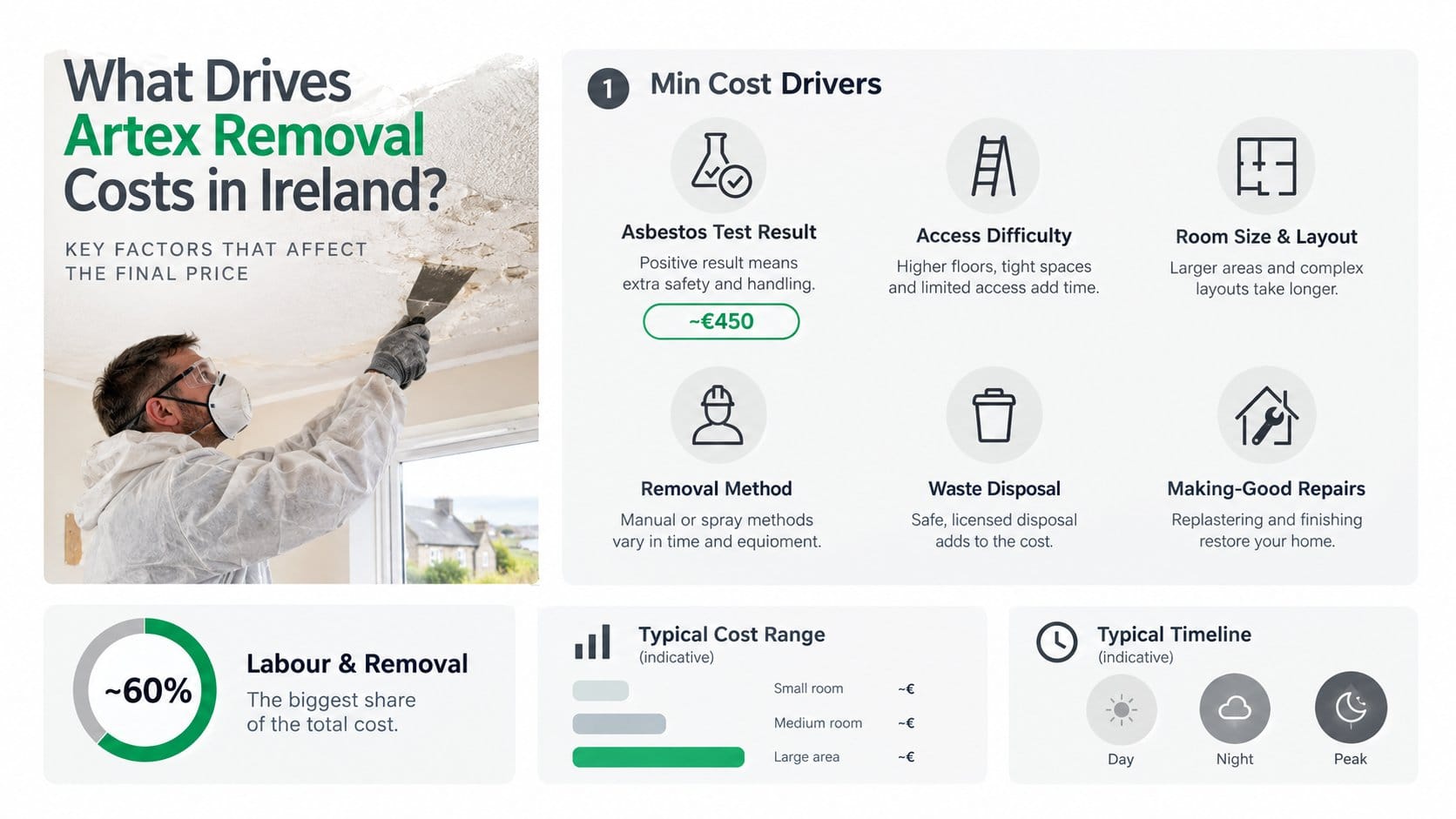
The biggest cost driver is the asbestos result. A confirmed asbestos-containing material can require specialist controls, containment, respiratory protection, air monitoring and hazardous-waste disposal. Irish guidance notes that damaged or friable material pushes costs higher because enclosure, respiratory controls and clearance testing may become necessary.

The next issue is access. A high ceiling, stairwell, tight landing or room full of furniture slows preparation and removal. Contractors also need to protect floors, fittings and nearby rooms, and those fixed tasks don't disappear because the ceiling area is small.

The price hierarchy

  1. Asbestos testing and controlled removal. The result determines whether a standard plastering quote is appropriate.
  2. Height and access. Towers, platforms, protection and slower work increase labour.
  3. Area and room layout. Larger ceilings need more material and disposal capacity, while several small rooms create repeated setup.
  4. Chosen method. Skim-over, removal and overboarding have different labour and material requirements.
  5. Waste handling. Asbestos waste requires compliant packaging and an authorised disposal route.
  6. Making good. Reboarding, repairs, stain blocking, priming, re-skimming and painting may follow the removal.

A ceiling can look like a simple flat surface while hiding damaged plasterboard, old water staining or failed previous repairs. If the coating is removed and the substrate needs repair, the homeowner pays for both the original removal and the remedial work.

A clear visual infographic for an article section about what drives Artex removal costs in Ireland, showing key price fa

A per-area rate is therefore only a starting point. Bonded asbestos cement is typically priced below interior asbestos board work because the latter can involve negative-pressure containment, double-bagging, air monitoring and hazardous-waste disposal at an EPA-permitted facility. The €35 to €90 per m² and €120 to €250 per m² benchmarks apply to those different material categories, not to every Artex ceiling.

The quote should identify whether the price covers removal only or the complete return to a decorated room. That distinction prevents the homeowner from paying twice.

Why the Cheapest Quote Often Costs the Most

A low quote often becomes expensive because it prices the visible task and ignores the risk around it. A figure for “scrape and skim” may exclude testing, waste, access, VAT, staining treatment, painting and repairs to the substrate.

Line item Cheap quote often missing Proper written quote
Asbestos status No test or an unstated assumption Test result or clear written assumption
Area and access No m² or ceiling height Measured area and access conditions
Removal method “Remove Artex” Wet scraping, specialist removal or another stated method
Waste Ordinary skip or no detail Compliant asbestos packaging and authorised disposal route
Finish One vague “skim” Preparation, repairs, coats and final finish
VAT Unclear Total price states whether VAT is included
Follow-on work Painting and repairs excluded Making-good exclusions and allowances listed

Residential renovation labour generally attracts the 13.5% reduced VAT rate, and supply-and-fit work can also fall under that rate under the two-thirds rule. The homeowner should confirm that VAT is included in the quoted total rather than assuming the displayed figure is the final amount.

A quote that doesn't name the ceiling area, disposal route or finish specification isn't a proper comparison figure. It may still be a genuine preliminary estimate, but it shouldn't be accepted as a fixed price.

A safe quote is not necessarily the lowest quote. It is the one that makes the risks and exclusions visible before work starts.

The most serious omission is asbestos. Dry-scraping or sanding a positive coating can release fibres and contaminate the work area. Professional decontamination and remedial work can then become necessary, while the health risk is far more important than the saving on the first invoice.

The homeowner should reject any contractor who treats asbestos testing as an optional extra on an older textured ceiling.

How to Compare Written Quotes the Right Way

Three quotes are useful only when they are like for like. Each contractor should receive the same photographs, test result, measurements and description of the desired finish. If one contractor prices removal and another prices overboarding, the figures don't answer the same question.

The written scope checklist

Every quote should state:

  • Measured area: The ceiling or wall area in m².
  • Access conditions: Height, stairs, furniture protection and lighting.
  • Chosen method: Skim-over, full removal or overboarding.
  • Preparation: Washing, bonding, repairs, stain treatment and protection.
  • Finish specification: Number of plaster coats, sanding, priming and painting.
  • Asbestos position: Test result, survey requirement or written assumption.
  • Waste route: Ordinary construction waste or asbestos waste, with the correct authorised route.
  • VAT: Total price and confirmation of whether the 13.5% rate is included where applicable.
  • Commercial terms: Programme, payment schedule, insurance and defects arrangements.

Phrases such as “allow for”, “as required” and “TBC on survey” need clarification. They aren't automatically unacceptable, but the homeowner should ask what triggers an additional charge and whether the contractor has included a maximum allowance.

The HSA requires asbestos work to be planned and completed by competent persons. A contractor's answer should therefore cover who will carry out the work, how the area will be controlled, what documentation will be supplied and where the waste will go.

A practical final question is: what would the tradesperson do in their own home? The answer often reveals whether the recommendation is based on the ceiling's actual condition or on the lowest headline price. A written scope should follow that conversation before any deposit is paid.

Your Action Plan and Where to Go From Here

The homeowner can make the project safer and easier to price by following a fixed order.

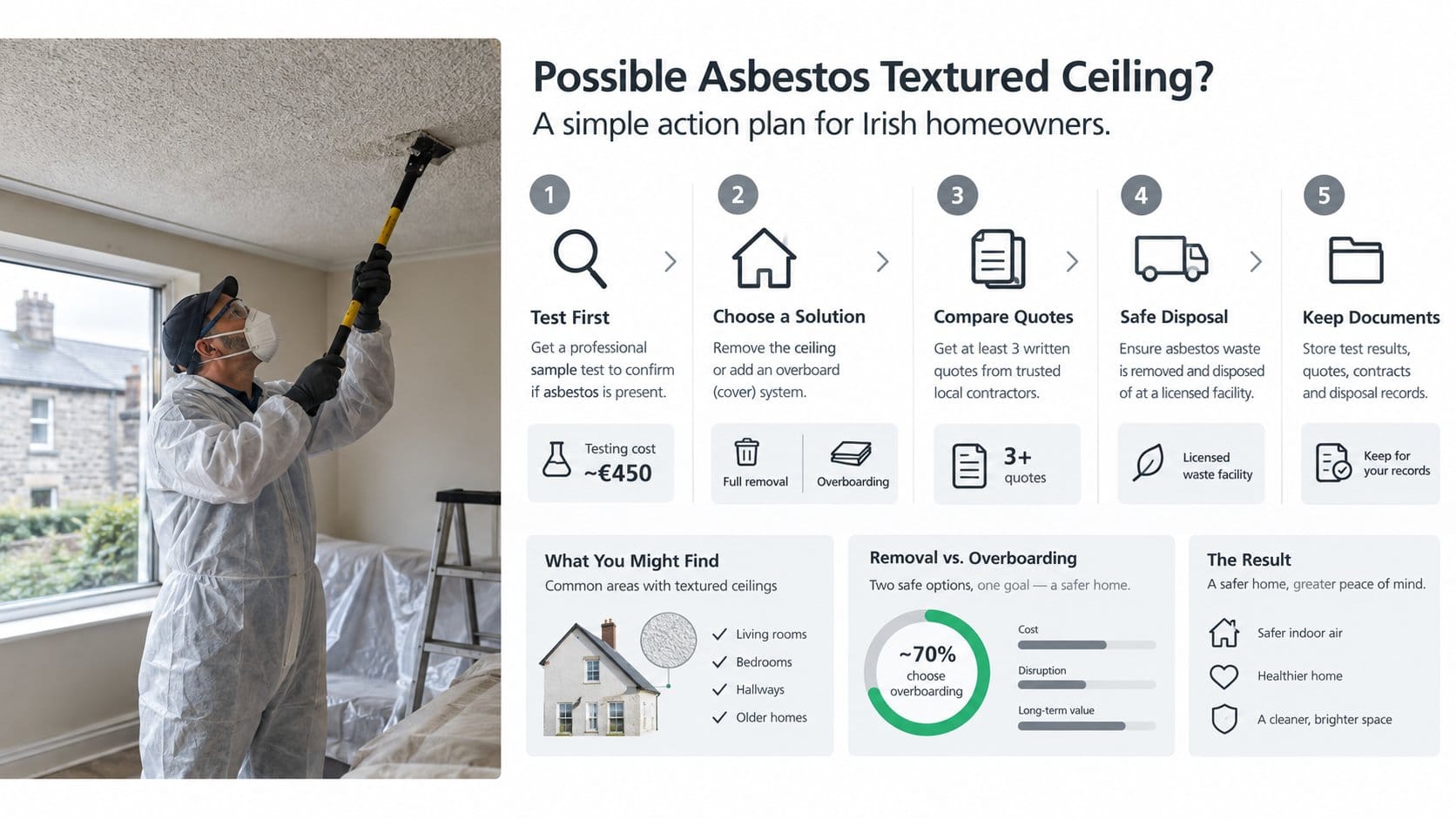
  1. Commission testing first. Keep the ceiling untouched until the result is available.
  2. Choose the route afterwards. Decide between covering, removing or overboarding based on the material, substrate and intended finish.
  3. Obtain like-for-like quotes. Give each contractor the same measurements and test documentation.
  4. Separate every cost. Ask for testing, labour, materials, disposal, making good and VAT as distinct lines.
  5. Keep the records. Store the test certificate, written scope, waste documentation and completion paperwork.

A whole-house asbestos survey may make more sense where several rooms will be renovated. A full re-skim, wall repairs or a wider room renovation can also turn a ceiling job into a broader construction project. For wider construction and renovation work, homeowners can find tradespeople and post a task.

A practical homeowner action plan for dealing with a possible asbestos textured ceiling in Ireland, showing a clear step

The correct next step isn't booking the cheapest scraper. It is arranging the asbestos test, then asking competent contractors to price the same safe method with disposal and making good clearly included.

Homeowners can use how ShamFix connects Irish homeowners with local providers to identify local options and route an enquiry, while checking each provider's credentials, insurance and asbestos competence directly. The platform's two-sided review principle gives customers and providers the opportunity to rate and review each other after a completed job, but matching an enquiry is not a quality guarantee.


For an Artex ceiling or wall, start by arranging the asbestos test before disturbing the surface, then use the written result to request comparable quotes. Posting the job on ShamFix connects you with local Irish providers for the plastering, overboarding or wider renovation work that follows.

Keep reading