A washing machine stops halfway through a cycle in a Malahide terrace. A fridge-freezer loses its cooling overnight in a Dublin city-centre flat after a storm. A gas hob clicks repeatedly but won't light in a Lucan kitchen just before dinner. These failures disrupt the household immediately, but they don't automatically mean the appliance belongs in a skip.
Ireland already has a substantial repair economy. A 2022 WEEE Ireland survey recorded 138,746 repair requests across surveyed home-appliance producers and associations in 2020, with 132,767 products repaired, or about 95% of requests. The same survey estimated roughly 500 full-time employees worked in repair and after-sales services across Ireland. The WEEE Ireland White Goods Repair Data Project shows that appliance repair is an established service, not a niche favour from a local handyman.
This guide gives Dublin homeowners a practical way to handle the whole job. It covers safe pre-call checks, the four fault families repairers commonly encounter, quote and call-out pricing, repair-versus-replace decisions, RGI and Safe Electric rules, choosing a technician, and the legal position when a repair fails. The aim is simple: understand the problem before paying for a visit, and know what the trader must do afterwards.
When the Appliance Dies Mid-Routine in a Dublin Home
A stopped washing machine leaves wet clothes locked behind the door. A dead oven can ruin an evening planned around dinner. A warm fridge creates a more serious concern because food may spoil while the owner is still deciding whom to call.
The first response should be calm and methodical. Many breakdowns need a professional, but some apparent faults come from a tripped electrical supply, a blocked filter, a closed-off valve, an incorrect setting or a door that isn't sealing. The checks below are safe only when they involve external controls and accessible parts.
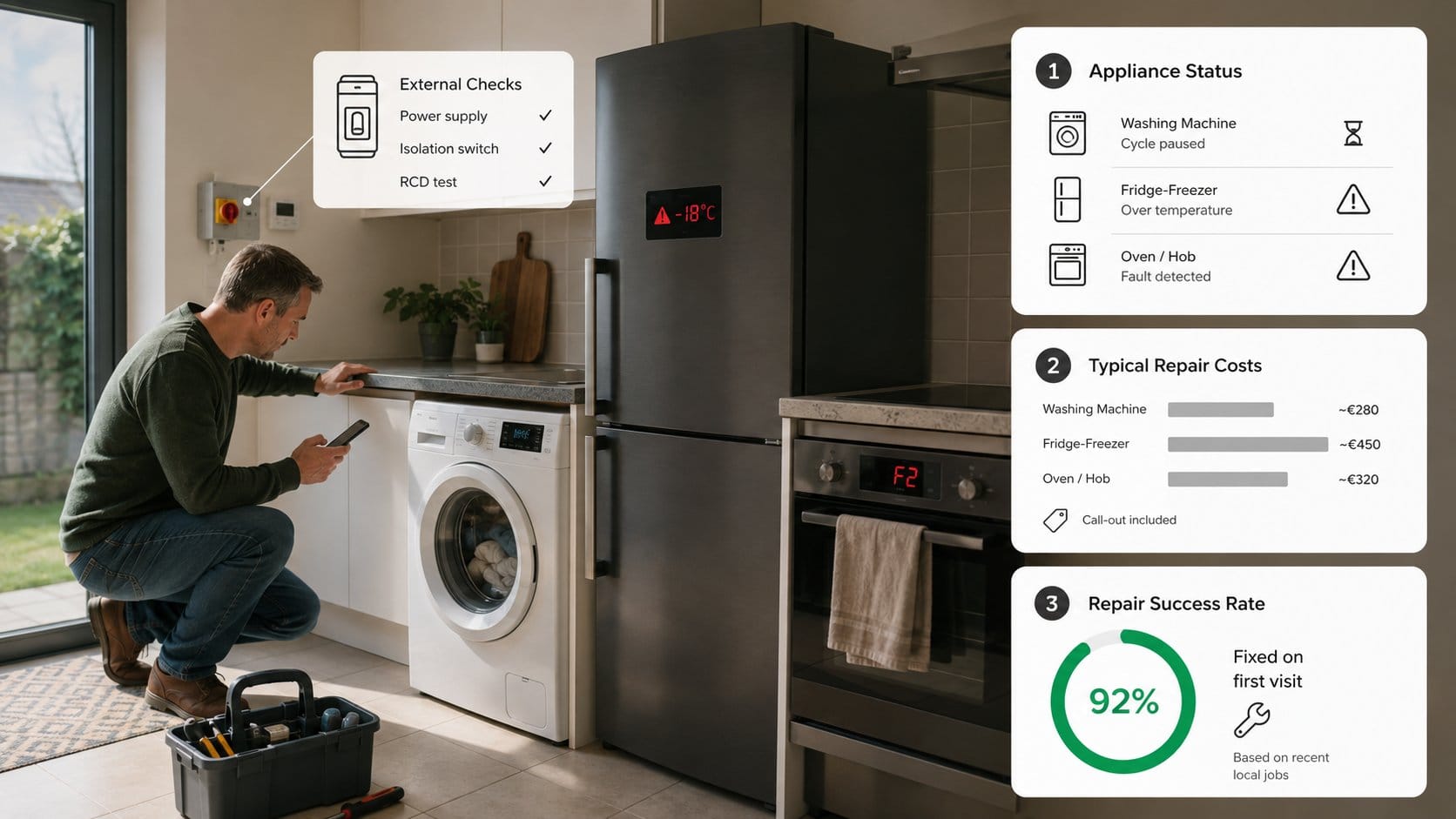
The ten-minute pre-call check
Confirm the socket works. Plug in a known-working appliance or use a socket tester. Check whether the consumer unit has tripped and reset the RCD if appropriate. A blown plug fuse can be replaced only with the correct type and rating.
Inspect the outside of the plug and cable. Don't use the appliance if the flex is worn, cut, scorched or loose. Electric Ireland's home electrical safety guidance advises professional repair for faulty appliances and warns against using damaged flexes.
Check a washing machine's simple causes. Look at the inlet hose, drain hose, drain filter and door interlock. A blocked filter can stop draining, while a door that hasn't latched can prevent the cycle from starting.
Check the dishwasher externally. Clear the accessible waste trap, confirm the water supply is open and inspect the spray arms for visible blockage. The salt reservoir should contain the correct dishwasher salt, not table salt or detergent.
Check the oven settings. Confirm the clock, timer delay, temperature setting and child lock. Some electric ovens won't heat after a power interruption until the clock is reset.
Check the fridge-freezer basics. Make sure the door closes fully, the seal sits evenly and the temperature dial hasn't moved. Dust around accessible condenser areas can restrict ventilation, but panels shouldn't be removed.
Practical rule: External checks are sensible. Opening the casing is not.
A homeowner must stop at the boundary of accessible maintenance. Internal electronics, wiring, refrigeration refrigerant lines and gas connections require professional attention. A gas cooker or hob fault must go to an appropriately registered gas professional, and a homeowner shouldn't try to make the appliance safe by dismantling it.
Homeowners can see how it works when comparing the process of posting a local service request, but the safety decision remains straightforward. If there's a burning smell, scorching, sparking, a damaged cable, a gas smell or repeated tripping, switch the appliance off and arrange qualified help.
Common Appliance Faults Dublin Repairers See
The most familiar Dublin call-outs involve appliances that combine water, heat, motors and electronic controls. National repair data show that large household appliances generate meaningful repair activity across Ireland.
| Appliance family | Common faults | Typical cause |
|---|---|---|
| Washing machines | Drain pumps, bearings, door locks and control boards | Blocked drainage, wear in moving parts, failed interlocks or electronic faults |
| Dishwashers | Drainage, heating elements, circulation pumps, solenoid valves and spray arms | Food debris, scaling, pump failure, water-inlet problems or heater faults |
| Ovens | Heating elements, timers, printed circuit boards and thermocouples in gas units | Element burnout, control failure, ignition or flame-sensing problems |
| Fridge-freezers | Door seals, thermostats, fan motors, thermistors, compressor relays and cooling faults | Air leakage, sensor failure, motor or relay faults, or a sealed-system issue |
The symptom rarely identifies the failed part by itself. A washing machine that won't spin could have a blocked drain, a door-lock fault, a worn bearing or a control-board problem. An oven that stays cold could have a failed element, a timer setting or a deeper electrical fault.
Scaling can also make recurring problems harder to judge. Where local water conditions contribute to limescale, dishwasher spray arms and washing-machine heaters can become restricted over time. That doesn't prove the cause of a particular breakdown, so a competent technician should test the machine rather than sell the most expensive part first.
For homeowners comparing local providers, household appliance repair services in Dublin can be reviewed alongside credentials, and pricing terms.
How Appliance Repair Pricing Actually Works
A Dublin appliance repair quote normally has four moving parts: call-out or diagnosis, labour, parts and VAT. The homeowner should request each item separately. A vague “repair price” makes it difficult to know whether the final invoice includes the return visit, a replacement component, parking or tax.
The call-out fee covers attendance and may include diagnosis, but businesses set their own terms. It might be payable even when the homeowner rejects the repair. A clear diagnosis-fee policy should be provided before the visit, including whether that fee is credited against approved repair work.
Labour can be charged hourly, by task or as a fixed repair price. Parts may be supplied at cost, with a margin, or within a bundled total. VAT must be checked rather than assumed. Repair of household appliances, as movable goods, generally attracts Ireland's reduced 13.5% VAT rate, though some supplies differ, the Revenue guidance on VAT rates should be used to confirm the treatment, and the quote should state whether VAT is included.
| Line item | What it covers | When it is charged |
|---|---|---|
| Call-out or diagnosis | Travel, inspection and fault finding | On attendance, or sometimes credited if work proceeds |
| Labour | Technician time or the agreed repair task | During the first visit, a return visit or within a fixed total |
| Parts | The named replacement component | When ordered, fitted or included in the repair price |
| VAT | Tax applied to the taxable supply | On the invoice, with inclusion stated in the quote |
| Extras | Parking, access, after-hours attendance, disposal or making good | Only where agreed or clearly disclosed |
Parking and difficult access matter in apartments, particularly where loading restrictions or underground car parks add time. Disposal of the old appliance, additional visits and parts ordered after diagnosis can also sit outside the headline figure. The cheap quote is often the incomplete quote.
Before booking, the homeowner should ask three direct questions: Is the diagnosis fee payable if the repair is declined? Is the quoted price fixed or estimated? What happens if the named part doesn't solve the fault? The ShamFix guide to hiring a pro in Ireland also provides a broader checklist for comparing local service providers.
Repair or Replace an Appliance in Dublin
A broken appliance does not automatically justify a new purchase. Make the decision from four facts: its age, the failed component, whether the part is available and the complete repair cost compared with a suitable replacement.
Start with the model plate, purchase record and warranty papers. Age affects likely remaining service life, but it does not settle the decision by itself. A younger appliance with a failed door lock, pump, seal, belt or heating element is usually worth assessing for repair. A worn bearing, compressor fault or failed printed circuit board demands closer costing because access, labour and parts can change the value of the job.
The fault must be identified before anyone recommends replacement. Ask the technician to name the failed component and explain whether the proposed part is compatible and available. A discontinued or model-specific part can turn a straightforward repair into an expensive delay.
There is also a separate question: who should pay? If the appliance remains within the trader's legal obligations or warranty, contact the seller before authorising paid work. The homeowner should not fund a repair that the trader is responsible for providing.
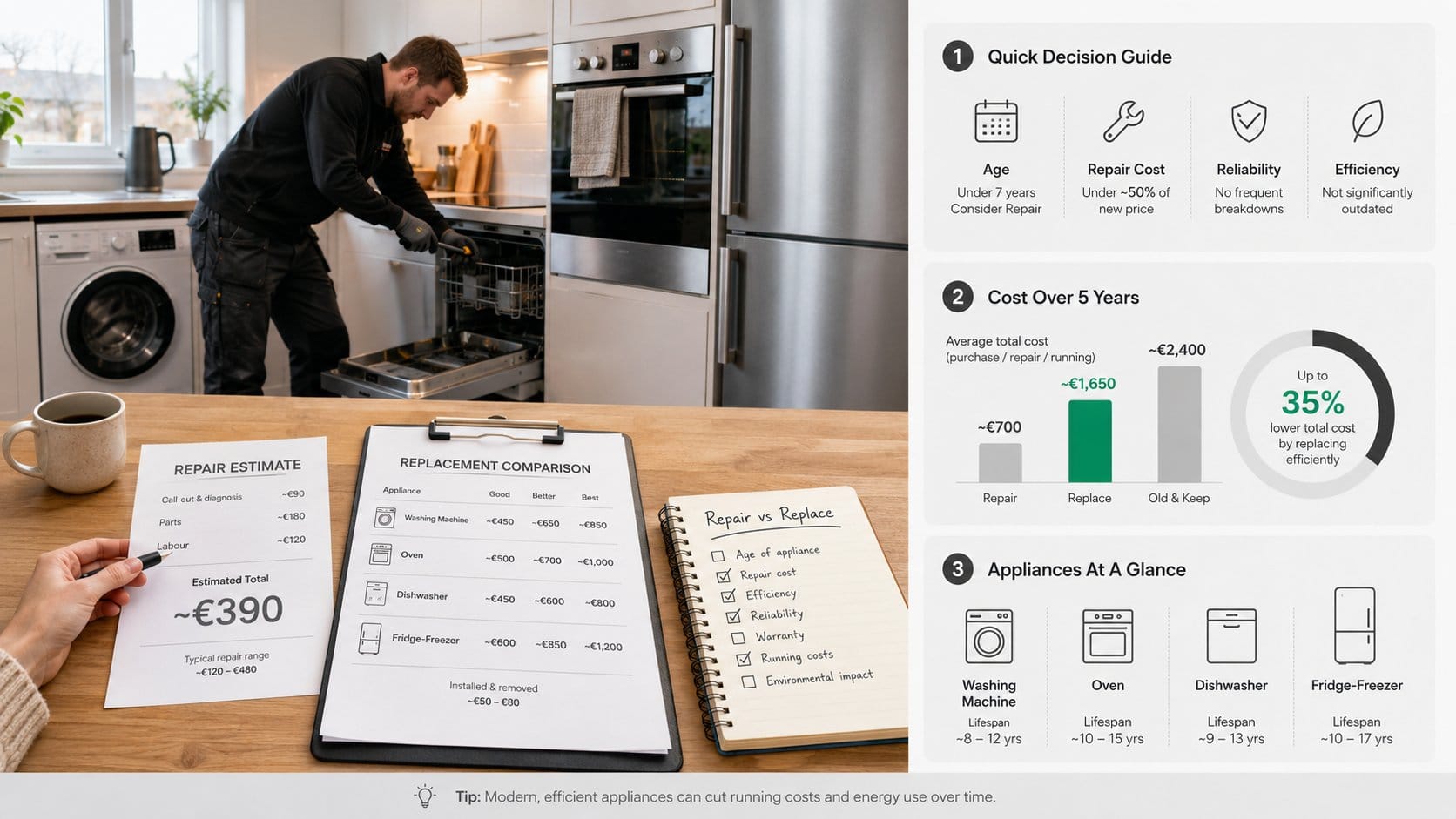
Use a simple comparison before approving the job. Set the full repair figure against the price of a suitable replacement, including any return visit, required part and disposal cost. A cheap initial diagnosis does not make a repair good value if the final bill rises after parts are ordered.
The EU Right to Repair policy context supports giving repair a proper hearing. Department of Enterprise information on the Right to Repair framework explains that repair obligations operate alongside the Consumer Rights Act 2022. Manufacturers cannot refuse a covered repair solely because a product is old or has been repaired before, and covered repairs must be reasonably priced.
Practical rule: repair when the fault is clear, the part can be sourced and the total quote sits comfortably below a suitable replacement. Compare both full figures carefully where the fault involves a sealed refrigeration system or major control failure.
Gas and Electrical Safety Rules That Apply
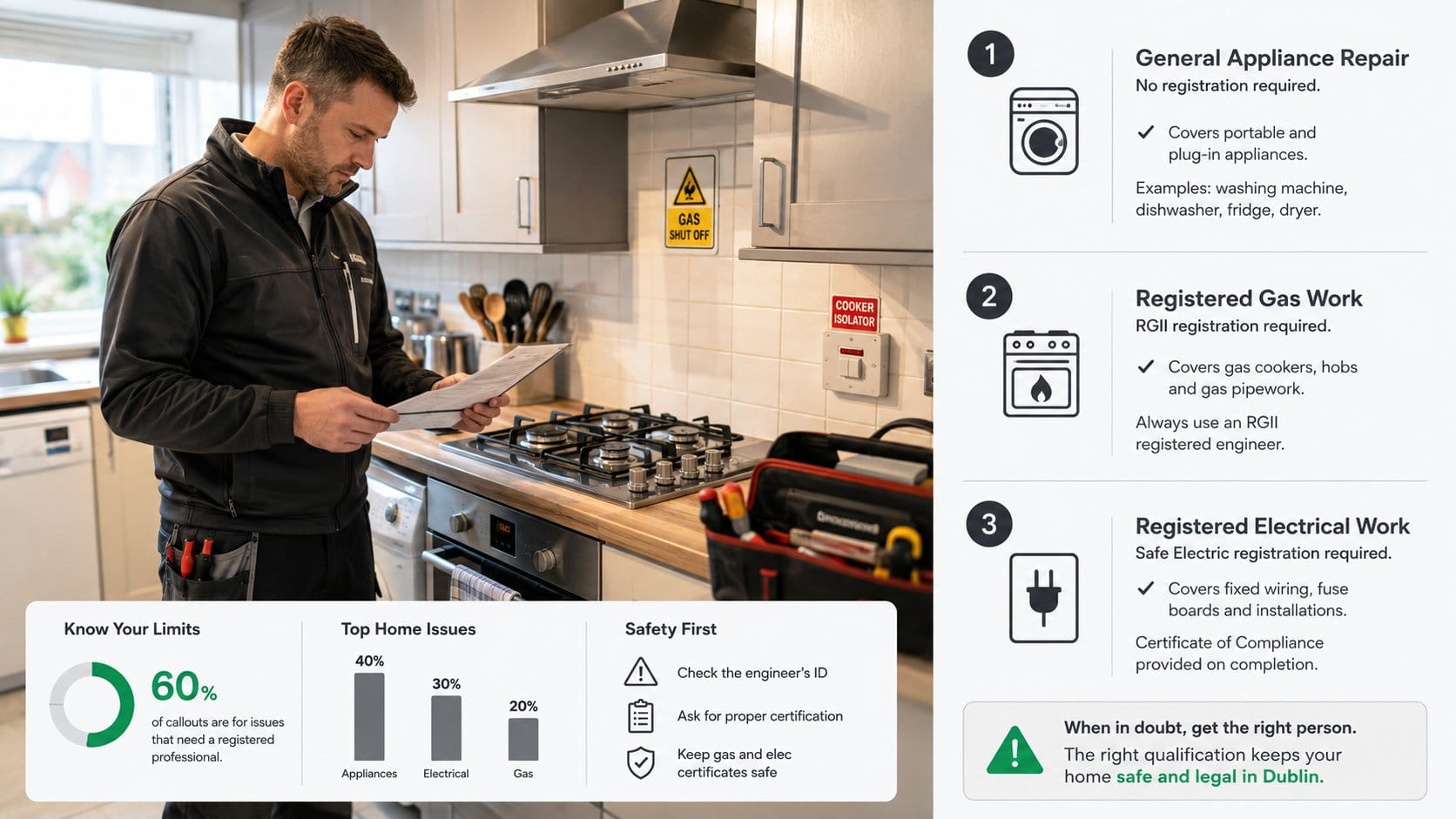
Gas and electrical work has a firm legal boundary in Dublin. A gas cooker, hob or gas oven must not be opened, disconnected or repaired by an unregistered person. Check the Registered Gas Installer, or RGI, register before approving any gas connection or gas-appliance work. Do not let a general repairer take on a gas task because they can repair other appliances.
Hard-wired appliances require the same care. If the appliance connects to the property's fixed wiring rather than a standard plug, use a Safe Electric registered electrical contractor for work involving fixed wiring, isolation switches, circuits or the appliance connection. A freestanding repairer may handle a washing machine or plug-in oven fault, but that does not authorise every electrical job.
Before the visit, get these points confirmed in writing:
Registration: Verify RGI status for gas work and Safe Electric registration for fixed electrical work.
Insurance: Ask for public liability cover and check that it applies to the proposed job.
Business identity: Look for a registered business name, proper address and clear contact details, not only an unexplained mobile number.
Written scope: The quote should name the appliance, suspected fault, diagnosis fee, labour basis, parts policy and VAT treatment.
Parts: Ask whether the part is original, compatible or refurbished, and whether availability could delay the repair.
Return visit: Confirm whether a second visit is included if a part must be ordered.
Warranty: Get labour and parts warranty terms, including exclusions.
Attendance: Ask who will arrive. A booking service may send a different contractor or subcontractor.
Reviews are useful for unregulated appliance repair, provided you read them for specific evidence. Google Business Profile, Trustpilot and two-sided marketplaces can show whether a repairer communicates clearly, arrives on time, diagnoses faults properly and handles complaints. Company testimonials alone are weak evidence.
General appliance repair is separate from gas installation and fixed electrical work. For those ordinary repair jobs, insurance, a written scope and genuine customer feedback carry more weight. The ShamFix RGI safety guide explains why registration matters. ShamFix does not verify or approve a provider's credentials, so the homeowner must check the relevant register directly. Each provider remains responsible for holding the correct registration.
Your Consumer Rights if a Repair Goes Wrong
A repair that fails twice is not something you have to accept. Start by checking whether the appliance was recently bought, because your rights may sit with the seller rather than the independent repairer. The CCPC guidance on guarantees and warranties says that a fault appearing within 30 days of receiving the goods can entitle the consumer to a full refund. After that period, repair or replacement is generally available, subject to the circumstances set out in law.
Under the Consumer Rights Act 2022, an agreed repair or replacement must be free of charge, completed within a reasonable time after notification and carried out without significant inconvenience. The Irish Statute Book version of section 25 sets out these requirements.
Keep the paperwork before the dispute grows. Save the receipt, quote, model number, messages, photographs and error codes. Record the original diagnosis, the part fitted and every missed appointment. If the appliance returns with the same fault, has an unsuitable part installed or remains unusable, that evidence shows what the trader promised and what happened.
Send the complaint in writing. Describe the fault, explain whether the appliance is unsafe or unusable, and state the remedy you want. Depending on the transaction, that may be another repair, a replacement, a price reduction or a refund. Give the trader a clear opportunity to respond, then set out any repeat failures, delays or extra practical problems.
If the trader stops engaging, send a formal letter of claim and use the CCPC complaint information. The CCPC identifies small-claims options for disputes up to €2,000, subject to the scheme's conditions. Check the scheme rules before filing.
The EU Right to Repair framework supports repair and access to parts, but it does not replace the homeowner's existing rights under Irish consumer law. “Out of warranty” is not a complete answer to every complaint. The correct remedy depends on whether the issue concerns the original sale, the repair service or both.
The ShamFix Insights guidance can help with consumer and hiring questions. For a disputed high-value repair, rely on the written agreement and evidence, then obtain specific legal advice rather than treating general guidance as a decision on your case.
Do You Repair Appliances in Dublin?
Appliance repair providers in Dublin can list their services on ShamFix, an Ireland-only marketplace connecting homeowners with local service providers. Listing on ShamFix is free and there's no commission; a subscription is planned for the future. The platform uses a two-sided review system, so customers and providers review each other after a completed job; that is a reputation record, not a quality guarantee, and each repairer remains responsible for insurance, qualifications and any RGI or Safe Electric registration the work requires. A Dublin appliance repairer who wants to be among the first found as local demand grows can list through ShamFix. Find out more at https://www.shamfix.ie/for-tradesmen.