
A studio or one-bed Airbnb turnover in Ireland typically costs €45–€72, a two-bed €55–€99, a three-bed €70–€110, and a four-bed €90–€145. Dublin usually sits towards the higher end and rural areas towards the lower end, while these listed benchmarks exclude 13.5% VAT.
That range covers more than vacuuming and wiping surfaces. A turnover, also called a changeover clean, prepares the property between one guest leaving and the next guest arriving. The final price depends on whether the cleaner supplies and launders linen, replenishes consumables, stages the accommodation and handles extra work, rather than on floor area alone.
What Airbnb Turnover Cleaning Costs in Ireland in 2026
Irish short-let benchmarks place a studio or one-bed at €45–€55 for clean-only service, or €60–€72 with linen, according to Ireland-specific Airbnb cleaning fee guidance. A two-bed commonly costs €55–€65 clean-only or €75–€99 for a fuller turnover. For a three-bed, the ranges are €70–€85 clean-only or €95–€110 with linen and consumables. A four-bed generally falls between €90–€110 clean-only and €120–€145 for a full turnover. These published figures exclude 13.5% VAT.
| Property size | Clean-only turnover | Full turnover with linen and consumables |
|---|---|---|
| Studio or one-bed | €45–€55 | €60–€72 |
| Two-bed | €55–€65 | €75–€99 |
| Three-bed | €70–€85 | €95–€110 |
| Four-bed | €90–€110 | €120–€145 |
The figures are 2026 Ireland-specific benchmarks, not fixed national tariffs. Dublin quotes may be higher where parking, travel, demand and tightly timed changeovers add pressure. Rural work may cost less, although a remote address, a long drive or limited laundry access can reduce that difference.
Floor area helps set the starting point, but turnover cost often follows the work moving through the property. More beds mean more linen to strip, wash or manage, while guest-ready presentation may require towels, consumables and staging. In that sense, cleaning behaves like a per-turnover operating cost, with linen and supplies often widening the gap between a basic clean and a complete reset.
The key comparison is clean-only versus full turnover. Clean-only usually covers the accommodation itself. A fuller service can include bed-making, linen handling, consumable replenishment and presentation for the next guest, so two quotes may differ because their scopes differ.
Hosts can post the short-let cleaning job to get quotes, then ask each provider to price identical work. Check whether VAT, linen, laundry, consumables and urgent-turnaround work are included before comparing totals. The cleaning fee charged to guests should reflect this recurring cost for each departure, rather than an occasional household expense.
How Property Size and Service Level Shape the Price
Property size matters, but service level often moves the price more sharply than floor area. A cleaner may spend much longer on a four-bed house because there are more beds to strip, more towels to process, more bathrooms to reset and more rooms to inspect. The same principle applies to a smaller apartment with heavy laundry or a detailed guest presentation standard.
Published Irish benchmarks indicate that labour time rises from roughly 1.25 hours for a studio to about 3.25 hours for a four-bed property when the work includes linen, consumables and guest-ready presentation, as set out in Irish turnover cleaning cost guidance by property size.
Clean-only and full turnover side by side
A clean-only service may suit a host who owns several linen sets, runs laundry separately and keeps a stocked supply cupboard. The cleaner focuses on the accommodation, floors, bathrooms, kitchen and rubbish, while another person handles washing, drying, folding and replenishment.
A full turnover suits a host who wants one provider to take responsibility for the complete reset. That can include used-linen removal, fresh bed-making, towels, consumables and staging. It costs more because the cleaner is managing more tasks and carrying more responsibility within the same check-out to check-in window.
| Service decision | Usually suits | Main price effect |
|---|---|---|
| Clean-only | Host handles linen and supplies separately | Lower base quote |
| Full turnover | Cleaner handles linen, consumables and presentation | Higher per-turnover quote |
| Managed turnover | Additional coordination is included | Base clean plus management uplift |
The two-bed apartment is a useful anchor. Irish guidance places a clean-only service around €55–€65, while a fuller turnover can reach €75–€99 when linen and consumables are included. That difference reflects scope, not the number of rooms.
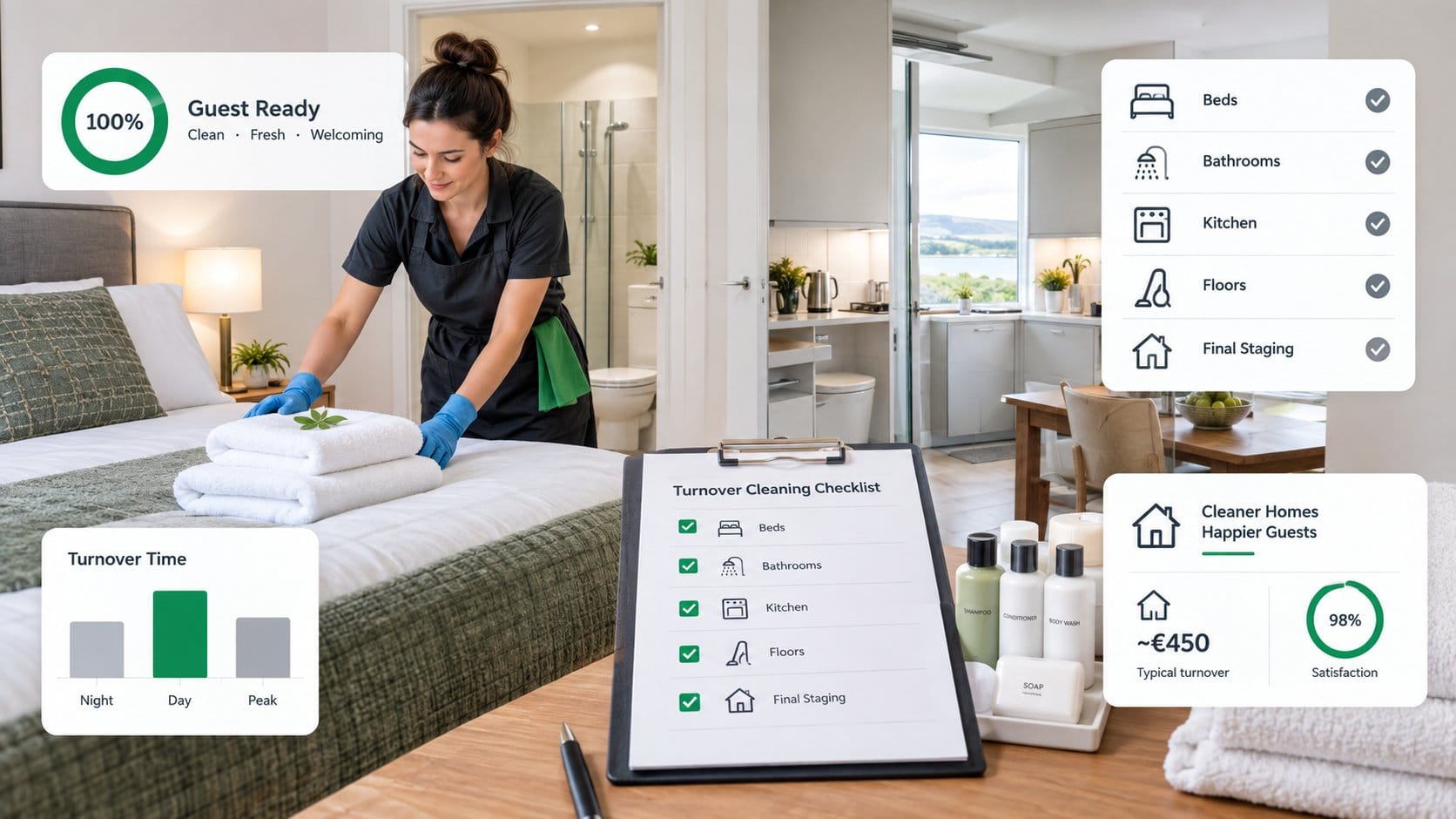
A Dublin quote may sit towards the upper part of the applicable range, while a rural quote may be lower if access and scheduling are straightforward. Hosts should still check travel, parking and laundry arrangements before assuming that a lower headline price is the cheaper option overall.
What a Standard Turnover Clean Includes for the Next Guest
A standard turnover should create a guest-ready reset, not just a visibly tidy room. The cleaner needs to remove signs of the previous stay, restore supplies and leave each space ready for arrival without the host having to finish the job.
The room-by-room reset
The work usually follows a repeatable sequence:
- Beds and linen: Used sheets and towels are removed, beds are remade with fresh linen and the sleeping areas are checked for belongings or visible damage.
- Bathrooms: Toilets, basins, showers and other surfaces are sanitised. Towels, toilet paper, hand soap and agreed guest essentials are replaced.
- Kitchen: Counters, sinks, hobs and commonly used appliances are cleaned. Dishes are washed or put away, rubbish is removed and the fridge is checked for items left behind.
- Floors and surfaces: Rooms are dusted, vacuumed and mopped as appropriate. Tables, touchpoints, handles, switches and remotes receive attention.
- Final reset: Cushions, throws, furniture and welcome items are arranged. The cleaner checks that the property presents correctly for the next arrival and reports anything missing or damaged.
The exact checklist should be written into the quote. “Airbnb clean” can mean different things to different providers, particularly around laundry, oven cleaning, interior windows, balcony areas and consumables.
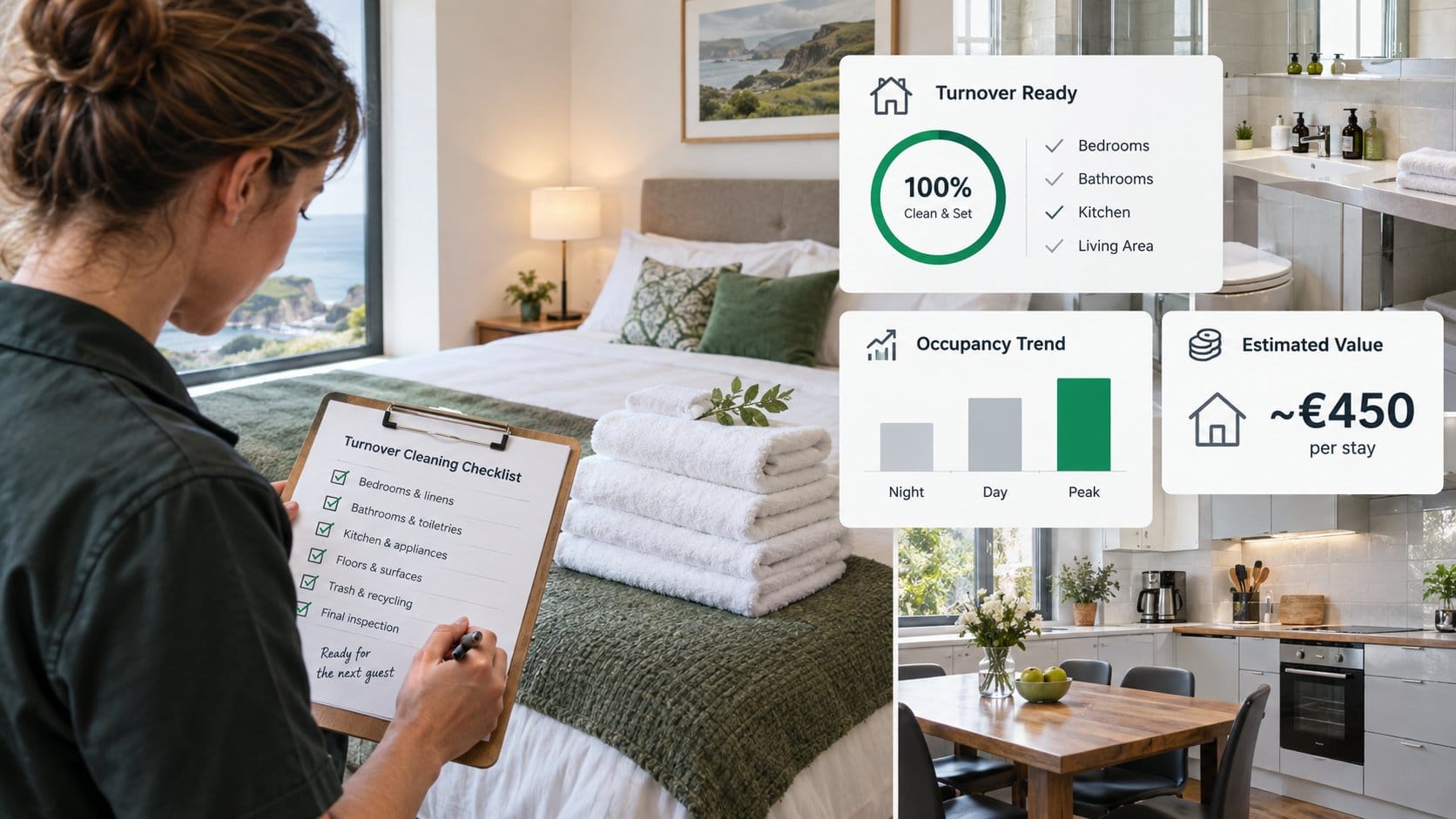
Why a written checklist matters
Back-to-back stays leave little room for assumptions. A checklist gives the host and cleaner the same definition of “ready”, including bed presentation, bathroom supplies, rubbish removal and final staging.
The checklist can also separate routine work from chargeable extras. For example, standard kitchen cleaning might be included, while a heavily soiled oven or extensive food waste could require a separate agreement. Hosts who want practical preparation guidance can adapt a standard home-cleaning prep checklist for the short-let property.
Practical rule: A quote is only comparable when every cleaner is pricing the same checklist.
Common Add Ons and How They Are Typically Charged
Add-ons turn a clean-only quote into a full turnover cost. Linen hire and laundering show the clearest difference: the charge follows each bed and towel set, rather than the property's floor area.
Irish guidance places linen hire and laundering at roughly €8–€22 per set. Define “set” in writing. One provider may mean bed linen only, while another may include towels, bath mats, collection and delivery.
Linen and laundry
Ask who supplies the linen, who collects used items and where washing takes place. A property with its own washing machine may have a per-turnover laundry charge. A provider supplying commercial linen may price by set instead.
The number of available linen sets affects how reliably the property can be turned around. Used items may be removed while fresh stock is installed, with washing completed separately. For a tight booking schedule, the quote should state whether laundry is on-site, off-site or handled through a linen service.
Consumables and welcome packs
Restocking is commonly charged per turnover, or by the time required to buy and place supplies. Typical items include toiletries, toilet paper, bin liners, dishwasher products, coffee, tea, sugar and basic kitchen supplies. Separate product costs from labour or handling, so you can see what the cleaner purchased.
Welcome-pack setup may also be priced per turnover. It can include placing agreed items in a specified location, arranging the presentation and checking the pack against the host's instructions. Confirm whether the host supplies the items or the cleaner buys them and invoices the cost.
Some labour-intensive managed or high-occupancy properties may carry a €15–€25 per-turnover co-host or management uplift on top of the base clean. List this separately from cleaning and laundry, so the total operating cost remains clear.
A host-reported west coast range of €12–€20 per hour also appears in the same Irish guidance for cleaning work, depending on cleaning and laundry handling. Hourly pricing can help compare unusual jobs. For routine short-let work, a per-turnover quote is easier to budget because it describes the finished service.
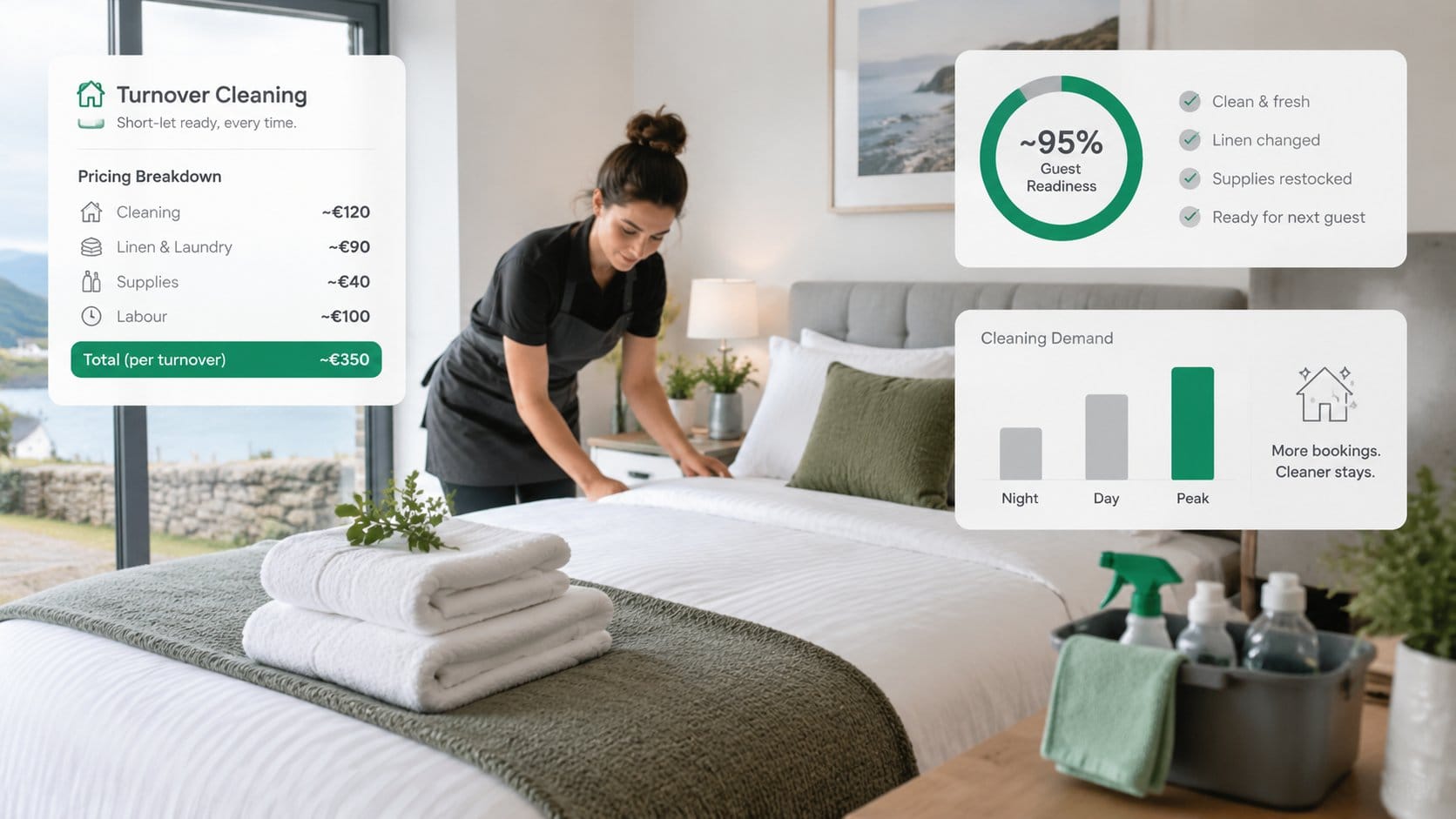
Surcharges for Deep Cleans Same Day Turnarounds and Extra Mess
A standard turnover assumes an ordinary departure and a defined amount of work. The price can change when the cleaner has to restore the property beyond that baseline or work under unusual time pressure.
A periodic deep clean is different from a changeover. It may involve detailed attention to areas that routine cleaning does not cover, such as accumulated limescale, difficult kitchen grease, neglected appliances, skirting boards, windows or hard-to-reach surfaces. The provider should quote this separately rather than adding work to every standard visit.
Urgency and operating hours
Same-day or last-minute turnarounds can attract a premium because the cleaner has less flexibility to arrange staff, laundry and travel. The surcharge may be a fixed amount, an additional percentage of the agreed turnover price or an amended per-hour charge. There isn't one national Irish tariff for urgent work, so the host should ask for the provider's written policy before accepting bookings that leave a narrow changeover window.
Out-of-hours work can also cost more. Early check-outs, late departures and arrivals outside the cleaner's normal working hours may require a separate fee, particularly when the work disrupts another scheduled turnover.
Ask before booking: Does the quoted price apply to the normal check-out window, and what happens if a same-day changeover is added later?
Condition-based charges
Heavy mess is another common trigger. Extra food waste, stains, excessive rubbish, pet hair, broken items or evidence of a party can take the job beyond the agreed checklist. A cleaner may charge for additional labour, specialist products, waste handling or replacement items after documenting the condition.
Hosts can reduce disputes by setting house rules, explaining pet arrangements clearly and asking the cleaner to photograph unusual mess before work begins. The agreement should state whether the cleaner can proceed with extra work up to an agreed limit or must receive approval first.
The useful budgeting approach is to keep routine turnover, deep cleaning, urgency and damage-related work as separate lines. That makes the standard cost predictable while preserving a fair method for exceptional jobs.
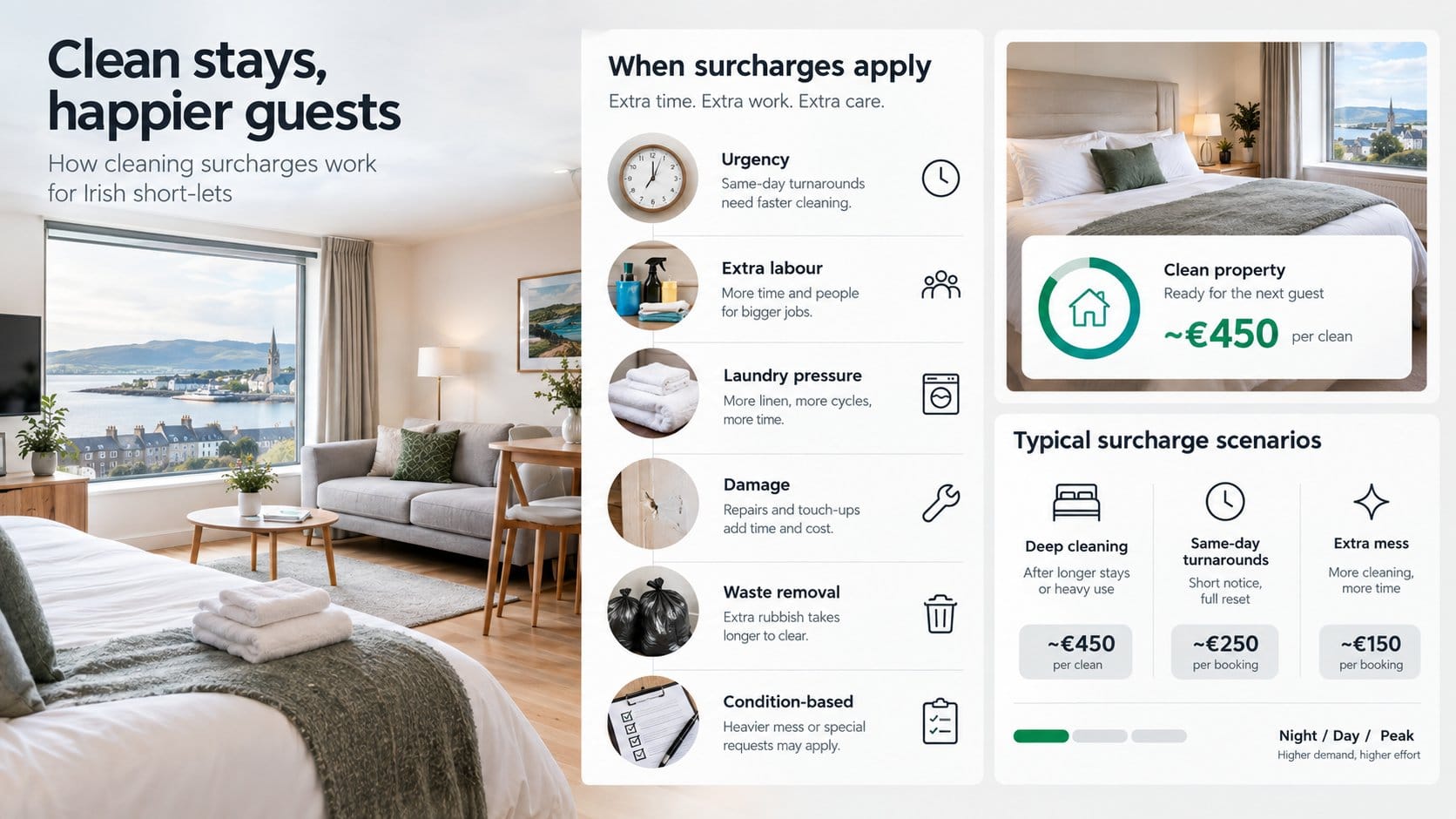
How to Set Your Guest Cleaning Fee and Treat Costs for Tax
A cleaning charge applies once per reservation, not once per night. Under Airbnb's Irish listing rules, hosts may add a one-off cleaning fee at booking to cover preparation before arrival or after departure, or include that cost in the nightly rate.
A separate fee makes the turnover cost easier to track. It suits a property with a clear per-booking expense, since making beds, resetting bathrooms and preparing the kitchen may take similar effort after a short or long stay. Guests will see the charge while comparing the total booking price, so the amount should match the service provided.
Including cleaning in the nightly rate gives guests a simpler price structure. The host still needs to recover the money across bookings, which can be harder when stays differ in length. The work happens once per reservation, while the nightly rate spreads the recovery across each night.
A practical pricing check
Set the fee from the agreed turnover service, rather than copying another listing. Confirm these points first:
- Scope: Whether beds, linen, laundry, consumables, rubbish and final staging are included.
- VAT: Whether the quoted amount includes VAT or is stated before VAT.
- Frequency: How often the property turns over and how much one clean adds to each reservation.
- Guest presentation: Whether the property's standard supports a separate charge that guests can understand.
For budgeting, treat the cleaner's invoice as a per-turnover operating cost. Linen washing, replacement items and consumables can make the charge rise even where the floor area stays unchanged. A short booking may therefore carry the same cleaning cost as a longer one.
Irish Revenue states that short-term-let income isn't treated as rental income. It is taxed as trading income under Schedule D Case I or miscellaneous income under Schedule D Case IV. Cleaning fees may be allowable expenses when they are directly incurred in providing the short-term let, according to Revenue's Irish rental-income guidance.
The Revenue and Airbnb Ireland tax guide says trading-income deductions can include maintenance costs such as cleaning and painting. For non-trading income, deductions can include cleaning fees, food supplied to guests and a reasonable share of utilities such as gas, heating and electricity.
Keep invoices, receipts and booking records together. Tax treatment can become less straightforward as the activity changes, so a tax adviser can confirm how the costs should be recorded. Citizens Information says short-term-let income must be declared to Revenue each year and isn't rental income for tax purposes, as set out in its guidance for Irish hosts.
Hiring a Reliable Short Let Cleaner and Reducing Ongoing Costs
The cheapest quote isn't automatically the lowest operating cost. A missed same-day turnaround can create far more disruption than a modest difference in the cleaning price, so reliability should be assessed alongside the headline figure.
Before booking, a host should check:
- Turnaround reliability: Ask how the cleaner handles same-day departures, delayed check-outs and calendar changes.
- Insurance: Request confirmation of appropriate cover and clarify whether damage caused during the service is addressed by the policy.
- Written checklist: Make sure beds, bathrooms, kitchen, floors, rubbish and final staging are listed.
- Linen logistics: Confirm who supplies, washes, stores and replaces linen.
- Consumables: Agree which products are included, who buys them and how purchases are approved.
- Reviews: Read genuine customer feedback and ask for references where appropriate.
- Reporting: Agree how damage, missing items and exceptional mess will be documented.
Cleaning is not a regulated trade in Ireland, so insurance, a clear written scope and real reviews matter. Hosts should still check each cleaner's insurance, terms and suitability independently.
Cost control comes from removing avoidable complexity. Standardise linen sizes, keep duplicate sets available, store consumables in one labelled cupboard and use the same checklist after every departure. Clear house rules can reduce excess mess, while a predictable booking calendar can make scheduling easier for the cleaner.
Hosts looking for a relevant local category can browse Airbnb and short-term rental cleaning services and compare the scope offered by individual providers.
ShamFix connects hosts with local short-let cleaning providers for quote requests in the Republic of Ireland. Hosts should check reviews, insurance and the agreed checklist themselves, because ShamFix doesn't vet or verify providers.
Are you a short-let cleaner in Ireland?
Listing on ShamFix is free and there's no commission; a subscription is planned for the future. Cleaners can create a provider listing and set out their own service area, turnover scope and availability.