
Ctrl+FFitted blinds in Ireland generally cost €70 to €400 per window, supply and fit.
That's the starting point for window blinds Galway, because this is rarely just a style purchase. In a west-coast house, blinds are about light control, condensation, child safety, and whether the fitting is done properly the first time.
Why Choosing Window Blinds in Galway Is More Than a Style Decision
A Galway kitchen can look tidy on paper and still be miserable in real life. The window mists up, the sill stays damp, and a nice-looking blind starts trapping moisture where nobody wants it. That is why window blinds Galway should be treated as a practical comfort decision first, and a decorative choice second.
Start with the room, not the brochure
The first fork in the road is recess fit or face fix. Recess fit sits inside the reveal and looks cleaner, but it needs enough depth and a window opening that can accommodate it. Face fix sits forward on the wall or frame, blocks more light, and is often the better choice where the reveal is uneven or shallow.
Practical rule: if the window is awkward, old, or a bit out of square, the neatest-looking option on the brochure is often the wrong one at home.
That matters in Galway because many older houses have rougher reveals, deeper plaster, or awkward frames. A blind that looks grand in the showroom can still fail if the depth, handles, or opening direction were never checked. The local market also shows the trade is active, not theoretical, with Galway suppliers visible in Irish directories and established local showrooms in the city and nearby suburbs, including Oranmore, Westside, Liosban and Tuam.
Safety sits beside comfort
Blinds with cords or chains bring a separate issue that homeowners cannot ignore. In Ireland, corded and chained internal blinds must meet EN 13120 and be supplied and fitted with a safety device so no hazardous loop is within a child's reach, under the CCPC framework that has applied since September 2014. Cord-free and motorised blinds remove that risk entirely, which is why they deserve serious consideration in family homes.
For Galway buyers, the useful mindset is simple. Measure properly, match the blind to the room, and make sure the safety setup is part of the job rather than an afterthought. A blind that handles glare but fails on condensation or child safety is a bad buy, no matter how tidy it looks from the footpath.
Measuring Galway Windows the Right Way Before You Order
Bad measuring is where most grief starts. A blind that is a touch too wide, too shallow, or ordered off one optimistic number can turn a straightforward job into a messy return visit. The safest approach is to measure width and drop in at least three places each, then work off the actual opening rather than the best-looking figure.
Recess fit needs the smallest width and the real depth
For a recess fit, the blind goes inside the reveal, so the smallest width is the number that matters. Measure the top, middle and bottom of the opening, then do the same for the drop on the left, centre and right. Older Galway stone houses and period properties are often out of square, so one measurement tells the wrong story.
The reveal depth matters just as much. A recess blind needs enough depth for the blind, brackets, roller diameter, and stack height to sit properly without fouling the glass or the handle. If the window opens inward, if there is a tiled sill, or if the reveal is shallow plaster, that needs to be written down before anything is ordered.
Face fix is more forgiving, but still needs care
Face fix is often the smarter choice where the opening is awkward or the homeowner wants better light blocking. It sits in front of the reveal, so it can hide uneven edges and improve coverage around the frame. That said, the blind still has to clear the handle and leave the window usable.
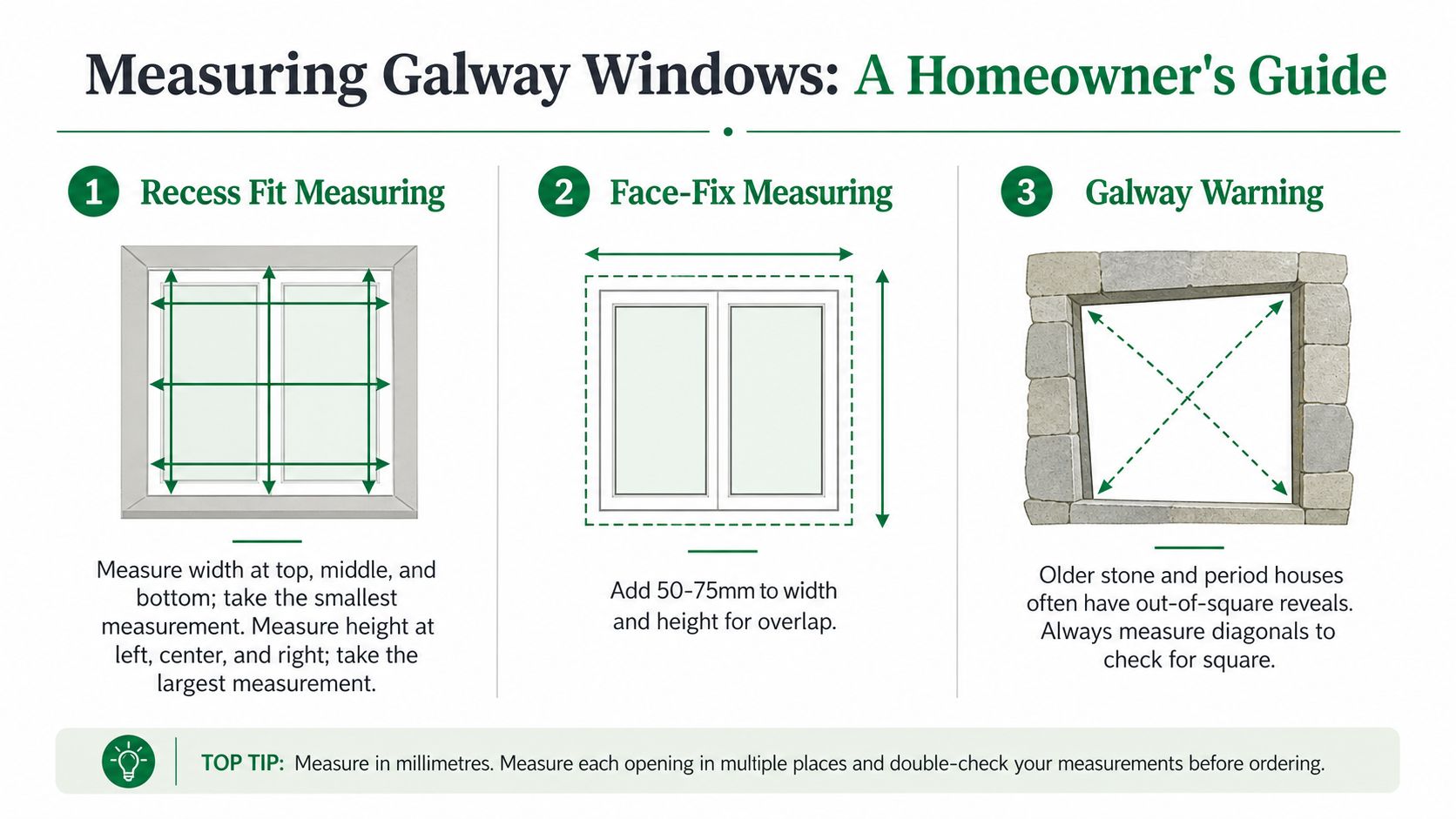
A clean measurement sheet for any Galway supplier should include these details:
Window type: recess fit or face fix.
Widths and drops: three readings each, with the smallest width noted for a recess fit.
Reveal depth: especially where the window frame is shallow.
Obstructions: handles, tiled sills, vents, trim, or inward-opening sashes.
Room notes: kitchen, bathroom, north-facing room, or another damp-prone space.
Never order from one number taken in a hurry. On an out-of-square reveal, that is the expensive mistake.
A homeowner who arrives with that level of detail is already ahead of most. It makes quotes easier to compare, reduces the chance of a remake, and gives any fitter a fighting chance of getting it right first time.
Best Blind Materials for Galway's Coastal Damp
Galway's damp coastal climate changes the material conversation completely. A blind that looks fine in a dry living room can be a poor choice in a steamy bathroom, a kitchen over the sink, or a north-facing room that never quite dries out. The question is not which finish looks nicest on a sample board, it is which material will survive condensation without warping, mildewing, or turning into a cleaning job every week.
The safer picks for wet or cool rooms
For kitchens, bathrooms, and other moisture-prone spaces, PVC blinds, faux-wood composite blinds, and aluminium venetians are the sensible picks. They wipe clean, handle damp air better, and don't warp in the way real timber can when the room stays humid. They also suit Galway houses that see a lot of temperature change between indoors and outdoors.
Real timber venetians belong in drier rooms where ventilation is decent. In a steamy bathroom, wood can bow or swell, and that is not a cosmetic issue, it shortens the life of the blind. Natural-fabric romans and heavy curtains can also hold moisture on cold glass and become a nuisance on condensation-prone windows.
Match the material to the room's moisture, not to the showroom lighting.
That simple rule saves money later. A homeowner can love the colour, but if the room mists up every morning, the wrong material will keep showing it. Galway buyers should be especially blunt with themselves about north-facing rooms, en-suite bathrooms, utility rooms and kitchens, because those are the places where the wrong blind fails first.
Dry rooms give more freedom
Living rooms and bedrooms are different. Where the room is drier and better ventilated, fabric options are usually fine, and the visual choice becomes easier. The key is not to force one material across the whole house just because it keeps the quote neat.
A sensible Galway approach is to treat blind material as part of the moisture plan for the house. If a room already struggles with condensation, a wipe-clean blind is a better bet than an absorbent one. That's especially true in older homes where the windows themselves can run cold.
For people dealing with damp on the walls or mould around the frame, the blind choice should sit alongside the wider room problem. A blind can help with comfort and airflow, but it won't fix a moisture issue on its own, which is why targeted work matters, including services such as damp proofing and mould treatment.
Child Safety, Cords and Chains Under Irish Rules
Corded blinds are not just a fitting choice in Ireland, they are a safety job. Internal blinds with cords or chains must meet EN 13120, and they must be supplied and fitted with a safety device such as a breakaway connector, tensioner, or cord stops so no hazardous loop sits within a child's reach. The CCPC is the Irish authority tied to that requirement, and the rule has applied since September 2014.
What Galway homeowners should insist on
Cord-free blinds remove the danger entirely. Motorised blinds do the same. That is the cleanest answer for homes with young children, bedrooms near cots, or any room where a loose loop would be a bad idea from day one.
If a corded or chained blind is being fitted, the homeowner should expect the fitter to do more than hang it and leave. The safety device has to be installed properly, and the cord or chain tensioner needs to be fixed to the wall so the loop stays out of reach. The blind should also be demonstrated before the fitter leaves.
A practical handover should cover these points:
Safety device fitted: breakaway, tensioner, or cord stops are in place.
Loop position checked: no hazardous loop is left within reach of a child.
Operation shown: the chain or cord works smoothly and doesn't snag.
Room placement checked: cot, bed, or furniture isn't too close to the cord.
Blind style explained: cord-free or motorised options are discussed where safety is a concern.
What to watch in family homes
The rule is simple. If there is a cord or chain, the safety device is not optional. A Galway fitter who treats it as a side note is not doing the job properly. The same goes for anyone who leaves the room without showing how the tensioner works or how the blind should be used day to day.
This is one of those areas where the cheap, casual approach can look fine and still be wrong. A child safety setup that is installed correctly takes a few minutes more, but it is the difference between a blind that merely looks finished and one that is acceptable in an Irish home.
What Window Blinds Actually Cost in Galway
Pricing in Galway makes more sense when it is broken into two parts, the blind itself and the fitting. Fitted blinds in Ireland generally cost €70 to €400 per window, supply and fit, depending on style, material and window size. As a rough order: basic roller blinds sit at the lower end, mid-range fabric and venetian blinds in the middle, and premium or motorised blinds at the top. Treat this as a general Irish market range, not a fixed quote.
Typical Galway blinds cost bands
| Item | Typical band | What's usually included | What often sits outside it |
|---|---|---|---|
| Basic roller blinds | lower end of €70-€400 | Standard blind supply and a straightforward fit | Extra fixings, difficult access, making good |
| Mid-range fitted blinds | mid €70-€400 range | Better fabric or finish, supply and fit | Child-safety extras, unusual reveals, repairs |
| Venetian blinds | mid €70-€400 range | Supply and fitting for standard openings | Shallow plaster returns, awkward handles, remedial work |
| Premium or motorised blinds | upper end of €70-€400, plus any electrical work | Higher-end blind or motorised option | Electrical work, access issues, wall repair |
On a supply-and-fit quote the labour is usually folded into the per-window price rather than shown separately. If a fitter does price labour on its own, ask for it as a clear line - a whole-house job of eight to twelve windows is a real trade day, not a token add-on. What matters is that the quote states clearly what the fitting includes.
Why the cheap quote is often incomplete
The lower quote often leaves out the bits that cause hassle. Brackets for stone or plaster, awkward access, waste removal, and making good around old reveals can all sit outside the headline price. Access and fixings matter especially in Galway houses with solid walls or shallow plaster returns, because the first drill hole is not where the job starts and ends.
A rough sanity check helps. If a home needs eight windows and the labour sits near the lower end of the market, the fitting portion should still feel like a real trade job, not a token add-on. If a quote looks far below the typical €70–€400 range and no one can explain what is included, it is usually missing something.
The smarter move is to compare like with like. Ask whether the price covers supply, fitting, safety devices, and any extra work around the opening. A quote that spells that out is worth more than a cheap number with gaps hidden underneath.
What a Good Galway Fitter Does on Installation Day
A decent fitter earns the money by being methodical, not by rushing. The first thing they should do is confirm the delivered blind against the final measurements before any drilling starts. That sounds basic, but it stops the classic mistake of hanging the right product in the wrong opening.
The day should follow a clean sequence
The fixing surface matters next. A fitter needs to know whether the blind is going into plaster, timber, a tiled reveal, or a plastered stone wall that needs the right fixings. Level brackets matter too, because a crooked bracket gives a crooked blind even when the measurements were perfect.
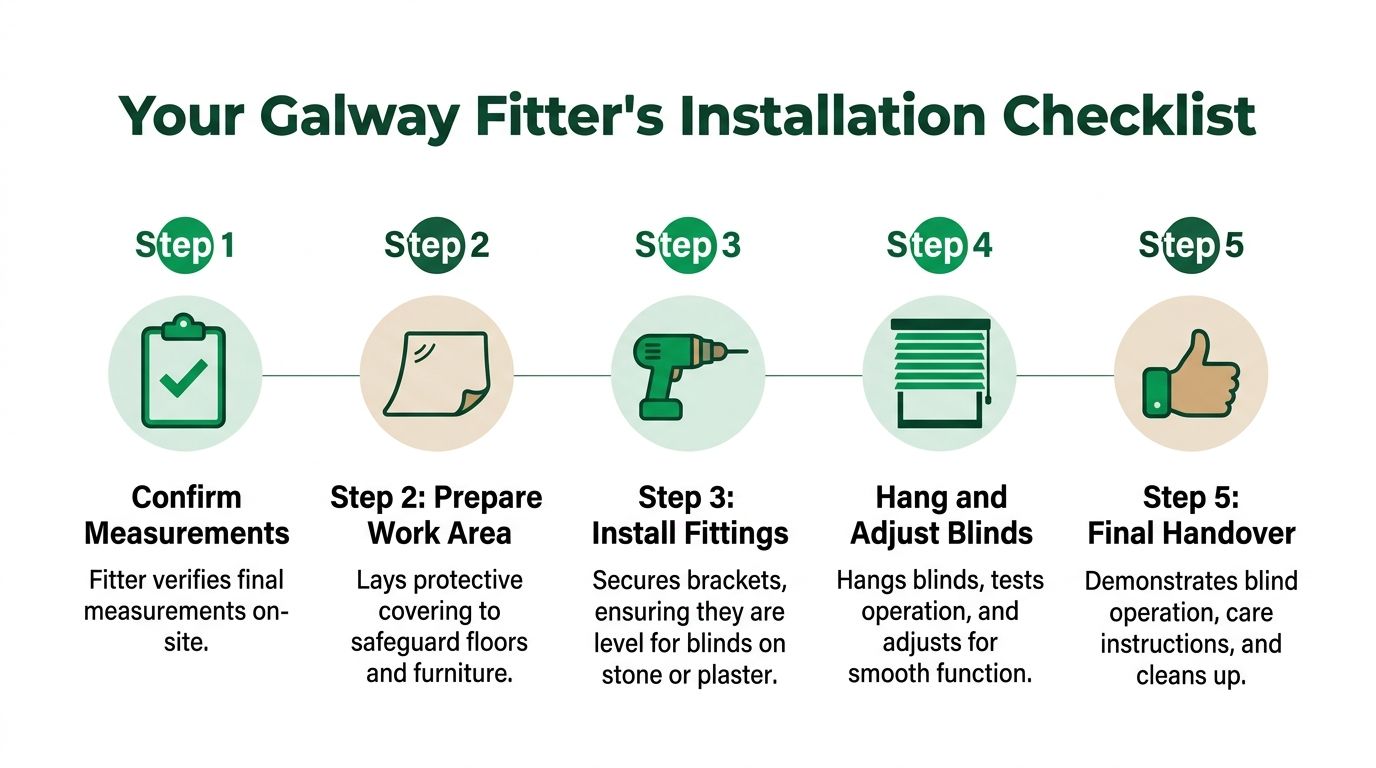
A proper installation day should include these checks:
Final measurement check: the delivered blind is matched to the window before drilling.
Surface check: the fitter looks at plaster, timber, tile, or stone and chooses the right fixings.
Bracket line: brackets go on level, not by eye and hope.
Mechanism test: the blind is hung and opened fully to see if it runs smoothly.
Clearance test: the blind clears handles and the window still opens and closes.
The safety handover is part of the job
For corded or chained blinds, the safety device should be fitted and shown properly before the fitter leaves. The wall tensioner or cord stop needs to be set so no hazardous loop remains within a child's reach. That is not a side task, it is part of finishing the job correctly in Ireland.
A good fitter also tidies the area, checks for snags, and makes sure the blind sits comfortably in the opening. If it catches on a handle, fouls a sill, or stops the window opening properly, the job is not done. Homeowners should expect that to be fixed before sign-off.
For people comparing providers, a straightforward route such as blinds and curtains installation is one way to get the job matched with the right kind of local help, but the important part remains the same, the fitter has to measure, fit, test, and hand over properly.
Hiring a Galway Blinds Fitter Without Getting Burned
Blinds fitting is not a regulated trade in Ireland, so there is no licence register to rely on. Your protection comes from public liability insurance, a written measure-and-fit quote, proper child-safety fitting, and reviews from real past customers. If a fitter cannot show paperwork, that is a warning sign. If you are comparing options, use hire a Galway blinds fitter as part of your short list and ask for the documents before anyone starts drilling.
The service model matters as much as the blind
Galway buyers usually run into three models. Some suppliers offer supply-and-fit from a showroom, which suits homeowners who want samples, measuring, and installation under one roof. Others work as a mobile measuring service with online ordering, which suits people who know roughly what they want but still need a site visit. A third group is supply-only, which only really makes sense for confident DIYers with the right tools and a straightforward opening.
Visible providers in Galway tend to cluster in and around the city and nearby areas, including Oranmore, Westside, Liosban and Tuam. That matters because outer Galway homes can face longer travel times, fewer sample options, and more variation in how much site-measuring support a fitter will offer.
A decent quote should answer the awkward questions without a song and dance:
Insurance: ask for a copy of the public liability insurance certificate.
Scope: check whether measuring, brackets, fixings, labour, and waste removal are included.
Safety compliance: ask how the fitter handles corded blinds and what child-safety device they fit.
Paper trail: request the written measure-and-fit quote before you pay a deposit.
Local proof: read recent customer reviews and look for comments on punctuality, clean work, and aftercare.
Fit model: choose showroom, mobile measure, or supply-only based on the house, not the sales pitch.
Ask for photos of previous installs in homes like yours. Ask what fixings they use for plaster, tile, timber, or stone. Ask whether they will return if a blind rubs a handle or needs a small adjustment after settling. A fitter who answers clearly is worth more than one who just talks about finish and colour.
The cleanest decision is the one that matches the house. A dry, square opening in a modern room is easy. A damp, awkward, period window in Galway is not. A good fitter knows that and acts like it. They measure properly, explain the safety setup, give a fair quote in writing, and leave you with no guesswork.
Are you a blinds fitter in Galway?
ShamFix lets local providers be found by homeowners who are comparing options in the Republic of Ireland. It's free to list during Phase 1, there's 0% commission, and providers can use the platform to be matched to relevant requests without paying per-lead credits. Visit ShamFix to see how the marketplace works for Galway jobs.