Sofa cleaning prices in Ireland usually fall inside an aggregate Irish market estimate of €80–€180 for a standard two- or three-seat sofa. That figure describes a straightforward clean on a fabric suited to a standard process, and a written quote for a particular sofa can sit below or above it once size, method, fabric, staining and add-ons are assessed. Homeowners comparing carpet and upholstery cleaning should treat the range as a starting point, then read the written terms closely, because the terms rather than the headline figure decide the final bill.
Sofa size is the first price driver
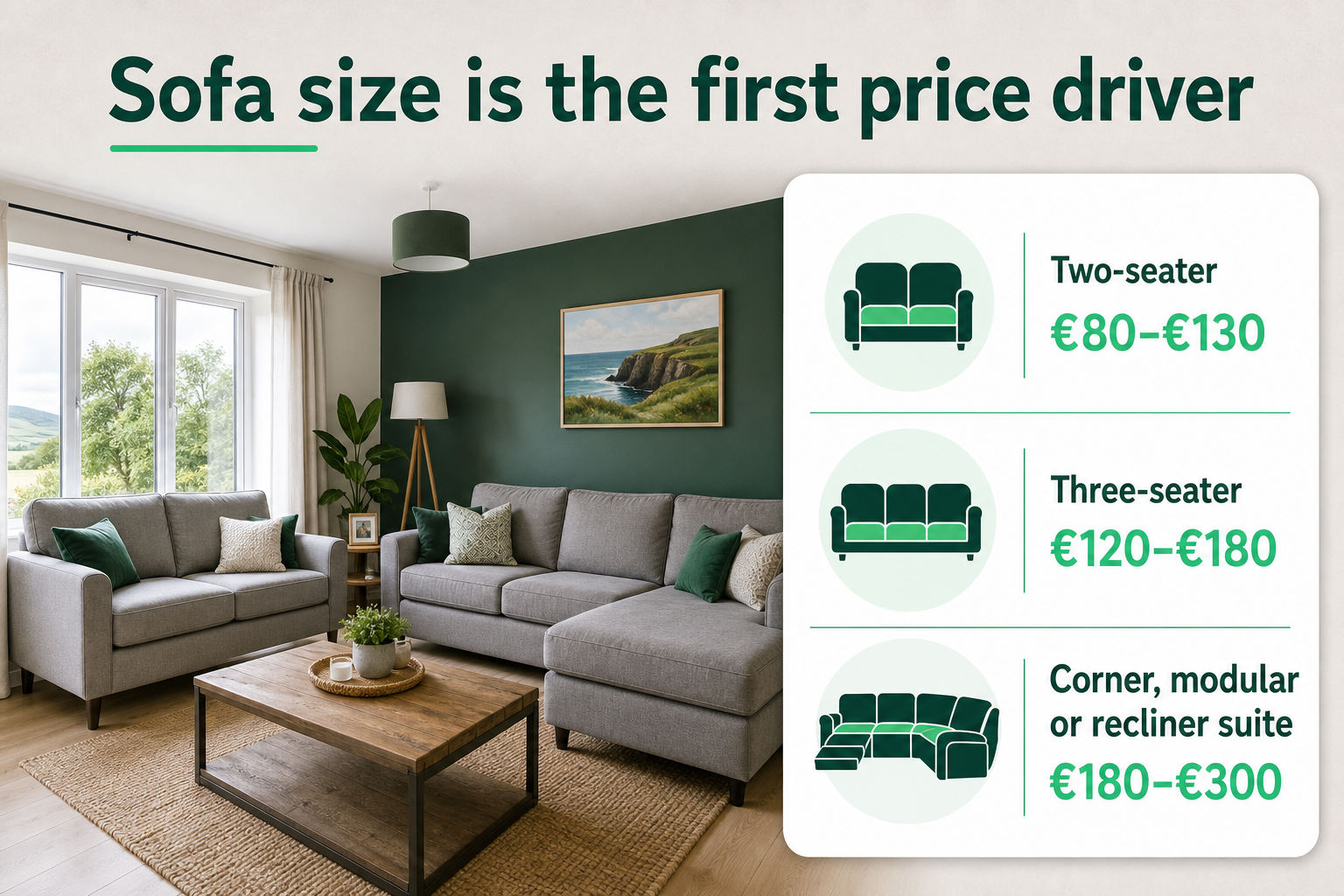
Size is the first thing that moves a sofa cleaning price. A two-seater has less surface area, fewer cushions and a shorter drying time than a three-seater. A corner sofa, a modular suite or a recliner takes far longer again, because every section, arm, back, cushion and seam has to be worked around, and fixed covers or recliner mechanisms limit how much fabric can be treated at once. Reversible cushions and covers that can be removed and handled separately may cut labour; deep fixed cushions with foam filling usually add handling and drying time. A written quote should say which parts are covered — cushions, arms, back, frame, underside — because "the sofa" means different things to different providers.
The figures below are an aggregate Irish market estimate for a standard clean on a sofa with reasonable access and a fabric suited to a standard process:
| Sofa type | Typical range |
|---|---|
| Two-seater | €80–€130 |
| Three-seater | €120–€180 |
| Corner, modular or recliner suite | €180–€300 |
Access matters as well. Stairs, narrow doorways, a sofa that cannot be moved safely, or limited parking all add time, and those points belong in the conversation before the visit rather than in a surprise charge on the day.
Cleaning method changes labour and drying time
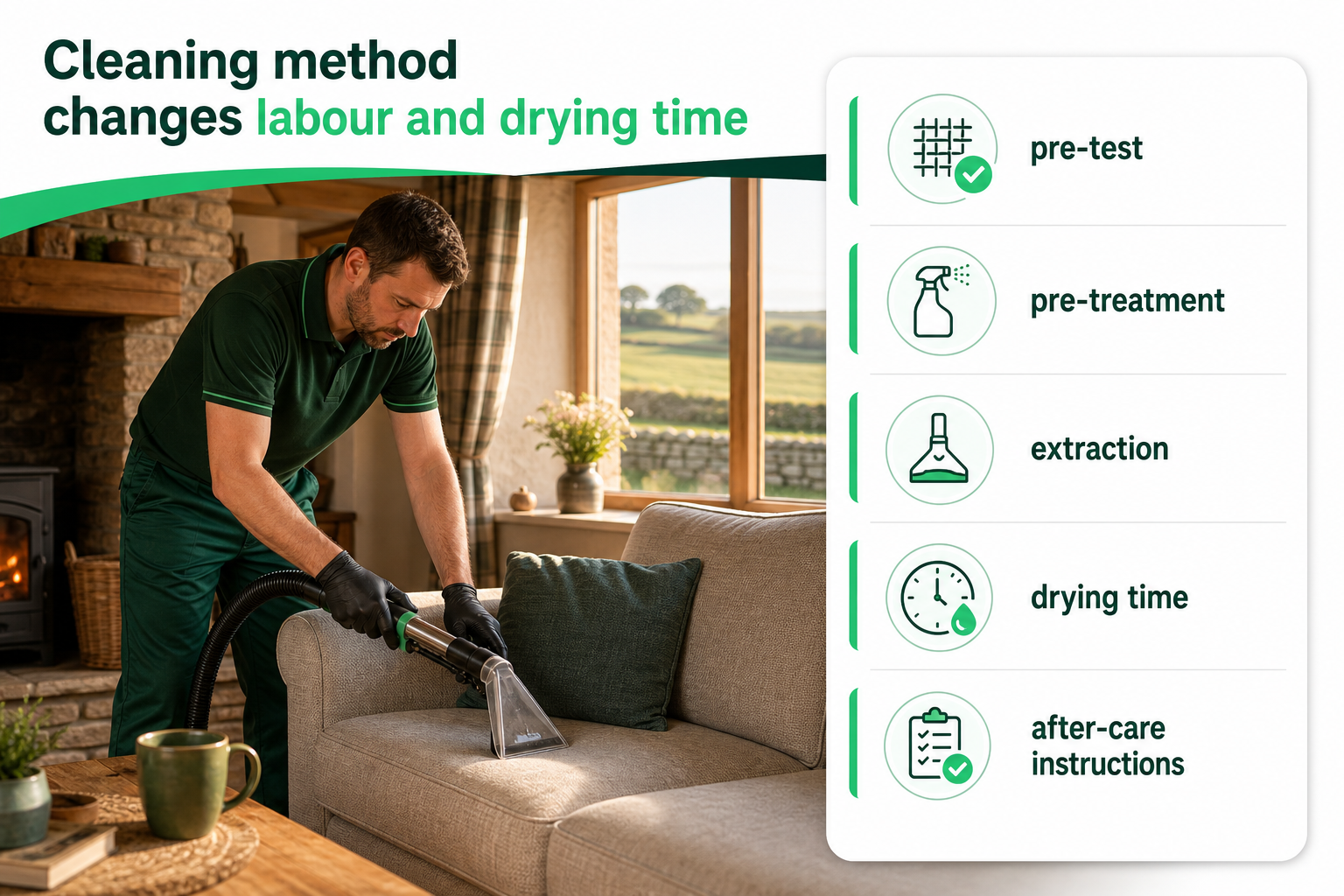
Method is the second driver. The provider chooses a process that suits the fabric and the level of soiling, and that choice affects labour, equipment, drying time and risk. Low-moisture or dry methods can suit delicate or water-sensitive fabrics, while hot water extraction or deep-rinse methods may be used where soil and residues are heavy. Some fabrics need a pre-test on a hidden area before any liquid is applied. A process that takes longer, needs extra preparation or carries a higher risk of colour bleeding will normally be quoted higher. What matters for a homeowner is not the name of the method but what it includes: pre-testing, pre-treatment, extraction, drying time and after-care instructions. A quote that names no method is hard to compare with one that does, and the lower figure may simply describe a lighter clean.
Fabric type and stain type
Fabric and staining are often the biggest reasons two similar-looking sofas attract different prices. Natural fibres, viscose, velvet, linen blends and some synthetic weaves can be sensitive to water, heat or friction, so they may need a gentler process, a specific product or a longer drying period. Stains are not equal either. Food and drink spills, ink, cosmetics, dye transfer, mud and pet accidents can each need different pre-treatments and dwell times, and older marks may have set into the fibres. Some staining will not come out fully even after a professional clean, and an honest quote says so in advance rather than afterwards. Ask what the price covers if a mark remains visible, and whether a return visit is included in the figure or charged separately.
Pet odour and pet stain treatment
Pet odour and pet staining normally sit above a standard clean, because the problem is not only on the surface. Urine can travel through the fabric into the cushion filling and, in some cases, into the frame, so a surface-only clean can leave odour that returns as moisture or humidity rises. Proper treatment may involve locating the affected areas, using an enzyme-based product, flushing or extracting the residue, and checking whether the filling needs separate attention. Heavy or long-standing contamination can take more than one visit. The amount below is part of the same aggregate Irish market estimate and is charged on top of the clean itself:
- Pet odour or enzyme treatment: €40–€90
A realistic quote separates pet treatment from general cleaning, states what will be attempted, and explains that where contamination has reached the filling the odour usually reduces a great deal but may not disappear completely.
Optional protection and finishing add-ons
Protectors, stain guards, deodorisers and anti-microbial treatments are usually priced as extras, and they should appear as separate lines in the quote rather than being folded into a single figure. The following is part of the same aggregate Irish market estimate:
- Fabric protector or stain guard: €30–€70
A protector can make a future spill easier to blot, but it is not a permanent shield and it does not replace prompt cleaning. Ask whether the product suits the specific fabric, whether it changes drying time, and which areas will be treated. Because add-ons are billed separately, some cleaning services can look cheaper than they really are until the extras are added up, which is why a line-by-line quote is the fairest way to compare. A deodoriser may improve short-term smell, but it does not remove the source of a spill or a pet odour.