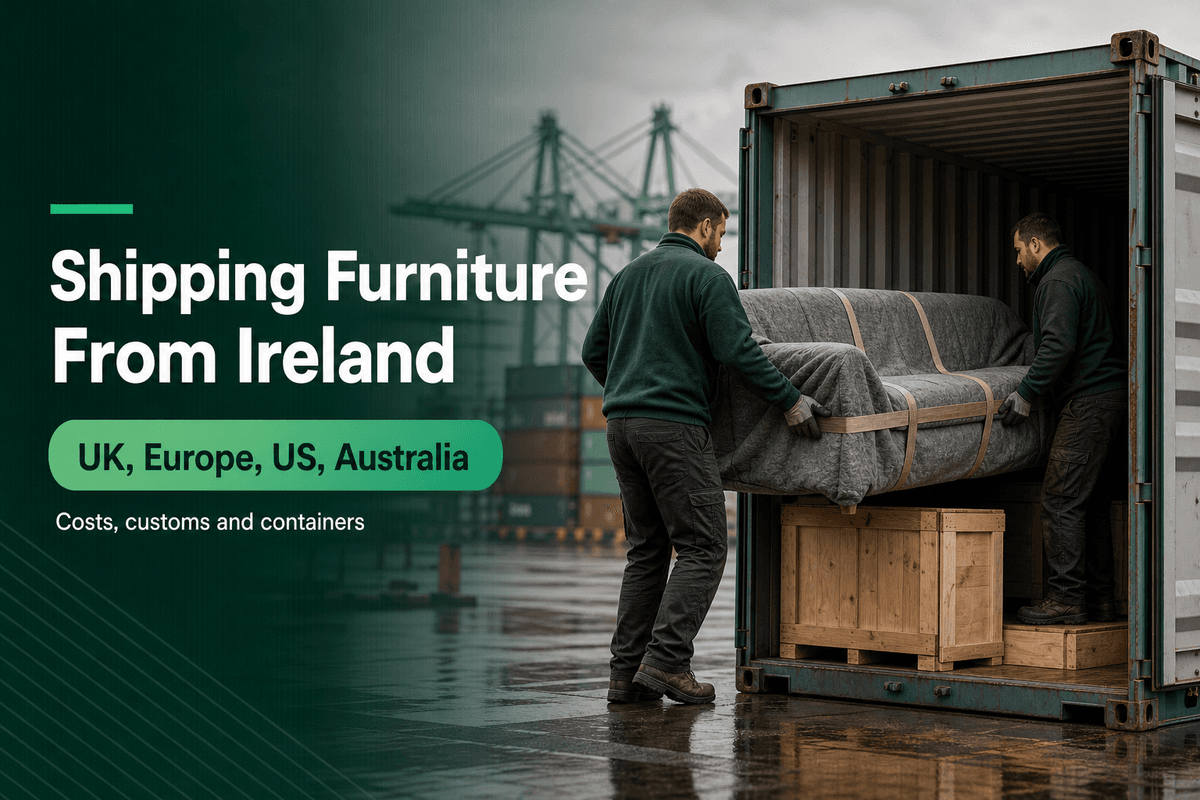
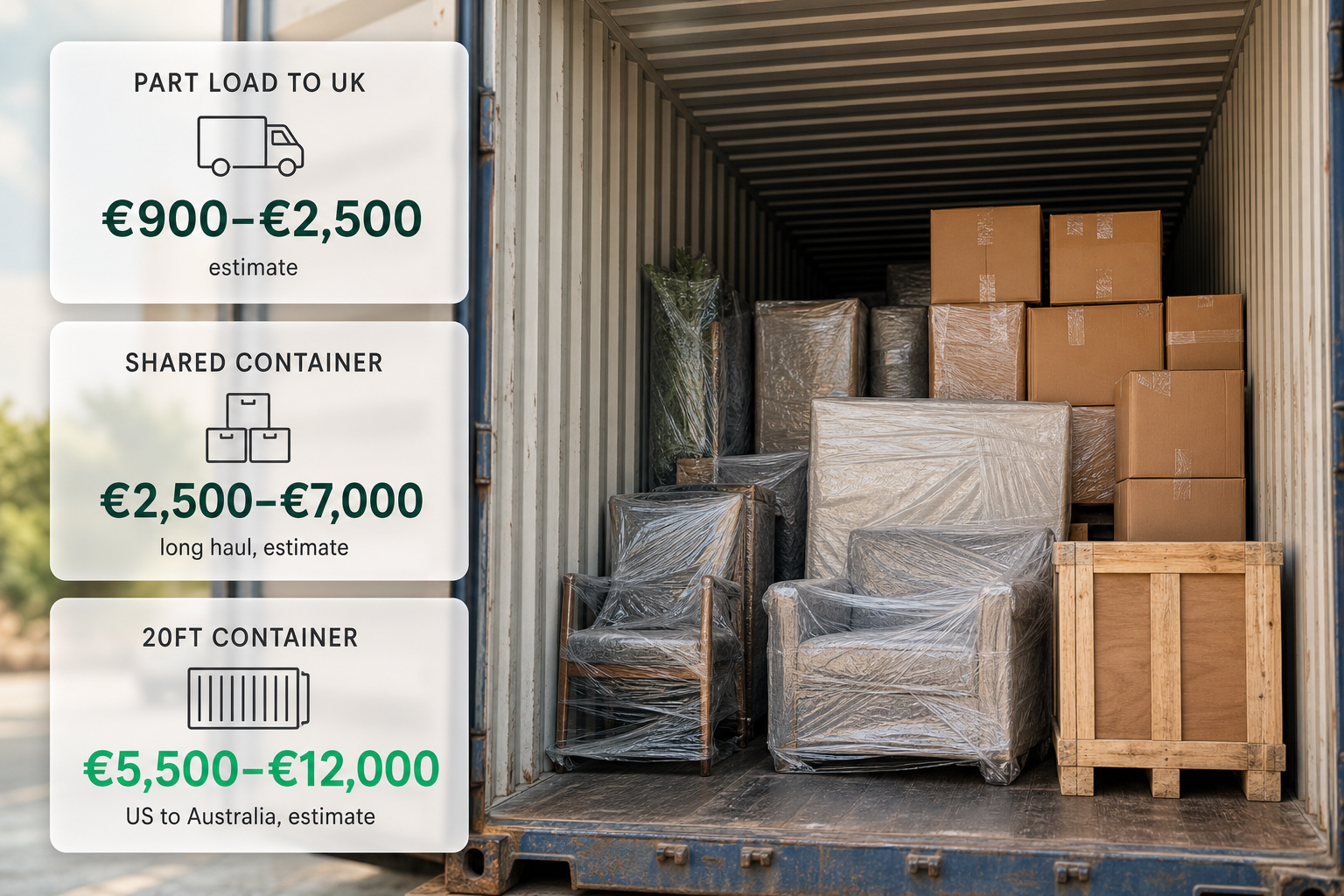
Shipping furniture from Ireland usually costs between €150 for a single item sent to the UK on a pallet and €16,000 or more for a whole house packed into a 40ft container bound for Australia, as an aggregate Irish market estimate including VAT where it applies. Most moves land somewhere in between: a part load to Britain often costs €900 to €2,500, a shared container to North America or Australia €2,500 to €7,000, and a full three-bed house in its own 20ft container €5,500 to €12,000 depending on the destination. Distance matters less than volume, the type of shipment and the customs paperwork at the other end. People planning a move abroad can post the job under furniture transport and compare quotes from carriers who handle international work.
Shipping furniture from Ireland: prices at a glance
The figures below are an aggregate Irish market estimate for door-to-door moves from Ireland, including packing and loading but not destination duties, storage or optional insurance.
| Shipment | Typical price | Typical transit time |
|---|---|---|
| Single item such as a sofa or wardrobe to the UK by pallet or courier | €150–€450 | 3–7 days |
| Part load to Great Britain, shared van or truck | €900–€2,500 | 1–2 weeks |
| Full load of a three-bed house to Great Britain | €3,000–€6,500 | 2–7 days once collected |
| Part load to mainland Europe | €1,500–€4,000 | 1–3 weeks |
| Full load to mainland Europe | €4,000–€9,000 | 1–2 weeks |
| Shared container (groupage) to the US, Canada or Australia, a few rooms | €2,500–€7,000 | 6–14 weeks |
| Sole-use 20ft container to the US or Canada | €5,500–€10,000 | 4–8 weeks |
| Sole-use 20ft container to Australia or New Zealand | €6,500–€12,000 | 8–12 weeks |
| Sole-use 40ft container, long haul | €9,000–€16,000+ | 6–12 weeks |
| Transit insurance | Usually 2–4% of the declared value | — |
A worked example: a couple moving from a two-bed apartment in Cork to Sydney with about 15 cubic metres of furniture and boxes. In a shared container the move would typically cost €4,000–€6,500 and take three months or more, because the carrier waits to fill the container. In a sole-use 20ft container the same move costs roughly €6,500–€9,000 but sails sooner and is not unpacked or mixed with other people's goods on the way. Adding full packing by the carrier, insurance at 3% on €20,000 of goods (€600) and destination port and inspection charges can push the real total €1,000–€2,000 above the headline quote.
The four ways to ship furniture abroad
Single items by pallet or courier. For one sofa, a dining table or a few boxes, a pallet service or specialist furniture courier is usually cheapest. The item is wrapped, strapped to a pallet and moved through a freight network. It suits the UK and mainland Europe; for long-haul destinations a single item often costs almost as much as a small shared container.
Part load by road. The removal company fills one truck with several customers' goods heading the same way. It is the usual choice for a flat or a few rooms going to Britain or Europe. It is cheaper than a full load but less flexible on dates, because the truck leaves when it is full.
Shared container (groupage). For overseas moves, goods are packed into crates or liftvans and consolidated with other shipments in one container. It suits anything from a few items to a small apartment. It is the cheapest way to send a modest load to the US, Canada, Australia or New Zealand, but transit times are longer and less predictable.
Sole-use container. The whole 20ft or 40ft container is reserved for one household. A 20ft container generally takes the contents of a two- to three-bed home, and a 40ft suits a larger family home. It costs more, but the container is sealed at the door, sails on a fixed booking and is opened only for customs or biosecurity checks.
Moving furniture from Ireland to the UK after Brexit
Since Brexit, Great Britain is outside the EU customs union, so household goods moving from Ireland to England, Scotland or Wales cross a customs border. A removal company handling the move normally prepares the export and import declarations. Getting the paperwork right is what keeps the furniture from being held or charged duty at the port.
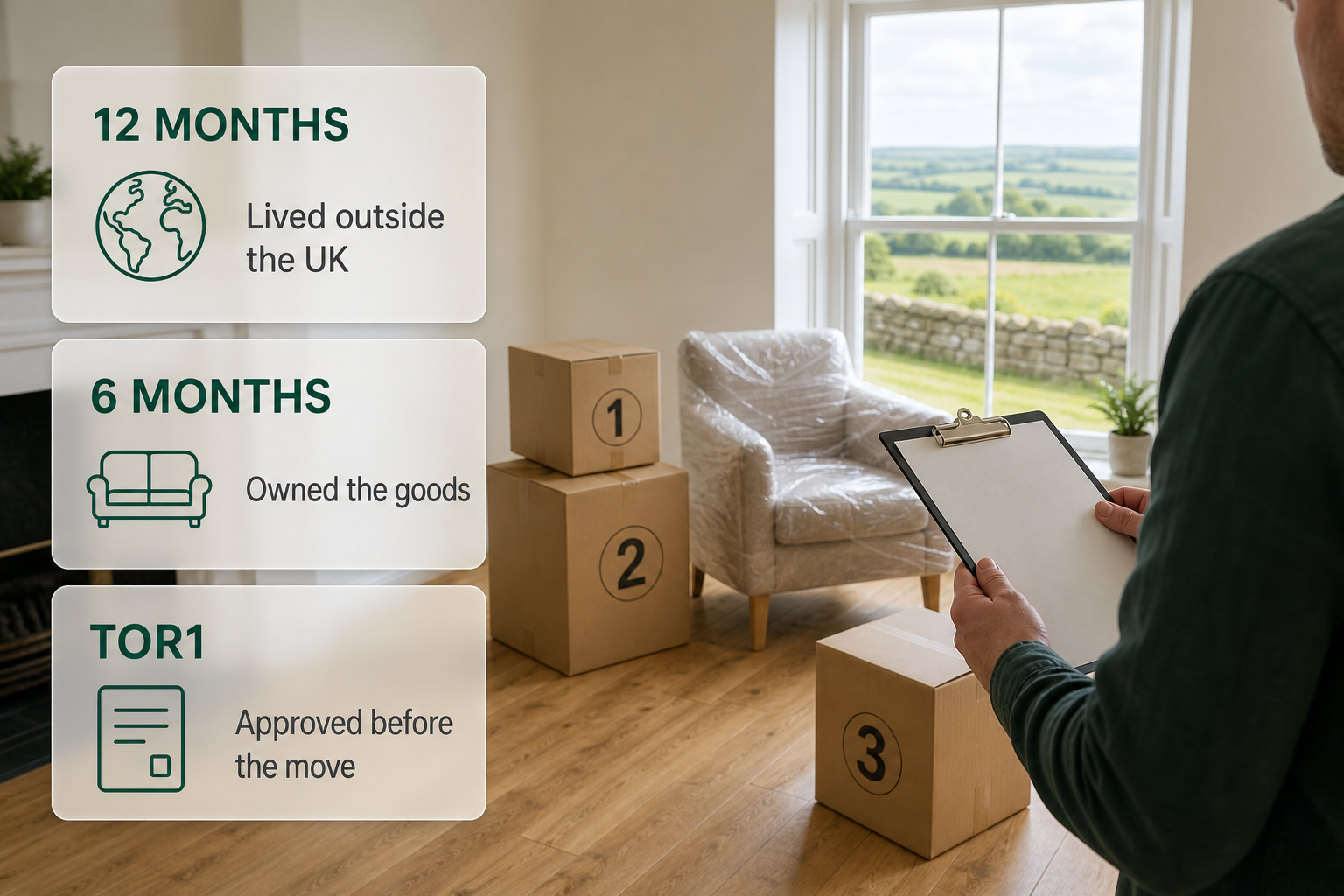
The main relief is Transfer of Residence. According to GOV.UK guidance on Transfer of Residence relief, it generally applies when:
- the person has lived outside the UK for at least 12 consecutive months before the move;
- the goods have been owned and used for at least 6 months;
- the goods are brought in within 12 months of moving, and they can arrive in more than one consignment;
- the goods will be used for the same purpose in the UK;
- approval is obtained from HMRC on form ToR1 before the goods are claimed.
Goods brought in under the relief cannot be lent, hired out, used as security or transferred to someone else within 12 months. Alcohol, tobacco, commercial vehicles and goods from a holiday home are excluded. Without the relief, customs duty and VAT can be charged on the value of the goods plus shipping and insurance, so the form is worth sorting out before the truck is booked.
Moving from Ireland to Northern Ireland is different. Under the post-Brexit arrangements for Northern Ireland, personal belongings moving from the EU usually carry no tax or duty, and there is no customs border to cross on the island, as GOV.UK notes for moves to Northern Ireland.
Moving furniture to the EU, the US, Canada and Australia
Mainland Europe. Moving within the EU means no customs declarations for personal belongings, so the price depends mainly on volume, distance and ferry route. Direct sailings from Rosslare and Dublin to France avoid the land bridge through Britain and its customs formalities, which some carriers prefer for EU moves.
The US and Canada. Household goods are shipped by sea through an east coast or west coast port, then delivered inland by truck. Both countries expect a customs declaration and a detailed inventory, and returning residents and new immigrants usually qualify for duty-free entry on used personal belongings. The removal company's destination agent normally handles clearance.
Australia and New Zealand. These are among the strictest destinations for biosecurity. The Australian Department of Agriculture asks owners to clean outdoor furniture, garden tools, barbecues and camping gear before shipping, to check wooden furniture for small holes or fine powder that can signal wood borers, and to declare items of concern on the Unaccompanied Personal Effects Statement (B534). Cane, rattan, wicker and bamboo items get extra attention. Inspection, treatment or destruction of goods is at the owner's expense, so a clean, well-labelled shipment is cheaper to clear.