
Septic tank costs in Ireland depend on the job. As an aggregate Irish market estimate including VAT, desludging a domestic septic tank usually costs €150 to €300, a new conventional septic tank with a percolation area costs €6,000 to €12,000, and a packaged wastewater treatment system costs €8,000 to €15,000 installed. Repairs range from a few hundred euro for a broken pipe or baffle to €4,000 to €9,000 for a new percolation area. Households whose system fails a council inspection may qualify for a grant of up to €12,000, covering 85% of the cost of the work. Homeowners who need a tank emptied or checked can post the job under septic tank desludging and compare quotes from local operators.
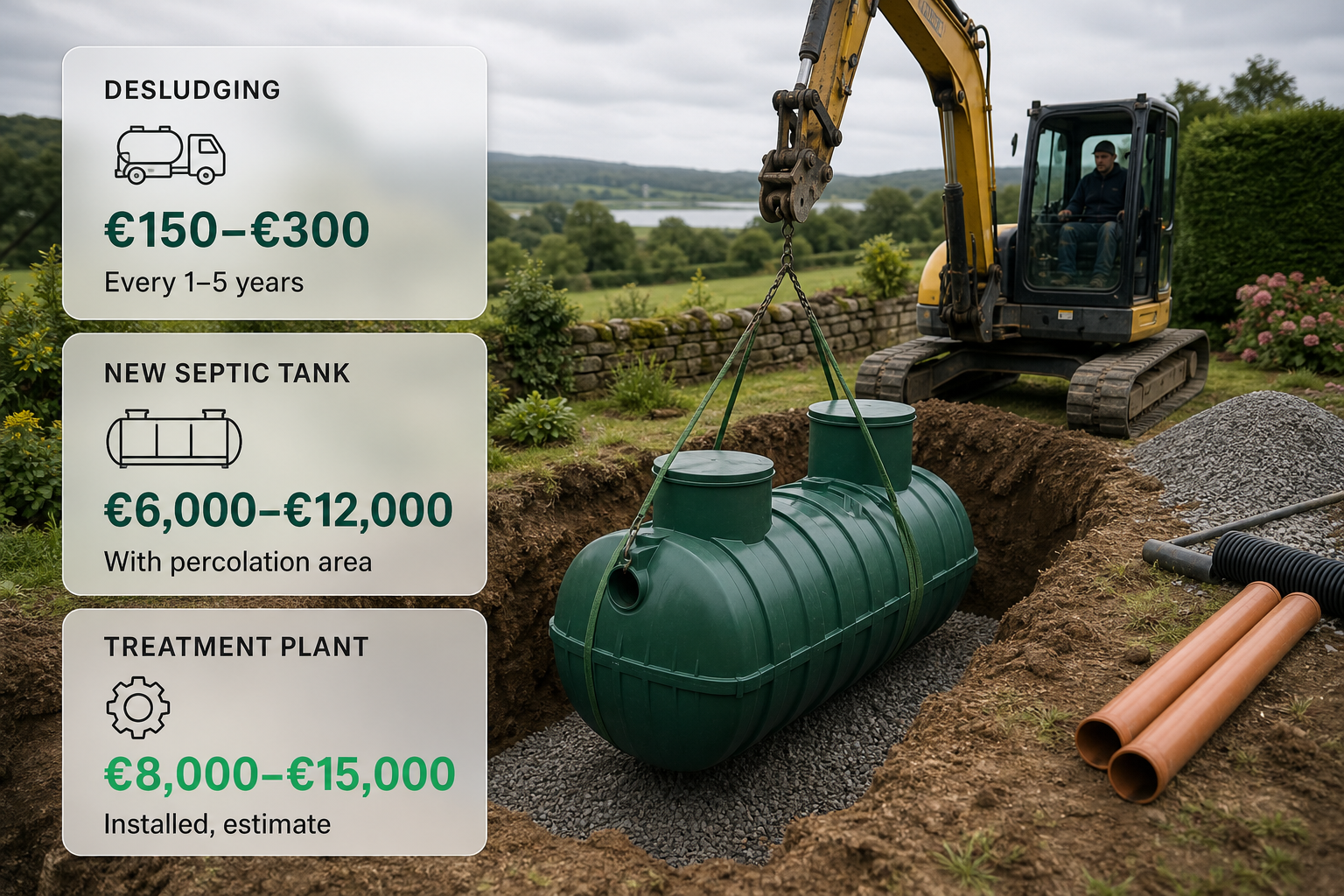
Septic tank prices at a glance
The figures below are an aggregate Irish market estimate, VAT included, for a typical rural house with three to four bedrooms.
| Job | Typical price |
|---|---|
| Desludging (emptying) a domestic septic tank | €150–€300 |
| Annual service of a packaged treatment plant | €150–€350 |
| CCTV survey of pipes from house to tank | €150–€350 |
| Repair of inlet or outlet pipes, baffles or tees | €300–€1,500 |
| Site suitability assessment for a new system | €400–€900 |
| New percolation area only | €4,000–€9,000 |
| New conventional septic tank with percolation area | €6,000–€12,000 |
| Packaged wastewater treatment system with polishing filter | €8,000–€15,000 |
| Raised percolation area on poor ground | €10,000–€20,000 |
The biggest swing in price comes from the ground. Where the soil drains well, a standard tank and percolation area may be enough. Where the soil is heavy clay, the water table is high or bedrock is close to the surface, a treatment plant and a raised or imported-soil filter are often needed, and the cost can double.
A worked example: a four-bed bungalow in County Mayo with an old concrete septic tank that failed a council inspection because effluent was ponding on the surface. A site suitability assessment costs about €600, a new packaged treatment plant €4,000 to €6,000 supplied, installation with a new polishing filter and pipework €5,000 to €8,000, and removing or decommissioning the old tank €500 to €1,000. The total comes to roughly €10,100 to €15,600. If the household qualifies for the grant at 85%, the grant would cover about €8,600 to €12,000 of that, leaving around €1,500 to €3,600 to pay.
How often should a septic tank be desludged?
According to Meath County Council, a system should be desludged by an authorised operator every 1 to 5 years, at intervals that suit the size of the tank and the number of people living in the house. A household of two in a large tank can go longer; a family of five in an older, smaller tank may need it every year or two.
Signs that a tank needs emptying or attention:
- toilets and sinks draining slowly, or gurgling noises in the pipes;
- a sewage smell near the tank or in the garden;
- wet, spongy or unusually green grass over the percolation area;
- sewage backing up into the house.
A desludging operator should hold a waste collection permit and take the sludge to an approved treatment facility. Asking for a receipt showing the date and the volume removed is useful if the council inspects the system later.
The law: registration and inspection
Under the Water Services (Amendment) Act 2012, every owner of a domestic wastewater treatment system, including a septic tank, must have it registered with the local authority. The same law set up a national inspection system. Councils inspect a share of systems each year under the National Inspection Plan, and Meath County Council notes that households due for inspection are notified in writing in advance.
The owner is responsible for keeping the system working properly. That means knowing where the tank and percolation area are, having it desludged and maintained, making sure rainwater from roofs and yards does not drain into it, and making sure it does not discharge sewage to the ground surface or to a stream or ditch. A system that fails inspection gets an advisory notice setting out what has to be fixed and by when.
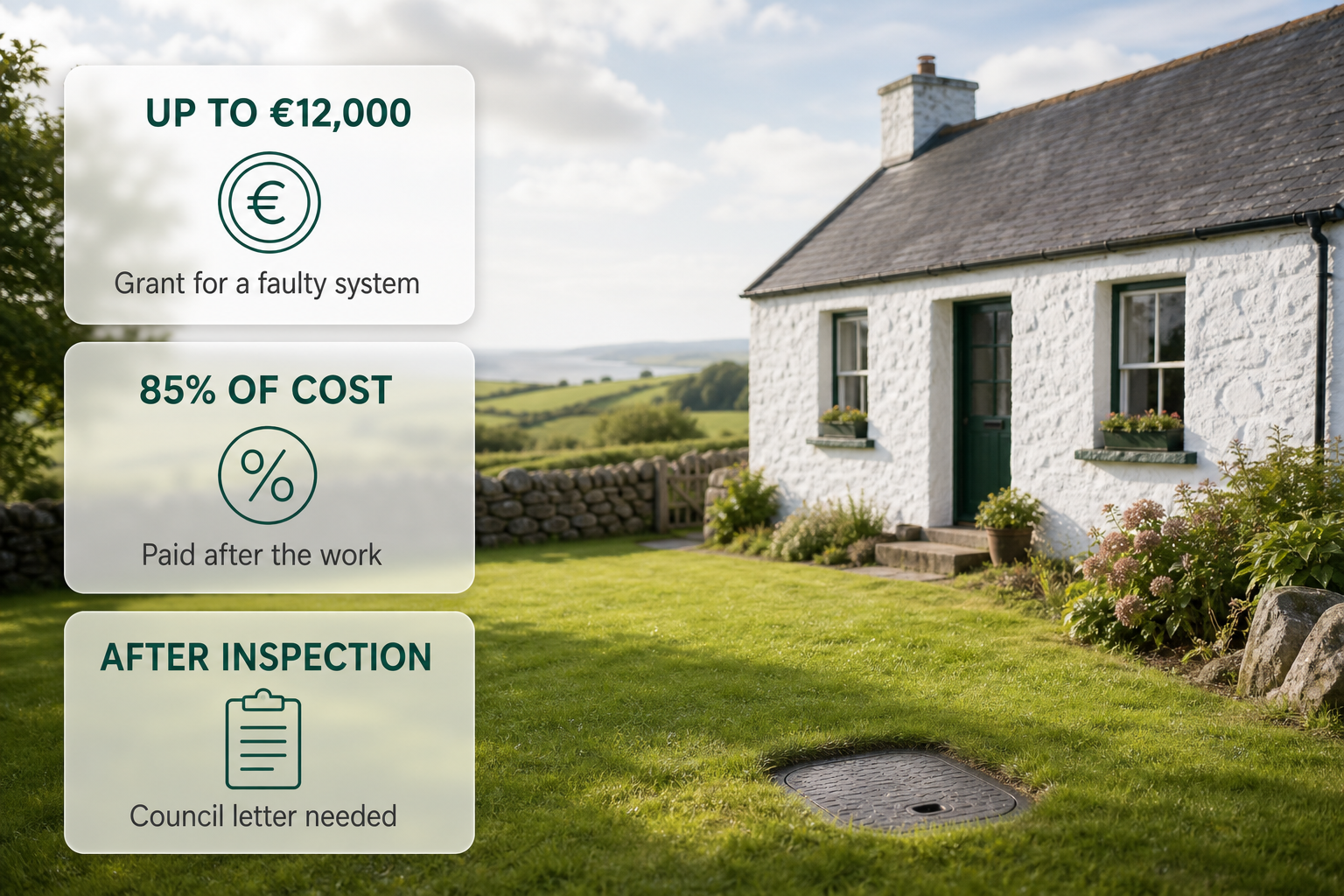
Septic tank grants
The Domestic Waste Water Treatment System grant helps with the cost of fixing a faulty system. According to gov.ie, the maximum grant rose from €5,000 to €12,000 from 1 January 2024, and the rule that a system had to be registered before 1 February 2013 was removed.
According to localgov.ie, the grant covers 85% of the cost of the works needed to fix the system, up to €12,000. The main conditions are:
- the household has received a letter from the local authority saying a fault was found after an inspection, or the house is in an area covered by one of the targeted schemes for river catchments;
- the house is permanently occupied and is not a holiday home;
- the house was built at least seven years ago, and no grant has been paid for the system in the last seven years;
- the grant is paid after the work is completed to the council's satisfaction.
Routine desludging, servicing and maintenance do not qualify. There is also no grant for a new system on a new house. Applications go to the rural water section of the local council, and it is worth contacting the council before starting work, because paying for work first and applying afterwards can put the grant at risk.
Septic tank or treatment plant?
A conventional septic tank separates solids from liquid, and the liquid then soaks away through a percolation area of perforated pipes in gravel trenches. It has no moving parts and no electricity, so it is cheap to run, but it relies entirely on suitable soil for treatment.
A packaged wastewater treatment plant treats the effluent inside the unit, usually with air pumped in by a small blower, before it goes to a polishing filter. It produces cleaner effluent, suits poorer ground and smaller sites, but costs more to buy, uses electricity and needs an annual service.
On a new house, the choice is set by the site suitability assessment carried out to the EPA code of practice, not by preference. On an existing house, the choice depends on why the old system failed.