
A Waterford homeowner usually notices roofing trouble the same way, by accident. A quiet stain on the hallway ceiling after a windy night, a missing slate on the driveway, or a drip that only appears when rain is driving in off the coast.
That is the point where delay becomes expensive. Waterford's mix of exposed weather, older city stock, and estate housing means a roof problem can stay small for a while, then turn into a larger repair fast. The right move is to identify the roof type, judge whether the damage is urgent, check what rules apply, and compare local roofers on facts rather than sales talk. For local context, start with the Waterford roofing area page before making any call.
Introduction to Waterford Roofing Guide
A stormy weekend is enough to expose a weak roof in Waterford. The roof may have looked fine from the street on Friday, then a slipped slate, a tired flashing, or blocked guttering shows itself on Monday morning. That is usually when homeowners realise the job is no longer cosmetic.
Waterford homes are not all built the same, and the roof on each one behaves differently. Estate houses often carry concrete tile, older city stock often carries natural slate or fibre-cement slate, and extensions or garages often use flat roof membranes. Coastal exposure matters too, because wind uplift, salt air, and driven rain punish weak fixings and poor detailing.
There are two traps to avoid. The first is assuming every visible defect needs a full replacement. The second is assuming a roofer can start without checking planning, access, and Building Regulations. The sensible route is simple, understand the roof type, budget for material and scaffolding, ask for proper paperwork, and compare local options before agreeing anything.
For homeowners trying to shortlist roofers Waterford has a strong local pool, so there is no reason to settle for a vague quote or a rushed visit. A good roofer should explain the problem clearly, price the work fairly, and say what happens if weather interrupts the job. If they cannot do that, they are not the right fit.
Understanding Roofing Types and Materials in Waterford
The main roof types homeowners will see
Waterford follows the standard Irish pattern. Concrete tile is common on modern estates and Celtic Tiger-era housing, natural slate and fibre-cement slate are common on older city stock, period property, and homes in conservation areas, and felt, EPDM, or GRP appears on flat roofs over extensions, dormers, and garages. The material choice matters more than most homeowners think, because it shapes cost, appearance, lifespan, and how the roof handles exposure.
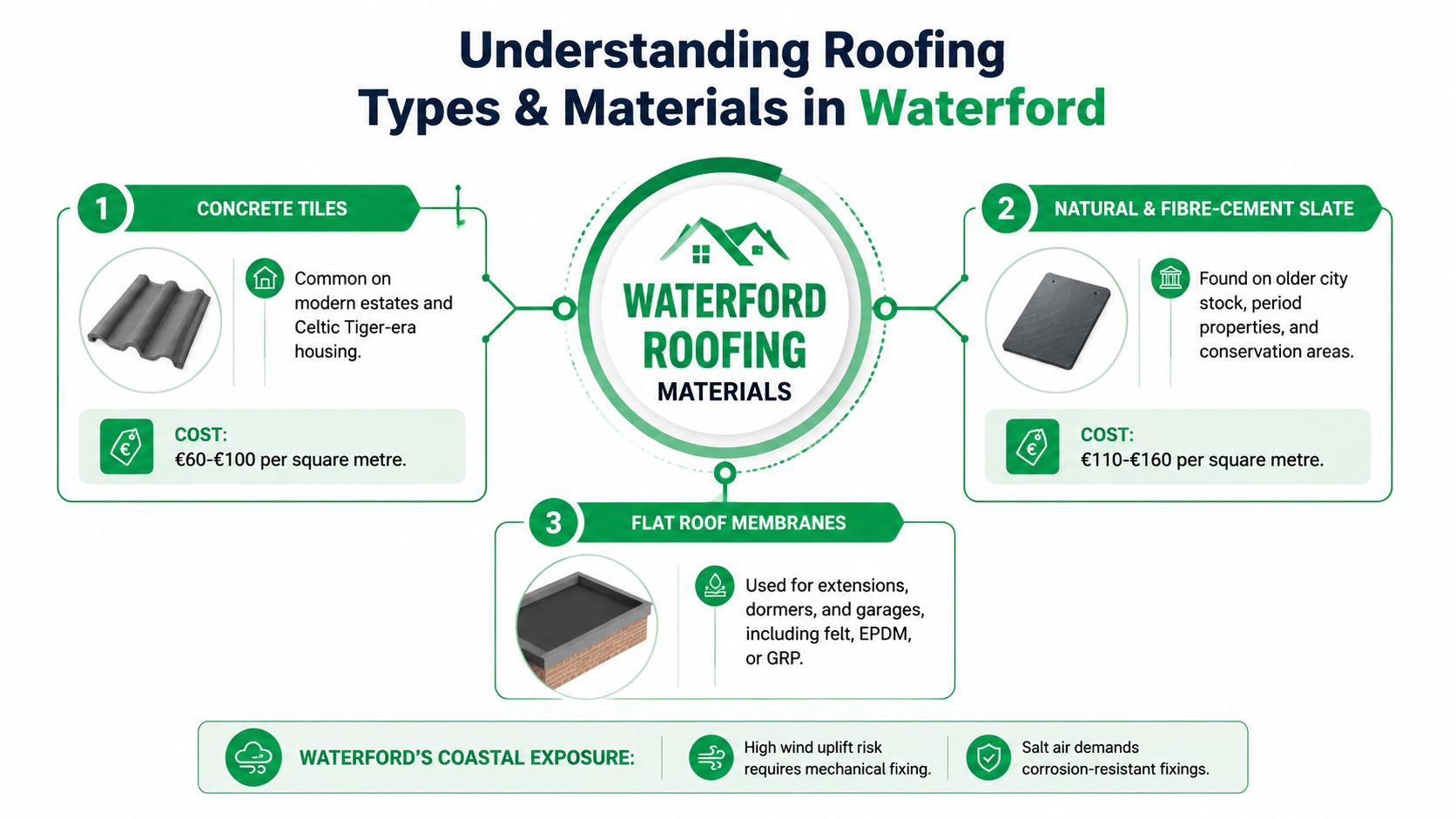
Concrete tile is the practical default for many newer homes. It suits pitched roofs well and usually gives a lower material cost than slate, with €60 to €100 per square metre as the working figure for the roof area. A homeowner should still check how the tiles are fixed, because in an exposed county the issue is not just the tile, it is how well the roof resists wind uplift.
Natural slate is the more traditional look and is still the right choice where the house, street, or planning status calls for it. It sits at €110 to €160 per square metre for the roof area, so the material itself already pushes the budget up before labour or access is added. On older houses, that is often the right spend because the roof has to match the character of the building, not just keep out rain.
Practical rule: on exposed sites, a neatly installed roof is not enough. Mechanical fixing matters more than old bedding habits, especially at ridges, verges, and other edges where wind gets under the roof cover.
Flat roofs need a different eye. Felt, EPDM, or GRP works well on extensions and garages, but the detailing around upstands, flashings, and drainage is what decides whether the roof stays dry. Waterford's coastal weather is unforgiving, so a roofer should talk plainly about fixings, flashings, and corrosion resistance, not just the visible finish.
For more on local roofing services, see the roofing services page.
Estimating Roofing Costs
What a real roofing budget has to include
A roof quote that looks cheap at first glance is often missing something important. The headline price can leave out scaffolding, access, waste removal, making good, or other enabling work, and those extras are not optional on most jobs. In Waterford, the homeowner should ask for the full scope in writing before comparing numbers.
| Roofing Material Cost Comparison | Cost per m² | Typical 3-Bed Semi Cost |
|---|---|---|
| Concrete tile | €60 to €100 | €10,000 to €15,000 |
| Natural slate | €110 to €160 | €13,000 to €18,000 |
Those figures give a realistic starting point for a full re-roof in Ireland. A full roof replacement typically runs €9,000 to €20,000, and scaffolding is often quoted separately at €800 to €3,000. That scaffolding line matters because it can change the total sharply, especially where access is awkward or the house is taller than average.
VAT also needs attention. Construction, renovation, and repair services are generally 13.5%, so every quote should be checked to see whether VAT is already included. On a €12,000 job, VAT adds over €1,600, which is too much to discover late in the process.
One point worth stating plainly: there is no SEAI grant for re-roofing itself. Replacing a roof covering is maintenance, not an energy upgrade. The adjacent work that does attract SEAI support is attic insulation, and since scaffolding and access are already paid for during a re-roof, it can be worth pricing both at the same time. Check current attic insulation grant values on seai.ie before budgeting.
Recognising When to Call a Roofer
Signs that should move a roof to the top of the list
A slipped or cracked tile after high winds is the obvious warning, but it is not the only one that matters. In Waterford's coastal setting, wind uplift is the main structural risk, so one loose piece can point to a wider fixing problem across the slope. A single visible fault should not be treated as a one-off until the rest of the roof has been checked.
Blocked gutters and valleys need attention because they feed water into places where it should never linger. North-facing slopes often hold moss and lichen, and that growth can lift covering materials and slow drainage. If the roof has lead flashing around a chimney, a failed joint there can be the start of a persistent leak long before the ceiling shows a stain.
A homeowner should photograph every fault before anyone starts work. A clear set of pictures makes it easier to separate surface damage from signs of a wider failure.
What counts as urgent
The urgent jobs are the ones that let water in or threaten more movement. That includes missing slates, cracked flashings, loose ridge details, and any roof edge that seems to have shifted after a storm. A roofer should also look at rooflights, valleys, and chimney abutments, because driven rain finds weak points there first.
A small repair can still signal a bigger issue if the same detail is failing across more than one part of the roof. That is why homeowners should not wait for the next storm before acting. If a defect is visible now, the safer move is to get it documented and priced before weather has another go at it.
Vetting Roofers and Questions to Ask
Start with insurance and a written guarantee
Roofing is not a regulated trade in Ireland, so there is no licence register to lean on the way there is with gas or electrical work. That puts the burden on the homeowner to ask for current public liability insurance, a written scope of work, and references from similar roofs in Waterford. Without those three things, the quote is not strong enough.
The guarantee matters too. Ask what workmanship guarantee is offered and get it in writing before signing. Many Irish roofers offer ten years or more on workmanship, and manufacturer warranties on the materials themselves are usually longer. A roofer who will not put the guarantee in writing is not making the homeowner's life easier.
The eight questions that separate real professionals from fast talkers
What exact roofing material is being proposed, and why is it the right fit for this house?
Is the quote including scaffolding, access, waste removal, and making good, or are those separate?
What public liability insurance is in place right now?
What written workmanship guarantee comes with the job?
How will the roof be mechanically fixed against wind uplift on this site?
What temporary weatherproofing will be used if rain interrupts the work?
Can references be shown from similar local roofs, not just general claims?
Who is responsible for permits, licences, and any council paperwork?
These questions force clarity. They also expose sloppy quoting quickly, which is exactly what homeowners need before a wet week makes the decision for them.
Navigating Permits Building Controls and Insurance
Planning rules are simpler than most people think, until they are not
Ordinary like-for-like re-roofing is generally treated as exempted development in Ireland, because it does not materially affect the external appearance of the house. Replacing a roof with the same or a closely matching material is usually fine without planning permission. The trouble starts when the property is protected, sits in an ACA, or the roof appearance changes.
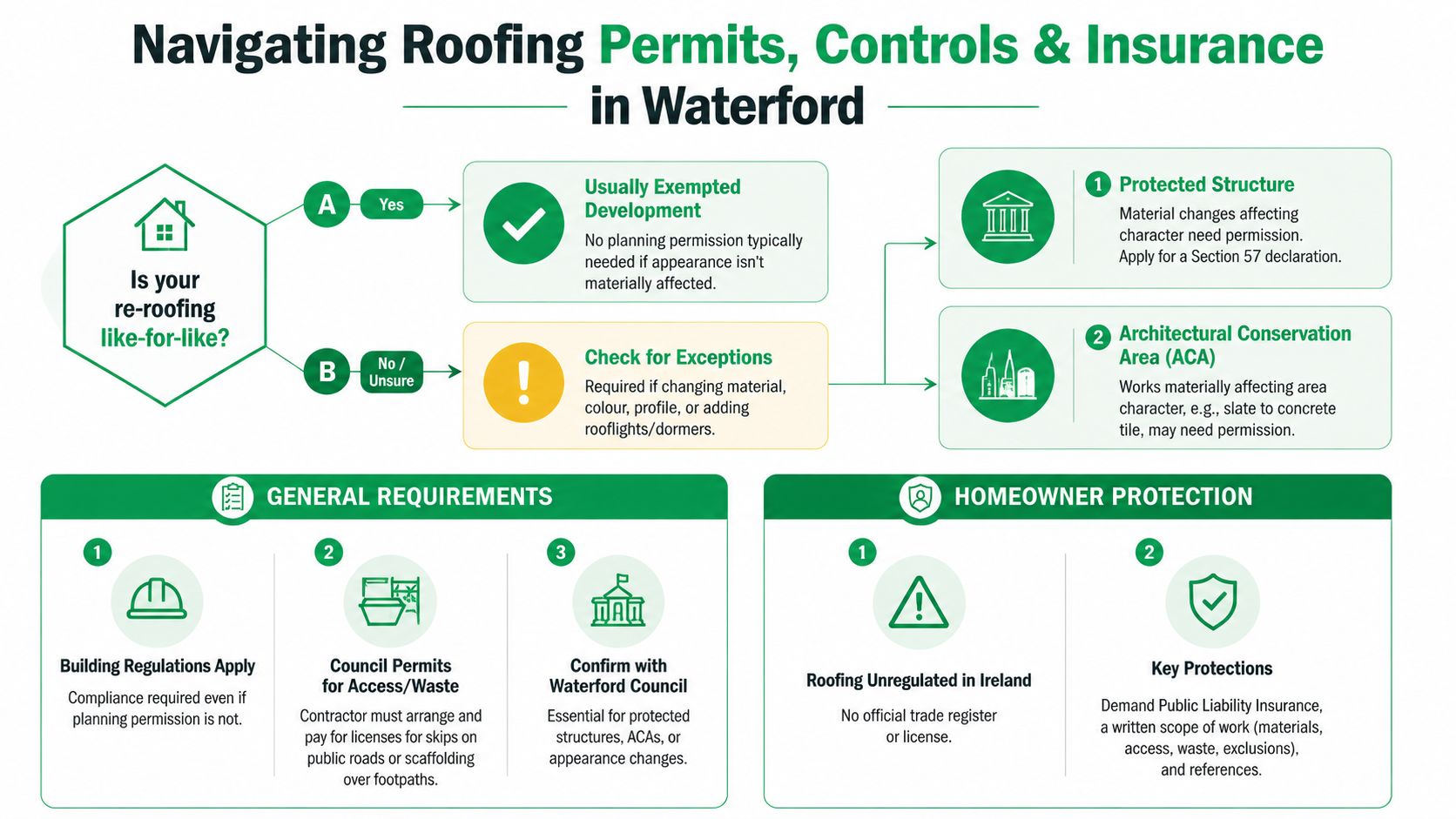
Protected structures need extra care. If works would materially affect the character of the building, planning permission can be required even where the same work would be exempt on a normal house. Waterford has a substantial stock of protected structures, so this is not a corner case.
Architectural Conservation Areas are similar in principle, but the test is whether the works would materially affect the character of the area. Changing from natural slate to concrete tile in an ACA is exactly the sort of material change that can trigger planning issues. Under Section 57 of the Planning and Development Act 2000, the owner of a protected structure can apply to Waterford City and County Council for a free written declaration to remove the guesswork.
Building control and access licences still matter
Planning permission is not the same thing as Building Regulations, and the work must comply with the building rules even where planning is not needed. Routine repair - replacing slates or tiles on an existing structure, repairing flashings and valleys, repointing ridge tiles — is generally treated as maintenance. Where the work goes further, such as altering the roof structure or affecting fire or ventilation performance, a Commencement Notice may be required, and it must be lodged with the local Building Control Authority no later than 14 days before work starts. If there is any doubt, check with Waterford City and County Council before the job is booked.
If a contractor says no paperwork is needed, that answer is only acceptable after the property has been checked properly against the work scope.
Access and waste are separate again. A skip on a public road and scaffolding over a public footpath both need the correct licence or permit from Waterford City and County Council, and the homeowner should ask who is arranging and paying for that. Roofing is already complicated enough without discovering late that the public road, the footpath, or the roof design adds another layer of admin.
Using ShamFix to Compare and Hire Local Roofers
How to compare roofers without the usual noise
Waterford has a solid local pool of roofers, so the better decision is to compare written scope, insurance, guarantee and review history rather than rely on the first person who answers the phone.
ShamFix is useful here because it is built around a marketplace model, not a pay-per-lead race. The platform uses an AI concierge as a routing tool, then lets customers compare local providers through reviews and ratings from both sides after completed work. That matters more than badges, because the only trust that counts is earned through real transactions.
The right way to use it is simple. A homeowner can place the job, review how each roofer presents their own credentials, and shortlist the people who look strongest on insurance, scope, and guarantee length. The place-task page is the starting point when the job is ready to be compared.
Useful filter rule: pick the roofer who explains the roof, not the one who sounds busiest.
ShamFix does not carry out the work, verify documents, or approve providers. Each roofer is responsible for their own trade registration where one exists, and roofing in Ireland is not one of the trades with a public licence register. That is exactly why the homeowner should combine platform reviews with direct checks on insurance and paperwork.
Conclusion and Next Steps
The safest roofing decision in Waterford is the one that starts with the roof type, not the sales pitch. Concrete tile, slate, and flat roof membranes each have their place, but the material choice, the fixing method, and the access costs often matter more than the contractor's name on the van. Once the homeowner understands that, the rest becomes much easier to manage.
The next step is to price the work properly, including VAT, scaffolding, and any council permissions. After that, the filter is straightforward, insurance, a written guarantee, a clear scope, and evidence of similar local work. Waterford's weather is not forgiving, so roofing should never be treated as a casual purchase.
Use that discipline before the next storm season turns a small defect into a bigger bill. Compare local roofers, ask the awkward questions early, and choose the one who answers cleanly.
ShamFix is an Ireland-only marketplace based in Clifden, County Galway, founded in 2025. It does not carry out, manage, vet, verify or guarantee the work. Providers state their own credentials, and customers should confirm insurance directly. Trust on the platform comes from a two-sided review system, with providers and customers rating each other after completed work. For a Waterford roof, describe the roof type and the symptom rather than just asking for a price, ask for the scope in writing, and compare what each roofer says they will actually do.