Painters in Cork commonly work to a day rate of roughly €200–€350, a single room often lands at €300–€600, and a full 2–3 bed house interior is broadly €1,400–€4,000. Those figures exclude VAT at 13.5%, and they may or may not include materials unless the quote says so.
That is the starting point, not the finish line. In Cork, the cheap quote usually looks attractive only because it has skipped prep, coats, materials, access, or the awkward damp patch by the window. ShamFix publishes this guide. The providers below are described from their own public information; we have not vetted them.
What a Painter Decorator in Cork Actually Costs in 2026
Cork homeowners should treat a decorator's quote as a scope document first and a price second. The market is broad enough to compare properly, because Cork accounts for 104 of the 228 painters listed by Paint Ireland, or about 45.6% of that directory's Irish painter count, which points to a busy local supply base rather than a thin niche market. Paint Ireland is the clearest live directory signal in the verified data.
Start with the right benchmark
A sensible Cork comparison starts with €200–€350 a day, a single room at €300–€600, and a 2–3 bed interior at €1,400–€4,000. Those are the figures to sanity-check against, not the final quote to accept blindly. The spread comes from prep, ceiling height, trim detail, staining, access, and whether the painter is supplying paint, consumables, and touch-up time.
Practical rule: the cheaper quote is usually not cheaper, it is thinner. It has cut prep, reduced coat count, or left out materials and finish-up.
The Cork-specific wrinkle is that the county has enough decorators to shop around, but not enough regulation to protect a homeowner from a vague estimate. Painting and decorating is an unregulated trade in Ireland, so there is no licence register to check and no national badge that proves quality. The homeowner's protection is the written scope, insurance, references, and recent local work.
What sits outside the headline price
A proper comparison must separate the headline painting price from the jobs that often sit outside it. Scaffolding, access, waste removal, making good, furniture moving, and extra prep can all move the number sharply if they are missing from the first quote. In practice, the cheap quote is often the one that assumes the room is already perfect, which is not how occupied homes work.
One more detail matters. The buyer should confirm whether the price includes materials and VAT. In Irish decorating work, that question is not pedantic, it is the difference between a quote that is close to the final bill and one that lands much higher once the job starts.
Where to Find Painter Decorators in Cork
The best Cork search is still a local one. Ask neighbours, scan the estate WhatsApp or Facebook group, check Google Business Profile listings, and use a trade directory as a backup rather than a starting point. Each route does a different job, and relying on just one is how homeowners end up with a slick advert and no recent proof of local work.
Use word of mouth for trust
Neighbours and friends are useful because they can tell a homeowner what the decorator was like on site, not just what the finish looked like on day one. A painter who showed up on time, protected floors properly, and came back for a snag list is worth more than a glossy social post. In Cork, that local repetition matters because many jobs are in the same estates, terraces, and suburbs, so reputation travels fast.
Use local groups and profile listings for evidence
Facebook community groups for Cork City, Ballincollig, Douglas, Carrigaline, and Cobh are worth a search because they often surface names that have already worked nearby. Google Business Profile is better for proof, especially when the reviews mention specific Cork streets, room types, or exterior work rather than generic praise. Photos matter too, but only if they show real rooms, edges, and finished details rather than stock-looking close-ups.
A useful search route is to compare the provider's own public pages with a Cork service page such as the painting and decorating listings for County Cork. That gives a single place to start, but the homeowner still has to do the checking.
Paid lead models can add cost without adding trust. A profile, some photos, and a phone number are not enough on their own, especially in a labour-heavy trade where the finish is only half the story.
Use directories last, not first
Trade directories are handy for building a shortlist, but they are not proof of good work. A directory can help a homeowner find names quickly, yet the key filter is whether the decorator can show recent Cork jobs, responsive communication, and specific references. If that evidence is missing, move on.
How to Vet a Painter Decorator Without a Licence Register
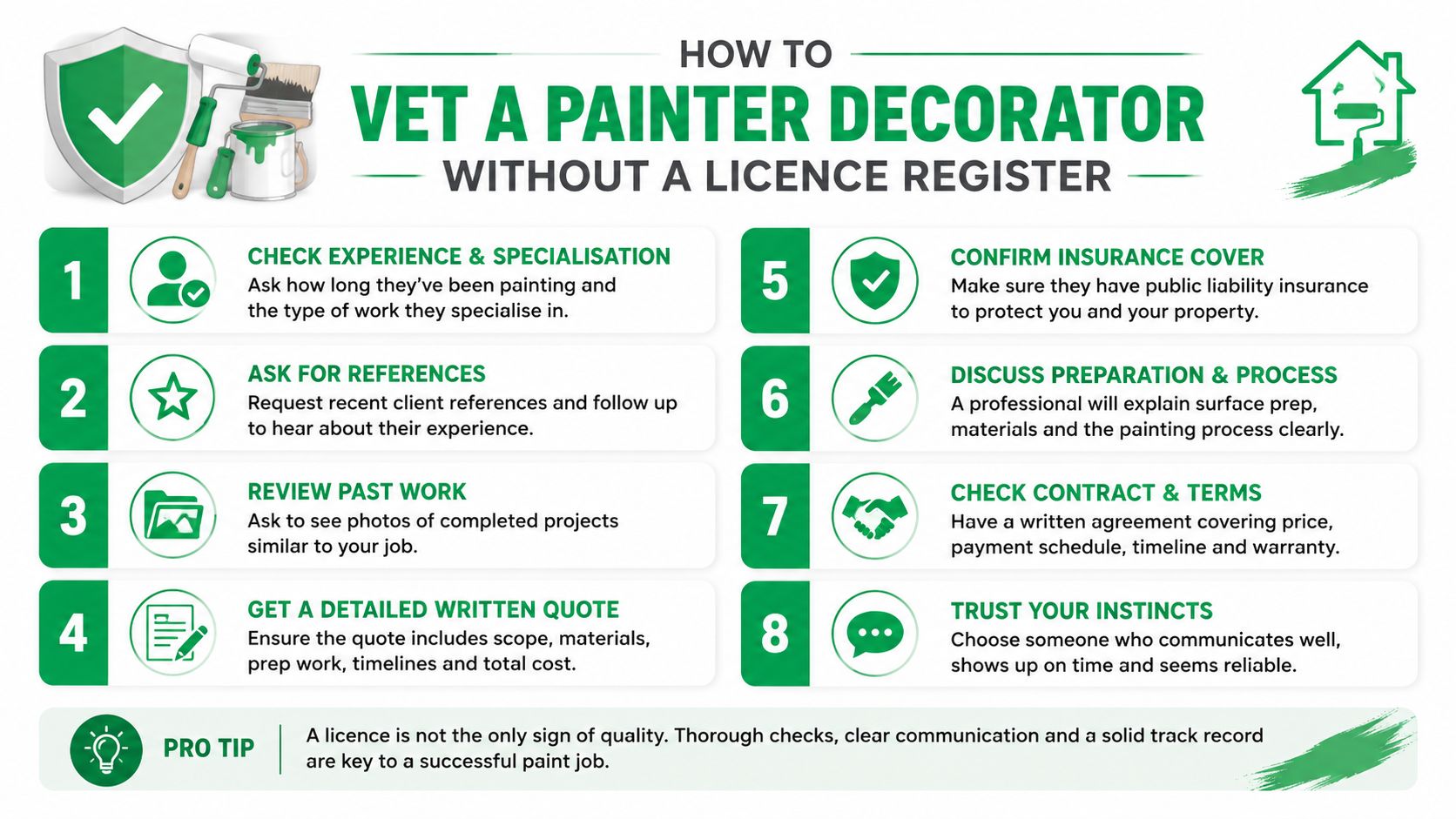
Painting and decorating in Ireland is not regulated, so there is no central licence to check and no statutory register that proves competence. That makes the homeowner's questions more important than the logo on the van. Insurance, written scope, and recent local proof are the essential protection.
Ask for the basics in writing
A Cork homeowner should ask for public liability insurance, a written scope, and a breakdown of what is included and excluded. The scope should name the rooms, the prep, the number of coats, who supplies the paint, and whether small repairs or stain blocking are included. If the decorator hesitates to write it down, that is a warning sign.
Check the site-safety paperwork
Irish job ads for this trade commonly require Safe Pass and Manual Handling. One Indeed Cork listing states “Safe Pass, Manual Handling Required,” and another says “Applicants must hold a current Safe Pass and Manual Handling certificate.” That does not make the trade regulated, but it does tell a homeowner what many employers expect in practice. Indeed Cork painter and decorator jobs
Verify recent local work, not vague claims
Two or three recent Cork addresses are better than a pile of adjectives. A decorator who can name recent streets, estates, or housing types is easier to judge than one who only says they “do all kinds of work.” Recent local references matter even more in Cork because weather, condensation, and older housing stock can change the job significantly from one property to the next.
If the quote is vague, the work usually will be too.
Irish apprenticeship rules also give a sense of how people enter the trade. SOLAS says the minimum age to commence employment as an apprentice is 16, and the minimum educational requirement is either Grade D in five Junior Certificate subjects, completion of an approved pre-apprenticeship course, or three years' relevant work experience gained over age 16 that SOLAS deems acceptable. That is about entry, not quality, but it shows why homeowner checks still matter. SOLAS Painting and Decorating brochure
A homeowner can also ask for a plain explanation of who will be on site, who supervises the job, and who returns for snagging. That simple conversation usually tells the truth faster than a sales pitch. For context on how ShamFix describes its own marketplace model, see what ShamFix is in Ireland.
Comparing Quotes the Right Way
Two Cork quotes for the same room can look miles apart because they are not pricing the same job. One may include full prep, two coats, materials, and touch-up. The other may only price a brush-and-roll over a room that already looks near enough perfect.
Read the line items, not the total
A proper quote should name the rooms, the prep work, the number of coats, the paint type or brand, whether paint is supplied by the decorator, and whether VAT is included. It should also state what is excluded, such as furniture moving, scaffold, waste, or making good beyond a basic patch. If the document only says “paint hall and stairs,” it is too thin to compare properly.
| Line Item |
Complete Quote |
Incomplete, Cheap Quote |
| Rooms |
Hall, stairs, landing, plus trim |
“Interior painting” |
| Prep |
Fill, sand, caulk, prime, stain block where needed |
No prep listed |
| Coats |
Two coats stated clearly |
One coat implied |
| Paint |
Paint type and who supplies it stated |
Paint not mentioned |
| Exclusions |
Access, waste, furniture, repairs listed |
Exclusions absent |
| VAT |
VAT stated clearly |
VAT not mentioned |
Fixed price or day rate
A fixed price suits a defined job with known prep and a clear finish target. A day rate works better when the scope is still moving, such as when hidden defects might appear or the homeowner is changing rooms midstream. The point is to get the arrangement in writing, because a day rate without scope is just open-ended labour.
Decision rule: if one quote is much cheaper, check whether it has omitted the prep, the second coat, or the paint supply.
The same caution applies to pre-quote pricing bands used by some Irish decorators to filter enquiries. According to Legacy Growth Partners painters and decorators guide, some decorators use bands around €600–€1,200 for most living rooms and €3,500–€7,000 for most exteriors to separate serious enquiries from tyre-kickers. Those are not a Cork rulebook, but they show why a quote should arrive with a clear scope before anyone wastes time on site visits.
A homeowner should confirm materials and VAT before comparing totals, because that is where the mismatch hides. A quote that looks low on page one can overtake a fuller quote once the missing items are added back. If the pricing still feels hard to compare, place your task on ShamFix and ask each painter to price the same scope line by line.
Cork-Specific Prep Work You Should Insist On
Prep is where a Cork painter decorator earns the money. Protecting floors and furniture, filling cracks and nail holes, sanding back rough edges, caulking gaps, washing down greasy surfaces, and priming bare plaster or patch repairs should be visible in the quote. If those words are missing, the finish will usually suffer.

Coastal air, condensation-prone rooms, and older terraces mean many Cork homes have black mould in corners, behind wardrobes, or around window reveals. Painting straight over that problem hides it for a short while, then it bleeds back through. The moisture source has to be dealt with first, then the affected area treated, then the paint applied.
The cheap quote falls apart when a wall visibly has mould and the quote does not mention treatment. A homeowner should not accept paint over contamination as a finished solution.
What a proper damp-aware prep sequence looks like
The sequence should be straightforward. First comes cleaning and drying. Then a fungicidal or anti-mould treatment on affected areas, followed by primer where needed, then a mould-resistant finish suitable for the room.
For kitchens and bathrooms, the finish should reflect moisture, not just colour. In exterior render, especially near the coast, breathable masonry paint matters because trapped moisture needs a route out. That is a practical Cork issue, not a decorative one.
If the decorator cannot explain why a wall is mouldy, the paint is not the first problem.
The homeowner should also watch for the hidden prep jobs that separate a decent quote from a bargain. A cleaned, sealed, and primed wall takes longer than a quick roll-over, and the time difference is exactly where the value sits. Cheap painters often shave the time here and call it efficiency.
Paint Types, Colours and the Matching Problem
The right question is not which brand wins. It is which paint type fits the room's moisture and wear. In Cork, that usually matters more than the colour chip on the wall.
Match the paint to the room
For bathrooms, kitchens, and other high-moisture rooms, a moisture-resistant or anti-condensation emulsion with a satin or soft-sheen finish makes more sense than a flat matt finish. Those surfaces wipe down better and stand up better to the kind of condensation Cork homes see in everyday life. For dry living rooms and bedrooms, standard matt emulsion is still fine when the room is ventilated properly.
On exterior render in a coastal county, breathable masonry paint is the sensible choice. On walls that were previously mouldy, the sequence still matters more than the label, because the moisture source has to be fixed before the finish can hold.
Why colour matching trips people up
A fresh tin of the “same” colour often does not match an older wall. Old paint fades, yellows, and changes with light, so the new patch can stand out even when the code is identical. The honest options are to repaint the full wall corner-to-corner, or to have the colour scanned and matched at a paint counter.
That is why a painter decorator Cork job should never be priced as if patching one small area is the same as repainting a whole wall. The finish only looks smooth when the old and new surfaces are handled together. Otherwise the eye catches the difference immediately.
Colour matching is not magic. It is a decision between a full-wall repaint and a matched mix.
A homeowner should ask how the colour will be handled before any paint is opened. That avoids arguments later when a patched section looks different in daylight than it did under a single bulb.
Timeline, Site Conduct and Aftercare That Protects the Finish
A 2–3 bed Cork interior usually takes 5–8 working days, including preparation, priming, and two coats, according to the Cork renovation source in the verified data. Exterior work depends on weather, which means the schedule is never as tidy as the quote sheet makes it look. Sh Renovation painting Cork
What the homeowner should expect on site
A clean job starts before the first brushstroke. Floors should be covered, furniture protected or moved as agreed, and dusty work contained so the rest of the home is still liveable. In terraced streets and tighter Cork suburbs, access and parking can slow the job down, so those details should be discussed before start day.
A decent decorator also flags surprises instead of hiding them. Rotten timber, hidden damp, cracked plaster, or a failed window sill can change the sequence, but they should trigger a conversation, not a silent change to the finish. The written scope should say how those surprises are handled and who approves extra work.
Aftercare is where good paint jobs are saved
Ventilation is the highest-value habit in a Cork home. Open windows when weather allows, use extractor fans in kitchens and bathrooms, keep trickle vents clear, and wipe condensation off cold walls and window reveals before it feeds mould. That one habit does more to protect painted surfaces than many homeowners realise.
Washable finishes need light cleaning, not harsh treatment. Satin and soft-sheen can usually be wiped gently with a damp cloth and mild detergent, while flat matt is less forgiving. Scuffs should be dealt with early, and any new damp patch or mould spot should be addressed at once rather than painted over.
Keep the same tin for touch-ups, because colour drifts between batches. Also keep a note of the colour codes and finish used in each room, so a later repair does not become a guessing game. Touching up from the original tin is one of the easiest ways to keep a freshly painted house looking consistent.
A good finish is only half the job. The other half is keeping moisture out of the wall.
For Cork homeowners, that means the painter's last visit is not the end of the process. It is the point where ventilation, cleaning, and touch-up discipline take over from the ladder and roller.
Are you a painter-decorator in Cork? Listing on ShamFix is free and there's no commission; a subscription is planned for the future, so there's no risk in getting your business in front of local homeowners. Visit ShamFix to see how the Cork marketplace works and decide whether it suits your business.