
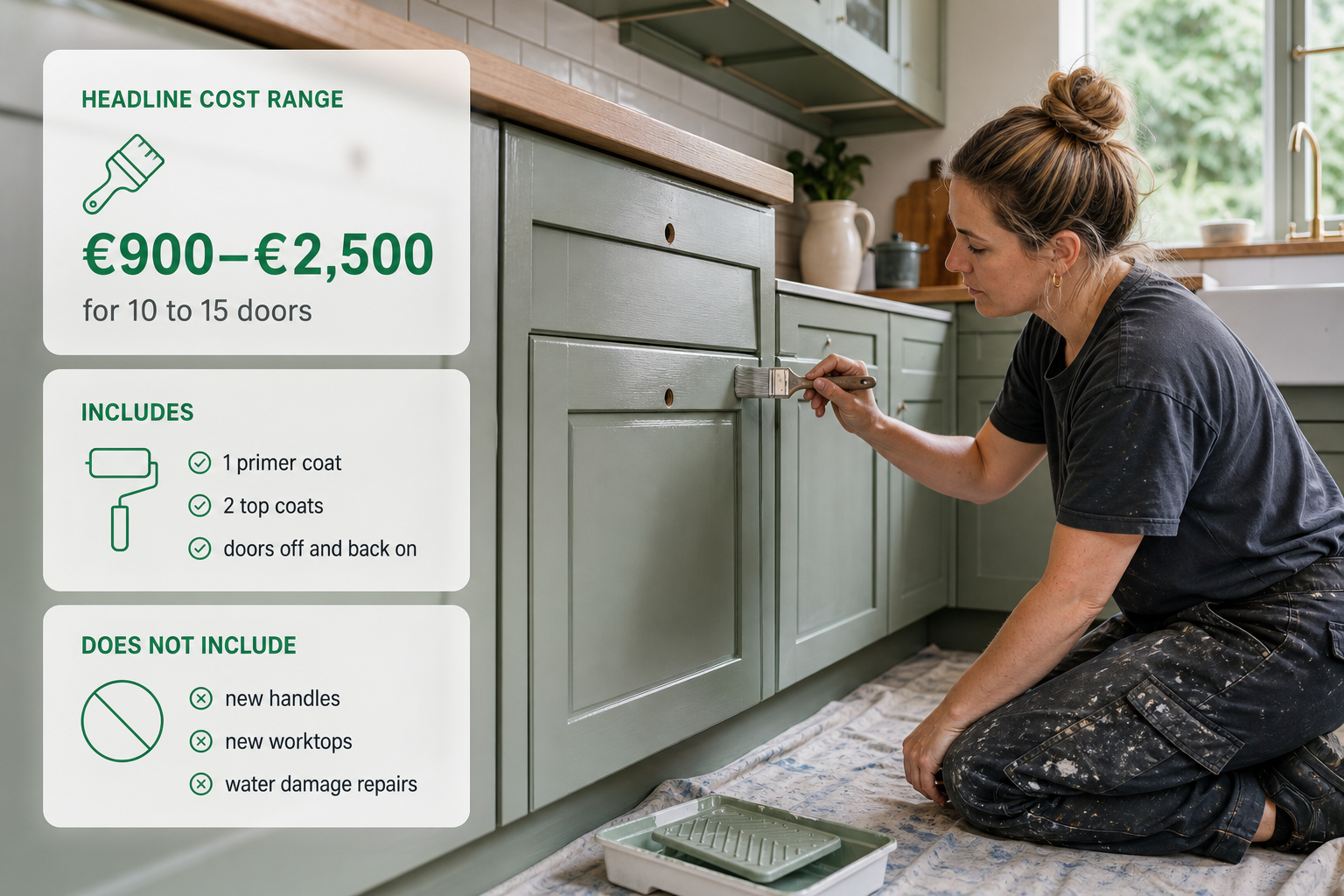
Repainting kitchen cabinets in Ireland typically costs between €900 and €2,500 for a standard 10 to 15 door kitchen, given as an aggregate Irish market estimate. The figure moves up or down depending on how many doors and units the quote covers, whether removing and refitting doors, hinges and handles is included, and whether VAT is shown on the paperwork. This guide is for homeowners who want to judge whether a quote is fair, compare offers like for like, and know what to check before hiring anyone to carry out kitchen renovation work such as cabinet repainting.
What the headline cost range covers
The €900 to €2,500 headline is an aggregate Irish market estimate for repainting the cabinet fronts of a typical Irish kitchen of roughly 10 to 15 doors and drawer fronts, in an occupied home, with the doors taken off and put back on. It assumes the carcasses are sound, the existing finish is in reasonable condition, and the job is one primer coat plus two top coats. It does not cover new handles, new hinges beyond simple adjustment, new worktops, tiling or splashbacks, plumbing, electrical work, or repairs to swollen or water-damaged chipboard. A small kitchen of five to eight doors sits at or below the bottom of the range, while a kitchen with 20 or more doors, an island, a pantry run or tall units sits above the top of it.
What a quote may or may not include
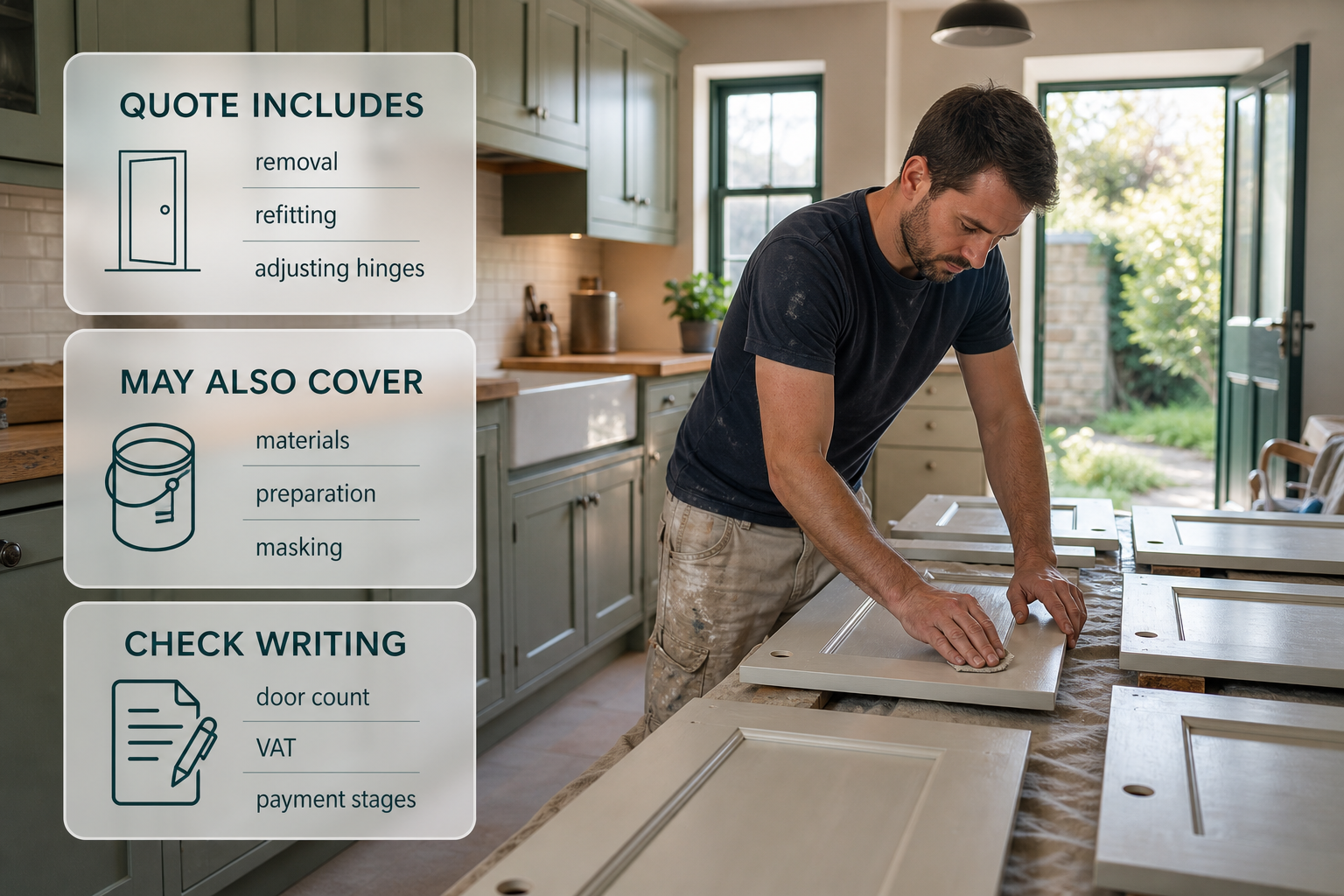
The biggest difference between two quotes for the same kitchen is rarely the paint or the number of coats. It is usually whether the price includes taking off the doors, drawer fronts, handles and hinges, working on them, and putting everything back and adjusting it. Some tradespeople quote for doors that leave the kitchen and are refinished away from the house; others quote for doors that stay hung. Both are legitimate ways to work, but the two quotes describe different jobs and should not be compared as though they were identical.
The table below is an aggregate Irish market estimate for a standard 10 to 15 door kitchen, showing the line items a homeowner might see on a written quote.
| Line item | What it usually covers | Typical range |
|---|---|---|
| Labour only | Preparation, masking, priming and finishing the quoted doors and units, and refitting them | €450 – €1,200 |
| Materials | Cabinet paint, primer, filler, abrasives, masking film and tape | €150 – €400 |
| Preparation and masking | Degreasing, filling old handle holes, protecting walls, floor and worktops | €100 – €300 |
| Removal and refitting | Taking off doors, drawer fronts and handles, labelling them, rehanging and adjusting hinges | €120 – €300 |
| Per-door or per-unit extra | Each additional door, drawer front, end panel or plinth beyond the count in the quote | €45 – €120 per item |
| Waste and contingency allowance | Used materials and an allowance for repairs found once the doors come off | 5% – 10% of the total |
Added together, those line items produce the €900 to €2,500 headline. A quote that leaves out the removal and refitting line, or that counts 10 doors where the kitchen has 16, will look cheaper without actually being cheaper. Handles are a common version of the same trap: some quotes include taking off and refitting the existing handles, while others charge for new handle holes or new handles at a rate inside the per-item range in the table.
How the number of doors or units changes the price
Most quotes start with a base count of doors and drawer fronts, then add a charge for everything above that count. The table above puts that charge at €45 to €120 per item as an aggregate Irish market estimate. What counts as an item is where quotes diverge. Drawer fronts, end panels, plinths, cornices, boxed-in pipework, open shelving and the visible sides of a tall unit all have to be prepared and finished, and many tradespeople count them. A kitchen with 10 doors and an island can easily be quoted as 18 or 20 items.
This is why two homeowners with kitchens they consider identical can receive very different totals. Walk the kitchen with the tradesperson, count the items together, and ask for the final count to be written on the quote. Ten extra items at the rates in the table above is a substantial addition to a job, and it is far easier to discuss that before the work starts than after the invoice arrives.
Why some quotes are much higher than others
- Scope of the work. Doors that leave the kitchen for off-site finishing have to be removed, transported, finished and refitted, which adds the removal and refitting line and tends to push labour towards the upper end of the range in the table.
- The item count. A quote that counts 20 items and one that counts 12 can describe the same kitchen, and the difference in totals follows directly from the per-item rate.
- Condition of the existing finish. Previously varnished or factory-finished doors, chipped veneer, grease around handles and old silicone all add preparation time, which sits in the preparation and masking line.
- Materials and specification. Different paint systems and higher-build finishes cost more, and the materials line in the table reflects that spread.
- Access and protection. Small kitchens, low ceilings, tiles that need masking and appliances that must be moved all add labour time.
- VAT treatment. One quote may show a total inclusive of VAT and another a figure that is exclusive of VAT, which makes the second look lower for identical work. This is dealt with in the next section.
- Overheads and travel. Distance, call-out charges and how busy a tradesperson is all feed into the total.
A higher quote is not automatically better, and a lower quote is often simply narrower. The useful question is which line of the table above accounts for the difference.