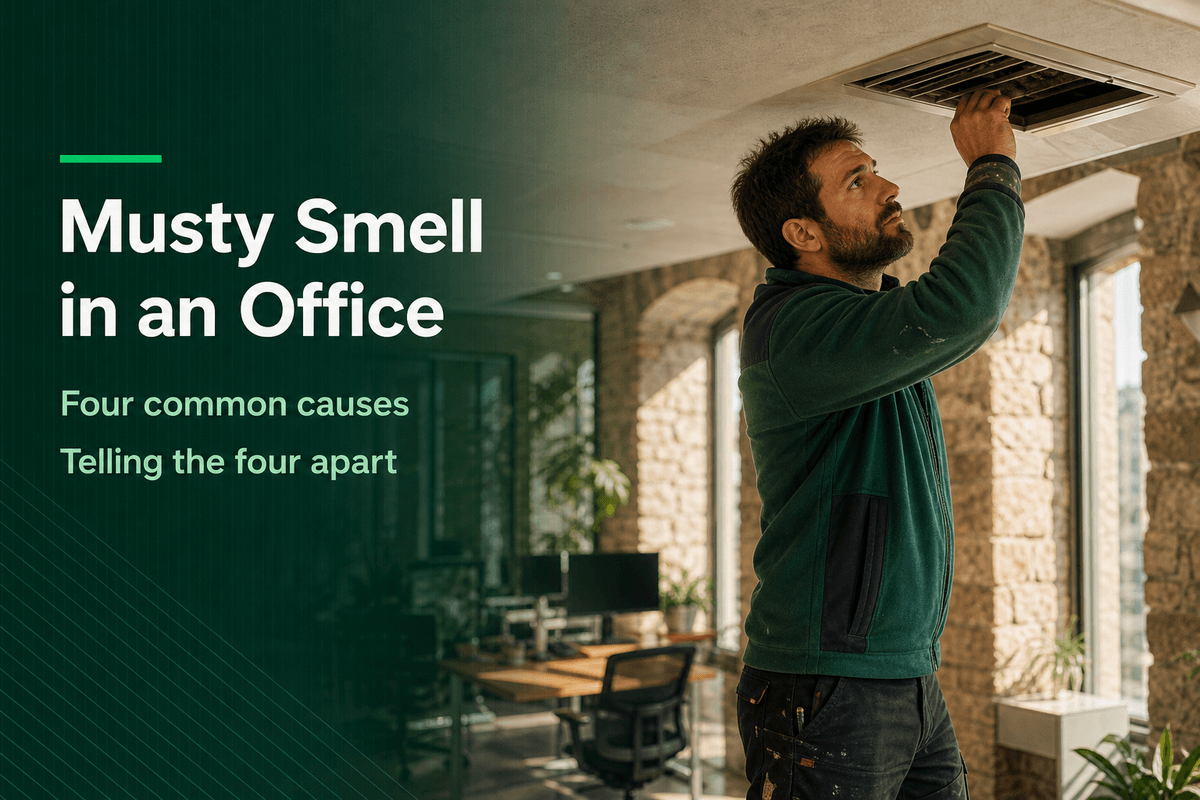
A musty smell in an Irish office is usually a symptom with a traceable source rather than a problem in its own right. In Irish workplaces the four common causes are stale air from poor ventilation, damp or mould growing on cold surfaces, an HVAC system circulating contaminated air, and drain or water-related odours that smell earthy rather than chemical. Telling them apart comes down to three questions: when the smell appears, where it is strongest, and whether it clears when the air is changed.
What Usually Causes a Musty Smell in an Irish Office
Poor ventilation. The HSE notes that poor indoor air quality can happen when there is not enough ventilation, and that spaces which feel stuffy or have bad smells may indicate poor air exchange (Health Service Executive). Irish offices often have sealed windows, a mechanical system running mainly on recirculation, or meeting rooms with no dedicated extract, so body heat, cleaning products, kitchen smells and paper dust build up through the day. This type of odour is usually mild, fairly even across a whole floor, and noticeably better once windows are opened or the system is run on fresh air.
Damp and mould. Mould needs moisture, and in Irish buildings that moisture tends to come from condensation on cold external walls, window reveals, thermal bridges at ceiling edges, or leaks around windows, roofs and pipework. Active growth gives off a distinctly earthy, cellar-like smell, and it is often strongest in corners behind furniture, in rooms closed up overnight, and in spaces that are not heated.
HVAC-related odours. A musty smell that appears only when the heating or air conditioning runs is a strong clue that the source sits inside the system: dust and moisture on coils, a wet drain pan under a fan coil unit, damp insulation inside ductwork, filters left too long between changes, or standing water in a plant room. The smell normally arrives within minutes of the system starting and eases when it is switched off, which is what separates it from a building-wide damp problem.
Drain and water-related smells. Earthy, vegetable-like odours that concentrate around toilets, kitchens, teapoints or floor drains usually come from the drainage side rather than from damp. Traps that have dried out in unused floor drains, a toilet with a failed seal, or a slow leak under a sink all let sewer gases and damp air back into the room. Water itself can also carry an earthy note: Uisce Éireann explains that a musty or earthy taste or smell in drinking water can be caused by algae where the water is sourced (Uisce Éireann). If the smell matches the tap water, the water is where to look rather than the walls.
Where the odour is tied to general build-up in shared kitchens, meeting rooms and desk areas rather than a single fault, a regular office cleaning service can keep surfaces and soft furnishings fresher while the underlying cause is being dealt with.

Telling the Four Apart at a Glance
| Likely cause | Where it is strongest | How it behaves |
|---|---|---|
| Stale air, poor ventilation | Open-plan floors, meeting rooms, anywhere with little outside air | Builds through the working day, eases when windows open or the system runs on fresh air |
| Damp and mould | Cold external walls, window reveals, corners behind furniture, under sinks | Constant, worse in humid or wet weather, often with staining, bubbling paint or dark speckling |
| HVAC-related | At supply vents, ceiling diffusers, fan coil units and plant rooms | Arrives when the system runs, fades when it stops |
| Drains and water | Toilets, kitchens, teapoints, floor drains, sink units | Earthy, worse in rooms closed up overnight or after dry spells |
First Checks to Run Before Calling Anyone
The aim of these checks is to narrow the smell to one source and to gather evidence that a landlord, letting agent or building manager cannot easily dismiss. Work through them in order and write down what is found.
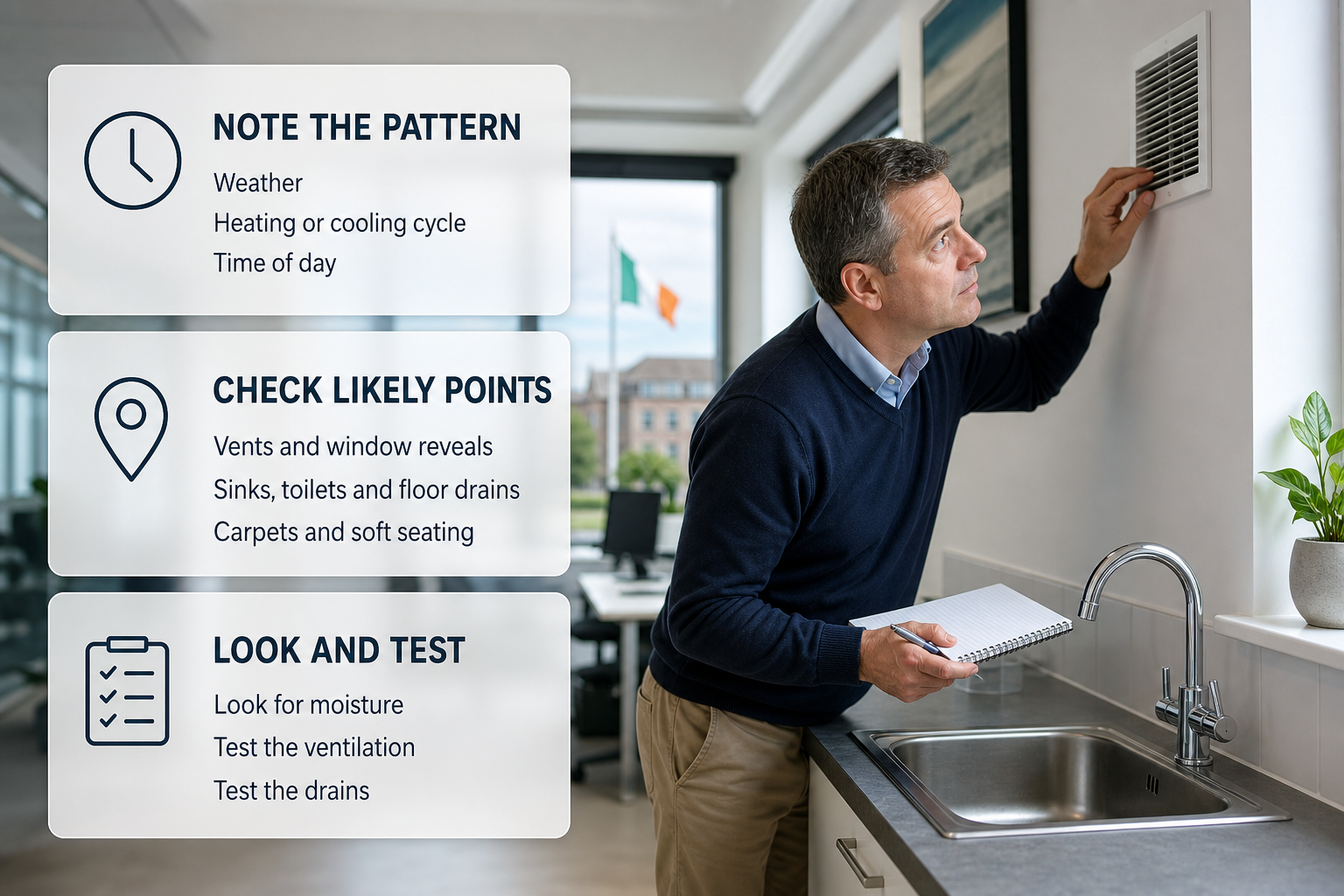
- Note the pattern. Record whether the smell is constant or linked to weather, to the heating or cooling cycle, to the time of day, or to weekends when the office is empty. Odours that disappear when nobody is in the building point to the building fabric or the drainage, not to people or equipment.
- Walk the floor slowly. Stand in each room, close the door behind you, and let the air settle before sniffing. Compare an open-plan area, a meeting room, a store, a kitchen and the toilets.
- Sniff the likely points. Check supply and extract vents, window reveals and curtains, sinks and sink units, toilet bases and cisterns, floor drains, kitchen appliances, carpets and soft seating, and stored paper, boxes and files.
- Look for moisture. Check for condensation on windows in the morning, water staining on ceilings, bubbling paint, dark speckling along sealant lines, and cold external corners hidden behind furniture. Feel the wall surface rather than relying on sight alone.
- Test the ventilation. Confirm the system is actually running, that vents are not blocked by furniture or storage, that fresh-air intakes are open, and that filters and drain pans have been checked as part of the maintenance schedule. Note the state of the filters when they are inspected.
- Test the drains. Run the taps, pour a jug of water down floor drains and any sink that is rarely used to refill the traps, listen for gurgling, and look for signs of a slow leak or a loose toilet seal.
- Test the water. Fill a glass, let it stand, and smell it. If the glass carries the same earthy note as the room, the supply is contributing and the building fabric is not the whole story.
- Protect yourself while checking. If mould is visible or the smell is sharp, wear gloves and eye protection, open a window or door, and damp-wipe rather than dry-brush any growth, since dry brushing spreads spores into the air.