
A Cork homeowner usually starts this search in a familiar place, the kitchen is too cramped, the sitting room feels unfinished, or a renovation has stalled because nobody agreed the brief before the builder started. That is exactly when an interior designer in Cork earns the fee, not by picking cushions, but by deciding what the space should do, what gets kept, what gets replaced, and how the work gets coordinated without turning the whole house into a moving target.
A good fit is usually a property with moving parts, a terraced house kitchen that needs space planning, an older Cork home with awkward rooms, or an apartment that needs a cleaner finish than a builder alone will deliver. If the job is only hanging art and choosing a paint colour, a decorator or consultation-only service may be enough. If the work touches layout, joinery, sourcing, trades, and sign-off, the designer's role becomes much more valuable.
Why Cork Homeowners Hire an Interior Designer
A Cork homeowner hires a designer when the decisions are too expensive to get wrong. A Victorian house needs restraint, a terrace needs storage without making the rooms feel cramped, and a newer home can look finished on paper while still feeling awkward once the family starts living in it. A good designer earns their keep early, before anyone orders furniture, because the layout, materials, lighting, and sequencing shape the whole result.
Where a designer beats a decorator
A decorator improves how a room looks. A designer decides how the room works. That matters the moment a kitchen needs better circulation, a bedroom needs built-in storage, or a living space has to handle family life, guests, pets, and work calls without turning into a storage unit.
The point is not luxury for its own sake. It is avoiding the expensive mistake of buying the wrong pieces, choosing finishes that clash, or pushing ahead before the room has been measured properly. That matters in older Cork housing stock, where awkward corners and inherited alterations are common.
Practical rule: if the job needs a plan, not just taste, a designer is worth the call.
Interior design is an established profession in Ireland, with a recognised professional body, the Institute of Designers in Ireland, rather than a decorative afterthought.
When the work is bigger than styling
Treat a designer as a coordination problem solver when the job involves joinery, lighting, finishes, supplier lead times, and trades that need to be sequenced properly. It also matters on any project where the household cannot afford a loose brief, because every change order costs more than the last one.
A useful way to judge the need is to ask whether the room already has a clear shape in your mind, or whether you only know it needs to function better. If the answer is the second one, design saves money by preventing rework, not by chasing the cheapest chair.
For Cork homeowners trying to pin down local support and service coverage, the ShamFix Cork county page is a useful starting point for checking what is available in the area.
Understanding Interior Designer Fee Models
Interior designers in Ireland usually price in three ways, and the homeowner should force the fee model onto paper before any deposit changes hands. The common structures are hourly, fixed fee, and percentage of project spend. Each can work, but each creates different incentives, and that is where disputes start if the contract is sloppy.

Hourly, fixed, or percentage
An hourly rate suits advice, small-room work, and undefined jobs. General Irish market ranges put that around €65 to €120+ per hour ex VAT, and an initial consultation is often €150 to €500. It makes sense when the homeowner wants a few sharp decisions, not a full project wrapper, but the bill can drift if the scope is loose. Dublin tends to run higher than the regions, so Cork should not be priced as if it were central Dublin.
A fixed fee is cleaner for a single room or a defined project. Room designs often start from around €500, while flat project fees are broadly €2,000 to €10,000 depending on scope. This model works best when the brief is clear and the designer is being paid for a defined outcome, not open-ended advice.
A percentage of spend aligns the fee to the overall project budget. It can suit bigger renovations, but only if the homeowner understands whether the percentage applies to furnishings, works, or both. If that is not spelled out, the fee can become vague very quickly.
The number that matters most is the total
The design fee is separate from the cost of the actual works and furnishings. That is where most budget arguments begin, because a homeowner hears one number and assumes it covers everything. It usually does not.
Budget rule: the cheap quote is often just the incomplete quote.
The smarter question is not which model sounds cheapest. It is which model matches the amount of certainty already available. If the layout is unresolved, hourly may be safer. If the room is clearly defined, fixed fee is easier to control. If the project is large and complex, a percentage structure can work, but only with a very explicit scope and payment schedule.
A proper fee agreement should say what counts as extra, how revisions are charged, and whether procurement or supplier mark-ups sit inside the fee or outside it. Without that, the homeowner is guessing, and guesswork is where renovation budgets go to die.
Preparing a Design Brief a Cork Designer Will Take Seriously
A designer can only work well if the brief is useful. A vague “make it nice” brief forces expensive back-and-forth, while a clear brief saves time, cuts rework, and gives the designer something solid to price against. The homeowner should arrive with decisions in hand, not just a Pinterest folder.
What needs to be ready before the first meeting
Start with the rooms in scope and how each one is used. A kitchen that handles school mornings, a dining room that doubles as a laptop zone, or a bedroom that must work around storage all need different answers. Add a realistic all-in budget range, and that range should include the design fee as well as the works and furnishings it will buy.
A rough timeline matters too, especially if there is a fixed date attached to the project. A move, a wedding, or a new baby changes how the work should be sequenced. If the deadline is tight, the brief should say so plainly rather than hoping the designer will somehow absorb the pressure.
The Cork-specific details that change the job
Photos and measurements are not optional. Neither is a folder of likes and dislikes, because the designer needs to see what the household responds to, not what looked good in a showroom. Saved images, colours, existing pieces to keep, and anything the homeowner hates all belong in the brief.
Cork housing throws up its own constraints, so they need to be stated early. That includes rented versus owned, listed or period status, north-facing damp rooms common in older stock, and practical realities like pets and children. If the room has to survive heavy use, say so up front.
A strong brief is not fussy, it is cheaper than guesswork.
For homeowners who want to frame the job properly, a task listing can help organise the first call, including scope, room count, and the kind of service needed. ShamFix place a task is one way to start that process without confusing inspiration with specification.
If the brief already knows what “done” looks like, the designer can move faster and make sharper recommendations. If not, the project usually turns into repeated revision, and revisions are where both cost and patience leak away.
The Typical Cork Interior Design Project From Brief to Snag
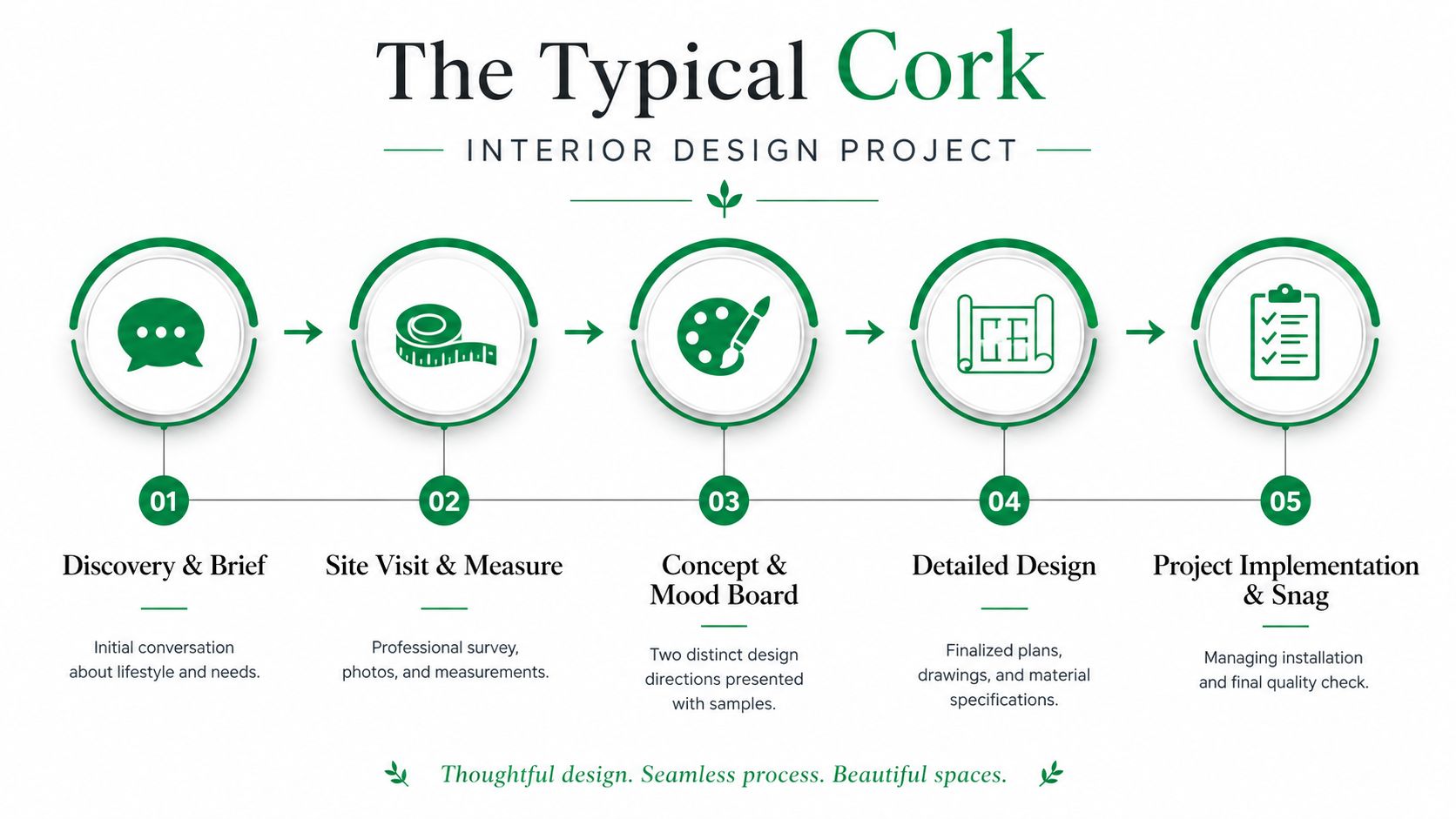
A well-run project follows a clear sequence. The homeowner should not be guessing who does what next, because that usually means somebody has skipped a step. Once the brief is agreed, the project should move from discovery to measurements, then concept, then detailed design, then implementation, then snagging.
What happens first
The first conversation should be about how the room is lived in, not just how it should look. A site visit follows, with measurements and photos taken properly so that layouts, storage, and furniture scale are based on real dimensions rather than hope. The homeowner should expect this stage to produce questions, not answers, because the designer is collecting the facts needed to make the job workable.
The next step is usually a concept or mood board stage. Good designers often show two directions rather than forcing one fixed answer, because that gives the household something to react to. Samples matter here, paint, fabric, tile, and flooring samples read differently in a real Cork room with Atlantic light than they do on a screen.
Where decisions and deposits usually land
Detailed design is where the plan becomes specific. That means drawings, material choices, furniture directions, and a scope that is detailed enough to price and order against. This is the point where the homeowner should know what is included, what is not, and what changes will trigger extra charges.
Procurement and coordination come next if they are part of the service. Some designers handle sourcing and scheduling, others stop at specification and leave the homeowner to manage trades. Those are very different services, and the contract should say which one it is before any money changes hands.
Snagging is the final step. That is the quality check, the list of fixes, the small errors that need to be corrected before the job is finished. It is not glamorous, but it is where good design earns trust.
Useful shorthand: concept decides direction, specification decides detail, snagging protects the finish.
The biggest mistake is treating the project as a shopping exercise. It is a sequence of decisions, and each one affects the next. When the sequence is clear, the work feels calmer and the budget is easier to hold.
Why Interior Design Is Unregulated in Ireland and What That Means for Homeowners
Interior design is not a regulated trade in Ireland. There is no central licence register the homeowner can rely on, so the usual protections are not about a badge, they are about evidence. That means the designer's written fee agreement, public liability insurance, portfolio, and reviews matter much more than a vague promise of expertise.
What protection actually looks like
A proper agreement should set out the fee model, the scope, the revision limit, and the payment stages. That is the bare minimum. If the homeowner cannot see how the job is priced, what is included, and when extra charges kick in, the contract is weak before the work even starts.
The practical test is not glamorous. Does the designer show similar projects? Are the reviews from real previous clients? Is the proposal clear about whether the fee covers concept, sourcing, procurement, or full project management? Those are the questions that prevent arguments later.
Where the project includes trades, the regulated parts still have to be checked properly. Electrical work should be confirmed with Safe Electric, and gas work should be confirmed with RGI. Those are not decorative claims, they are the registrations that matter when the homeowner is paying for work hidden behind walls and floors.
Why this matters more in mixed projects
Cork renovations often mix unregulated design advice with regulated trade work. That means one person may be creating the concept while another is fitting the electrics, plumbing, or heating work. The homeowner should never assume the designer's involvement covers trade compliance automatically.
Interior design can be excellent without being regulated, but it is still a business arrangement. That is why written terms beat verbal reassurances every time. If a designer is steering a project with multiple suppliers, the homeowner should know who is responsible if a delivery is late, a finish is wrong, or a trade turns up with bad information.
The right mindset is straightforward. Trust the creative eye, but verify the contract. Trust the trade names, but confirm the registration with the authority. That keeps the project grounded in accountability instead of personality.
Vetting a Cork Interior Designer Before You Sign Anything
A homeowner should not choose a designer on taste alone. Pretty boards can hide weak process, vague pricing, and poor coordination. The right filter is simpler, check whether the portfolio matches the scale of the job, read published reviews from actual clients, and insist on a written fee agreement before any work starts.

The three trust signals that matter
A portfolio should show work similar to the homeowner's property type and project size. A compact apartment refresh is not the same as a period-home renovation, and a designer who has only shown showroom-style mood boards may not be the right fit for a practical rebuild. Similarity matters because process matters.
Published reviews are the second filter. They show whether previous clients felt heard, whether the work finished cleanly, and whether the handover matched the promise. In a market where there is no licence register for the trade, those reviews carry real weight.
The third signal is the contract. It should spell out the fee model, the scope, the revision count or revision process, and the payment stages. If procurement is included, the agreement should say how supplier mark-ups or commissions are handled. If it is not included, that needs to be explicit as well.
A homeowner should also ask one blunt question, is the design fee separate from the cost of furniture and building work? If the answer is unclear, the rest of the arrangement is probably fuzzy too.
Questions that cut through the sales chat
A good interview should produce direct answers, not polished waffle. Ask what extra charges trigger, who signs off on the works, and who carries responsibility if a supplier gets something wrong. If the designer is coordinating trades, the homeowner needs to know whether that means project management or just making introductions.
The same applies to revisions. Unlimited changes sound friendly until the bill arrives. The better setup is a clear allowance in the fee agreement, with extra work charged only when the brief changes.
For homeowners comparing services, ShamFix interior design services is one place to look at local listings alongside the provider's own public information. That still leaves the actual checking to the homeowner, because no platform replaces a proper contract and proper due diligence.
Bottom line: the best designer is not the one with the nicest photos, it is the one whose paperwork is hardest to misunderstand.
A Practical Checklist Before Committing to a Cork Interior Designer
A Cork homeowner should treat the first meeting like a contract check, not a mood board session. Before any deposit changes hands, define the rooms, how each one is used, the full budget range, and the date that cannot move. If those basics are fuzzy at the start, the rest of the project will drift.
The paperwork and the people
Start with the fee model and see if it fits the job in front of you. Hourly billing suits advice and small tasks, fixed fees suit a clearly defined room or project, and percentage pricing only works when the scope is written in plain English. Ask the fee-separation question directly, because the design fee should stand apart from the cost of the works and the furnishings it is meant to cover.
Then read the portfolio, the reviews, and the contract as one package. The portfolio should match the scale of your own project, the reviews should come from real previous clients, and the contract should spell out scope, revisions, and payment stages. If procurement, supplier mark-ups, or commission are part of the deal, they need to be written down plainly.
The trade check that should never be skipped
If the project includes electrical or gas work, the homeowner should confirm those registrations with the authority, not rely on a brochure claim. Safe Electric matters for electrical work, and RGI matters for gas work. A designer can coordinate the job, but that does not replace the regulation that applies to the trade itself.
The last question is the one many homeowners avoid. Do you need a designer, or would a decorator, a consultation, or a builder with a clear brief be enough? A smaller scope does not need an expensive layer of design fee on top of it, and a larger scope can cost far more if you hire the wrong level of service.
| Fee Model | Typical Range (ex VAT) | Best Fit For | Pin Down In Writing |
|---|---|---|---|
| Hourly rate | about €65 to €120+ per hour | Advice, small tasks, uncertain scope | What counts as billable time, revision limits, extra charges |
| Initial consultation | about €150 to €500 | First advice session, early direction setting | What is included, what follows, and whether it is credited later |
| Fixed room or project fee | rooms often from €500, flat projects broadly €2,000 to €10,000 | Defined rooms or clearly scoped jobs | Deliverables, number of revisions, payment stages |
| Percentage of project spend | no fixed figure in the verified data, so it should be treated as a negotiated model | Larger renovations with broad coordination needs | What the percentage applies to, and whether works, furnishings, or both are included |
ShamFix connects Cork homeowners with local interior design providers through a simple marketplace, so the first step is finding the right kind of help rather than guessing at it. Compare how providers present their own work, then apply the same checks: a written fee agreement, a portfolio that matches your project, and reviews from real clients.
Are you an interior designer in Cork?
List your business free on ShamFix during Phase 1, with 0% commission and no per-lead credits. Be among the first found as local demand grows. There are no promises about lead volume or speed. Visit ShamFix to learn more.