A deep clean is a full reset of a home rather than a weekly tidy. Routine cleaning maintains a home week to week, while a deep clean empties rooms as far as is practical and works them from the ceiling down, including the appliances, seals, grout and high-touch points that everyday cleaning skips. It is needed when grease, limescale, dust or grime have built up, after illness or building work, at a change of season, or when moving in or out — and homeowners who would rather not take it on can find help through a local deep cleaning service on ShamFix.
How to deep clean a house: the order of work
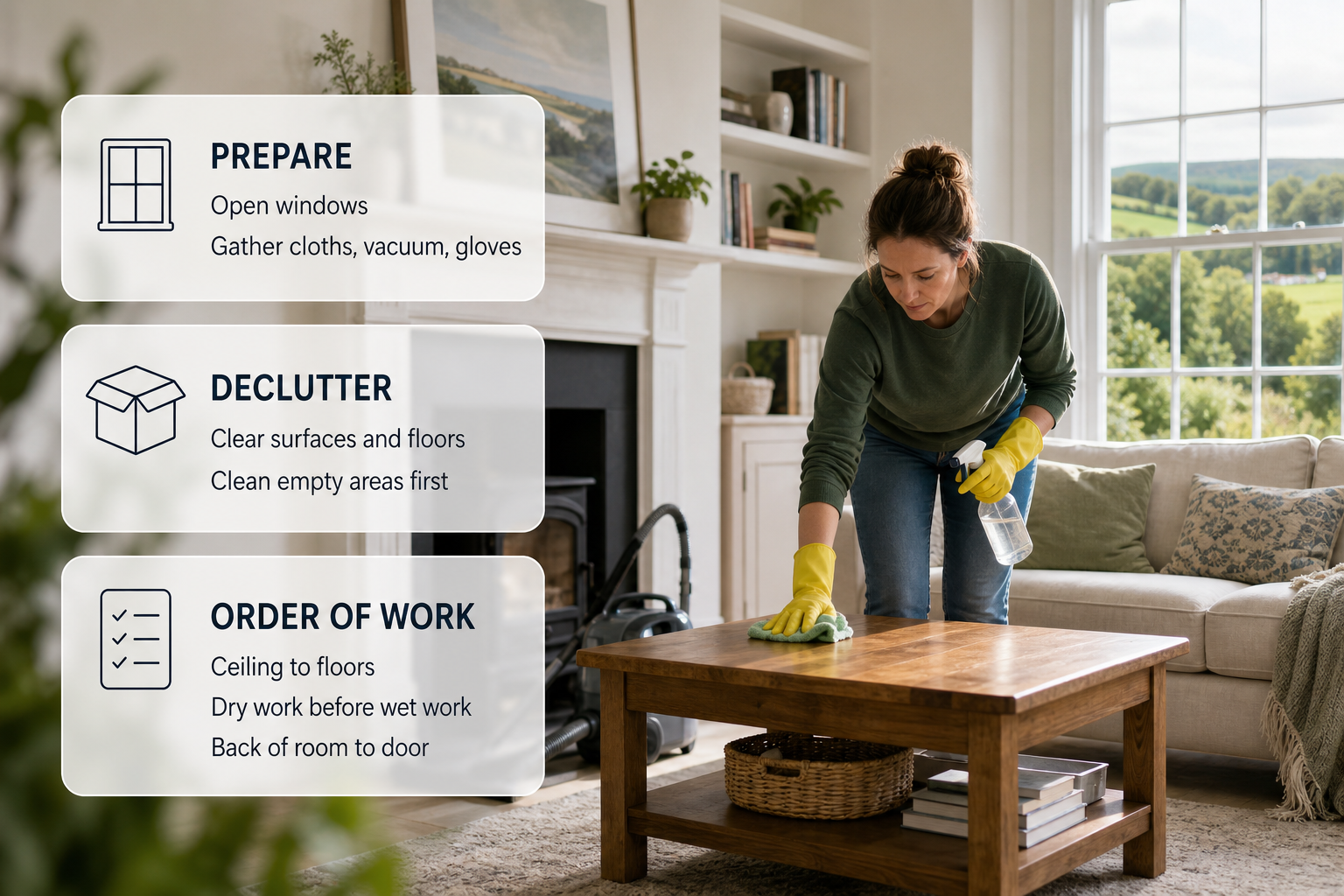
Start with preparation. Open the windows of the room being worked on and keep them open while products are in use. Gather microfibre cloths in several colours, a bucket, a vacuum with a crevice tool and an upholstery attachment, bin bags, rubber gloves, eye protection and, where dust is likely, a mask. Add an old toothbrush for grout and corners, a squeegee for glass and tiles, and a non-scratch pad. Keep children and pets out of the room, never decant products into unlabelled bottles, and test anything unfamiliar on a hidden patch of stone, painted wood or laminate before it goes on a visible surface. Keep separate cloths for dry dusting, for wet wiping and for the bathroom.
Declutter before cleaning. Clear worktops, shelves, bedside tables and floors. Dust or wash each item, then put it back or box it for another room, and clean the empty surface before anything returns to it.
Then work through one room at a time in a fixed order: ceiling and corners first, then walls and high shelves, then furniture, then floors, always from the back of the room towards the door. Do all dry work, such as dusting and vacuuming, before any wet work, so that dust does not settle on damp surfaces. Bedrooms come first, then living areas, then the hall and stairs, then the kitchen, and the bathroom last, so that cloths and buckets used in the most contaminated room do not travel through the rest of the house. Finish each room by letting surfaces dry fully before replacing furniture and textiles.
Room-by-room deep clean checklist
Kitchen
- clear worktops and soak removable parts
- degrease the extractor filter, splashback, tiles and cupboard fronts, especially around the cooker
- wipe inside the microwave and the fridge, including the door seals, and bin old food
- clean the sink, taps and the drain area
- wipe cupboard handles, switches, the bin lid, and the oven door and dials
- vacuum and mop, moving only what can be moved safely
Bathroom
- spray descaler on tiles, the shower screen, taps and the shower head, and let it dwell as the label directs
- clean the toilet inside and out, including the hinges and the base
- wash the bath, basin and shower tray
- buff mirrors and chrome with a squeegee or a dry cloth
- wash bath mats and towels
- mop the floor, including behind the toilet, and wash the bin
Bedrooms
- strip the beds and wash the bedding
- dust ceiling corners, light fittings, the headboard and bedside tables
- vacuum the mattress on both sides where the mattress allows it
- clean under the bed and vacuum the skirting boards
- wipe switches and lamp bases
- clean mirrors and wash any curtains or throws the care label allows
Living areas
- dust the ceiling, corners, light fittings, shelves and electronics with a dry cloth
- vacuum upholstery, including under the cushions
- wipe remote controls, door handles and switches
- clean windows, tracks and sills
- vacuum and mop floors, moving furniture only where it is safe to do so
Hall and stairs
- dust the banisters, spindles and skirting
- wipe the front door inside and out, with the handles and the letterbox
- vacuum the stairs with an attachment for the edges
- mop hard floors and shake out mats
Frequently touched surfaces
- switches, door handles, cupboard handles, taps, the toilet flush, remote controls, phones, handrails and the fridge handle
- wipe with a clean cloth and soapy water or a suitable disinfectant, then dry with a separate cloth
Homeowners who want some of these jobs handled locally can browse the cleaning services category on ShamFix.
How often each room needs a deep clean
There is no fixed timetable that suits every home. How often a room needs a deep clean depends on how it is used: how much cooking is done, how many people share the bathroom, how hard the water is, whether there are pets, and whether anyone in the home has allergies. Kitchen and bathroom surfaces change fastest, because grease, moisture and limescale build up there continuously. Bedrooms and living areas hold dust and upholstery grime for longer. The hall, stairs and high-touch surfaces are usually handled as part of a whole-house deep clean, with wipe-downs in between.
| Room or area | What makes it need a deep clean sooner | Signs it is due |
|---|---|---|
| Kitchen | Cooking volume, frying, heavy extractor use | Sticky cupboard fronts and a tacky extractor filter |
| Bathroom | Moisture, hard water, number of users | Chalky film on glass and taps, discoloured grout |
| Bedrooms | Dust, bedding, pets on the bed | Dust under the bed, bedding that smells stale |
| Living areas | Foot traffic, pets, upholstery | Dull upholstery, dusty shelves and electronics |
| Hall and stairs | Outdoor dirt carried in | Grimy skirting, marked paintwork, gritty floors |
| High-touch surfaces | How many people live in and visit the home | Visible marks on handles, switches and remotes |
A workable approach is to deep clean each room when the signs in the right-hand column appear, rather than by the calendar alone, and to treat moving in or out, building work and illness as extra triggers.
Matching products to surfaces safely
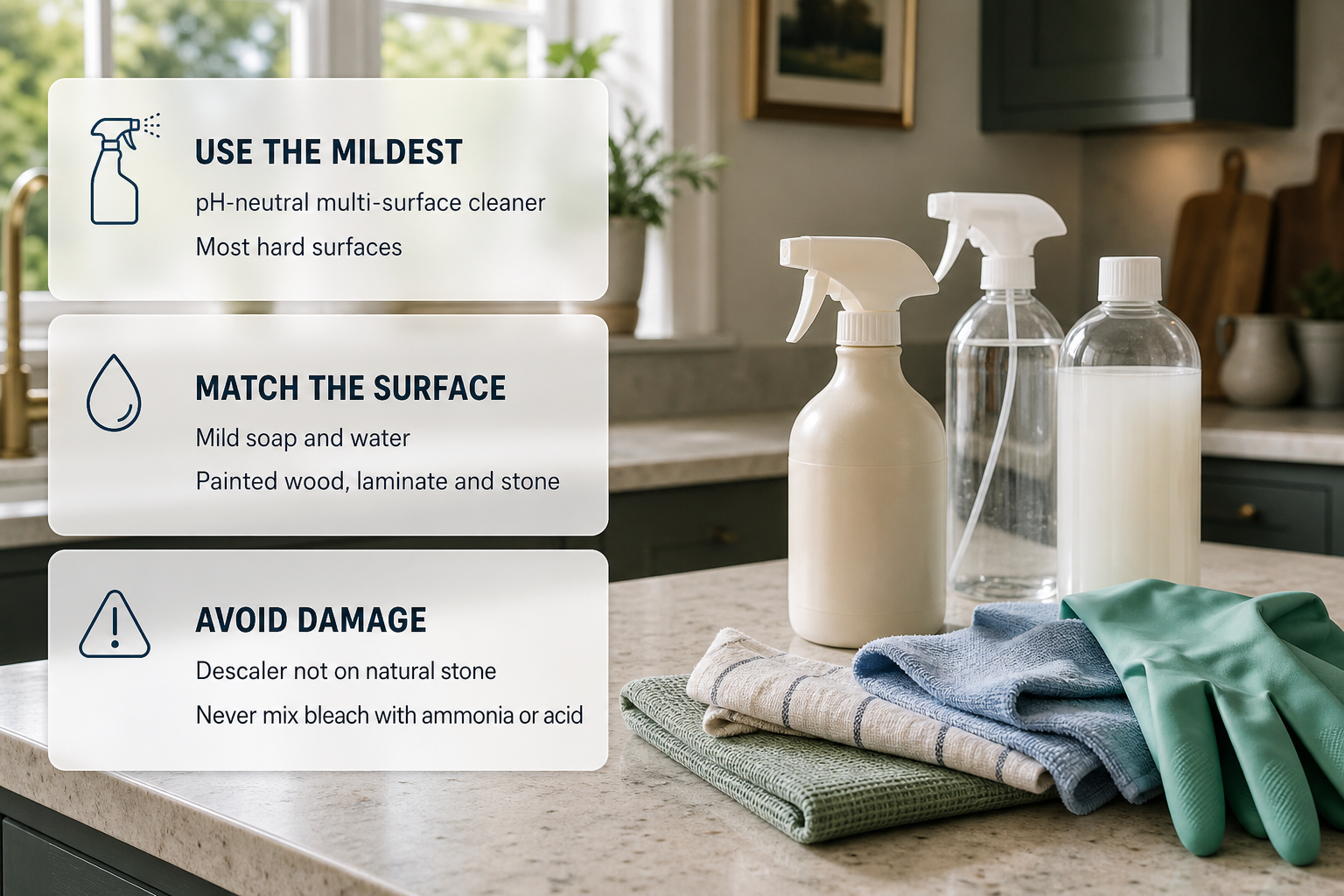
Use the mildest product that will do the job, and match it to the surface: a pH-neutral multi-surface cleaner for most hard surfaces; mild soap and water for painted wood, laminate and stone; an acid-based descaler for limescale on tiles, glass and chrome, but never on natural stone; an alkaline degreaser for kitchen grease; baking soda as a mild abrasive for sinks and hobs; white vinegar for glass, chrome and limescale, but not on natural stone or aluminium. Never mix bleach with ammonia or with an acidic cleaner, because the fumes are dangerous. Wear gloves and eye protection, keep the room ventilated, and rinse any surface that comes into contact with food afterwards.