
ShamFix
Back to insights

How to clean sofa covers: removable and fixed

Unzip, check the care label, patch test and wash on a cool gentle cycle, then dry flat away from heat. Here is how to clean sofa covers safely.

10 min read
How to clean sofa covers: removable and fixed

Most sofa covers that unzip or unfasten can be cleaned at home: take them off, read the care label, test a hidden patch, wash on a cool gentle cycle with a mild detergent, and dry them flat away from direct heat. Fixed covers, and covers in velvet, wool, leather or anything the label marks dry clean only, are safer cleaned in place with spot treatment and as little moisture as possible. Where the fabric is delicate or the soiling is heavy, booking local carpet and upholstery cleaning removes most of the risk from the job.

Read the Care Label and Identify the Fabric

Most sofa covers carry a sewn-in label listing fibre content and care symbols. It is usually tucked under a seat cushion, inside a zip flap or stapled to the frame, and it is the single most useful piece of information on the sofa. The symbols to look for are:

  • Washtub with a number — the maximum wash temperature in degrees Celsius.
  • Washtub with a hand inside — hand wash only, in cool water.
  • Washtub crossed out — do not wash.
  • Triangle — bleach is permitted; crossed out means it is not.
  • Circle — professional cleaning only; a letter inside (P or F) tells the cleaner which solvent family to use.
  • Square containing a circle — tumble drying is permitted at the heat shown.
  • Iron — the maximum ironing temperature.

If the label has faded, been cut out or never existed, treat the cover as spot clean only or dry clean only. Guessing is the commonest way a cover is ruined, and a cover that is washed against its label has no comeback if the fabric fails.

Identifying the fabric by hand is the next step:

  • Cotton and cotton blends feel matte and cool, and crease sharply.
  • Linen shows slubs, feels crisp and holds a crease.
  • Polyester, acrylic and nylon blends feel smooth and spring back when squeezed.
  • Microfibre is dense and fine, with a suede-like surface.
  • Velvet, velour, chenille and corduroy have a cut pile that shades light and dark when brushed against the nap.
  • Wool feels warm and slightly hairy, and felts when agitated in hot water.
  • Viscose and rayon feel smooth and cool but lose strength when wet and watermark easily.
  • Leather and faux leather have no weave at all; they are wiped, never washed.

Before any product touches a whole cover, dab it on an inconspicuous area — inside a zip flap, under a seat cushion or on the back panel — and leave it for about ten minutes. Colour lifting onto the cloth, a ring mark or flattened pile means stop and choose another method. Store the label details, a photo of the care symbols and the fabric type on a phone, because they are easy to lose once the covers come off.
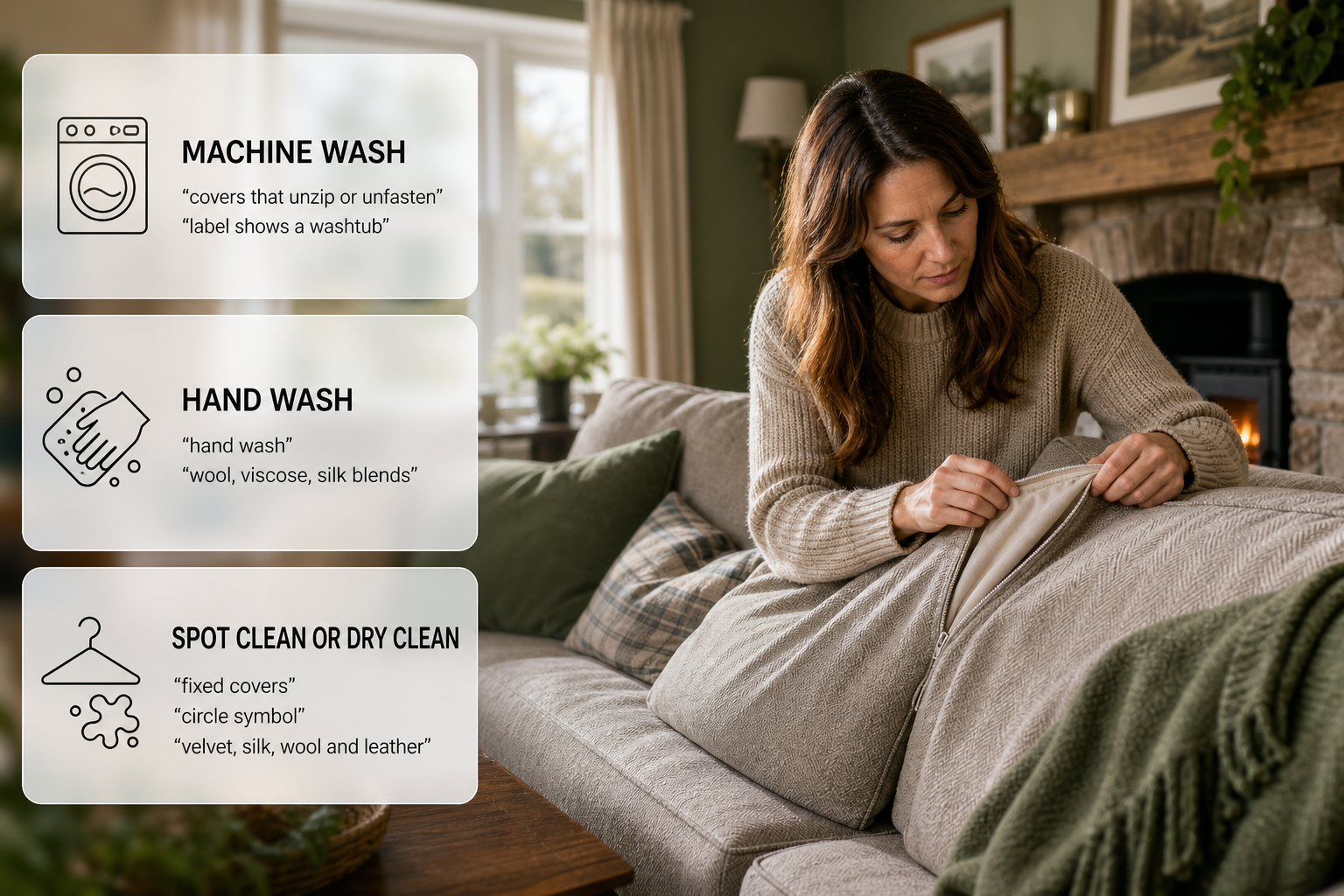
An infographic over a photo of a sofa in an Irish home shows the four cleaning methods for sofa covers and which situations each suits.

Choose the Method: Machine, Hand, Spot Clean or Dry Clean

Four routes cover almost every sofa cover:

  • Machine wash suits covers that unzip or unfasten and whose label shows a washtub. It is the quickest option, but only ever at or below the setting the label allows.
  • Hand wash suits anything labelled hand wash, plus wool, viscose, silk blends, embroidered or beaded covers, and covers whose colour is new and strong.
  • Spot cleaning suits fixed covers, cushions that cannot be removed, and covers with a handful of marks rather than overall soiling.
  • Dry cleaning or professional cleaning suits anything marked with the circle symbol, plus velvet, silk, wool and leather, which water damages more often than dirt does.

Clean one cover first, let it dry completely, and inspect it before committing the rest. Shrinkage, colour loss and pile damage appear after drying, not in the drum, so a single test cover gives a real answer. Where a whole suite, a fitted cover that will not unzip, or several covers need attention at the same time, arranging cleaning services for the wider job is often more practical than working cover by cover.

Fabric-by-Fabric Washing Guidance

The table below describes the water and cycle to choose by fabric type. Where it says cool, the coolest setting the label permits is the right one; where the label gives a maximum temperature, stay at or below it rather than above it.

Fabric Best method Water and cycle What to avoid
Cotton and cotton blends Gentle machine wash Cool water, gentle cycle, low spin Hot washes and tumble drying, which shrink cotton
Linen Gentle machine or hand wash Cool water, gentle cycle Wringing, tumble drying and long spells in strong sun
Polyester, acrylic and nylon blends Gentle machine wash Cool, or lukewarm if the label allows it High heat, which causes pilling and a shiny surface
Microfibre Gentle machine wash Cool water with an extra rinse Fabric softener and hot drying, which clog and stiffen the fibre
Velvet, velour, chenille and corduroy Spot clean or dry clean Surface moisture only, never a full soak Full immersion, which crushes the pile and leaves water marks
Wool and wool blends Cool hand wash or dry clean Cool water, no agitation, wool cycle if available Heat, agitation and wringing, which felt the fibres
Viscose and rayon Hand wash or dry clean Cool water, brief dip only Soaking and heavy agitation, because the fibre is weak when wet
Silk blends Hand wash or dry clean Cool water and a mild detergent Enzyme or bleach-based detergents
Leather and faux leather Wipe with a barely damp cloth Surface only, then buff dry Soaking, which stiffens and cracks the surface

Whatever the fabric, the mechanics of a home wash are the same. Close every zip, turn the cover inside out, and put small or delicate covers inside a mesh laundry bag. Run a half load rather than a full drum, choose the gentlest cycle with an extra rinse, and set the spin to its lowest setting. Use a mild liquid detergent in the dose the bottle states; specialist chemicals are rarely needed for everyday soiling. Skip bleach unless the triangle symbol permits it, and skip fabric softener on microfibre and thick pile, where it coats the fibres and dulls the colour.

Product safety matters as much as the fabric. Never mix a bleach-containing product with one containing ammonia, keep products away from children and pets, wear gloves and eye protection when handling spirits-based spot treatments, wear a mask when brushing off powders or using spray cleaners, and keep the room ventilated throughout. Wash similar colours together, and give new dark, red or indigo covers their first wash on their own.

For a hand wash, fill a basin or bath with cool water and a small dose of mild detergent. Lower the cover in and press it under the water rather than scrubbing it. Leave it to soak for ten to fifteen minutes at most, then lift it out and rinse in clean cool water until no suds remain. Support a heavy wet cover with both hands or a towel when lifting, because a wet cover stretches out of shape when lifted by one corner.

Treating Common Stains Before Washing

Stain treatment follows three rules: lift solids with a spoon or blunt knife, blot rather than rub, and work from the outside of the mark inwards so it does not spread. Use as little liquid as possible, and set the cover on a towel so moisture does not travel into the cushion filling.

  • Blood — cold water only; hot water sets it permanently.
  • Red wine — blot, then dab with cool water and a little mild detergent.
  • Coffee, tea and soft drinks — cool water with a drop of mild detergent, blotted repeatedly.
  • Grease and cooking oil — cover with cornflour or talc, leave for fifteen to twenty minutes, brush it away, then treat with mild detergent.
  • Ballpoint ink — dab with methylated spirits on a cotton bud, testing a hidden area first.
  • Candle wax — harden it with an ice cube, lift the pieces, then press a warm iron over kitchen paper laid on the mark.
  • Chewing gum — the same ice trick, then pick it out.
  • Chocolate — scrape, then cool water and mild detergent.
  • Pet accidents and vomit — scrape and blot, treat with an enzyme-based cleaner, then rinse with cool water.
  • Dried mud — let it dry fully, brush it off, and only then clean the residue.

Treat marks before washing, and never iron or tumble dry a cover while a stain is still visible, because heat fixes it. Oily or greasy marks often need a repeat of the same treatment a day later rather than one aggressive attempt. Fixed covers cannot be soaked, so work in small sections with a foam or spray fabric cleaner, following the product instructions, and dry each section with airflow before moving on to the next.

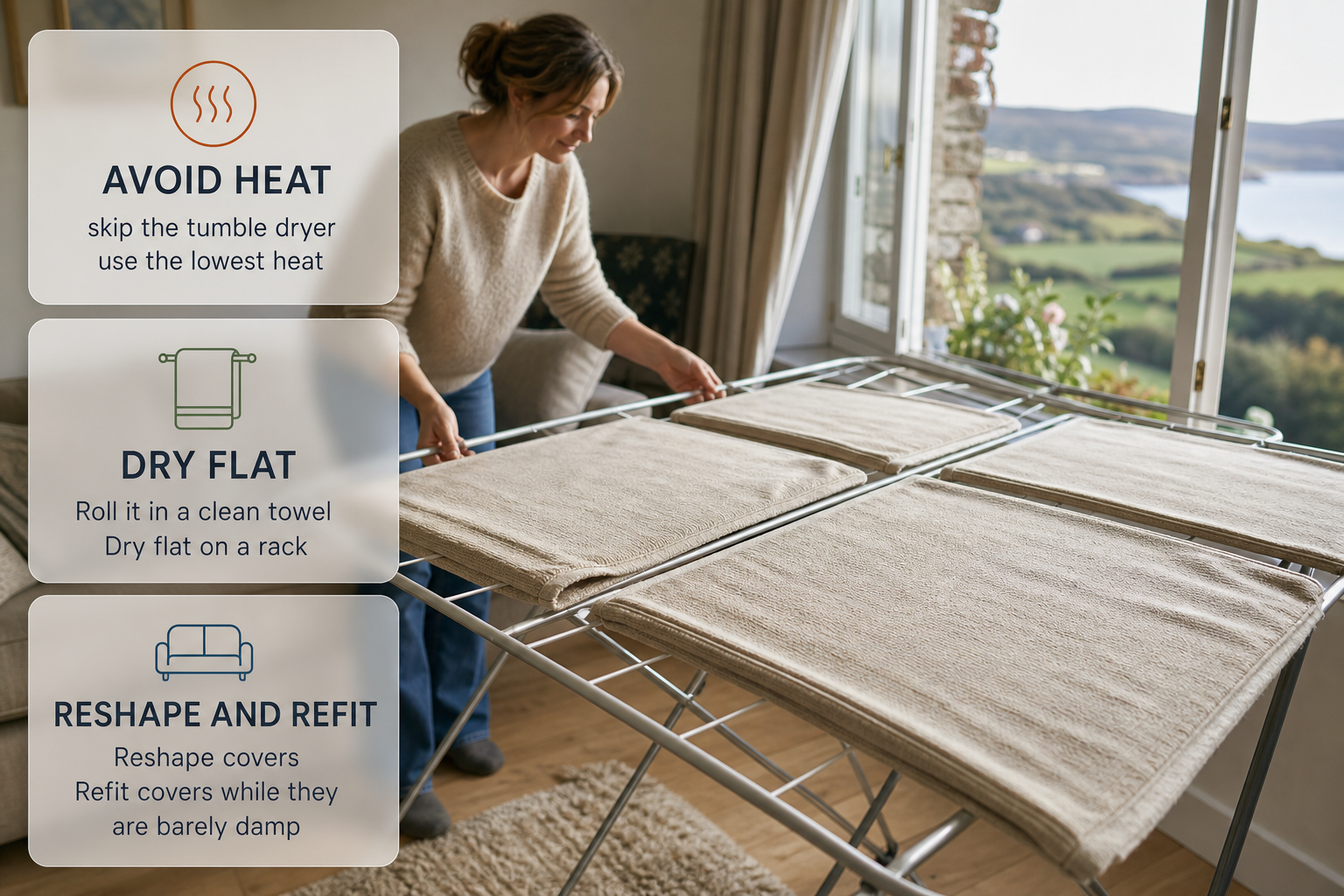
An infographic over a photo of sofa covers drying in an Irish home shows the key steps to dry covers safely without shrinkage or colour run.

Drying Covers Without Shrinkage, Colour Run or Damage

  • Heat is the main cause of shrinkage, so skip the tumble dryer unless the square symbol allows it, and then use the lowest heat.
  • Never wring or twist a wet cover. Roll it in a clean towel and press down to take out the bulk of the water.
  • Dry flat on a rack or over a clean towel, away from radiators and out of direct strong sun, which fades colour and makes cotton and linen brittle.
  • Reshape covers to their original measurements while they are still damp, so they dry to the right size.
  • Dry velvet, velour and chenille pile side up where possible, and brush the pile with a soft brush once dry.
  • Never leave a wet cover sitting in the drum or a basin, which is where colour run happens.
  • Colour-catcher sheets in the wash cut the risk of transfer from new or strongly dyed covers, and washing like colours together does the same job.
  • Indoor drying needs ventilation — an open window or a dehumidifier — to prevent damp smells and mildew.
  • Iron cotton and linen on the reverse at the heat the label allows, but never iron velvet, chenille, microfibre pile or printed surfaces.
  • Refit covers while they are barely damp so they ease over the cushions and settle into shape.

A cover that has already shrunk once will usually shrink further with each hot wash, so it is worth treating any cover that has lost size as a hand-wash-only item from then on. Zip covers up before storing them, and keep spares flat rather than folded tightly on a shelf, because sharp folds leave permanent creases in coated and pile fabrics.

When DIY Cleaning Stops Being Sensible

Some covers should not be washed at home at all. Stop and call an upholstery professional when the label carries a circle symbol, when the cover is fixed to the frame, when the fabric is velvet, wool, silk, leather or a loose viscose weave, when staining covers a whole cushion or several cushions, when a previous wash left water rings that will not lift, or when the cover has already shrunk. Professional cleaners use low-moisture or hot-water extraction methods and controlled drying, which is the difference between a clean cover and a ruined one.

Homeowners who decide to hand the job over can post a job on ShamFix, a free Irish marketplace where homeowners list work and local tradespeople respond. Posting a job and listing on ShamFix is free and there is no commission, and a subscription is planned for the future. ShamFix does not check or certify tradespeople and profiles are filled in by tradespeople themselves, so homeowners should check registrations themselves and read reviews before booking.

FAQ

Can every removable sofa cover go into a washing machine?

No. Removability and washability are two different things: a cover may unzip easily and still be marked hand wash only or carry the professional cleaning circle. Lightweight covers also snag on zips during a mixed load, so wash them inside a mesh bag or on their own. When in doubt, clean one cover by hand and judge the result before the rest go near a machine.

What wash setting should sofa covers be washed at?

Choose the coolest setting the care label permits, and never exceed the maximum temperature shown on it. Cottons, linens and synthetic blends usually tolerate the gentle cycle at a cool setting, while viscose, wool blends and strongly dyed covers are safer washed by hand in cool water. A warm wash is reasonable only for sturdy cotton or synthetic covers whose label explicitly allows it.

How do I stop sofa covers shrinking or colours running?

Shrinkage comes from heat and agitation together, so a cool wash, a low spin and flat drying do most of the work. Colour run comes from hot water, long soaking and mixing new or deeply dyed covers with pale ones. Washing like with like, keeping the wash short and refitting covers while barely damp solves most of both problems.

Can a steam cleaner be used on a fixed sofa cover?

Steam works well for refreshing a fixed cover and lifting odours, but it needs care. Test a hidden patch first, keep the head moving rather than resting it in one place, and avoid saturating the fabric, since velvet pile can crush and viscose can watermark. Steam is a poor choice for heavy soiling, which needs low-moisture professional cleaning instead.

Should the covers be washed one at a time or all together?

Wash one cover first as a test, because it reveals shrinkage and colour loss before the whole set is at risk. Once that cover comes back well, wash the remainder together as a set on the same cycle, so every cushion ages and fades evenly and the finished sofa still matches. Storing spare covers away from sunlight keeps them closer to the colour of the set.

Keep reading