A Dublin homeowner can spend a wet spring watching the back garden disappear under long grass, untidy hedges and weeds, then receive three completely different quotes. One gardener offers a monthly fee, another charges by the hour without setting a ceiling, and a third recommends a one-off clearance before discussing regular visits. The problem isn't always the price. Often, the scope of work hasn't been defined.
Garden maintenance in Dublin covers anything from routine mowing and bed care to clearance work, hedge reduction and tree-related tasks. Those services don't carry the same labour, equipment or waste-disposal requirements. A clear brief helps a homeowner compare like with like, avoid paying for unnecessary project work and secure a schedule that keeps the property presentable.
Why Garden Maintenance in Dublin Demands a Clear Plan
Dublin gardens vary sharply. A Victorian terrace may have a narrow rear yard with difficult access, while a suburban semi-detached home may have a larger lawn, established hedges and mature trees. Newer estates often have compact gardens that look untidy quickly because every border and paved edge is visible from the house.
The maintenance challenge also follows the garden type more than the postcode. Mature suburban gardens usually need more lawn, hedge and tree attention. Coastal properties face salt-laden wind exposure. City-centre and new-estate gardens are smaller, but regular visits can make a greater difference to how presentable the property looks.
Ireland's gardening market has substantial recurring demand. Bord Bia's survey reported about 1.3 million regular gardeners across almost 1 million households, and found that time was the biggest barrier for 44% of respondents, rising to 71% among younger adults. The same survey found 75% would garden more if maintenance were easier, which supports the practical case for scheduled upkeep rather than repeated emergency tidy-ups.
Practical rule: A quote should state exactly what happens during each visit, what gets removed, what costs extra and how the garden will be left.
Gardening isn't a state-registered trade in Ireland. That makes a written scope, public liability insurance, detailed local reviews and lawful waste handling especially important.
What Regular Garden Maintenance Includes
A good maintenance visit keeps a Dublin garden under control without becoming a landscaping project. Before agreeing to recurring work, require a written task list, visit frequency and waste arrangement.

The standard visit
For many Dublin gardens, routine work covers:
Lawn care: Mowing, edging and either removing or mulching grass clippings, as agreed.
Hedge trimming: Light, regular trimming where the hedge's height and species fall within ordinary maintenance.
Bed and border care: Weeding, deadheading, light cultivation and removal of spent growth.
Surface tidying: Clearing paths, patios and visible areas of leaves and loose debris.
General presentation: Gathering small green trimmings and leaving the garden in the agreed condition.
Fortnightly or monthly visits suit many maintained suburban gardens. The correct schedule depends on growth, weather, household expectations and whether the property must remain ready for viewings or tenants. The provider should confirm whether autumn leaf clearance, spring mulching and similar seasonal tasks are included, charged separately or left to the homeowner.
Waste handling belongs in the scope. Ask whether trimmings go into the brown bin, are removed by the gardener under the correct arrangement, or remain on site for composting. Do not assume disposal is included because the garden looks tidy at the end of the visit.
Work that needs a separate price
Routine care does not cover specialist work. Tree surgery, large branch removal, stump grinding, jet washing, fencing, paving, drainage, soil excavation and full clearances need different equipment and may require separate safety or waste arrangements.
A one-off clearance also differs from ongoing maintenance. It can involve cutting back neglected growth, removing accumulated waste, preparing beds and restoring access before regular visits begin. Agree the clearance price and disposal terms first. Otherwise, a low recurring quote can lead to an unexpected additional charge.
A maintenance contract should preserve the garden's condition. It should state clearly what is included, what requires a separate price and how waste will be handled.
Garden Maintenance Pricing Models and Cost Drivers
Dublin homeowners should choose the pricing model before comparing quotes. Hourly work suits changing tasks, a per-visit rate makes recurring care easier to budget, and a seasonal or annual agreement fits properties that need planned attention across the year.
Public Irish pricing references in Garden Pro's Dublin pricing guide place basic lawn mowing at about €30–€50 per visit and monthly maintenance commonly at €100–€200. Use these figures as reference points, not guaranteed tariffs. A written quote must state whether labour, travel, equipment, green-waste removal and VAT are included.
| Pricing model |
Best suited to |
What changes the quote |
| Hourly work |
Variable jobs, light tidy-ups and gardens being assessed |
Number of workers, access, overgrowth and task changes |
| Per-visit maintenance |
Regular mowing, edging, weeding and hedge care |
Garden size, visit frequency, hedge density and waste |
| Seasonal or annual arrangement |
Properties needing planned spring, summer and autumn attention |
Included visits, seasonal extras, clearance allowances and cancellation terms |
| One-off clearance |
Neglected gardens, move-outs and pre-maintenance preparation |
Volume of growth, access, cutting, loading and disposal |
The cost drivers that matter
Garden size is only the starting point. Narrow side access, steps, slopes, locked gates and long routes to the collection point all increase handling time. Green-waste removal becomes more expensive when bags, bins or cuttings must be moved a long distance. A tall leylandii hedge also requires more equipment and effort than a low, regularly trimmed mixed hedge.
Visit frequency changes the total cost. Regular care usually limits corrective work, while an overgrown garden may need a separate reset charge before routine visits begin. Ask whether the quoted monthly rate assumes the garden stays manageable between visits.
VAT should appear clearly on every written quote. Ask whether it applies, whether the stated amount includes it, and which items sit outside the headline price, including waste removal, access equipment, soil, planting or making good. Two or three itemised quotes are more useful than several vague totals.
Verify each provider independently, confirm waste arrangements, and reject any quote that leaves disposal or VAT unclear.
Typical price bands for common garden jobs in Dublin
Many homeowners are not looking for a single "garden maintenance" figure. They want the price by job or by billing unit so they can compare quotes properly. For a small to medium Dublin garden with ordinary access, the bands below are a practical starting point. Figures marked aggregate Irish market estimate are broad market ranges, not fixed tariffs.
| Job or pricing unit |
Typical price band |
| Basic lawn mowing |
€30–€50 per visit |
| Light hedge trimming |
€60–€120 per visit (aggregate Irish market estimate) |
| General gardening labour |
€25–€45 per hour (aggregate Irish market estimate) |
| One-off tidy-up or reset visit |
€150–€350 per visit (aggregate Irish market estimate) |
| Ongoing monthly maintenance |
€100–€200 per month |
The useful comparison is not just the headline figure. A lower quote may cover mowing only, while a higher one may include edging, weeding, clipping collection and a small amount of hedge work. The first visit also costs more than later visits when the garden is overgrown, blocked by toys or pots, or needs a lot of hand work before ordinary maintenance can start.
When a quote sits near the top of the range, the homeowner should check whether that higher figure includes waste removal, seasonal leaf work or a first-visit tidy-up rather than assuming the labour rate itself is unusually high.
Monthly maintenance or one-off visits: which usually costs less?
A monthly arrangement is usually better value only when the garden is already under control. Regular visits keep mowing, edging and weeding at maintenance level, so each return visit is shorter and more predictable. If the lawn is long, borders are full of weeds or hedges have been left too long, the usual pattern is a separate first clearance or reset charge followed by a lower recurring rate.
The main reason quotes vary is that "monthly maintenance" does not always mean the same thing. Before comparing prices, ask for the answer to these points in writing:
- how many visits are included each month or season
- whether hedge trimming is routine maintenance or a separate job
- whether autumn leaf clearance is included or added when needed
- whether the price assumes use of the homeowner's brown bin
- whether off-site green-waste removal is priced separately
That last point matters. Dún Laoghaire-Rathdown County Council states that Ballyogan Recycling Park accepts household green waste such as grass, hedge cuttings and leaves, and that green waste is a chargeable item (source). So a low monthly figure may exclude loading and disposal rather than represent cheaper labour.
For tidy gardens, a monthly plan can smooth costs. For neglected gardens or homes where work is only needed occasionally, paying per visit is often clearer and avoids paying a standing monthly fee for light-growth periods.
Seasonal Maintenance Calendar for Dublin Gardens
Dublin's maintenance rhythm is shaped by wet conditions, changing growth and the specific structure of each garden. A calendar should guide decisions, not force every property into the same schedule. A related county guide, garden maintenance in Galway, shows how the same principles apply outside the capital.
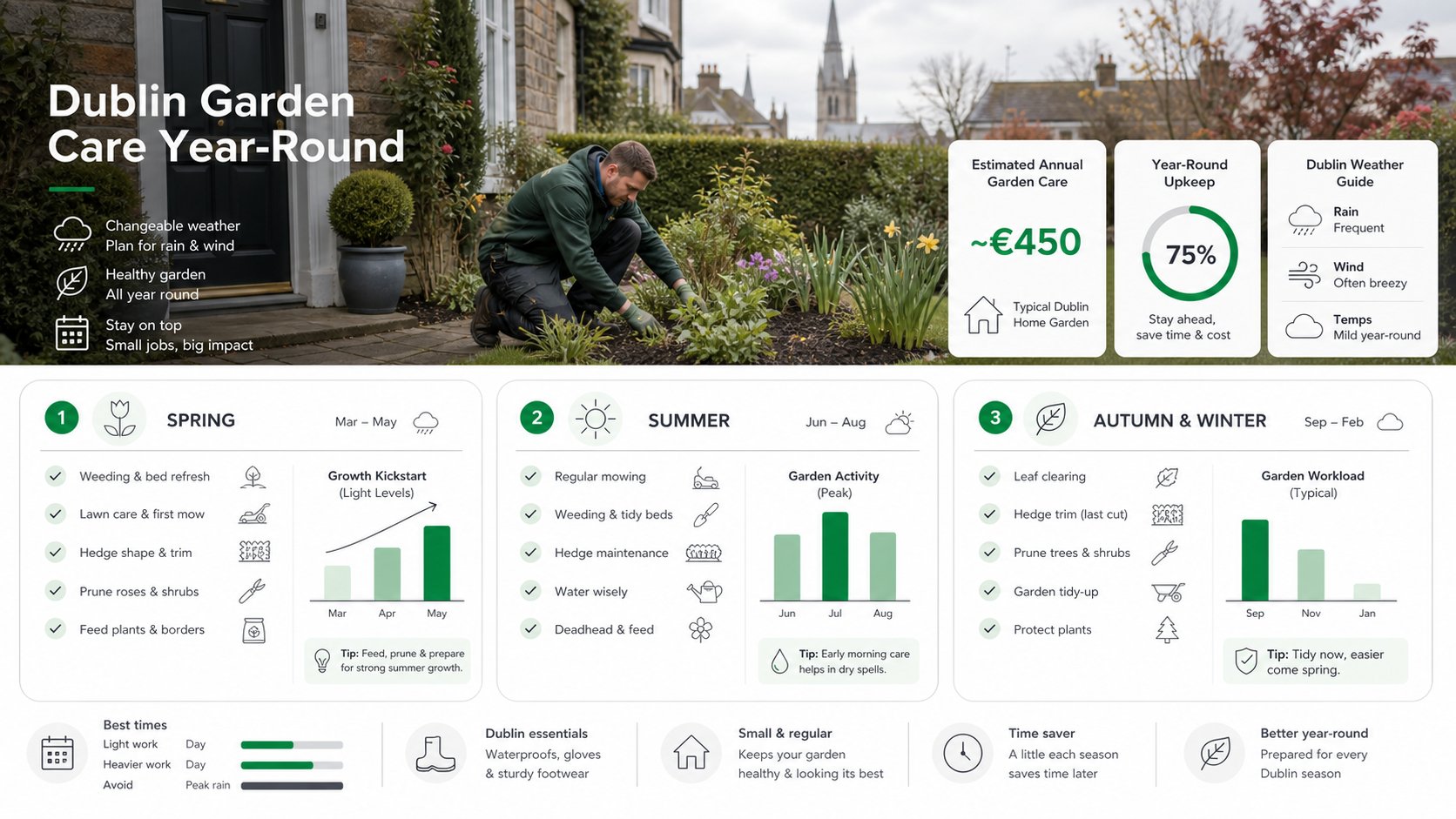
Spring
Spring is the reset period. Clear winter debris, remove early weeds, inspect borders and improve soil structure where planting areas stay wet. On heavy or wet ground, working in coarse grit and plenty of well-rotted organic matter, or moving planting into raised beds, improves drainage and plant vigour.
Avoid working wet ground aggressively. Repeated shallow cultivation can compact soil and smear clay rather than improve it. Mulch after weeding, repair bare lawn areas when conditions allow and agree whether spring feeding is part of the regular service.
Summer
Summer maintenance is mainly about keeping growth under control. Lawns need consistent mowing, borders need weeding and deadheading, and hedges may require trimming before they become difficult to manage. Watering should be targeted rather than routine, especially where soil structure already holds moisture.
Pollinator-friendly and native planting can reduce the need for intensive intervention when the plants match the site. Interest in native species, pollinator-friendly planting and looser, lower-maintenance designs has been growing in Irish gardens. For Dublin homes, that can mean replacing awkward lawn corners with planting that tolerates local conditions and gives the gardener less repetitive work.
Autumn
Leaf clearance becomes the dominant task in gardens with mature sycamores, beeches and other large trees. Leaves should be removed from paths, drains and lawns where they block light or create slippery surfaces. Suitable leaves can be composted separately, while other green waste needs an agreed disposal route.
Autumn is also a useful time to inspect lawn drainage, refresh mulch and plant spring bulbs. A provider should identify whether leaf collection is included in the normal visit or charged as a seasonal service.
Winter
Winter work is lighter, but it shouldn't stop entirely. Check storm damage, keep paths clear, maintain tools and carry out carefully planned structural pruning where appropriate. South Dublin County Council advises that pruning should be minimal and carried out for a clear reason, because unnecessary cuts can affect growth and allow wood-decay organisms to enter trees. Its guidance points to formative pruning for young urban trees in line with BS 3998:2010, with removal treated as a last resort. The council's arboriculture response supports selective clearance near buildings, paths and sightlines instead of indiscriminate crown reduction.
How to Choose a Reliable Gardener in Dublin
Gardening is an unregulated trade in Ireland. A person can advertise gardening services without holding a state registration or mandatory gardening qualification, so homeowners need to build their own checks into the hiring process.
Three checks that should come before acceptance
Public liability insurance is the first. The policy should be current and suitable for the work being offered. A provider working around glazing, parked cars, fences, children's play areas or neighbouring property should be able to explain how the cover applies.
Waste compliance is next. If the gardener removes green waste, the provider should hold a waste collection permit. The National Waste Collection Permit Office is the relevant Irish authority for checking waste collection permits. A homeowner shouldn't accept “it goes to a green site” as a sufficient answer. The provider should explain who carries the waste and how it will be handled.
Local reviews and references should describe comparable work in Dublin. Look for detail about punctuality, communication, the condition left after visits and whether the final price matched the agreed scope. Generic praise is less useful than a specific review covering a garden with similar access and maintenance needs.

Match the provider to the work
A general maintenance gardener may be suitable for mowing, weeding and light hedge trimming. Tree surgery, large removals and work near overhead services require a specialist with the right equipment, experience and insurance. Landscaping work involving patios, drainage, retaining structures or major planting should be priced as a project, not added to a mowing visit.
The written quote should name the business or sole trader, list the tasks, state the frequency, identify exclusions and explain payment terms. A vague cash-only arrangement, pressure to decide immediately or refusal to provide insurance details are clear reasons to keep looking. The ShamFix Ireland trades guide can be considered alongside direct referrals, but ratings and credentials still need to be read and confirmed by the homeowner.
Garden Waste Disposal and Recycling Rules in Dublin
Waste handling changes the cost of garden maintenance. A gardener who cuts, loads and transports material is taking responsibility for waste after leaving the property, so the homeowner should confirm the disposal arrangement before work starts.
MyWaste defines Irish garden waste as items such as leaves, flowers, grass, weeds, dead flowers, pruned branches, clippings, twigs and home-grown fruit or vegetables. Its garden-waste guidance says light garden waste can go into a brown bin, while larger items such as tree trunks and large branches should not. Citizens Information also states that organic waste should be separated from general rubbish and recyclables, and that a requested brown-bin service must collect garden waste at least monthly from 1 March to 31 October. Bulky green waste such as trunks and large branches belongs at a civic amenity site or with a permitted collector, not in the brown bin.
| Disposal method |
Typical cost |
Permit required |
Best for |
| Brown bin |
Included under the household's collection arrangement |
No separate permit for the householder's bin |
Light garden waste accepted by the collector |
| Permitted waste collector |
Included as an agreed quote item |
Yes, for the operator collecting and transporting waste |
Regular maintenance with removal |
| Civic amenity or recycling facility |
Site charges may apply |
A contractor transporting waste still needs the appropriate permit |
Larger quantities and planned clearances |
| General rubbish route |
Not suitable for garden waste |
Not a lawful substitute for green-waste handling |
None, unless the material is separately classified and accepted |
Soil, rubble, timber and construction debris shouldn't be mixed with grass and hedge trimmings. Dublin City Council's waste-prevention guidance advises against overwatering and over-fertilising and promotes compost instead of chemical fertilisers. The same environmental approach matters during maintenance because excess nutrients and chemicals can run off into drains and watercourses.
Grass can often be mulched back into the lawn rather than removed. Leaves should be composted separately from mixed garden waste, and household green waste shouldn't be left in black sacks or litter bags. Illegal dumping can attract an on-the-spot fine of €150, under Irish litter legislation. A homeowner should never instruct a gardener to "dispose of it somewhere" without asking for a lawful method.
The related Kildare skip hire and man-with-a-van guide is useful for understanding why disposal arrangements must be agreed before a clearance, even though Dublin waste rules still apply to a Dublin property.
How to prepare the garden before a gardener arrives
A little preparation can reduce labour time and make the quote more accurate. This matters most for one-off tidy-ups, where the first hour can disappear into access problems and sorting mixed piles rather than actual gardening.
Before the visit, a homeowner should:
- unlock side gates and make sure the route to the back garden is clear
- move cars, bins, toys, hoses, furniture and loose pots off the lawn or path edges
- point out anything that must not be cut back, lifted or removed
- separate general clutter from green waste so the gardener is not sorting it on the clock
- keep soil, rubble and timber out of clipping piles, as mixed waste can change the job and price
- leave space in the brown bin, if that is the agreed disposal method
It also helps to decide the priority before the visit starts. If the budget only covers limited time, most homeowners get better value by asking for the visible areas first: front lawn, entrance path, patio edge and the main rear seating area. The overgrown back corner can wait if needed.
For first-time visits, a few clear photos and the access width to the garden are often enough to prevent underquoting and later add-on charges.
Finding and Hiring Your Local Garden Maintenance Provider
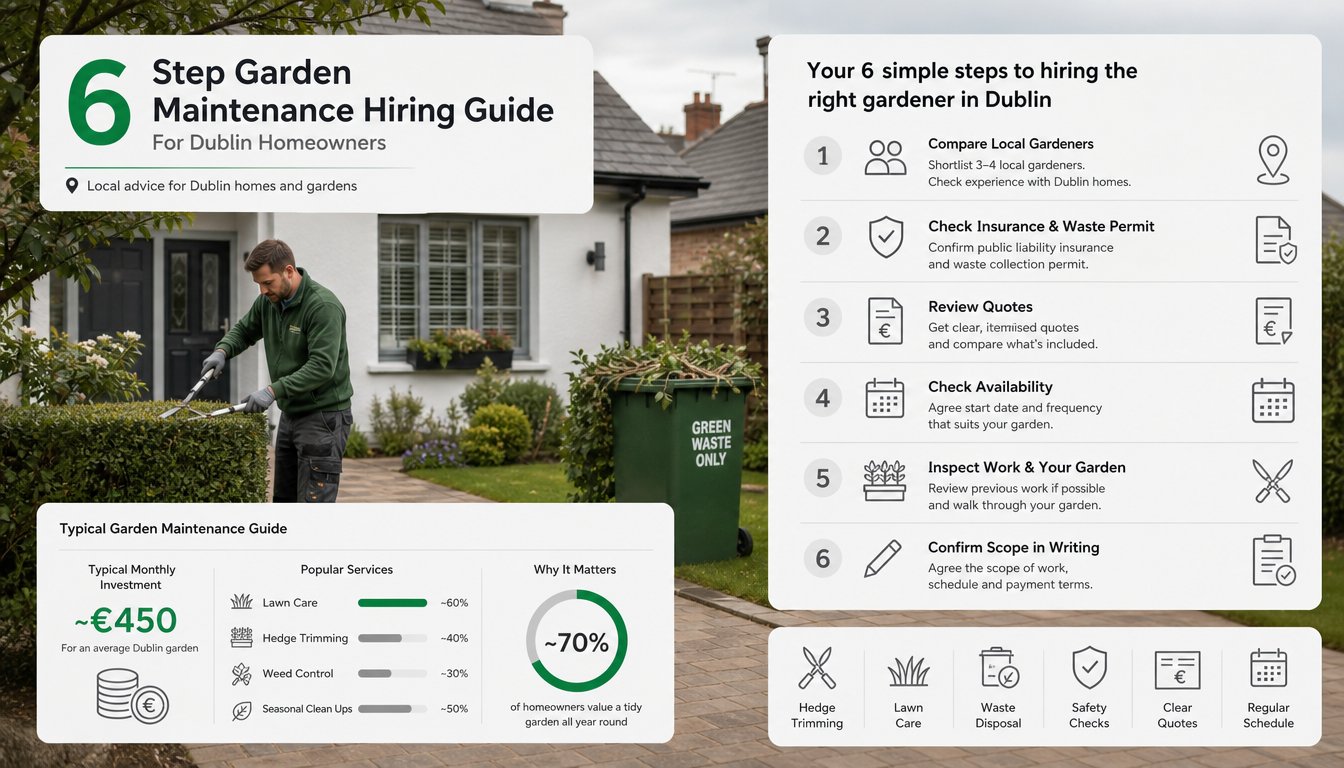
The most reliable hiring process is simple and written down.
Define the job: Separate routine mowing, weeding and hedge care from clearance, tree work, landscaping and waste removal.
Describe the property: Include the garden size, side access, gates, steps, slopes, parking and any shared boundaries.
Request comparable quotes: Ask two or three providers to price the same task list, visit frequency and disposal arrangement.
Check compliance: Request current public liability insurance details and confirm a waste collection permit if the provider will remove waste.
Agree the visit standard: Specify mowing height or edging expectations, hedge limits, bed care, leaf work and how the garden should look after each visit.
Put it in writing: Include the price, VAT position, payment date, cancellation terms, seasonal extras and the process for additional work.
A first visit should also identify hazards such as unstable branches, hidden drains, damaged fencing, children's equipment and access through a neighbour's property. The provider and homeowner should agree who handles keys, gates, water access and green-waste storage.
ShamFix is an Ireland-only marketplace that lists local service providers, and homeowners can read about how the ShamFix marketplace works before deciding whether to use it alongside direct outreach. It doesn't perform gardening work or guarantee the quality of a listed provider, so insurance, permits, written scope and reviews remain the homeowner's responsibility.
Garden owners can use ShamFix to find local garden maintenance providers in Dublin and compare enquiries around a clearly defined scope of work. The dedicated Dublin garden maintenance category is a practical starting point for homeowners who want to request local service information while still checking insurance, waste permits and reviews themselves.
Are you a gardener in Dublin?
Listing on ShamFix is free and there's no commission; a subscription is planned for the future. Visit ShamFix for tradespeople to list the business and be among the first found as local demand grows.