
Repairing a dishwasher in Ireland usually costs €100 to €220 for the most common faults, such as a failed drain pump, a broken door seal or a faulty water inlet valve, as an aggregate Irish market estimate including VAT, parts and labour. A heating element or circulation pump costs more, typically €150 to €300, and a new control board €200 to €350. Most engineers charge a call-out or diagnostic fee of €60 to €100, which is often deducted from the bill if the repair goes ahead. As a rough rule, a repair costing more than half the price of a new dishwasher on a machine over eight years old is rarely worth it. Households who need a dishwasher fixed can post the job under household appliance repair and compare quotes from local engineers.
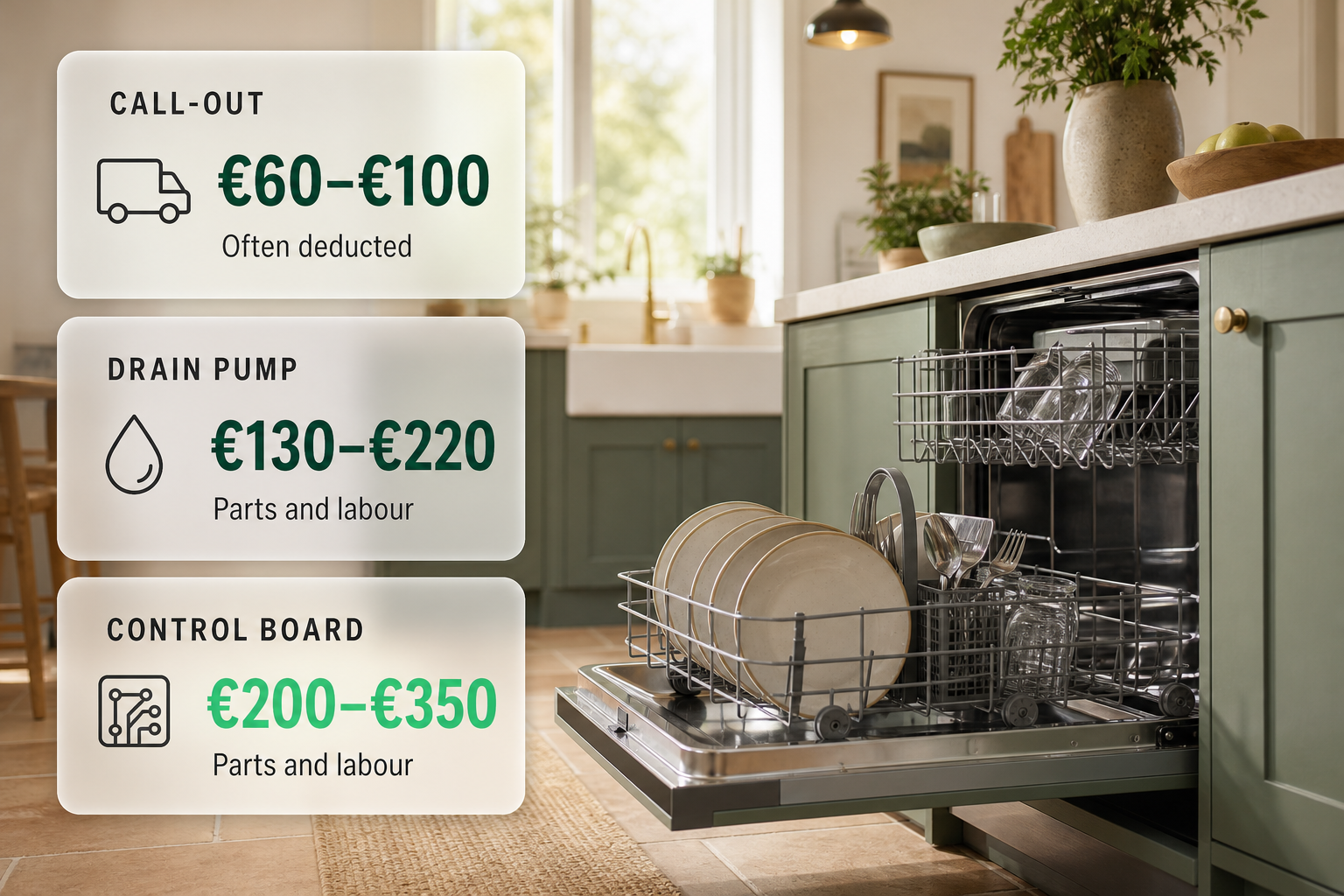
Dishwasher repair prices at a glance
The figures below are an aggregate Irish market estimate, VAT included, for parts and labour on a typical domestic dishwasher.
| Job | Typical price |
|---|---|
| Call-out and diagnosis | €60–€100 |
| Clearing a blocked filter, sump or drain hose | €70–€120 |
| Drain pump replacement | €130–€220 |
| Water inlet valve replacement | €120–€200 |
| Door seal, hinges or door springs | €100–€200 |
| Heating element or heater pump | €150–€250 |
| Circulation (wash) pump | €180–€300 |
| Control board (PCB) replacement | €200–€350 |
| Engineer's hourly rate | €50–€70 |
| New freestanding dishwasher, for comparison | €350–€900 |
| New integrated dishwasher, for comparison | €450–€1,200 plus €80–€150 fitting |
Integrated dishwashers usually cost a little more to repair than freestanding models, because the machine has to be slid out from the kitchen units and the door panel removed. Premium brands can also have dearer parts.
The call-out fee for appliance repair is the biggest variable between engineers, so it is worth asking whether it is fixed, whether it covers the first half hour, and whether it comes off the final bill.
A worked example: a family in Cork has a six-year-old integrated dishwasher that stops mid-cycle with water left in the bottom. The engineer charges €80 for the call-out, which is deducted when the repair goes ahead, finds a failed drain pump, and replaces it for €140 to €200 including the part and fitting. The total is €140 to €200. A comparable new integrated dishwasher with fitting would cost about €530 to €1,350, so the repair is clearly worth doing.
Common dishwasher faults and what they usually cost
- Not draining. Usually a blocked filter or drain hose (€70 to €120 to clear) or a failed drain pump (€130 to €220).
- Not filling with water. Often the water inlet valve (€120 to €200), a kinked supply hose or a tripped flood-protection switch.
- Dishes not getting clean. Blocked spray arms or filter, which can often be cleaned at home, or a worn circulation pump (€180 to €300).
- Dishes not drying or water stays cold. Usually the heating element or heater pump (€150 to €250).
- Leaking. Most often a worn door seal or a loose hose (€100 to €200), sometimes a cracked sump.
- Will not start, or shows an error code. Can be a door latch, a blown fuse in the plug or a control board fault (€200 to €350 for a new board).
Error codes vary by brand, and the manual or the maker's website usually explains what each one means. Giving the code to the engineer when booking helps them bring the right part.
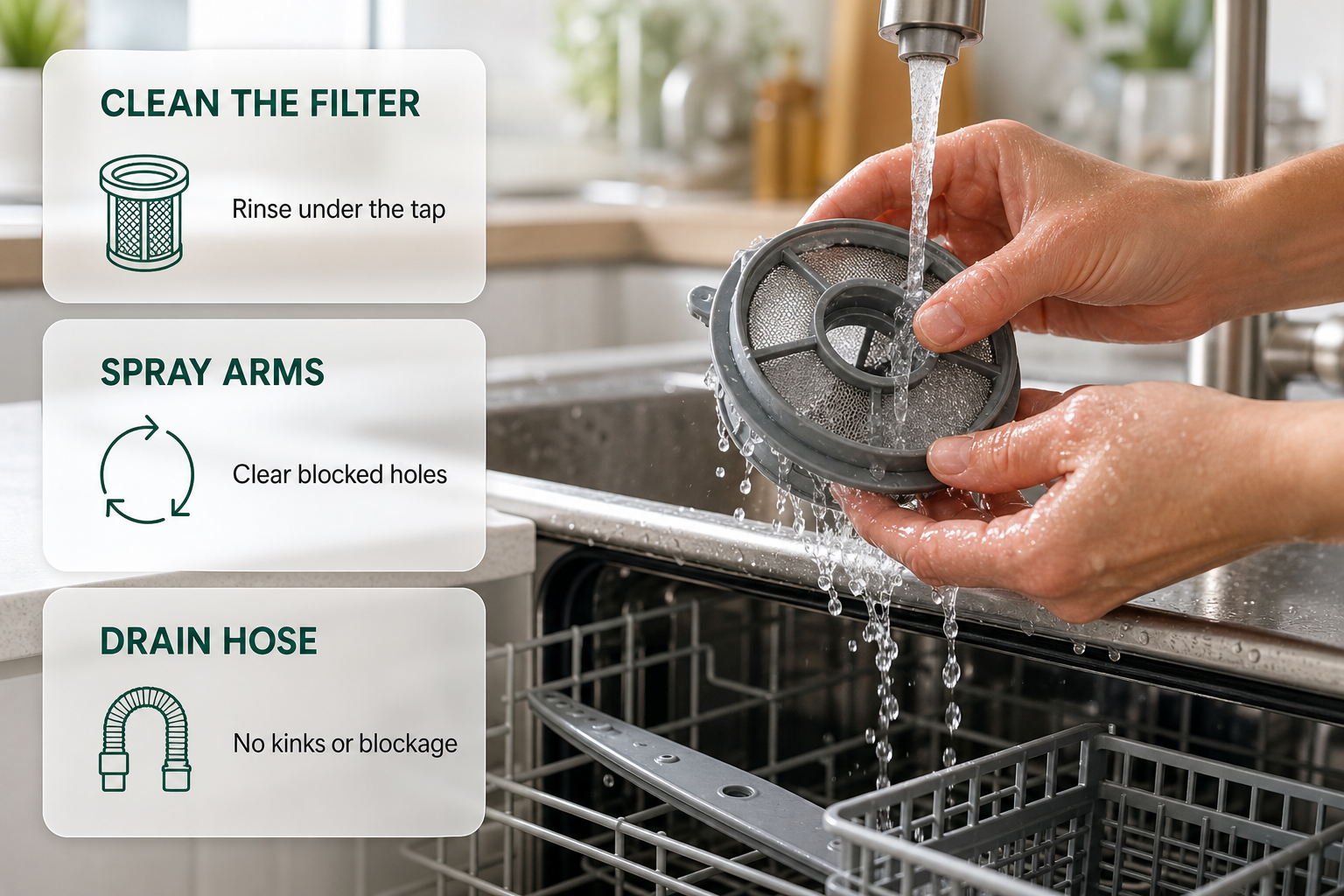
Checks to do before calling an engineer
Several faults that look serious have a simple cause:
- Clean the filter at the bottom of the machine, rinsing it under the tap.
- Check the spray arms turn freely and the small holes are not blocked with food or limescale.
- Check the drain hose behind the machine is not kinked, and that the sink waste it connects to is not blocked.
- Check the water tap to the dishwasher is fully open.
- Check the fuse and the socket, and make sure the door is closing fully.
- Run an empty hot cycle with dishwasher cleaner if the machine smells or leaves residue.
The machine should be switched off at the socket before any part is removed. Anything involving the electrics, the pump or the heater is a job for a qualified engineer.
Repair or replace?
Repair is usually the better choice when:
- the dishwasher is less than about eight years old;
- the fault is a single part such as a pump, valve or seal;
- the repair costs well under half the price of a comparable new machine;
- the machine is integrated, so a new one would also need fitting.
Replacement makes more sense when the machine is old and has had several repairs, when the control board fails on a cheap model, or when the tub or frame is rusted or cracked.