
€14.80 per hour is the statutory minimum pay floor for contract cleaning workers aged 20 and over from January 2026 in Ireland, but it is not the customer price. Any realistic commercial office cleaning quote sits above that because the contractor also carries employer PRSI, insurance, materials, supervision and margin.
That distinction matters because many Irish buyers are still handed vague monthly figures with no explanation of what they are buying. An office manager trying to tidy up a hybrid workplace, a landlord taking over a multi-tenant building, or an operations lead dealing with missed bins and dirty washrooms usually doesn't have a pricing problem first. The problem is a scope problem.
A good contractor gives a written specification, a sensible frequency for each area, clear responsibility for consumables and a workable plan for access, alarms and key-holding. A poor one hides behind a headline rate and leaves the details to argument later. Readers who want to find office cleaning contractors and post your job should still decide the scope before requesting quotes, because that is what makes the quotes comparable.
Contract Versus Ad-Hoc Office Cleaning in Ireland
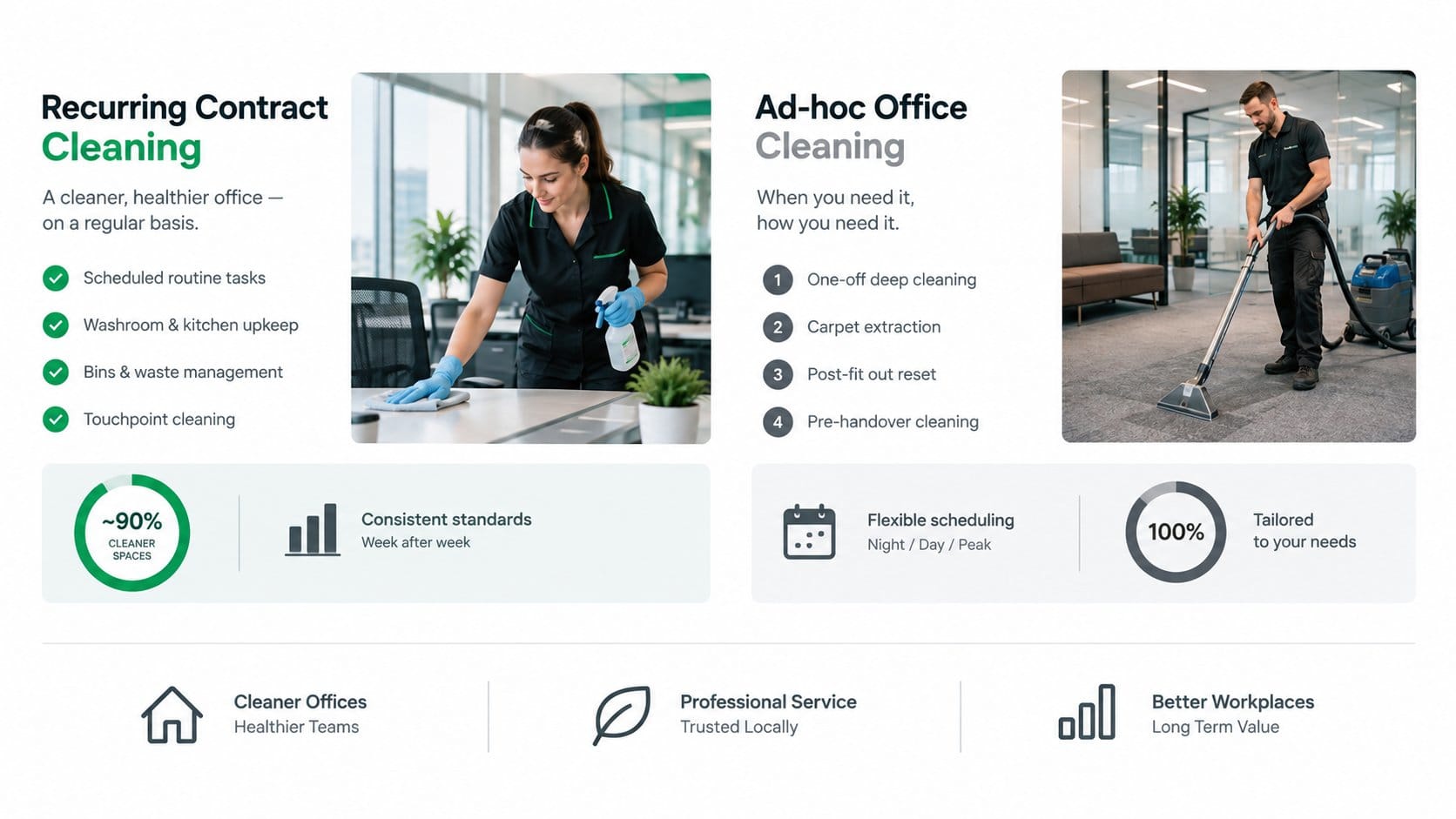
A recurring contract suits offices that need a predictable standard. An ad-hoc clean suits one-off resets, deep cleans after fit-out works, or periods when occupancy is too uneven to justify a standing schedule.
When a recurring contract makes sense
Most offices don't generate the same cleaning demand in every room. Shared kitchens, entrances, meeting rooms and washrooms usually need more attention than quiet corners or archive rooms. That is why a contract should be built around use patterns rather than a flat promise to “clean the office”.
Irish workplace guidance is clear that work areas must be cleaned regularly, frequently touched surfaces must be cleaned at least twice daily, and disinfection is an addition to cleaning rather than a substitute for it, according to the Health and Safety Authority work safely protocol. For a busy office, that pushes the conversation away from “one visit per week” and towards area-by-area frequency.
Practical rule: If the contractor talks first about hours and only later about washrooms, touchpoints and kitchens, the quote is probably being built backwards.
Where ad-hoc cleaning fits better
Ad-hoc office cleaning is often the right answer when the issue is occasional rather than routine. Typical examples include a once-off deep clean after internal works, a pre-handover clean for an incoming tenant, carpet extraction after heavy soil build-up, or a reset after a long period of partial occupancy.
It is also useful where management wants to test a contractor before committing to a longer agreement. That trial only works, though, if the one-off specification is detailed enough to show whether the crew can follow instructions.
In-hours and out-of-hours are not the same service
In-hours cleaning can work in lightly occupied offices where staff accept visible cleaning activity during the day. It allows quick response to spills and washroom issues, but it also means cleaners are working around meetings, desks, phones and IT equipment.
Out-of-hours cleaning is often easier to manage in professional offices. Bins can be removed without disruption, floors can be treated, and key-holding and alarm procedures can be standardised. The trade-off is that the contractor must be trusted with access, lock-up routines and consistency of crew.
A demanding commercial office cleaning contract usually becomes difficult for four reasons. Access is outside normal hours. Staff and equipment must not be disturbed. Washroom consumables need steady restocking. The client wants the same people on site rather than a rotating crew.
What a Commercial Office Cleaning Specification Should Include
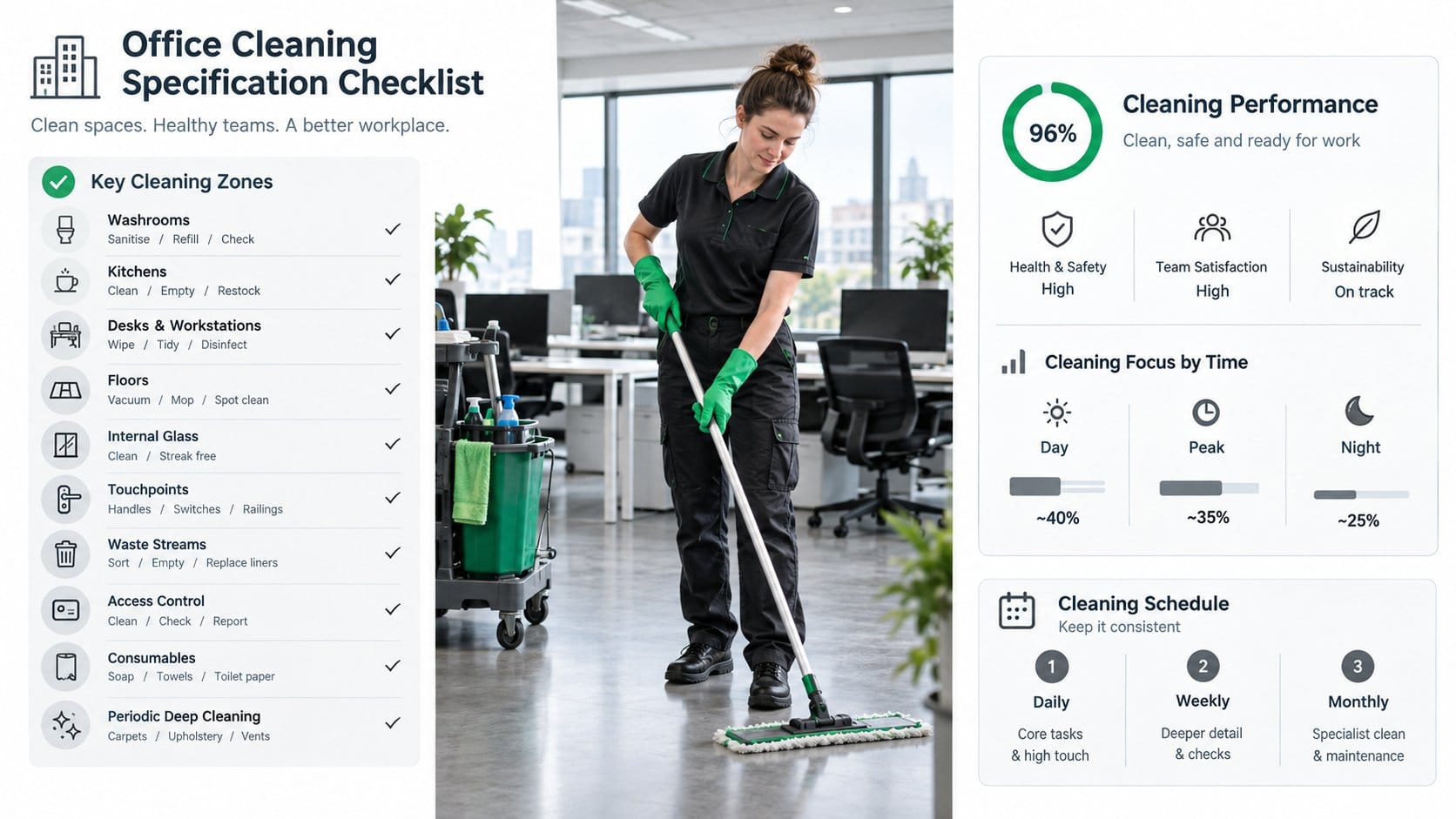
A weak cleaning brief produces strong disagreement later. The better approach is to write the specification by zone and by frequency.
List each area separately
Irish workplace rules require every workplace to be kept in a clean state, with waste removed as frequently as necessary to maintain safety and health, and the same guidance says frequently touched surfaces should be visibly clean at all times and cleaned at least twice daily, while washrooms and communal spaces should be cleaned at least twice per day and whenever visibly dirty, under the Return to Work Safely Protocol and related Irish guidance. That makes one blanket frequency across the whole office a poor specification.
A practical brief should separate:
- Bins and waste streams. State whether general waste, mixed recycling, food waste and confidential waste are all in scope.
- Washrooms. List toilets, urinals, sinks, mirrors, dispensers and sanitary units separately.
- Kitchen and tea station areas. Specify counters, sinks, splashbacks, fridge exteriors, microwave interiors if required, and dishwasher surrounds.
- Floors. Name the floor finish in each area, such as carpet tile, vinyl, sealed concrete or laminate.
- Internal glass and partitions. This is frequently missed, then disputed.
- Touchpoints. Door handles, push plates, handrails, switches and shared equipment need their own frequency.
A specification should read like a room-by-room operating instruction, not like a sales brochure.
The details most buyers forget
The most common omission is frequency per area. A shared kitchen may need daily attention, while a back corridor may not. Another frequent gap is consumables. The quote should say who supplies and who restocks toilet roll, hand soap, paper towels, bin liners and similar items.
The same applies to waste segregation. If the office has separate recycling streams, the contractor should be told exactly what goes where and how often bins are changed.
Buyers should also define the specialist items that sit outside routine cleaning:
| Area | What to specify |
|---|---|
| Floors | Spot cleaning, machine scrubbing, polishing, stripping or carpet extraction |
| Glass | Internal panes only, or doors, partitions and manifestations too |
| Kitchen | Appliance interiors included or excluded |
| Washrooms | Consumables supply, restocking and refill checks |
| Access | Key-holding, alarm unset/reset, lock-up responsibility |
For offices with staff kitchens or customer refreshment areas, apply the zoning logic used in food-service settings. Keep food-preparation surfaces, shared appliances and general office areas on separate cloths, separate schedules and separate sign-off lines, and make that split explicit in the written specification rather than leaving it to the cleaner on the night.
Periodic work should be written in separately
Routine cleaning is one line of the contract. Periodic work is another. Deep cleans, carpet extraction, hard floor restoration and higher-level dusting should be identified as separate scheduled items or optional extras. If they are left vague, they are usually left out.
How Commercial Office Cleaning Costs Are Structured in Ireland
A facilities manager receives two evening-cleaning quotes for the same Dublin office. One looks 20% cheaper. On closer review, the lower figure excludes washroom consumables, assumes fewer toilet checks, and prices access as if a staff member will always be there to let cleaners in. The headline number was never the comparison.
The sensible starting point is labour law. The Workplace Relations Commission contract cleaning order sets a statutory minimum rate of €14.80 per hour for covered cleaning workers. Employer PRSI adds 11.25% until 30 September 2026, and is scheduled to rise to 11.40% from 1 October 2026. That establishes the wage floor only. A client rate still has to absorb annual leave cover, supervision, insurance, materials, equipment, travel time, administration and margin.
This is why generic hourly pricing often misleads buyers. In office cleaning, cost is driven less by floor area on its own and more by how often each area needs attention.
Published price guides can still be useful as a rough sense check, but the only reliable range is the one that comes back from three local providers quoting the same written scope. Treat any headline figure for a recurring small-office clean or a one-off deep clean as orientation, not as a tariff. A fair contract price depends on the specification attached to the site.
Three variables usually explain most of the difference between competing quotes.
First, frequency by area. An office that needs desks and floors cleaned three evenings a week may still require washrooms checked daily and kitchens cleaned every day they are used. Contractors who price the whole building at one blanket frequency often understate the labour needed in hygiene-critical spaces. That matters because washrooms and tea stations consume a disproportionate share of cleaning time relative to their size.
Second, service inclusions. Restocking toilet roll, paper towels, hand soap and bin liners is labour. Supplying those consumables is a separate cost again. Buyers should also price in sanitary units, mat changes, internal glass, fridge cleans and periodic machine work only if they are required. If they are left vague, quotes become hard to compare and disputes usually appear later.
Third, access and operating conditions. Out-of-hours cleaning can increase cost if the contractor has to hold keys, unset alarms, sign in through security, work around restricted lifts or lock up the building afterwards. Those tasks are not cleaning in the narrow sense, but they still take paid time and carry risk.
A better quote therefore separates routine labour from variable items. In practice, the cleaner proposals are usually the ones that show a recurring service charge, a clear list of included consumables or excluded consumables, and separate rates for periodic work or extra call-outs.
VAT also needs a direct check. Commercial cleaning is generally invoiced at the standard VAT rate, so buyers should confirm whether the quoted figure is inclusive or exclusive before comparing totals.
Contract cleaning in Ireland is a large and fragmented market, with everything from one-van operators to national facilities companies bidding for the same office. That helps explain why one supplier may price from labour minutes while another prices from visit frequency and supervision assumptions. The practical lesson is simple. Compare scope line by line, then compare price.