Home CCTV in Ireland costs €500–€1,500 for 2–4 cameras and an alarm €450–€1,500. Monitoring, licensing and privacy rules.
/6 min read
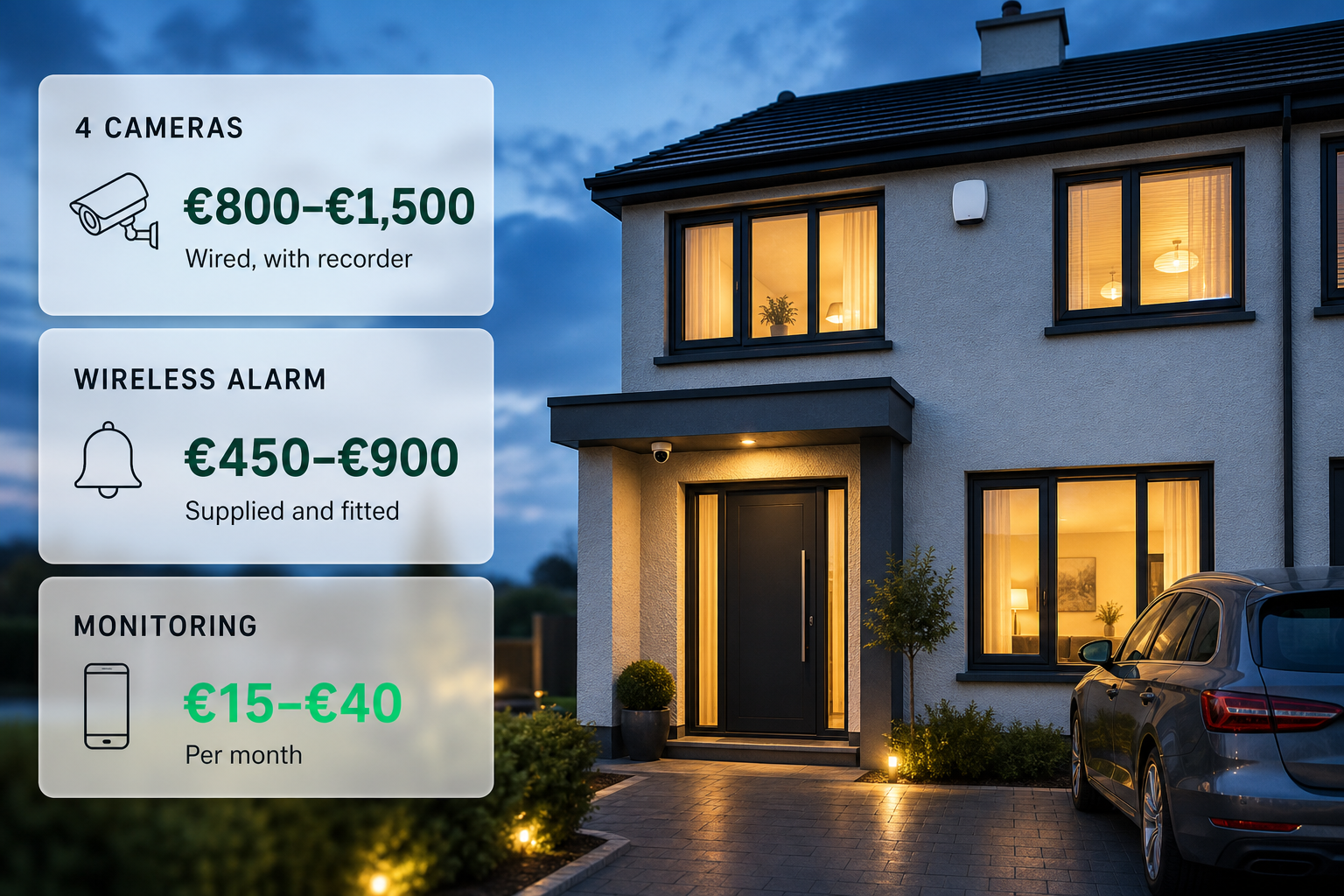
Installing home CCTV in Ireland usually costs €500 to €900 for a two-camera wired system and €800 to €1,500 for four cameras with a recorder, as an aggregate Irish market estimate including VAT, supply and fitting. A house alarm usually costs €450 to €900 for a wireless system and €700 to €1,500 for a wired one, and professional monitoring adds about €15 to €40 a month. A video doorbell fitted by an installer typically costs €160 to €400 including the device. Alarm installers in Ireland must be licensed by the Private Security Authority, and home cameras have to stay within data protection rules if they film beyond the property. Households who want cameras or an alarm fitted can post the job under alarm and CCTV installation and compare quotes from local installers.
CCTV and alarm prices at a glance
The figures below are an aggregate Irish market estimate, VAT included, for supply and installation in a typical house.
Job
Typical price
Two-camera wired CCTV system with recorder
€500–€900
Four-camera wired CCTV system with recorder
€800–€1,500
Eight-camera wired CCTV system
€1,500–€3,000
Fitting a wireless or battery camera, per camera, device extra
€100–€250
Video doorbell, supplied and fitted
€160–€400
Wireless house alarm, supplied and fitted
€450–€900
Wired house alarm, supplied and fitted
€700–€1,500
Professional alarm monitoring, per month
€15–€40
Annual alarm service
€100–€180
CCTV health check or service
€100–€200
Security light with motion sensor, fitted by an electrician
€80–€200
Prices depend mostly on the number of cameras or sensors, the quality of the equipment and how far cables have to run. Systems that connect to a phone app are now standard; higher-resolution cameras, colour night vision and longer recording storage cost more.
A worked example: a semi-detached house in Galway gets a wireless alarm with door contacts, three motion sensors and an external bell box for €600 to €900, and a four-camera wired CCTV system covering the front door, driveway, side passage and back garden for €800 to €1,500. Installation of both comes to roughly €1,400 to €2,400. Adding professional monitoring at about €25 a month costs around €300 a year on top.
Cameras, alarm or both?
An alarm is designed to deter and alert. A loud external siren and a visible bell box put off many opportunistic burglars, and a monitored alarm can alert a keyholder or a response service.
CCTV records what happens and lets owners check the house from a phone. It helps with evidence and with deliveries and visitors, but it does not stop someone on its own.
Both together give the strongest protection, and many installers offer a package price.
According to An Garda Síochána, alarms should comply with the European standard EN 50131, and an alarm is not a replacement for good physical security. Good locks and well-fitted doors and windows still come first; the cost of a locksmith for upgraded locks is covered separately.
Monitored or self-monitored alarm?
Self-monitored alarms send alerts to the owner's phone and sound a siren. There is no monthly fee, but someone has to respond.
Professionally monitored alarms are connected to a monitoring centre that contacts keyholders and, where appropriate, the emergency services. They cost about €15 to €40 a month, and it is worth asking the home insurer whether a monitored alarm affects the premium.
For a home that is often empty, or for older relatives living alone, monitoring is usually worth the monthly fee.
Installers must be licensed
The Garda advice is clear that all alarm installers and installation companies must be licensed by the Private Security Authority. Before booking, it is worth checking the installer's name on the Authority's register of licence holders, and asking which standard the alarm meets.
Home CCTV and data protection
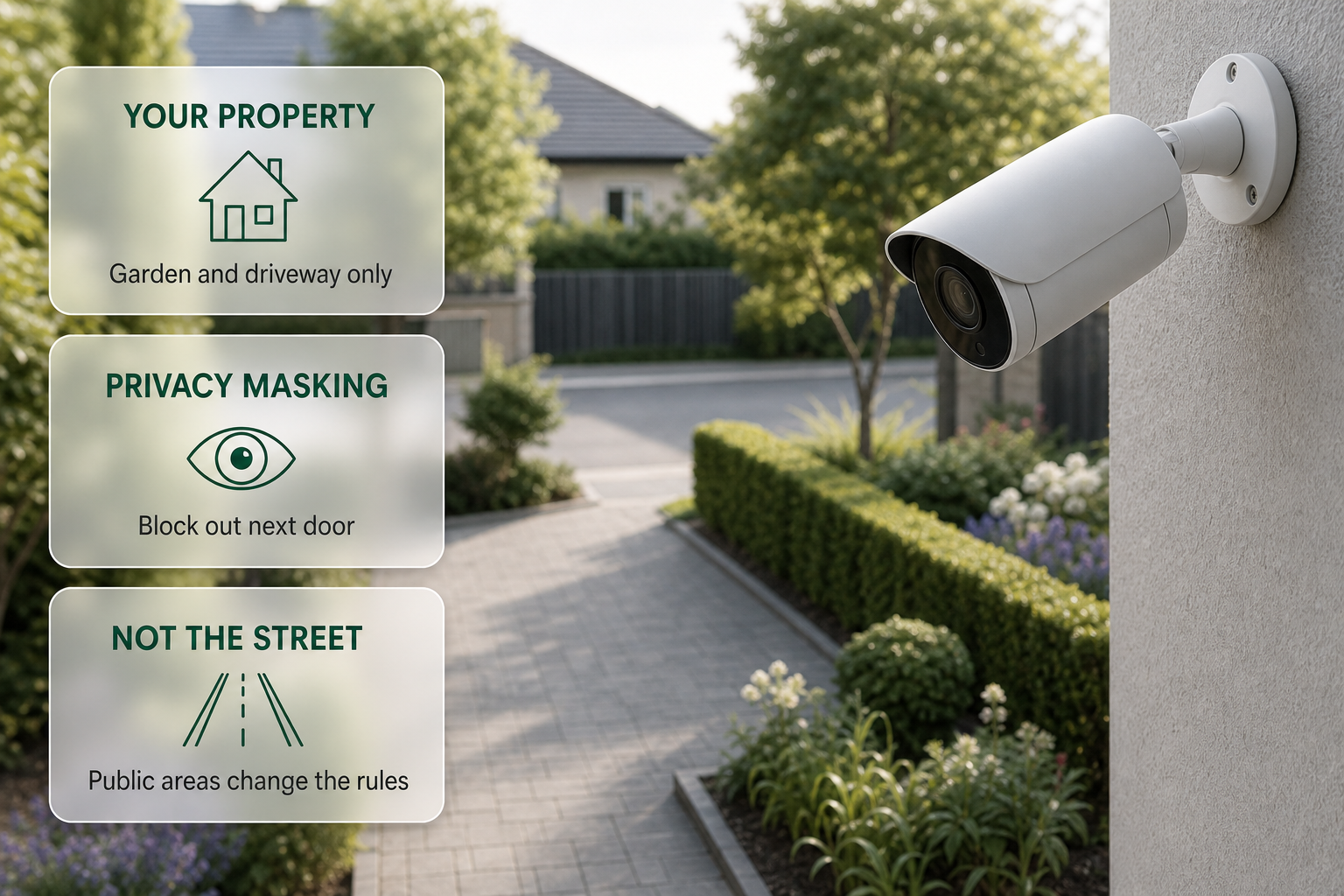
Home cameras are allowed, but where they point matters. According to the Data Protection Commission, data protection law does not apply to a purely household system that only captures images within the owner's own property, including the garden and driveway. If cameras capture images beyond the property, for example a public footpath or street, that exemption no longer applies. The Commission also says it is not acceptable to operate CCTV in a way that captures images of neighbours in their homes, gardens or driveways, and advises householders to set cameras up so that they only cover their own property.
In practice, a good installer will:
angle cameras so that they cover doors, driveways and gardens rather than the street or next door;
use privacy masking to black out parts of the image that show a neighbour's property;
explain where recordings are stored and for how long.
What affects the price
Number of cameras or sensors, and how many doors and windows need covering.
Wired or wireless. Wired systems cost more to install but are more reliable; wireless systems are quicker to fit but need batteries or a power supply.
Equipment quality. Resolution, night vision, storage and app features vary widely.
Cable runs. Long runs, solid walls and attics without access add time.
Monitoring and maintenance contracts add a monthly or yearly cost.
Location. Dublin and the larger cities are usually dearer.
Doing it yourself
Battery-powered cameras and video doorbells can be fitted by many householders. Wired CCTV, hard-wired alarms and anything connected to mains power are best left to a licensed installer and, for electrical work, a registered electrician. A badly placed camera or a false-alarming system can cause more trouble than it solves.
How to compare CCTV and alarm quotes
Ask each installer to visit and quote in writing for the same number of cameras and sensors.
Ask which brand and model will be fitted, the camera resolution and how much recording storage is included.
Ask whether the alarm meets EN 50131 and whether it can be monitored later.
Ask about monthly monitoring costs, contract length and cancellation terms.
Ask how cameras will be positioned to stay within the property.
Check the Private Security Authority licence and public liability insurance, and read reviews.
FAQ
How much does CCTV installation cost in Ireland?
As an aggregate Irish market estimate, about €500 to €900 for two wired cameras and €800 to €1,500 for four cameras with a recorder, supplied and fitted.
How much does a house alarm cost in Ireland?
About €450 to €900 for a wireless alarm and €700 to €1,500 for a wired alarm, plus about €15 to €40 a month if it is professionally monitored.
Can my CCTV camera film the street or my neighbour's house?
According to the Data Protection Commission, a home system that only captures the owner's property falls under the household exemption, but cameras that capture public areas take the system outside that exemption, and capturing neighbours in their homes, gardens or driveways is not acceptable.
Do alarm installers need a licence in Ireland?
Yes. An Garda Síochána states that all alarm installers and installation companies must be licensed by the Private Security Authority.
Getting quotes for CCTV and alarms
CCTV and alarm prices depend mostly on how many cameras and sensors are needed and on the equipment chosen, so a site visit gives the most accurate quote. Security systems often go together with locks, lighting and door upgrades among wider home services. On ShamFix posting a job and listing is free and there is no commission, and a subscription is planned for the future. ShamFix does not check or certify tradespeople and profiles are filled in by tradespeople themselves, so ask about experience, confirm insurance and read reviews before booking anyone.