Carpet Cleaning for Allergies: An Irish Homeowner's Guide
Carpet cleaning lowers dust, mite and pet dander levels, but it cannot remove every trigger. Here is how to do it without leaving damp.
/11 min read
Carpet cleaning can genuinely reduce the amount of dust, dust mite allergen and pet dander sitting in a carpet, and many Irish households find a room easier to be in afterwards. It cannot make a carpet allergen-free, and the HSE's position is that the most effective way of managing an allergy is to avoid the allergen that causes the reaction (HSE). Cleaning is therefore one part of a wider routine, and where a household wants a deeper clean than a domestic vacuum can reach, arranging carpet and upholstery cleaning is a sensible step alongside weekly habits at home.
What a carpet traps, and why it matters here
Every soft surface in a home collects material, but carpet holds onto it more stubbornly than most. The HSE notes that house dust mites can live in mattresses, carpets, soft furniture, pillows and beds (HSE), so a bedroom carpet sits directly in the path of the allergen most likely to cause year-round symptoms. The HSE's asthma guidance adds that carpets and rugs can hold lots of dust (HSE), and that dust carries more than mite allergen with it.
The allergens that matter most in an Irish fitted carpet are:
Dust mite allergen, the protein in mite droppings, which settles deep in the pile and in the underlay underneath it.
General house dust, a mix of fibres, pollen, mould spores and particles brought in from outside.
Pet dander, the small, sticky flakes of skin and dried saliva that cling to fibre and are hard to vacuum out of a dense pile.
Pollen, carried in on shoes, clothing and pets during the grass and tree seasons.
Mould spores, which become a problem where a carpet or its underlay stays damp.
Warm, humid rooms are the underlying issue. HSE guidance for children with asthma and respiratory conditions states that house dust mites thrive in warm, damp places such as mattresses, carpets, soft toys and furnishings (Children and Young Peoples Centre, CUH). That is why bedrooms in a sealed, heated home often produce the worst symptoms, and why drying a carpet properly after any wet cleaning matters as much as the cleaning itself.
Daily and weekly habits that keep levels down
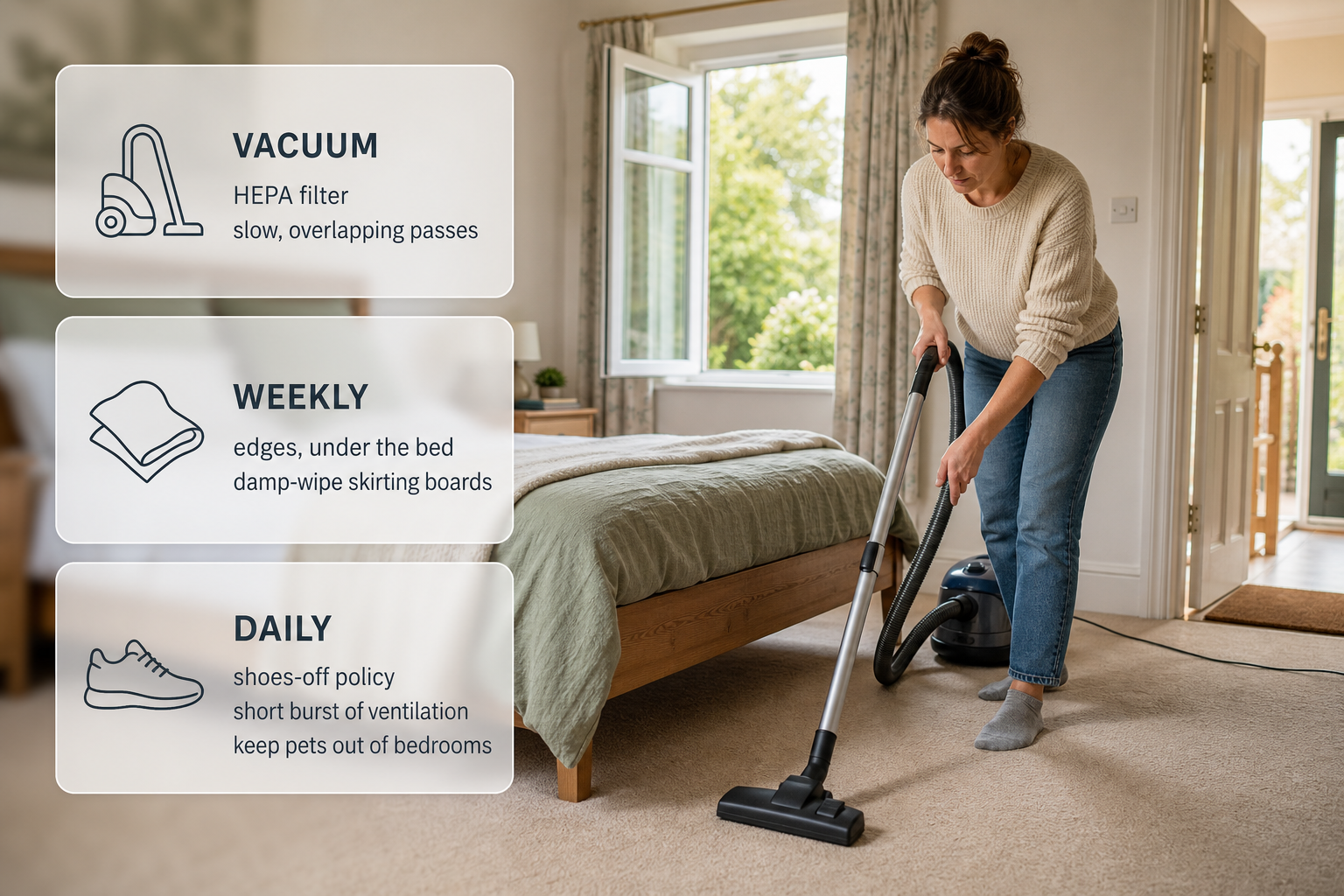
The single most useful piece of equipment is a vacuum with proper filtration. The HSE advises using a vacuum cleaner fitted with a HEPA filter (HSE), because an ordinary machine can blow fine allergen back into the air through its exhaust instead of capturing it.
A weekly routine that works:
Vacuum the whole carpet, not just the visible walkway. Use slow, overlapping passes and go over traffic lanes twice.
Use a motorised brush head on cut pile so the pile is agitated and dust is lifted from the base, and a gentler setting on wool or looped carpet so fibres are not pulled.
Reach the edges, under the bed and behind furniture at least once a week. Dust collects where feet and vacuum heads rarely go.
Damp-wipe skirting boards and radiator tops with a microfibre cloth. Dry dusting tends to move dust back into the air rather than remove it.
Empty the canister or change the bag outdoors, ideally wearing a mask, and do not let a bag fill beyond about two-thirds.
Leave a short gap between vacuuming and bedtime in a sensitive household, so disturbed particles have time to settle.
Daily habits matter as much as the weekly clean. A washable mat inside each external door and a shoes-off policy cut down what is walked into the pile, and a short burst of ventilation each day helps keep humidity down. Where a pet sleeps indoors, keeping it off beds and out of the carpeted bedroom removes a large share of the dander load before it ever reaches the floor.
Deep cleaning: does it help, and how often
Household vacuuming removes what sits near the surface. A deep clean with hot-water extraction flushes out material packed at the base of the pile: fine dust, mite allergen, dander and the residue left by earlier cleaning products. The effect is real but temporary, because allergen levels build up again as the room is used. Frequency matters more than a single effort.
As a general benchmark rather than a fixed rule, a home with no pets and hard flooring in the bedrooms may find an annual deep clean plenty. A household with a dog or cat indoors, high footfall, or a family member with asthma tends to arrange cleaning more often, sometimes several times a year. The practical trigger to book is usually the return of symptoms, a dulling of the pile that vacuuming no longer shifts, or an odour that lingers, rather than a date on the calendar.
Two cautions. Dry cleaning powders and heavily perfumed deodorising products leave residue in the pile, and fragrance itself is a trigger for some people, so it is worth asking for fragrance-free products. And no surface cleaning reaches the underlay beneath the carpet, which is where a great deal of fine dust and dander collects over the years. Households wanting that deep work handled can compare local cleaning services and ask specifically about extraction and drying.
Steam cleaning: when it helps, when moisture hurts
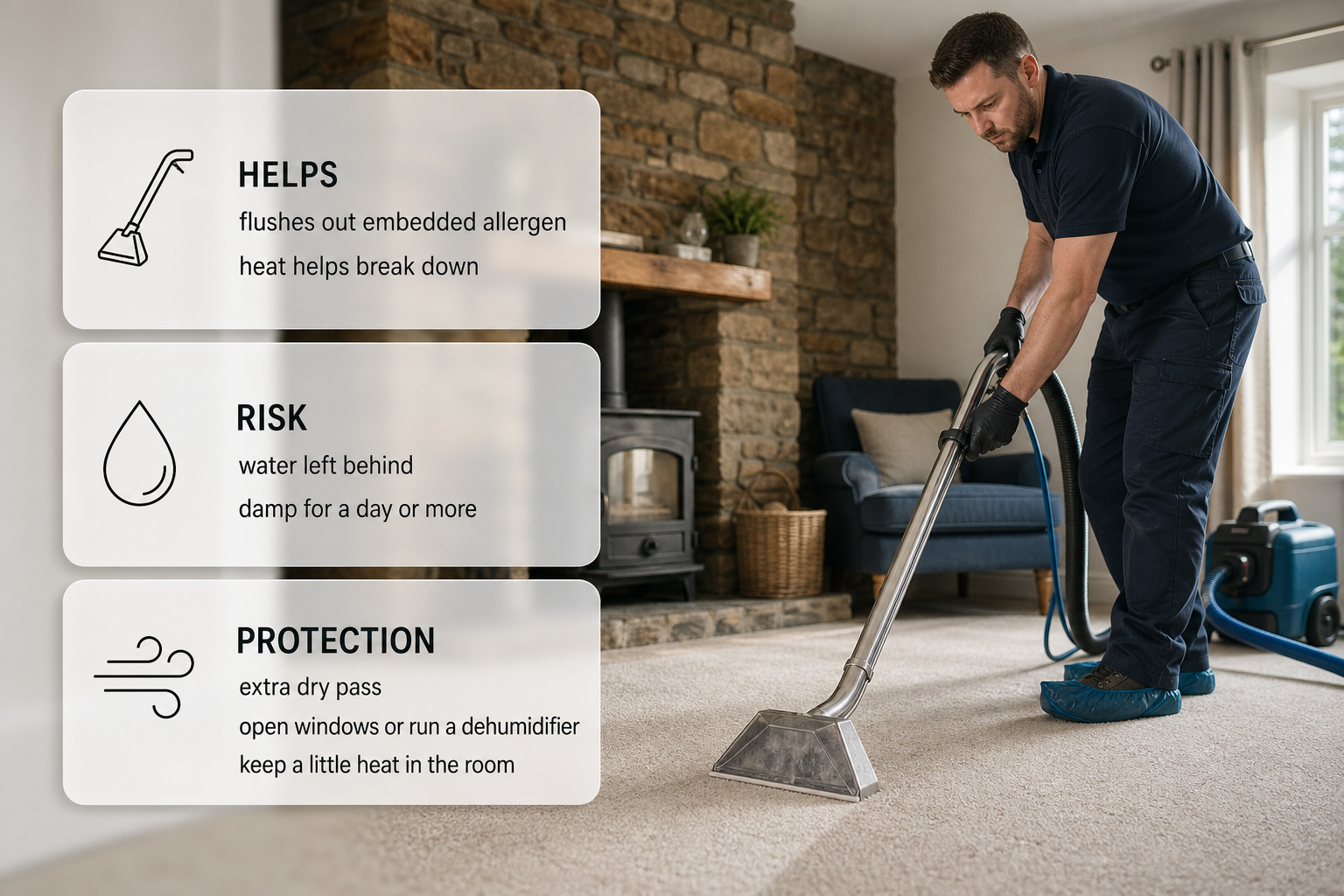
Hot-water extraction, which most people call steam cleaning, sprays heated water and a cleaning solution into the pile and pulls it straight back out with the same wand. It suits allergy households because it flushes out embedded allergen rather than stirring it up, and the heat helps break down the sticky proteins in dander. The risk is not the steam, it is the water left behind.
A carpet that stays damp for a day or more creates exactly the warm, humid conditions that dust mites do well in, and a damp underlay is a good place for mould to establish. Practical protection:
Ask for controlled moisture and at least one extra dry pass with the extraction wand.
Open windows or run a dehumidifier during and after the clean, and keep a little heat in the room rather than switching it off.
Keep the room ventilated until the pile and backing feel dry to the touch. In a warm, well-ventilated room that is often a matter of hours; a closed-up room can take far longer.
Keep outdoor shoes off the carpet and do not put furniture back until it is dry, since furniture legs trap moisture and can stain.
Lift loose rugs and clean them separately, or take them outside to beat and air.
Steam cleaning is a poor choice for carpet with perished foam backing, for glued-down carpet where water can loosen the adhesive, and for rooms that are already damp. Where a home has a persistent damp problem, the source should be dealt with by a relevant specialist rather than cleaning repeatedly on top of it.
Reducing pet dander in fitted carpet
Dander is the protein found in a pet's skin flakes, saliva and urine. It is far smaller and stickier than hair, which is why brushing the carpet and lifting visible fur deals with only part of the problem. In fitted carpet, dander works past the pile into the underlay where no household vacuum can reach it.
What helps, in order:
Reduce the load at source. Groom dogs and cats outdoors a few times a week, wipe paws at the door, wash pet bedding regularly and keep pets out of bedrooms where possible.
Lift hair before vacuuming. Working over the pile with a rubber squeegee, a stiff brush or a barely damp microfibre mop gathers surface hair so the vacuum collects it instead of pushing it deeper.
Vacuum weekly with a HEPA-filtered machine and a motorised head on cut pile, spending extra passes on the pet's favourite spot.
Treat accidents immediately. Blot rather than rub, then use an enzymatic cleaner made for pet odour and urine, follow the dwell time on the label and blot dry. Soaking a spot drives contamination into the underlay.
Arrange deep cleaning more often than a pet-free home would need. If a pet has not lived in the house for several months and symptoms continue, replacing the underlay along with the carpet is usually the only way to remove the residue.
Carpet materials that suit allergy sufferers
Fibre choice affects how much a carpet holds and how completely it can be cleaned. In general, low-pile, tightly woven carpet in a synthetic fibre is easier to keep clean, because a vacuum head can agitate the full depth of a short pile and there is less space for dust to settle. Smooth or lightly looped textures behave better than deep carved ones, and a dense, sealed underlay matters as much as the carpet itself.
Choices that tend to work less well:
Thick shag and long plush piles, which hide dust deep in the fibre and are difficult to vacuum thoroughly.
Fringed or heavily textured rugs, which trap dust in the edges and are awkward to clean properly.
Loose rugs generally, which slide about and gather dust underneath. A fitted carpet with sealed edges is easier to keep clean.
Wool. Wool is durable and naturally soil-resistant, but it holds moisture and dries slowly after wet cleaning, so it is a poorer choice in a damp room or beside a bathroom. Wool is rarely the allergen in a carpet; the dust and mites it holds are.
Old foam underlay that has begun to crumble, which releases dust every time the carpet is walked on.
Where a new carpet is being laid over a solid floor, the floor beneath should be dry and protected where needed, and a flooring specialist can advise on what suits the room.
Choosing a cleaner for allergy-safe results
The difference between a helpful clean and a wasted one usually comes down to equipment and technique, so it is worth asking direct questions before booking:
Is the machine a hot-water extraction unit, and does it have HEPA filtration on the vacuum side?
How much water goes down, and what is done to dry the carpet afterwards? Air movers or extra dry passes are a good sign; a single quick pass and an open window are not.
Which cleaning solutions are used? Ask for fragrance-free, low-residue products if anyone in the house reacts to perfumes.
Can the carpet be checked at the edges, or lifted slightly, to look for damp or mould in the underlay?
Are protective blocks used under furniture legs, and how long should furniture stay off the carpet?
Does the business have experience with pets, urine and allergy households, and does it carry insurance? Ask for answers in writing and read reviews left by previous customers.
Timing matters too. Cleaning on a mild, breezy day when windows can be opened is far better than on a cold damp day in a closed-up house. A patch test on an inconspicuous area is a reasonable request for wool, hand-dyed or older carpet, and any cleaner should be able to explain what will be done if a stain or odour does not lift.
When hard flooring is the better option
For some homes, replacing carpet is the more effective answer. The HSE advises choosing wood or hard vinyl flooring instead of carpet to reduce dust mite exposure (HSE). Hard flooring gives dust and dander nowhere to hide in the depth of a pile, and a HEPA vacuum with a hard-floor head or a damp microfibre mop lifts it away.
If the budget stretches to only part of the house, the sensible order is bedrooms first, since that is where the most hours are spent and where mite allergen from bedding and mattresses concentrates. Main living areas, halls and stairs come next, as they take the heaviest traffic and the most tracked-in pollen. A washable mat at each external door does more good than a fixed carpet runner.
When removing carpet, vacuum it with a HEPA machine before lifting, wear a mask and gloves, bag the old carpet and underlay rather than dragging them through the house, remove the gripper rods and wipe the subfloor clean. If the floor beneath is damp, that needs fixing first. A middle path suits many households: hard flooring in the bedrooms and hall, with a low-pile synthetic carpet in the living room where the family actually wants one. Hard floors are not maintenance-free, since dust still settles on them, but it is far easier to remove.
FAQ
Does cleaning help a pet allergy as much as a dust mite allergy?
Usually less completely, because dander penetrates past the pile into the underlay where cleaning cannot reach. It still helps: repeated deep cleans plus weekly HEPA vacuuming and grooming the pet outdoors will steadily reduce the load. Where a pet has left the home and symptoms continue, the underlay is the likely culprit.
Is a low-moisture or dry clean safer than a wet clean in a damp house?
Some cleaners offer low-moisture methods that leave the carpet usable much sooner, which can suit a house that struggles to dry a wet clean. The trade-off is that less water usually means less flushing of residues from the base of the pile. Ask what each method does and does not remove, and how the carpet is dried.
Should rugs be removed from bedrooms if someone has asthma?
Loose rugs and mats collect dust underneath and at the edges, and they are easy to overlook during vacuuming. Washable door mats that can go through a machine are worth keeping, but decorative rugs are best taken out of bedrooms, beaten and cleaned outdoors, or removed altogether.
Is it possible to clean a carpet too often?
Over-wetting rather than frequency is the real risk. A carpet cleaned repeatedly with too much water never fully dries, and a permanently damp backing is worse for allergies than a slightly dustier carpet. Set the interval around how quickly the room can dry, and give it extra ventilation whenever it has been cleaned.
Next steps for an allergy-friendly home
Households that want the deep clean handled can post the job on ShamFix and let local tradespeople respond. Posting a job and listing on ShamFix is free and there is no commission, and a subscription is planned for the future. ShamFix does not check or certify tradespeople and profiles are filled in by tradespeople themselves, so homeowners should check registrations themselves and read reviews before booking. Everything else — the HEPA vacuuming, the daily ventilation, the choice between low-pile carpet and hard flooring — stays in the household's own hands, and those habits are what keep allergen levels down between visits.