
Hiring carpenters in Limerick usually starts with a half-finished room and one annoying question, who can make the place look right without turning a small job into a mess. The answer depends on whether the work is first-fix or second-fix, whether the house is old enough to fight back, and whether the quote is for the visible finish or the hidden structural work. A clean result in Limerick homes usually comes from a clear brief, a carpenter who can prove trade standing, and a homeowner who knows what details matter before anyone lifts a saw.
Understanding First-Fix and Second-Fix Carpentry
First-fix and second-fix carpentry are not the same job, and mixing them up is how homeowners get the wrong quote and the wrong person. First-fix is the hidden, structural side, framing, joists, roof work, openings, and anything that disappears behind plasterboard. Second-fix is the visible finish, skirting, architrave, doors, fitted wardrobes, kitchen carcasses, stairs, and trim.
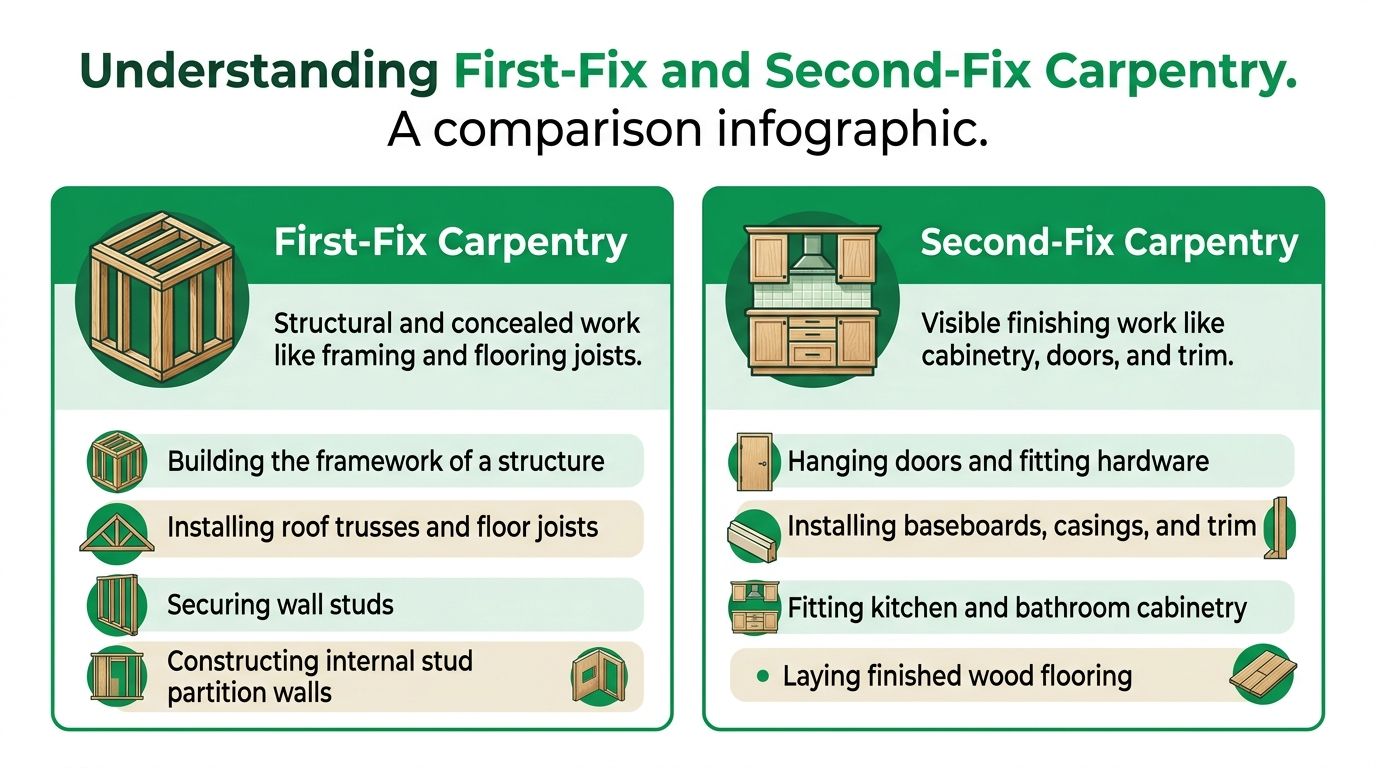
Why the distinction matters
A first-fix job is judged by structure and sequence. The carpenter is working to levels, spans, and hidden alignments, so the price follows the amount of timber, the scale of prep, and the time it takes to get the skeleton right. A second-fix job is judged by finish, and finish work exposes every mistake in the building around it.
That matters even more in Limerick, where older housing stock can throw up uneven floors, out-of-square walls, and sloping reveals. On that kind of property, a small trim job can take longer than the homeowner expects because the carpenter has to scribe, set out, cut, and refit until the finish sits properly. The skill isn't just cutting wood, it's making wood look straight in a room that isn't.
Practical rule: if the work will be hidden, think first-fix. If the work will be seen every day, think second-fix.
How to classify the job before quoting
A homeowner can sort almost any carpentry task into one of three buckets. Structural or concealed work is first-fix. Visible interior fit-out is second-fix. A project that includes both, such as a floor rebuild followed by skirting and architrave, needs both skill sets and shouldn't be priced like a simple hanging-door job.
The plain test is this, if the wall is open, it's usually first-fix. If the wall is painted and the job is about making the room look finished, it's second-fix. Get that right first, and the quote makes much more sense.
Preparing Your Carpentry Brief Before You Contact a Tradesperson
A short message like “need a carpenter in Limerick” produces lazy quotes. A proper brief gets a tighter price, fewer surprises, and less arguing on the day. The carpenter needs to know what kind of work it is, what's already on site, and what the finished result should look like.
The safest way to start is to describe the job in plain terms, hanging doors, fitting skirting and architrave, building fitted wardrobes or alcove units, kitchen carpentry, decking, stairs, or general repairs. Then add room count, rough dimensions, and whether the materials are being supplied by the homeowner or sourced by the carpenter. Photos and measurements matter because a room on paper is never as useful as a room with visible obstacles, existing damage, and awkward corners.
What to include in the brief
| Detail | Why It Matters |
|---|---|
| Exact job type | Stops first-fix and second-fix work being mixed up |
| Room count and rough sizes | Helps the quote reflect the real scope |
| Materials supply plan | Clarifies who buys doors, timber, MDF, and ironmongery |
| Photos and measurements | Reduces guesswork and back-and-forth |
| Existing condition | Flags out-of-square walls, uneven floors, and sloping reveals |
| Access and occupancy | Tells the carpenter how practical the site will be |
| Deadline | Prevents avoidable conflict later |
| Electrical overlap | Confirms if Safe Electric work is needed separately |
Older Limerick homes often need extra setting-out time because the structure itself isn't neat. That doesn't mean the job is difficult in a bad way, it means the quote has to reflect reality instead of a perfect rectangle in the homeowner's head. A carpenter can't fit clean trim into a crooked opening without spending time on cutting, scribing, and adjustment.
If the job touches electrics, the carpenter should not be expected to do the wiring. LED cabinet lighting, under-cabinet power, or electric underfloor heating under a fitted floor needs a Safe Electric registered electrician for the electrical part. The carpenter does the carpentry, not the wiring.
A clear brief protects both sides. It gives the carpenter enough information to price honestly, and it gives the homeowner a paper trail when the work starts.
The most useful habit is to include the practical nuisance details up front, occupied house, tight access, heavy furniture, or a fixed completion date. Those are the things that usually blow up a neat quote.
For anyone posting a job online, the task form at ShamFix's job posting page is built around that kind of detail, which is exactly what a carpentry brief needs.
Vetting Carpenters in Limerick What to Check Before You Hire
Carpentry is not a regulated trade in Ireland, so there's no licence register like there is for gas or electrical work. That shifts the burden onto the homeowner. Protection comes from public liability insurance, a written itemised scope, a portfolio of similar work, and reviews that say something useful.
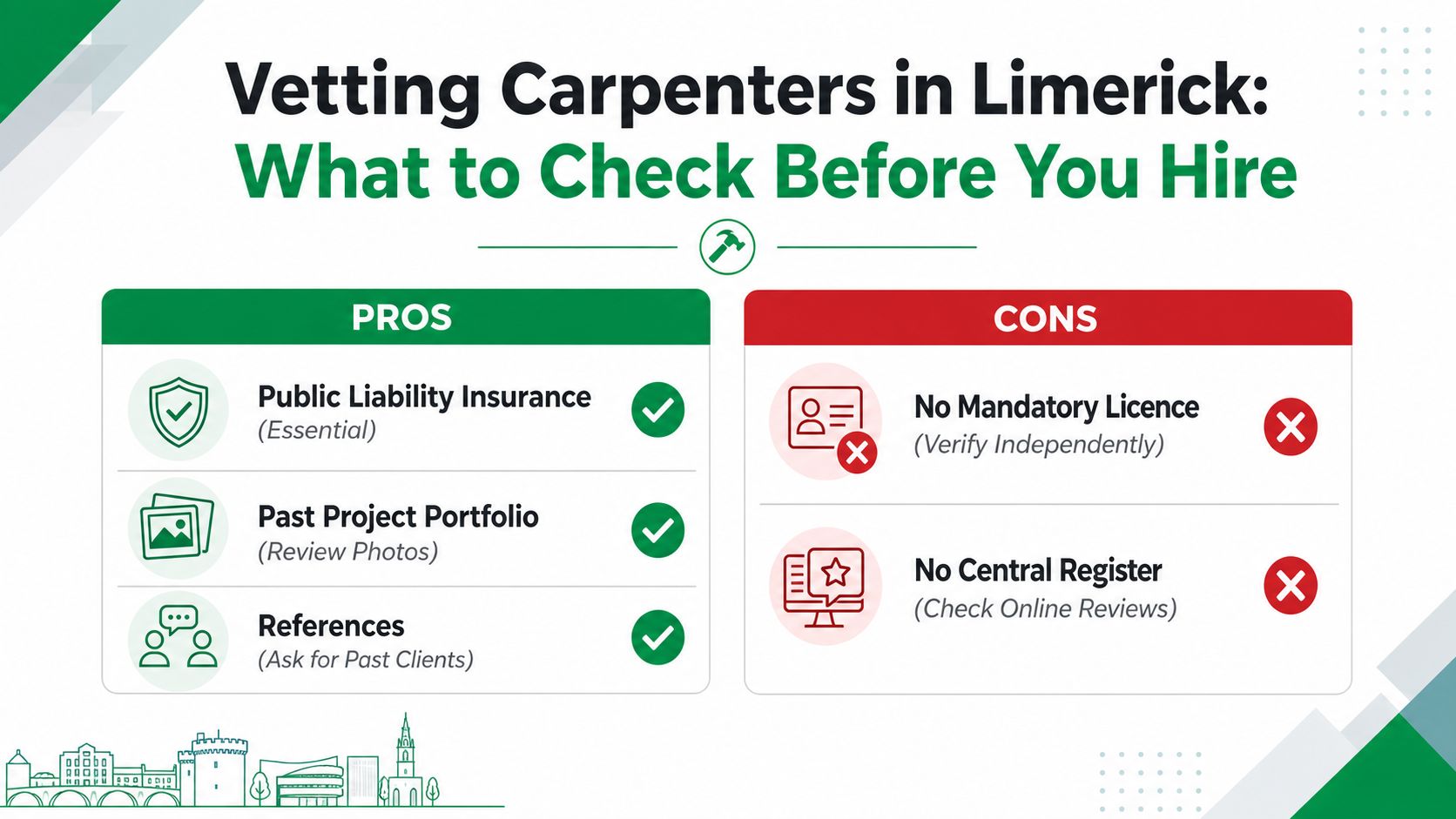
The first red flag is paperwork
If a carpenter can't produce proof of insurance and won't put the scope in writing, that's not a small omission. It means the homeowner is being asked to trust a job with no clear boundary, no defined finish level, and no easy way to settle disputes. A serious carpenter should be comfortable writing down what's included, what isn't, who supplies the materials, and what finish is expected.
The next warning signs are in the reviews
Vague praise like “great work” or “highly recommended” is almost useless. The better reviews mention whether the carpenter was on time, kept the area tidy, kept mitres clean, handled caulking neatly, and stuck to the quoted scope. If the feedback has no detail, it doesn't tell a homeowner much about the likely finish.
A second problem is portfolio mismatch. A gallery full of decking images doesn't tell the homeowner whether the carpenter can handle fitted wardrobes, stair trim, or internal doors. The work needs to match the job.
A carpenter who wants a big cash deposit before anything is written down is asking the homeowner to absorb the risk.
That doesn't mean every deposit is a problem. It means the paper trail should come first, not last. Once reviews exist, the useful ones will show how the carpenter handled scope, finish, and pricing, not just whether they were pleasant to deal with.
For homeowners comparing local marketplace options, the broader comparison page at ShamFix's trades platform guide is one route into how the review process is handled on different platforms.
Carpentry Costs and Rates in Limerick What Homeowners Should Expect
Carpentry prices in Limerick don't make sense until the homeowner separates day rate, fixed job price, and project pricing. The general Irish market puts a carpenter's day rate at roughly €200 to €350, with higher rates for heavy prep or detailed work and Dublin above the regions. Smaller jobs, such as a single room of skirting and architrave, are often priced at €300 to €600. Larger items like custom cabinetry, wardrobes, staircases, and heritage work are usually priced per project rather than hourly.
What the numbers usually mean
A day rate is useful when the task is uncertain, patching, repairs, or smaller finishing jobs where the time only becomes clear once the carpenter starts setting out. A fixed price is better when the scope is neat and bounded, such as one room of trim or a single built-in unit. A project price is the norm when the job involves design decisions, materials, workshop build time, and a lot of on-site scribing.
| Job Type | Price Range | Pricing Model |
|---|---|---|
| General carpentry day work | €200 to €350 per day | Day rate |
| Single room of skirting and architrave | €300 to €600 | Fixed price |
| Custom wardrobes, cabinetry, stairs, heritage work | Per project | Project price |
What should sit outside the headline rate
The cheapest quote is often the one with the most missing pieces. Scaffolding, access, waste removal, making good, and preparation can all sit outside the headline number. If those items are not listed, the homeowner should assume they may appear later.
VAT also matters. 13.5% VAT applies to most construction and renovation labour and materials in Ireland, so the homeowner should check whether the quote includes it or not. A price that looks tidy before VAT can stop looking tidy very fast once the tax line is added.
The best quote is not the lowest number. It is the quote that shows what is included, what is excluded, and what finish the homeowner is actually buying.
For simple domestic jobs, a written itemised quote is the only sensible way to compare one carpenter with another. That is especially true in Limerick, where a small room can hide a lot of extra scribing time.
What to Expect on Site From a Competent Limerick Carpenter
A competent carpenter doesn't start by cutting timber. The job starts with measuring the room properly, checking the walls, checking floor levels, and noting service positions that could interfere with the fixings or the cabinet build. On older Irish stock, that early survey is where a lot of the value sits, because the room itself often decides how hard the rest of the job will be.
The normal sequence
The first step is an accurate site survey. The carpenter measures the actual opening, confirms whether the wall is true, and makes a cutting list from what is really in front of them rather than from the ideal dimensions in the homeowner's head. For cabinetry, a workshop build often follows, which keeps the mess and cutting out of the main living area.
The next stage is delivery and dry-fit. Units or components are offered up before final fixing, because fit issues are easier to solve when the pieces aren't already pinned in place. Scribing then brings the work into line with the actual room, not the fantasy of a perfect square room. On period and estate stock, that is the skilled part of the job.

Once the pieces are fixed, the finish stage begins. That means mitres, caulking, filling, and sanding. A job either looks deliberate or looks rushed at this point. A poor finish can ruin solid underlying work, while a clean finish can make modest materials look far better than the price suggests.
How the homeowner should prepare the space
Clear the work area and the route into it. Move furniture, floor coverings, and fragile items well back, because carpentry is dusty and needs room for measuring, cutting, and laying timber out. Empty the units or wardrobes if they're being replaced, and make sure there's a working power point available.
Keep children and pets away from tools and offcuts. Agree in advance who moves heavy furniture and where waste or cut-offs are going. That avoids the awkward argument that always arrives when the van is already loaded.
A homeowner who prepares properly usually gets more of the paid time spent on actual carpentry and less spent on moving obstacles around the room.
Using ShamFix to Find Local Carpenters in Limerick
ShamFix is a Republic of Ireland marketplace that routes homeowner requests to local providers, including carpenters in Limerick. It's free to list during Phase 1, operates on 0% commission, and doesn't use per-lead credits. The platform's role is to route enquiries, not to do the work or guarantee the quality of any provider.

How the matching works
Homeowners post the job, the AI concierge routes the request, and local providers respond from their own public information and reputation. That is all a marketplace should be doing. It's a matching tool, not a badge of quality.
The important thing is the reputation model. ShamFix uses a two-sided review system, so after a completed job both sides rate and review each other. That keeps the focus on actual job behaviour, not on marketing gloss. ShamFix does not vet or verify provider documents, so each provider states their own credentials and remains responsible for holding the right registration for their trade.
The Limerick county service page at ShamFix's carpentry category for Limerick is the relevant entry point for homeowners trying to find local carpentry options without relying on directory clutter.
What a homeowner should expect from the platform
The platform is useful when the brief is clear, the job is defined, and the homeowner still wants a better way to compare local options. It doesn't remove the need to check insurance, scope, and reviews. It just makes the starting point less messy.
ShamFix is a marketplace, not a contractor, and it doesn't carry out carpentry itself. That distinction matters. The homeowner still chooses the tradesperson, and the trade still needs to stand up to scrutiny on its own merits.
ShamFix gives Limerick homeowners a cleaner way to compare local carpenters, post a clear brief, and review the work against the scope they asked for. It does not vet or verify providers, the homeowner still checks insurance, scope and reviews, and confirms a Safe Electric electrician for any electrical part.
Are you a carpenter in Limerick?
List your business free on ShamFix during Phase 1, with 0% commission and no per-lead credits. Be among the first found as local demand grows. There are no promises about lead volume or speed.