Self-employed carpenters in Ireland typically charge €40 to €50 an hour or €250 to €300 a day, and those figures can move sharply depending on where the job is, what stage of work is involved, and whether VAT applies. In practice, a quote for hanging doors in a rural county and a quote for bespoke finish work in Dublin are rarely built on the same cost base.
That's the point many homeowners only realise after the second or third quote lands in the inbox. One carpenter prices by the day, another by the job, and a third includes materials and VAT while the others don't. The spread can feel arbitrary, but it usually isn't.
A fair carpentry quote in the Republic of Ireland reflects three things at once. The local labour market, the type of carpentry involved, and the contractor's business costs. Once those are separated out, most quotes become easier to read and much easier to challenge when something looks off.
Understanding Carpenter Quotes in Ireland
Self-employed vs employed — the distinction to get right first. A self-employed carpenter in Ireland typically trades at €40–€50 an hour or €250–€300 a day. An employed carpenter is different: the statutory wage floor for a construction craftsperson is €23.00 an hour (€23.74 from August 2026). The trading rate is higher because it has to carry tools, van, insurance, VAT and the unpaid time between jobs — it is not a mark-up on a wage.
A common scenario goes like this. A homeowner needs skirting, a few doors rehung, and some shelving built into an alcove. Three quotes come back. One looks surprisingly low, one looks uncomfortably high, and one sits somewhere in the middle but doesn't explain much.
That spread doesn't automatically mean one tradesperson is overcharging. It often means the quotes are built differently. One may be labour only. Another may include collection of materials, fixings, disposal, travel time, and VAT. A third may assume a faster install because the carpenter has the right saws, routers, nailers, transport, and workshop setup already in place.
Practical rule: A useful quote isn't just the cheapest figure. It's the one that makes clear what is included, what is excluded, and what could change once the work starts.
The Irish carpentry market also has a built-in complication. Homeowners often compare a self-employed contractor's quote with what they think an employed carpenter “should” cost per hour. That comparison usually fails because the two prices are doing different jobs. One is a wage floor for employment. The other is a trading rate that has to carry tools, van costs, insurance, time between jobs, and business admin.
For that reason, the most reliable way to assess carpenter rates in Ireland is to look at the quote as a cost structure, not just a headline number.
A sound quote should let a homeowner answer four simple questions:
What labour basis is being used. Hourly, daily, or fixed-price.
What type of carpentry is involved. Structural first-fix, standard second-fix, or specialist joinery.
What site conditions apply. Access, parking, clear working space, and whether the property is occupied.
What sits outside the figure. Materials, finishing products, waste, and VAT.
When those points are clear, the quote becomes something that can be compared properly rather than guessed at.
How We Calculated These Carpenter Rates
Every figure here is a labour-only benchmark for the Republic of Ireland, put together from a consistent method rather than one source, so it is clear how the hourly, daily and project estimates were derived.
In our view the single biggest source of confusion is treating a self-employed trading rate as if it were an employed wage — so that comparison is stated before any job figures below.
Typical Carpenter Rates in Ireland 2026
Here is the quick answer before the detail — labour-only ranges for the Republic of Ireland in 2026, showing self-employed hourly and day rates, the employed wage floor, and how first-fix and second-fix differ.
| Pricing basis | Typical 2026 range |
|---|
| Self-employed — hourly | €40–€50/hr (avg ~€45) |
| Self-employed — day rate | €250–€300/day (avg ~€270) |
| Employed craftsperson — statutory wage floor | €23.00/hr (€23.74 from Aug 2026) |
| First-fix (structural) — hourly | €25–€35/hr |
| Second-fix (finish) — hourly | €40–€50/hr |
| Bespoke / built-ins | Priced per project, usually above the day-rate equivalent |
How carpenter rates are calculated in practice. The basis follows the risk. Hourly suits open-ended or unpredictable work; a day rate suits a full day of finish work the carpenter can commit to; a fixed project price suits bespoke work where measuring, materials coordination and repeat fitting make hours hard to predict.
Three things sit inside every rate: labour time and skill level (finish work is slower and less forgiving than framing), the overhead a self-employed carpenter must recover (tools, van, insurance, admin, and the unpaid gaps between jobs), and the small-job penalty — travel, unloading, setup and cleanup do not shrink just because the visible task is short, which is why a one-hour job is rarely charged as one hour.
In practice, the figure that trips up homeowners is the day rate on a small job. It is not padding — it is the cost of giving up a day, or half-day, that cannot easily be refilled. Labour-only quotes also exclude materials and, where it applies, VAT at 13.5%, so a labour rate and a supply-and-fit rate are never like-for-like.
The baseline labour rates
The clearest market benchmark for self-employed carpenters in Ireland is straightforward. Current Irish market rates put the typical daily rate at €250 to €300, averaging around €270 a day, with hourly work typically at €40 to €50, averaging about €45. Those are the figures most homeowners should treat as the starting point for standard labour-only pricing.
That “labour-only” point matters. It usually means the quote doesn't yet include timber, sheet material, ironmongery, adhesives, paint preparation, or VAT. If one quote is built on labour only and another includes supply and fitting, they are not competing figures even if they describe the same job.
For very small works, hourly pricing often looks tidy on paper but can be misleading in practice. Carpenters still have travel, unloading, setup, cutting space, cleanup, and collection of incidentals. That's why many small domestic jobs are effectively priced as part-day or full-day work, even when the visible task seems shorter.
A useful comparison with other general home maintenance pricing can be found in this Irish handyman hourly rates guide, but carpentry usually sits above a general handyman rate once accurate cutting, finish work, and trade tools are central to the job.
Why first-fix and second-fix price differently
The market also splits by stage. First-fix carpentry typically runs €25 to €35 an hour, while second-fix carpentry typically runs €40 to €50. That split surprises some homeowners because structural work sounds more demanding than finish work. On site, the pricing logic is a bit more nuanced.
First-fix carpentry covers work such as framing, roof structure, floor structure, and other concealed timber elements. It can involve long runs of work, clearer production flow, and fewer finish-sensitive details once the setting out is right.
Second-fix carpentry is where precision becomes visible. Hanging doors, fitting skirting, architraves, kitchens, shelving, panelling, and trim work leave little room for rough tolerance. The work is slower to execute neatly, and the result stays in view every day.
| Rate Type |
Typical Range |
| Hourly rate |
€40 to €50 |
| Day rate |
€250 to €300 |
| First-fix hourly rate |
€25 to €35 |
| Second-fix hourly rate |
€40 to €50 |
Good finish carpentry isn't expensive because timber is magical. It's expensive because mistakes stay on show.
This is also why specialist services tend to sit above standard second-fix work. Bespoke cabinetry, staircase work, hardwood finishing, architectural joinery, heritage restoration, and complex built-ins usually attract premium pricing because they combine design judgement, precision, repeated fitting, and higher finish expectations. They are rarely true commodity jobs.
How Location Affects Carpentry Costs
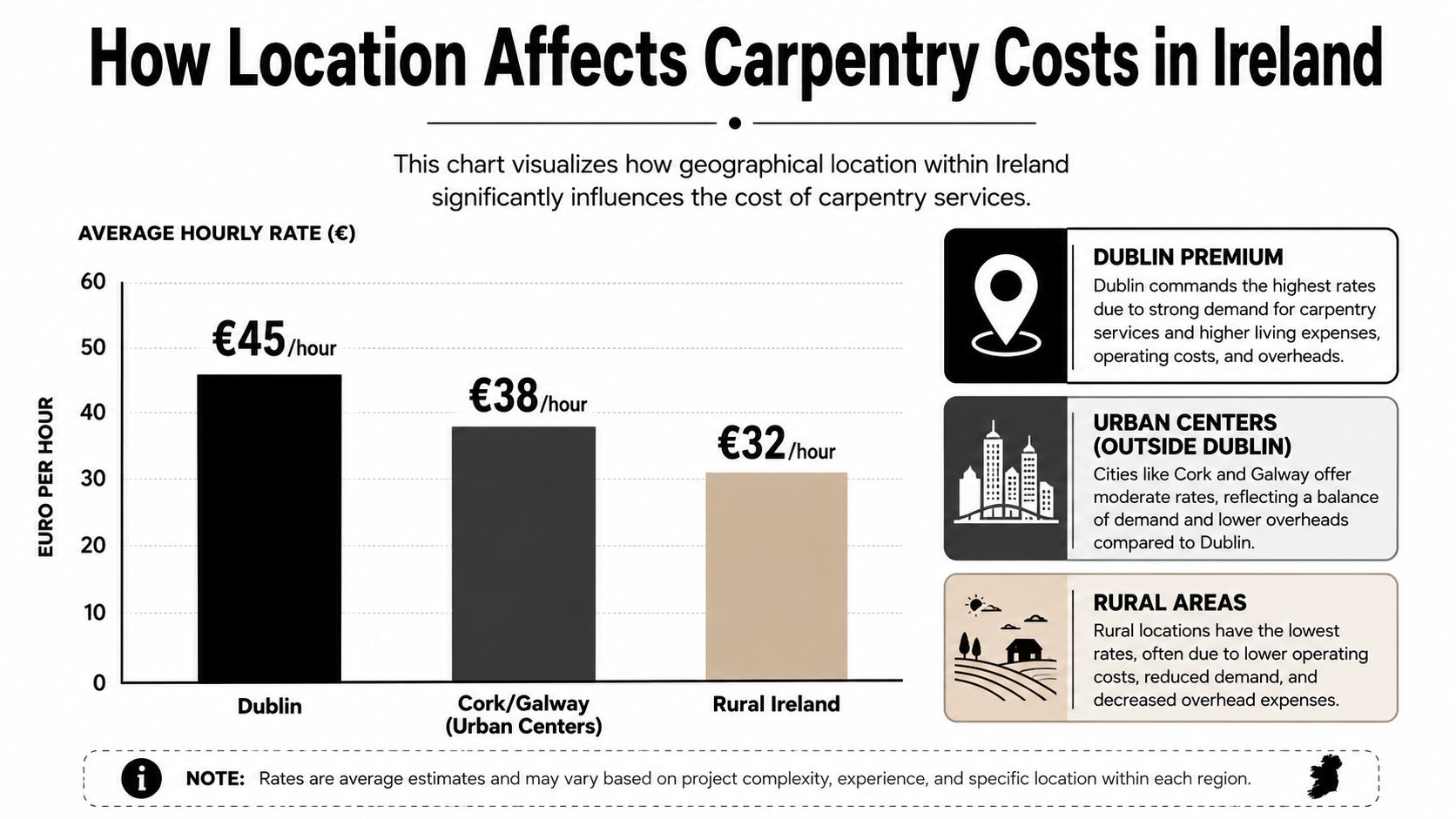
The Dublin premium is real
Location has a measurable effect on carpenter rates in Ireland. Dublin day rates typically run 15 to 20% above the national average and can reach €350 a day, against €250 to €300 a day in counties such as Mayo and Limerick.
That premium shouldn't be read as a simple surcharge for an urban postcode. It reflects the practical economics of working in the capital. More active construction, denser demand, parking difficulty, heavier traffic, and tighter scheduling all push up the cost of supplying labour. A carpenter who loses time to city logistics still has to recover that time somewhere.
Homeowners looking in the capital can compare local options through the Dublin carpentry category on ShamFix, but the key point is broader than any single platform. A Dublin quote and a rural quote are not expected to match.
Why geography changes the quote
Regional pricing isn't only about where the carpenter lives. It's also about how the job fits into the working day.
A carpenter in a compact urban area may handle more quote visits and more fragmented work, but also face parking charges, access issues, congestion, loading restrictions, and higher general overheads. A carpenter in a rural area may have lower daily operating pressure but spend longer travelling between jobs. Either way, location affects productivity.
Three location-related cost drivers show up repeatedly in domestic carpentry:
Access and handling. City apartments, narrow halls, stair access, and no cutting space slow everything down.
Travel efficiency. Rural jobs can be straightforward once on site, but long drives reduce how much productive time remains in the day.
Local demand pressure. Busy urban markets give tradespeople more choice over which jobs they accept, especially where second-fix and renovation work is strong.
A homeowner isn't paying for distance alone. They're paying for the hours that distance removes from the carpenter's working day.
There's another subtle point. A quote from outside the immediate area can still be competitive if the carpenter prices the whole job efficiently. But for smaller tasks, local usually wins because short travel and easier return visits reduce wasted time. That matters for snagging, missing parts, or unexpected adjustments after the first visit.
Factors That Influence Your Final Quote
Employee wage versus contractor rate
One of the biggest mistakes homeowners make is treating a contractor's quote as if it should resemble a direct wage. In Ireland, that comparison doesn't hold.
Selfbuild's labour cost guidance for Ireland makes the same point: skilled self-employed carpenters with extensive power tools, transport, and insurance start at around €50 per hour, because business costs - tools, vehicle, insurance, and VAT at 13.5% (Revenue''s reduced rate for building and construction services) - transfer to the contractor.
The employed rate, by contrast, is set by law. Under the Sectoral Employment Order (Construction Sector), the statutory minimum for a craftsperson is €23.00 an hour, rising to €23.74 from 1 August 2026, as set by the Sectoral Employment Order for the Construction Sector. That is a legal wage floor for PAYE employment, not an alternative price for the same thing.
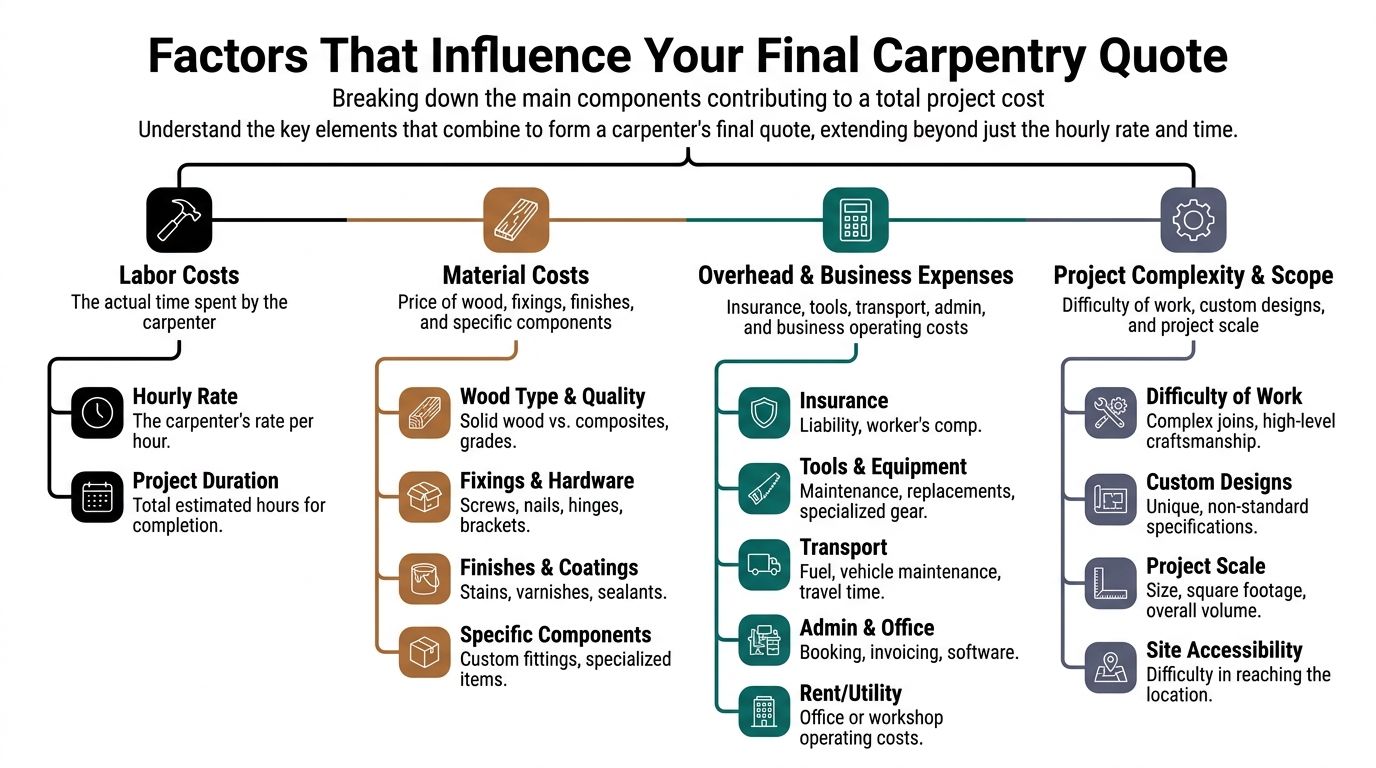
A homeowner hiring a self-employed carpenter isn't just purchasing hands-on time. The quote has to support the invisible parts of the job as well: estimating, procurement, travel, maintenance of saws and routers, consumables, liability cover, and the unpaid gaps between one project and the next.
What a homeowner is actually paying for
A carpentry quote usually combines several cost layers, even when it's presented as a single figure. Reading those layers properly is the fastest way to judge whether a quote is fair.
Labour time. This is the visible part. Cutting, fitting, assembling, levelling, scribing, fixing, and finishing.
Business overhead. Van, fuel, tool replacement, insurance, bookkeeping, and time spent pricing work.
Project difficulty. Uneven walls, old houses, awkward reveals, poor floors, occupied rooms, and hidden defects all slow the work.
Tax treatment. VAT can materially change the total payable figure where it applies.
A clean alcove with square walls is one kind of shelving job. An older property with sloping floors, out-of-plumb chimney breasts, and uneven plaster is another. On paper both are “alcove units”. In labour terms they can be very different pieces of work.
Cost check: If a quote looks high, ask what condition the carpenter has assumed the existing structure is in. Many disputes start because the client priced a visible finish while the contractor priced the hidden correction work needed first.
Specialist carpentry also sits above ordinary domestic fitting because the margin for error is thinner. Custom cabinetry, staircase restoration, hardwood detailing, period joinery, and architectural fitted furniture are usually priced as premium work because they demand repeated measuring, templating, workshop preparation, and a much higher finish standard than routine trim installation.
When comparing quotes, the strongest question isn't “Who is cheapest?” It's “Who has priced the actual job in front of them?”
What a labour-only quote usually leaves out
Because the benchmark rates are labour-only, it helps to know what typically sits outside the figure in Ireland: materials and timber, hardware and ironmongery (hinges, handles, fixings), finishing (filling, sanding, caulking, paint), waste disposal, parking or access charges in cities, and return visits for snagging or missing parts. When two quotes differ sharply, the gap is often here rather than in the hourly rate itself.
Example Price Estimates for Common Jobs
Abstract rates become more useful when they are turned into likely job costs. The figures below are labour-only estimates built from the Irish hourly and day-rate benchmarks already outlined. They are not fixed tariffs, and they can move with complexity, access, finish standard, and whether the work is standalone or grouped with other tasks.
Small second-fix jobs
A single internal door, for example, can look like a quick task until the frame is out of square, the floor finish has changed, or ironmongery needs adjustment. That's why many carpenters won't price tiny jobs by a strict minute-count.
| Job Description |
Estimated Cost Range (€) |
| Hang one internal door, assuming standard second-fix labour only |
€100 to €200 |
| Fit skirting and architrave in one average room, labour only |
€250 to €500 |
| Lay laminate flooring in one room, labour only |
€250 to €600 |
| Build simple wall shelving or basic alcove shelving, labour only |
€250 to €750 |
| Fit several internal doors over one visit, labour only |
€250 to €600 |
These aren't market-wide published tariffs. They are practical cost translations based on the established hourly and daily ranges and on how carpenters typically package small domestic work. The lower end usually assumes straightforward access and efficient sequencing. The upper end tends to reflect snagging, older houses, and more exacting finish requirements.
Carpenter prices by project type
The same benchmarks mapped to common homeowner jobs, with the scope each estimate assumes. Labour-only, Republic of Ireland, 2026.
| Job (scope assumed) | Labour-only range | What pushes it to the top |
|---|
| Hang 1 internal door (pre-finished, square frame) | €100–€200 | Out-of-square frame, changed floor level, or ironmongery adjustment |
| Fit 4–6 doors in one visit | €250–€600 | Mixed door sizes, older frames, or hanging plus latches and stops |
| Skirting & architrave, one average room | €250–€500 | Bay windows, many corners, or scribing to uneven walls |
| Alcove shelving / simple built-in | €250–€750 | Sloping floors, out-of-plumb chimney breasts, or a painted finish |
| Lay laminate flooring, one room | €250–€600 | Room size, subfloor prep, thresholds and trims |
Standalone vs bundled pricing. A single small job carries the full cost of the visit — travel, setup and cleanup — so it looks dear per item. The same task bundled with others in one visit is usually quoted lower per item, because that fixed cost is shared. From what we see in Irish quotes, bundling is the most reliable way to bring the per-item price down without pushing the carpenter to cut corners.
Larger or more specialised work
The moment the job becomes bespoke, pricing often shifts away from hourly logic and toward a project rate. Custom cabinetry is the clearest example. It usually commands more because the carpenter isn't only fitting units. The work often includes measuring, design judgement, material coordination, cutting accuracy, repeated test fitting, and finish detailing.
That's why trim work and second-fix tasks are often day-rate jobs, while custom cabinetry, built-in wardrobes, alcove furniture, staircase work, and heritage repairs are more often priced per project. The labour benchmark still matters, but it no longer tells the whole story.
A homeowner can use these estimates sensibly by checking three assumptions before comparing figures:
What room size was assumed. “Average room” means very different things in a box room and a large open-plan space.
What condition the surfaces are in. Straight, level, and ready-to-fit reduces labour.
Whether the price includes finishing stages. Filling, sanding, caulking, and final adjustments can shift the labour content.
The safest reading of estimate tables is this: they help identify a quote that is plainly out of line, but they don't replace a proper site-specific price.
How to Get a Fair Quote and Save Money
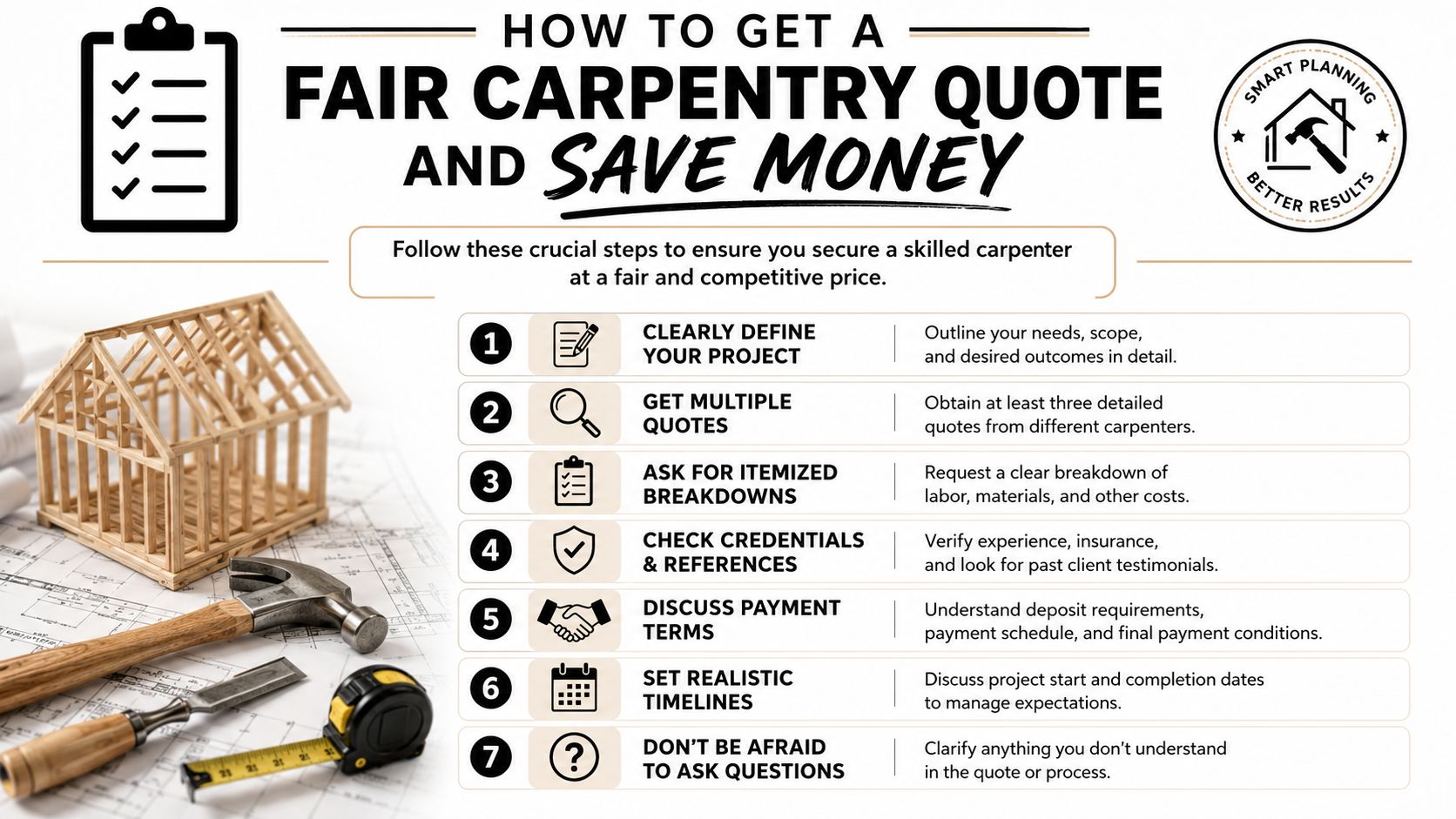
The cheapest quote often becomes the most expensive one if it omits preparation, underprices time, or leaves too much unresolved. Saving money on carpentry usually comes from improving the quoting process, not from forcing the rate down.
Questions worth asking before accepting any quote
A homeowner doesn't need technical training to ask good commercial questions. A short, direct checklist usually reveals whether a quote has been thought through properly.
What exactly is included. Ask whether the figure covers labour only, or labour plus materials, collection, fixings, disposal, and VAT.
How is the work priced. Hourly, daily, or fixed sum. Each has a different risk profile for the client.
What assumptions have been made about the existing condition. Old frames, bowed walls, rotten timber, and uneven floors can all affect labour.
Who supplies materials. If the homeowner is buying doors, timber, MDF, hinges, handles, or flooring, confirm the exact specification first.
What happens if hidden issues appear. Good quotes explain how variations are handled.
Ask for an itemised quote where possible. A one-line number is hard to compare and even harder to dispute.
It's also sensible to ask about insurance and recent similar work. For regulated trades, customers should confirm registrations directly with the relevant authority. Carpentry itself is not regulated in the same way as gas or electrical work, but insurance and experience still matter.
Ways to reduce cost without inviting poor workmanship
There are sensible ways to lower the final bill without pushing the carpenter into cutting corners.
Bundle jobs together. Combining doors, skirting, shelving, and small repairs into one visit usually uses time better than booking separate call-outs.
Prepare the area well. Clear rooms, remove fragile items, and make access easy. Less setup friction means more productive labour time.
Be realistic on finish level. Painted MDF and concealed utility-room storage are different propositions from stained hardwood joinery in a sitting room.
Buy materials carefully. Some clients save money by purchasing materials themselves, but only after the carpenter confirms quantities, sizes, and quality.
Stay flexible on scheduling. A carpenter may price more efficiently when the job can be fitted around larger contracts rather than forced into an awkward slot.
A fair quote usually sits in the middle ground between underpricing and overengineering. The strongest client position is not aggression. It's clarity.
Frequently Asked Questions
How much do carpenters charge per hour in Ireland?
Self-employed carpenters in Ireland typically charge €40–€50 an hour in 2026, averaging about €45. Finish (second-fix) work sits at the top of that band, while structural first-fix work is often €25–€35 an hour. These are labour-only rates and usually exclude materials and VAT.
What is the average hourly rate for an employed carpenter?
An employed construction craftsperson has a statutory wage floor of €23.00 an hour, rising to €23.74 from 1 August 2026 under the Sectoral Employment Order for the Construction Sector. That is a PAYE wage floor, not the trading rate a self-employed carpenter quotes a homeowner.
How much does a carpenter charge to hang a door in Ireland?
Hanging one internal door is typically €100–€200 in labour only. The price moves up if the frame is out of square, the floor finish has changed, or the ironmongery needs adjustment. Fitting several doors in one visit usually works out cheaper per door than booking them separately.
How much does a carpenter make in Ireland per month?
It depends on employment type and workload. An employed craftsperson on the €23.00 floor over a 39-hour week earns roughly €3,900 gross a month before overtime. A self-employed carpenter''s day rate is higher, but tools, van, insurance, VAT and unpaid gaps between jobs come out of it, so take-home is well below the headline rate.
Find and Compare Local Carpenters on ShamFix

Once a homeowner understands how quotes are built, the next job is finding someone local who can price the work clearly. The carpentry section on ShamFix gives homeowners in the Republic of Ireland a way to browse local providers, compare profiles, and request quotes without relying on a pay-per-lead model.
That structure matters. ShamFix is an Ireland-only marketplace for the Republic of Ireland. Listing on ShamFix is free and there''s no commission; a subscription is planned for the future.
Trust on the platform comes from a two-sided review system. After completed work, providers and customers rate and review each other. That's a more useful signal for homeowners than badges or broad marketing claims because it reflects how both sides behaved on an actual job.
ShamFix does not vet or verify provider documents. Providers list their own credentials and remain responsible for holding the right registration for their trade where registration applies. The platform's matching tool routes enquiries, but it isn't a quality guarantee.
For a homeowner comparing carpenter rates in Ireland, that setup keeps the focus where it belongs. On local availability, clear quoting, and real reviews after completed work.
A homeowner who wants to compare local carpenters, read two-sided reviews, and request quotes in one place can browse ShamFix. It's an Ireland-only marketplace with local, rated, and reviewed providers, with free listings and no commission for tradespeople.