
A boiler can fail at the worst possible moment in Dublin, usually when the house is cold, the shower won't heat, and the obvious question is whether the problem is safe, fixable, or serious enough to stop everything and call someone straight away. The right answer starts with safety, because gas boiler work in Ireland is regulated, and the person touching the appliance matters as much as the fault itself.
For a homeowner, boiler repair Dublin is never just about finding the cheapest call-out. It's about knowing what can be checked safely, what must be left to a Registered Gas Installer, and what a fair quote should include before any work begins.
Immediate Safety Actions Before Any Troubleshooting
A cold morning and a dead boiler can tempt anyone into lifting the cover, pressing buttons, or trying a quick reset. That's the wrong first move if there's any sign of gas or carbon monoxide risk. A homeowner needs a hard safety boundary before anything else.
Treat gas smell and CO alarms as emergencies
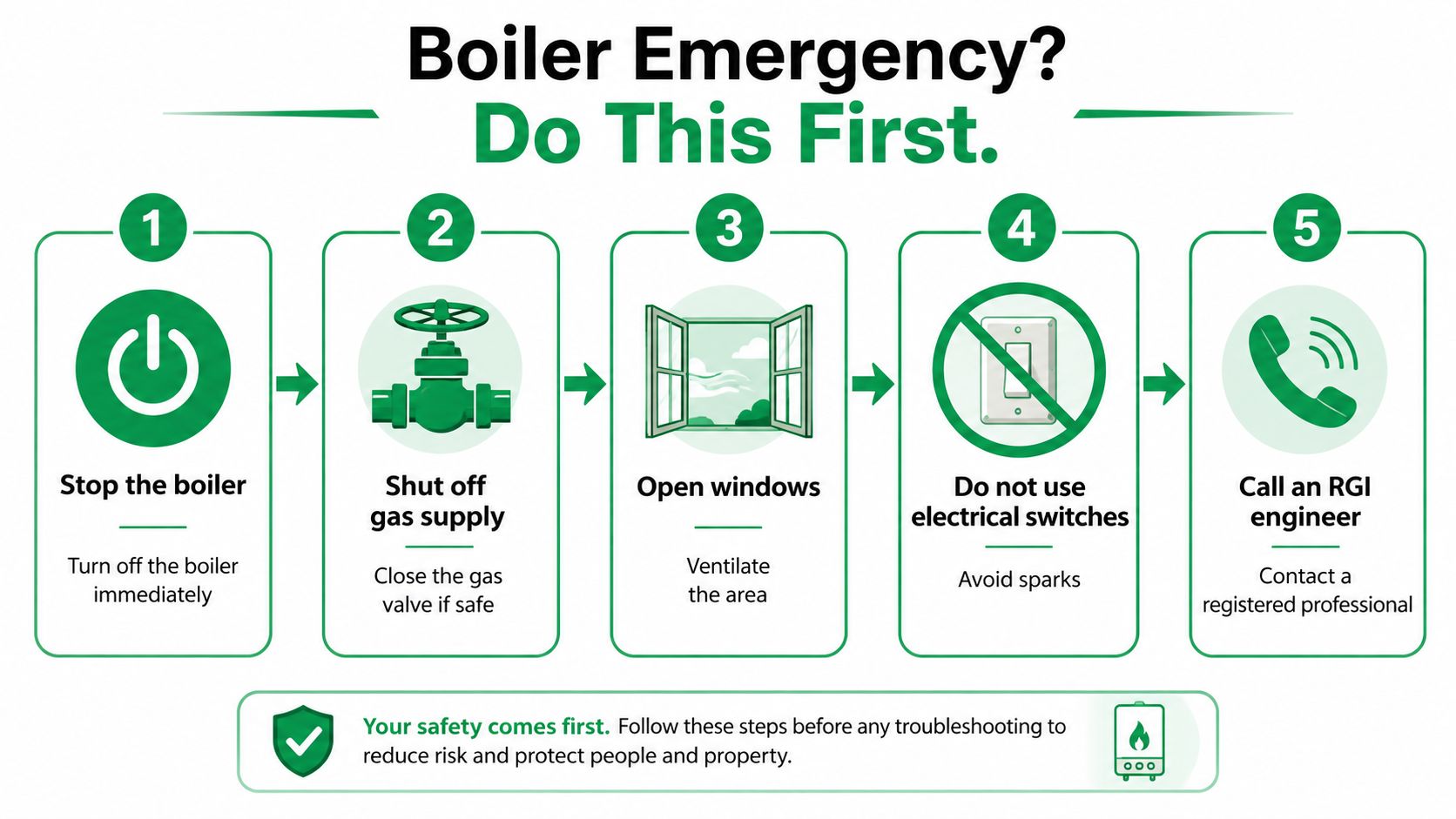
If there's any smell of gas, the sequence is simple. Call the Gas Networks Ireland emergency line, turn off the gas at the meter if that can be done safely, open windows to ventilate the property, and do not use electrical switches. The same response applies if a carbon monoxide alarm sounds, because CO is a life-safety issue, not a nuisance alert.
Practical rule: if the smell is strong, the alarm is sounding, or anyone feels dizzy or unwell, stop troubleshooting and get people out of harm's way first.
That boundary matters because any solid-fuel or gas appliance can create a CO risk. A compliant CO alarm to EN 50291 should be fitted, but an alarm is not a repair. It's a warning to leave the appliance alone and get the right help.
Stay outside the boiler case
Once gas smell and CO risk are ruled out, a homeowner can stay in the safe zone by looking, listening, and noting. The boiler case stays closed. No dismantling, no gas-valve work, no wiring inside the appliance, and no guessing.
The useful checks are external. Is the boiler powered? Is the display lit? Is there a fault code? Is there a tripped fuse or RCD? Those are the kinds of observations that help an RGI diagnose the fault later without turning a simple visit into a longer one. For a Dublin home, that distinction saves time and keeps the legal line intact.
If the fault is clearly not an emergency, the next step is to gather the basic facts before anyone visits. Emergency plumber guidance for Dublin homes is useful when the problem is broader than the boiler itself, but gas safety always comes first.
Safe Preliminary Checks a Dublin Homeowner Can Make
Most boiler faults don't need a screwdriver from the homeowner. They need a careful look at the controls, the power supply, and the system pressure before a call-out is booked. These checks are safe because they don't involve opening the boiler or touching gas components.
Start with the easiest fixes first
The first thing to confirm is power. Check that the fused spur or local isolator is on, then look at the thermostat and timer to see whether they're asking for heat. A surprising number of “boiler faults” are really scheduling or power-supply problems.
The next check is the pressure gauge. Low pressure, often below about 1 bar, is a common reason a boiler won't behave properly. If the manufacturer's manual allows topping up through the filling loop, that may be a homeowner action, but only if the steps are clear and safe. If there's any uncertainty, stop there.
A written note of the fault code helps more than a long phone description. The code, the pressure reading, and whether the boiler has power are usually the first facts an engineer wants.
Use a short checklist before calling
The useful pre-call questions are straightforward. Is the gas supply on to the house? Do other gas appliances work? Has a fuse blown or an RCD tripped? Is there an error code on the boiler display? Those observations don't fix the appliance, but they make the visit more efficient.
| Check | What to Look For | Action if Found |
|---|---|---|
| Power supply | Boiler display off, fused spur off, tripped breaker | Restore power if safe, otherwise book a visit |
| Thermostat and timer | Wrong schedule, low set temperature, no heat demand | Correct settings and retest |
| System pressure | Gauge reading low, often below about 1 bar | Follow the manual or ask an engineer |
| Gas supply | Other gas appliances not working | Treat as a gas-supply issue and seek help |
| Fuse or RCD | Tripped protection device | Reset once if safe, then stop if it trips again |
| Fault code | Code shown on display | Write it down exactly for the engineer |
For a homeowner trying to avoid an unnecessary call-out, that's usually enough. The rest belongs to the engineer, not the kitchen table.
Heating and water system support for Dublin homeowners can help narrow the issue category, but it still doesn't replace a proper gas inspection when the appliance itself is at fault.
The RGI Requirement and Why It Is Non-Negotiable in Ireland
Gas boiler work in the Republic of Ireland is not a free-for-all. It must be carried out by a Registered Gas Installer (RGI), and that is the legal and safety line a homeowner should treat as essential. The relevant authority is the Registered Gas Installers of Ireland, and the registration must be checked directly on the register before hiring anyone.
What the registration actually means
An RGI isn't just someone who says they do boiler work. It means the person is registered for gas work in Ireland and is expected to follow gas-safety practice and the relevant Irish Standard (I.S. 813). Dublin service checklists also include gas soundness testing, burner pressure checks, combustion results, and flue verification before the job is considered complete.
That last point matters. A repair isn't finished just because heat came back on. The appliance needs to run safely and efficiently, with the combustion and flue conditions checked after the fault is corrected.
Oil boilers are different, but still need competence
Oil boilers are not an RGI job, but that doesn't make them casual DIY work. They still need a competent technician, and the expectation is proper heating competence rather than guesswork. The key difference is the regulatory framework, not the importance of doing the job properly.
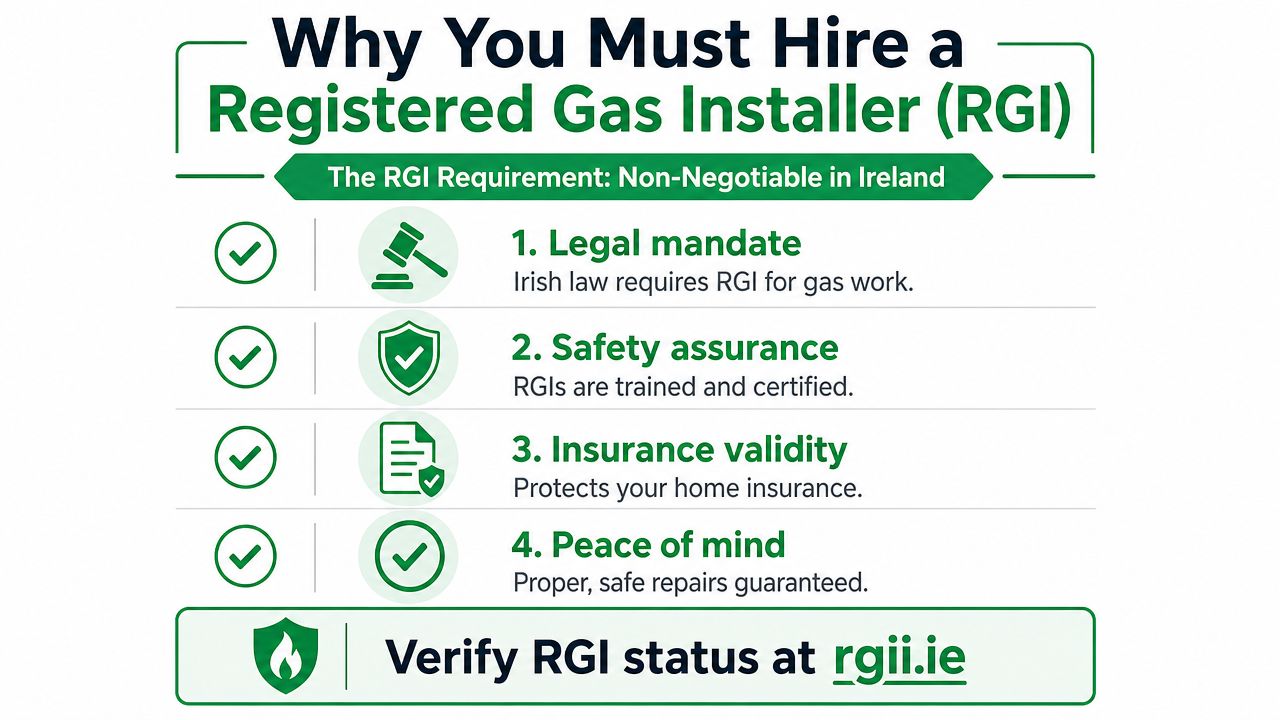
A homeowner should ask for the registration number, then check it on the RGI register directly. If the number can't be provided, that's the answer. There's no sensible reason to proceed with gas work in that situation.
Bottom line: speed is never a substitute for registration. In gas work, the credential comes before the quote.
A compliant engineer should also leave a record of the work, including the fault found, the parts replaced, and the safety checks completed. If those details are missing, the job is only partly documented, even if the boiler appears to be running again.
Understanding Boiler Repair Costs and Timelines in Dublin
Dublin boiler repair pricing isn't a single flat number. It moves with the fault, the urgency, the parts needed, and whether the job is a routine service, a first-visit fix, or an emergency call-out. That spread is exactly why a quote should spell out labour and parts separately.
What the Dublin market usually looks like
A gas boiler service in Dublin is commonly €70 to €180, typically €100 to €140. A repair call-out from an RGI engineer usually starts from around €200, with parts quoted separately on top. Treat these as general Irish market ranges, not a fixed quote.
The practical meaning is simple. A service visit is not the same thing as a repair visit, and parts are often extra. The cheaper-looking quote is often missing the bits that matter most.
| Service Type | Typical Cost (Dublin) | What Is Included |
|---|---|---|
| Standard gas boiler service | €70 to €180 (typically €100 to €140 in Dublin) | Basic inspection and service |
| Repair call-out from an RGI | From €200 | Diagnosis and labour, parts usually extra |
How long repairs tend to take
Some faults are sorted on the first visit if the engineer has the right part in the van. Others need a return trip, especially if the part is model-specific or has to be ordered. That's why a good quote should say what's covered now and what will be charged later if a second visit is needed.
VAT also matters. For repair labour and materials, 13.5% VAT generally applies, so the homeowner should confirm whether it's included in the price being quoted. A repair quote without that detail can look lower than the final bill.
The safest buying habit is to ask for a written, itemised quote before the work starts. Labour, parts, VAT, and any out-of-hours charge should all be visible in writing.
How to Choose and Vet a Boiler Repair Engineer in Dublin
A good boiler engineer in Dublin is not the one who sounds busiest. It's the one who can prove gas registration, explain the fault clearly, and put the price in writing before the work starts. That's the right order for a regulated gas job.
What to check before booking
The first check is always the RGI register. The engineer's registration number should match the register directly, not just a claim on a website or a van door. The homeowner carries the responsibility for that check, because gas safety in Ireland is too important to leave to assumptions.
After that, ask what the quote includes. Does it cover the first visit only, or labour plus parts? Will the engineer itemise replacement components separately? Will a written record of the repair be left behind? Those questions are basic, and a competent trade professional won't dodge them.
Red flags that should slow the decision
- No RGI number provided: A gas repair without a registration number shouldn't proceed.
- Bundled pricing with no detail: Labour and parts should be split out clearly.
- No explanation of the fault code: The engineer should be able to say what the code points to.
- Pressure to approve surprise charges: Unexpected work should be discussed, not slipped in.
- No written record after the repair: The homeowner should know what was changed and why.
A homeowner should also ask whether common wear parts are carried on the van. Thermistors, sensors, diverter-valve cartridges, PRVs, pumps for common systems, and condensate or PRV fittings are the sort of items that can turn one visit into a completed repair. If the part isn't on board, a second visit may be needed.
Ask for the part name, the labour charge, and the VAT position before work begins. If any of those are vague, the quote is incomplete.
ShamFix uses a two-sided review system, so reputation is built after a job is completed rather than handed out in advance. That helps a homeowner compare providers, but it does not replace the RGI check.
Using ShamFix to Find a Local Dublin Boiler Engineer
ShamFix is an Ireland-native marketplace based in Clifden, County Galway, founded in 2025, and it connects homeowners with local tradespeople across the Republic of Ireland. For a Dublin boiler issue, the platform works as a routing tool, not a quality guarantee, so the homeowner still checks the RGI registration independently.
The process is simple enough. A homeowner enters the boiler fault, reads the matched local listings, then reviews the provider's own stated credentials and customer feedback. Posting a job on ShamFix is one way to start that search when the issue needs a local engineer rather than a general browse.

The trust model matters here. After every completed job, both sides rate and review each other, so reputation is earned through actual work rather than claimed in advance. That gives the homeowner another layer of context when comparing local options, but it still sits alongside the RGI register, not above it.
ShamFix also leaves the credentialing to the provider. Each engineer states their own qualifications and is responsible for holding the correct registration for the job. For gas work, that means the homeowner should still verify the RGI status directly, even if the provider looks suitable on the platform.
Key Takeaways for Dublin Homeowners Facing a Boiler Breakdown
A boiler fault in Dublin becomes a lot less stressful when the order of operations is clear. Gas smell or a CO alarm means emergency protocol first, not troubleshooting, not resetting, and not waiting to see if the problem clears on its own. For everything else, the homeowner can safely check power, thermostat settings, pressure, fuse protection, and the fault code before calling anyone.
The single most important hiring rule is still the same, gas boiler work must be done by a Registered Gas Installer. That's the line that separates a compliant repair from an unsafe shortcut. If the person can't provide an RGI number, the search continues.
Cost-wise, a standard boiler service in Dublin is commonly €70 to €180, typically €100 to €140, while a repair call-out from an RGI often begins around €200, with parts quoted separately. 13.5% VAT generally applies to repair labour and materials, so the homeowner should confirm whether it's already included in the quote.
The best habit is to keep the process calm and documented. Write down the fault code, ask for an itemised quote, check the RGI register directly, and insist on a repair record that shows what was done. On ShamFix, reputation comes from two-sided reviews after the job is completed, so the homeowner can compare local options without mistaking a listing for proof of registration.
ShamFix connects Dublin homeowners with local tradespeople through a simple job-posting marketplace, so it can help narrow the search when a boiler fault needs a local engineer. It's worth using alongside the RGI register, not instead of it. When the boiler stops and the choices feel rushed, a clear listing, a proper registration check, and a written quote make the next step much easier.
Are you an RGI boiler engineer in Dublin?
ShamFix lists providers on a free Phase 1 basis, with 0% commission and no per-lead credits. If you're RGI-registered and take boiler repair work in Dublin, you can list your service and be among the first found as local demand grows, without any promise of lead volume or speed. Visit free leads for tradespeople to add your business.