Late spring to early summer, on a mild dry day, is usually the best time to pressure wash in Ireland, with surface-by-surface advice.
/8 min read
The best time to pressure wash in Ireland is usually late spring to early summer, on a mild, dry day with no frost and no heavy rain forecast. Working in the morning or early afternoon gives the surface time to dry before the evening damp sets in, while wet, freezing and very cold conditions are best avoided altogether. For larger patios, driveways, render or stone, homeowners can compare local pressure washing and pressure cleaning services rather than taking on the whole job themselves.
Why timing matters in Ireland's climate
Ireland's damp, mild climate suits moss, algae and blackspot, particularly on north-facing or shaded surfaces that stay wet right through winter. Washing at the right time of year gives the surface a chance to dry properly afterwards. In wet weather the rain can undo the work, and water sits in joints, behind render or under timber. In freezing or very cold weather, water can freeze in cracks and joints, and slow drying leaves surfaces damp for days. Very hot, direct sun is not ideal either, because a cleaning solution can dry out before it has time to work on the growth. The best window is a mild, dry day with a light breeze, when the surface dries within a few hours. In practice, watching the forecast for a settled dry spell works better than fixing a date in advance.
How often pressure washing is usually needed in Ireland
There is no fixed rule, but a practical habit is to inspect outdoor surfaces in spring, once the worst of the winter weather has passed. Where moss, algae, blackspot or slippery patches are visible, cleaning them before the surface gets heavy summer use makes sense. Many households settle into one main clean in late spring or early summer, with spot cleaning later if green growth returns. Shaded or north-facing patios and driveways usually need attention more often than sunny, exposed ones, because they stay damp longer. Decking tends to need cleaning when the finish starts to look grey or worn, while render and stone are best cleaned only when needed, since repeated high-pressure washing wears away mortar, pointing and surface sealers. Lightly soiled surfaces often come up well with a garden hose and a stiff brush, leaving pressure washing for the heavier build-up.
Patios and driveways
Patios and driveways are the most common pressure washing jobs. Concrete slabs, porcelain paving and block paving can usually be cleaned with a pressure washer, but the pressure and the technique matter as much as the timing. A wide fan nozzle, a wand that keeps moving and a jet that is never held in one spot are the basics. On block paving, high pressure can wash out the joint sand, so a lower setting is used and the joints are re-sanded once the surface dries. Tarmac or asphalt driveways are a different matter: high pressure can strip the binder and break up the surface, so soft washing is the safer option there. On a sealed or polished patio, the surface supplier's guidance is worth checking first, because pressure washing can dull the finish. Some paving can be sealed afterwards to slow future staining, but only once it is completely dry.
Render, stone, tarmac and decking
Render, natural stone, tarmac and timber decking need more care than concrete. Older render can be soft, cracked or painted, and a direct high-pressure jet can blow holes in it or force water behind the surface; pebbledash and painted render are especially vulnerable. Natural stone varies in hardness, and sandstone and limestone can erode, so a small hidden patch is tested first. Tarmac is treated as a delicate surface rather than a pressure washing surface. Decking boards can splinter or fuzz under high pressure and the finish can be stripped, so low pressure along the grain is the safer approach, and composite decking can be marked by high pressure as well. Where render is already crumbling or sounds hollow, it should not be pressure washed at all, and advice from a suitably qualified professional comes first. When in doubt, soft washing is the gentler method for all of these surfaces.
Pressure washing versus soft washing
Pressure washing relies on the force of water and suits hard, durable surfaces such as concrete, paving and some stone, provided the pressure is kept low enough. Soft washing uses low pressure and a cleaning solution to break down organic growth, dirt and algae, and it is usually the better choice for render, painted walls, natural stone, tarmac, decking, roof tiles and anything with delicate joints or seals. A sensible approach is to start with the lowest pressure that works, test a small area, and only increase the setting if it is genuinely needed. Cleaning solution is applied from the bottom up, left to dwell for the time stated on the product label, then rinsed from the top down. Where pressure washing is part of a wider maintenance list, ShamFix also lists home services such as gutter clearing and window cleaning.
Damage risks: joints, pointing, seals and finishes
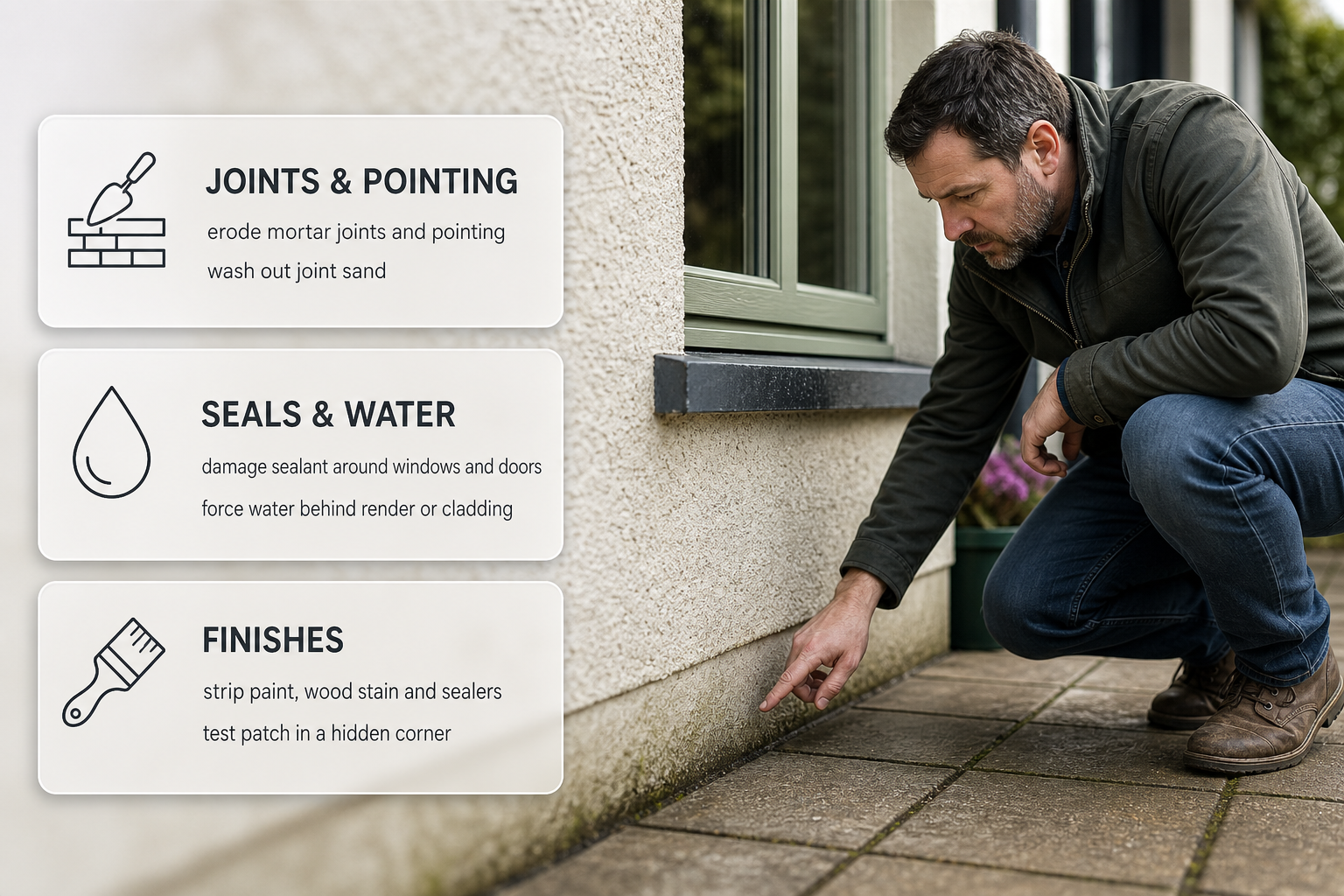
The main damage risks from pressure washing come from water getting into places it should not. High pressure can erode mortar joints and pointing, wash out joint sand, damage sealant around windows and doors, and force water behind render or cladding. It can also strip paint, wood stain and sealers. Jets are kept away from vents, weep holes, electrical fittings and outdoor sockets, and spray is never directed upwards under eaves or into cavities. A test patch in a hidden corner is the simplest way to check how a surface will cope. Where cleaning products are used, gloves, eye protection and a mask where the product advises it are sensible, and children and pets are kept away until the surface is dry. Nearby plants are covered or watered first, and cleaning chemicals are never mixed.
Weather, water use and hosepipe restrictions
In a long dry spell, Uisce Éireann can bring in a Water Conservation Order, often called a hosepipe ban, which covers garden hosepipes and other non-essential water use. Pressure washing from a mains tap can fall under it, so it is worth checking whether an order is in force in the area before starting. Dirty water and cleaning solution are kept away from drains, gullies and watercourses, and leftover solution is never tipped down a drain.
Choosing the right day and method
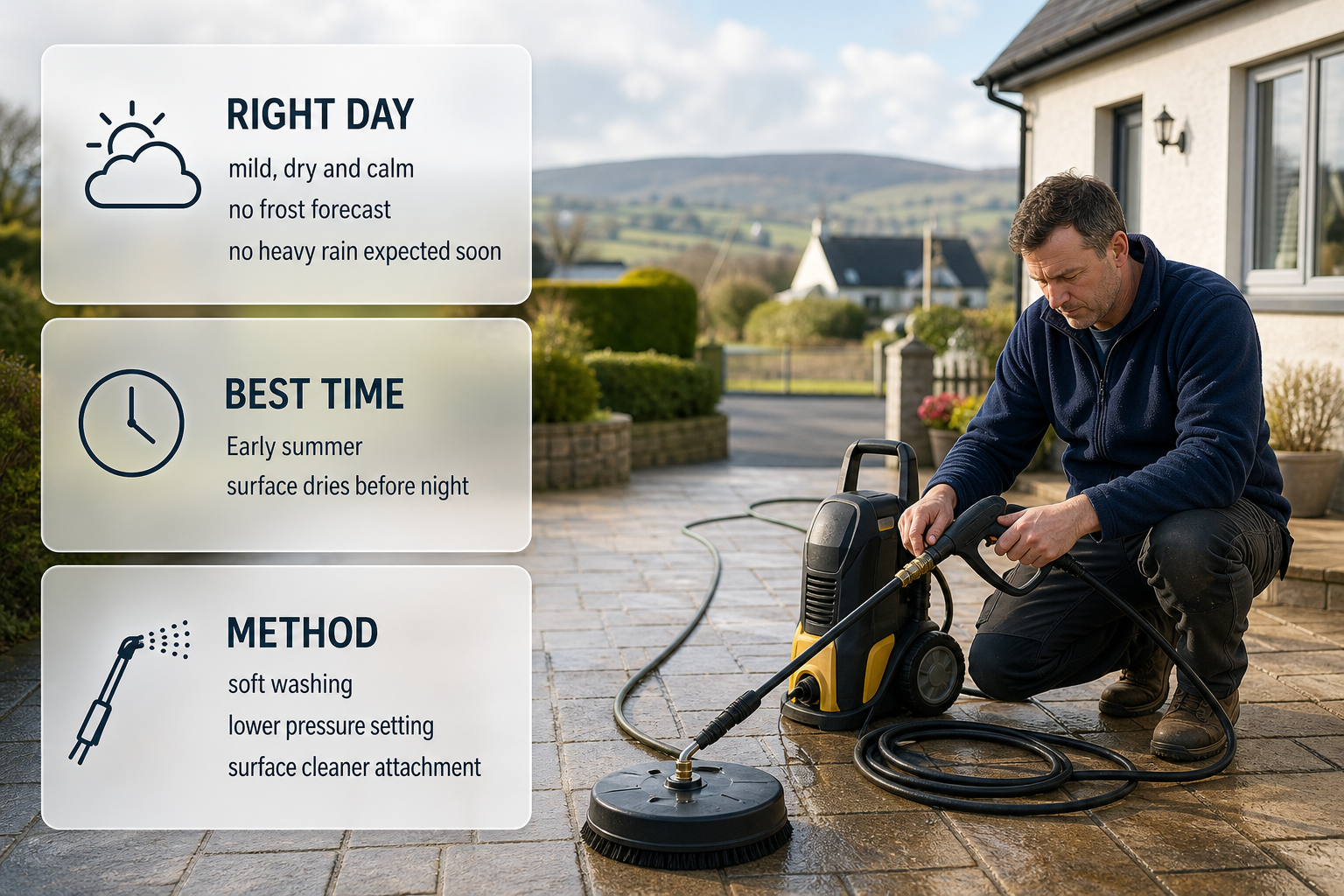
A good pressure washing day in Ireland is mild, dry and calm, with no frost forecast and no heavy rain expected soon. Early summer is often ideal, because growth is active, the weather is usually mild and the longer evenings give surfaces more time to dry. Starting early enough that the surface dries before night matters, and working in sections, rinsing as the job goes, keeps dirty water off clean areas. Windy days are best avoided, because spray drifts onto cars, windows and plants. On delicate, shaded, painted or already damaged surfaces, soft washing or a local service is the safer route than risking a repair bill. For driveways and patios, a lower pressure setting with a surface cleaner attachment gives a more even finish than a narrow jet.
Getting help with pressure washing
For large driveways, two-storey render, delicate stone or any job where the risk of damage is high, hiring a local service can be the safer choice. Posting a job and listing on ShamFix is free and there is no commission, and a subscription is planned for the future. ShamFix does not check or certify tradespeople, and profiles are filled in by tradespeople themselves, so homeowners should check registrations themselves and read reviews. The starting point is ShamFix.
FAQ
Can pressure washing be done in winter in Ireland?
It is usually best left until spring. Frost and very cold nights leave water trapped in joints and slow drying down, and grit or salt left over from winter is often better brushed off first. On a genuinely mild, dry winter day, a low-pressure clean of a hardy concrete surface may be possible, but the forecast is checked for frost in the following 24 hours before anything is switched on.
How can paving joints be protected during cleaning?
Lower pressure, a wide fan nozzle and a jet that never stops moving are the main protections. The jet is not aimed down into the joints, and any joint sand that is lost is brushed back in once the paving has dried. Walking on block paving before the joints are refilled can shift the blocks, so that stage is not left until later.
Is soft washing better for render and painted walls?
In most cases it is, because render and painted finishes are easily marked by a hard jet and water can find its way in behind cracks. Heavy organic growth sometimes needs a second application rather than more pressure. Plants close to the wall are covered or rinsed before and after, and any product is kept strictly to the surface being cleaned.
Can wooden decking be pressure washed?
Only at low pressure, and only when gentler methods have failed. A wood cleaner worked in with a stiff brush often lifts grey, weathered boards without any risk to the grain. Cleaning is done when the deck is not in strong sun so the product does not dry too quickly, and boards are checked for rot before water goes anywhere near them.
How soon can a surface be used after pressure washing?
Only once it is completely dry. Damp paving is slippery underfoot, and furniture or planters placed on it too soon can leave marks. Any sealing or re-sanding waits until the surface is dry, with the product instructions followed on how long to leave it before normal use resumes.