The dangerous assumption in Irish gas work is that a person who sounds competent is legally allowed to do the job. That assumption is wrong. Since 26 June 2009, unregistered domestic gas work in Ireland has been an offence, and the RGI scheme replaced the earlier voluntary register with a legally enforced safety regime (CER historical update).
That legal line matters because gas work is not decorative maintenance, it is safety-critical work tied to appliances, pipework, flues, certificates, insurance, and traceability. A homeowner who hires the wrong person is not just taking a gamble on quality, they're stepping outside the compliance system that protects the property, the occupants, and the paper trail needed after the job is done.
Why RGI Registration Is Non-Negotiable for Gas Work
RGI registration is the legal gatekeeper for domestic gas work in the Republic of Ireland. It is required, not optional, and it is no substitute for a tradesperson who merely sounds competent. Since 26 June 2009, domestic natural gas installers have had to register before carrying out gas works, and unregistered domestic gas work is an offence.
That matters because gas work leaves a legal trail. If the person doing the work is not registered, the homeowner starts in a weak position on compliance, warranty disputes, insurance questions, and later property transactions. Work carried out outside the scheme can also leave a home without proper conformance paperwork, which is exactly the sort of gap that causes disputes later.
Practical rule: if the installer cannot prove active RGI status before the job starts, the answer is no.
The scheme is overseen under the Commission for Regulation of Utilities, and it exists because gas installations need a controlled standard, not informal judgement. Homeowners should treat RGI verification as the first filter. Check the installer's registration status, ask for proof of insurance, and confirm they can issue the correct certificate before any work begins. If they dodge those questions, walk away. That is the sort of behaviour that often sits behind fake claims and shortcuts.
There is also a safety reason behind the legal one. The regulator's own energy safety reporting recorded 2,870 Registered Gas Installers at year-end, along with 26 investigations into alleged illegal gas works by non-RGIs that year. That tells you the issue is live, not theoretical (Energy Safety Annual Report 2023).
The blunt advice is simple. If the job involves domestic natural gas or LPG, the installer must be properly registered. Anything else is a compliance risk the homeowner should not carry.
What It Takes to Become a Registered Gas Installer

RGI status is earned through qualification and control, not through experience alone. A domestic applicant normally needs a Domestic Gas Safety award or a legacy GIS or GID equivalent, plus an Irish Level 6 advanced craft qualification in gas fitting, electrical, plumbing, or refrigeration (RGI FAQs). That bar is deliberate. Gas work should be left to people who have proved they can do it properly.
The qualification layer
The qualification rule exists for a reason. The installer must show gas-specific competence and a broader craft background that supports safe installation work. The scheme also ties eligibility to recognised Irish qualifications and to technical standards such as I.S. 813 for domestic gas installations.
That standards link matters. It means the installer is working to a defined Irish rule set for domestic gas installation, not relying on loose experience or habit. A homeowner should care about that difference.
The insurance and administration layer
Registration also carries commercial obligations. The RGI site says general membership requires appropriate commercial insurance, with €6.5 million public and product liability for sole trader RGIs and €13 million employers' liability for companies (joining RGI). Those figures show the scheme is built around accountability, not casual claims.
The paperwork is just as strict. The registration procedure says completion depends on Form G42 being fully completed and signed, insurance confirmation being in place, and the annual subscription fee being received. It also says the annual subscription fee must be paid within 30 days of the renewal date (RGII registration procedure).
For homeowners, the lesson is simple. A person who is registered has qualifications, insurance, standards, and renewal discipline in place. If they cannot show those basics, they are not ready for gas work.
How to Verify an Installer Is Genuinely RGI Registered
The verification step is where careless homeowners lose protection. A person can sound convincing on the phone and still be the wrong person for the job. The only sensible approach is to check the installer against the official register before any work is agreed.
What to ask before the quote
Start with three details. Ask for the RGI registration number, the company name, and the full name of the person who will attend. Then compare those details with the official register and with the ID presented on the day. If the names don't line up, that is not a paperwork issue, it's a warning sign.
Gas Networks Ireland says a registered gas installer has the required gas safety training, necessary insurance, and is registered under the scheme operated for the CRU. It also states that only a registered gas installer may work on domestic natural gas installations, and that a sample of each installer's work is inspected annually, with a Declaration of Conformance legally required for gas work (RGII application procedure). That is the chain the homeowner should insist on, every time.
What the certificate tells you
The certificate is not a bonus document. It is the proof that the work passed through the system after completion. If an installer hedges on whether a certificate will be issued, or suggests skipping it to make the job cheaper, the homeowner should walk away immediately.
A good filter is simple. The installer should be willing to show registration details, prove insurance, and explain what certificate will be issued at the end of the work. A bad one gets vague, changes the company name, or says the certificate is unnecessary.
A live fraud issue makes this more than theoretical. Public reporting has covered a 2025 prosecution for pretending to be a gas installer, so impersonation is not some distant edge case. The homeowner should treat any reluctance to provide verifiable details as a hard stop.
The clean habit is this, verify first, book second, pay after the paperwork is in order. Anything else is backwards.
What Work RGI Registration Covers and Where the Boundaries Lie
RGI registration covers domestic gas work, not every job in a house that happens to sit near a boiler. That boundary matters because homeowners often mix up gas work, plumbing, and heating work as if they were all the same trade. They're not.
Work that belongs with an RGI
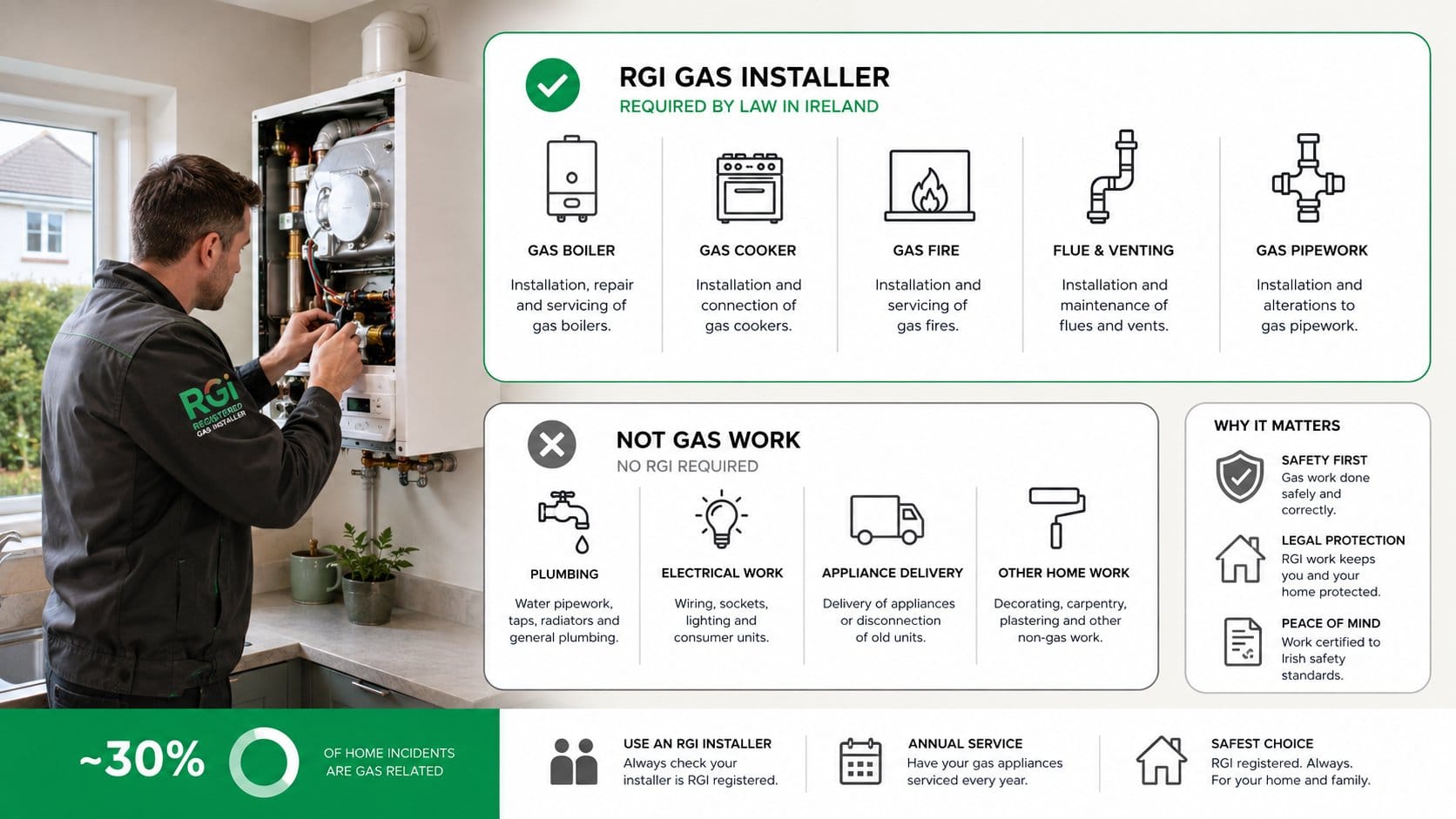
If the task involves a gas boiler, gas cooker, gas fire, pipework connected to gas appliances, flues, or other domestic gas installation work, the homeowner should be dealing with an RGI. The scheme exists to keep that class of work inside one regulated lane, with standards and certificates attached.
That distinction is especially important when a repair job starts to drift. A general plumber might be fine for non-gas plumbing tasks, but once the work touches gas appliances or gas pipework, the right person changes. The homeowner should not let the convenience of a single visit override the legal and technical boundary.
Where the boundary stops
Not every heating-related task is RGI work. General electrical work, plumbing work that does not involve gas pipes, and appliance sales without installation sit outside the gas registration scope. The owner of the job still needs a competent tradesperson, but not every competent tradesperson is an RGI.
That is why mixed-scope jobs need clear scoping before anyone starts. If a contractor says they can “sort the whole thing” but can't explain where the gas element begins and ends, the homeowner should slow the job down. Gas-related ambiguity is exactly how corners get cut.
The safest habit is to separate the tasks. If gas is involved, bring in an RGI. If it isn't, use the appropriate trade, but do not let anyone drift across the boundary casually. That is where the trouble begins.
Red Flags to Watch for When Hiring a Gas Installer
Gas work goes wrong when a homeowner accepts confidence instead of proof. A polished quote and a friendly manner do not tell you whether the installer is registered, insured, or able to issue the right certificate. Demand those details before the first tool comes out.
What should make the homeowner stop
A refusal to give the RGI number is a problem. So is a quote that skips a written scope, a request for cash to avoid the certificate, or vague answers about insurance. Those are warning signs that the installer wants less scrutiny than the job deserves.
The safety reports discussed earlier show why that matters. Oversight exists because illegal or poor gas work still turns up, and homeowners should treat any attempt to dodge checks as a serious red flag.
If the quote is too slick to question, it is probably too weak to trust.
What the homeowner should do instead
Ask for the installer's registration details in writing. Ask what certificate will be issued. Ask whether the company name on the quote matches the company name on the register. If any answer is muddy, stop there.
The cheapest quote is often the one that strips out something important, like inspection, paperwork, or proper finish. A safe gas job is a regulated process, not just a pipe connected to an appliance.
Use a proper screening method before you book anyone. A practical starting point is this guide on how to find a good plumber, but do not let general plumbing credentials blur the gas checks. For any gas-related work, insist on RGI verification, insurance proof, and the ability to issue the correct certificate.
Using Marketplaces to Find Local RGI Installers
Online marketplaces can help a homeowner shortlist local installers faster, but they do not replace verification. That's the key point. A platform can route an enquiry and surface local options, yet the homeowner still has to confirm the installer is registered, insured, and prepared to issue the correct certificate.
ShamFix is one Ireland-native marketplace that connects homeowners with local tradespeople, including gas installers, through an matching tool that routes requests to suitable providers. It uses a two-sided review system, so both customers and providers review each other after jobs, which builds reputation through feedback rather than platform-issued badges.
That distinction matters. ShamFix does not vet or verify provider documents, so each installer states their own credentials and remains responsible for holding the correct registration. For gas work, that means the homeowner still has to confirm RGI status with the official register before work starts.
The sensible approach is to use the marketplace as a discovery tool, not a trust shortcut. Reviews help identify local providers who've completed work, but they do not replace the legal check on registration, insurance, and certificate issuance. If the installer can't pass that test, the review score is irrelevant.
ShamFix publishes this guide.
The Coming Non-Domestic Gas Registration Requirement
The next regulatory change for gas work is no longer a distant proposal. The CRU has decided to extend the RGI scheme to non-domestic gas works from 1 September 2026, replacing the earlier proposal for 1 January 2026 (NSAI update). The underlying consultation process began with a paper published in December 2024, so the issue is well past the discussion stage and now sits close to enforcement.
That changes the framing completely. With 1 September 2026 now only weeks away, landlords, commercial property managers, and businesses should treat this as an urgent compliance deadline. This is not something to leave for the next service cycle or the next contractor review.
The practical risk is simple. Commercial gas maintenance arrangements, installer credentials, and compliance paperwork may already be out of step with the rule that is about to take effect. If a business waits until the last minute, it may discover that its current contractor cannot carry out the work under the new registration requirement, or that urgent work is delayed while compliant providers are booked out.
Property owners with mixed portfolios should act now. Audit every site where non-domestic gas work is being carried out, confirm who is doing that work, and check whether those contractors will be compliant when the new requirement starts. Any uncertainty at this stage is a problem that needs resolving immediately, not a note for later.
For businesses and landlords, the message is blunt. Check the final scope of the rule, speak to current contractors now, and make sure your maintenance planning is ready before 1 September 2026 arrives.
ShamFix connects Irish homeowners with local tradespeople, including independent RGI installers, through a marketplace that's built around local discovery and two-sided reviews. If gas work is on the list, use ShamFix to find local options, then still verify RGI registration, insurance, and certificate capability before any job begins.