
A tap won't stop dripping, a socket keeps tripping the fuse board, or a garden project has sat unfinished through the winter. The first search is often simple: find a tradesman in Ireland. The difficult part starts afterwards. Which person is available, properly registered where required, clear about the scope, and likely to finish the work without a dispute?
Finding a tradesman in Ireland now means solving three problems together: availability, accountability and suitability. A recommendation can help, but it doesn't confirm registration. A low quote may leave out waste removal, access equipment, making good or VAT. A polished online profile can show useful information, but it isn't a substitute for written terms and direct checks.
The practical route is to define the job before contacting anyone, understand why some trades have long lead times, compare like-for-like quotes and verify regulated work with the relevant Irish authority. Local reviews can add context, but responsibility remains with the homeowner and the chosen provider. The following guide focuses on that decision, from the first search to the final written agreement.
Introduction What Finding a Tradesman Really Means in Ireland Today
A leaking pipe creates more than a plumbing problem. It creates a question about whether the first available plumber can attend, whether the repair will address the cause rather than only the visible leak, and whether the price includes parts, labour and follow-up work. An electrical fault raises an even more important question, because domestic electrical work in the Republic of Ireland must be carried out by the appropriate registered professional.
That distinction matters for a search such as find a tradesman Ireland. The searcher may appear to want a list of names, yet the underlying need is often a workable start date, a fair description of the job and confidence that safety-critical work will be handled legally. For a larger project, such as a garden room, roof repair or retrofit, the homeowner also needs to understand access, materials, waste, certification and payment stages before agreeing to anything.
A useful way to approach the search is to treat each enquiry like a short project brief rather than a casual request for a price.
- Describe the fault or finished result: Include what has happened, what remains unfinished and what outcome is wanted.
- Give location and access details: A provider needs the town or county, parking information, stairs, restricted access and whether another contractor is involved.
- Ask for the same information from each provider: A labour-only rate can't be compared fairly with a fixed quote that includes materials and making good.
- Record the agreement: Keep the scope, price, start date, deposit and exclusions in writing.
Ireland's construction workforce is substantial, but homeowners still compete for limited specialist availability. That makes a calm, organised process more valuable than chasing the cheapest name in a directory. The later sections explain how supply pressures affect the search, how discovery routes differ and which checks protect the household before money changes hands.
Why Good Tradespeople Can Be Hard to Find Right Now
Ireland's construction sector employed 171,676 people in 2024, compared with 166,918 in 2023, an increase of 2.8%, according to the Central Statistics Office construction national accounts perspective. The sector represented more than 6% of all employment in the State and generated €14.3 billion in gross value added in 2024, which was 66% above 2018 levels, according to the same CSO release.
Those figures describe a large and economically important sector, not an unlimited pool of people available for a leaking tap tomorrow morning. A useful analogy is a town with many delivery vans but only a small number equipped for a particular type of callout. There may be plenty of general building activity while a homeowner still struggles to find an electrician, plumber or retrofit specialist for a specific date.

Which trades face the greatest pressure
The CSO identified electricians and electrical fitters, carpenters and joiners, and broader construction and building trades among the top occupations in the sector. The Government's Careers in Construction Action Plan estimates that 50,831 new entrants are needed across managerial, professional, skilled and semi-skilled occupations between 2023 and 2030.
The same Government analysis recorded 2023 demand for new entrants of 902 electricians, 988 plumbers, 1,325 carpenters, 742 plasterers and wall tilers, and 720 painters. These figures don't predict the exact waiting time for a job in Dublin, Cork, Galway, Limerick or Waterford, but they show why lead times can differ by trade, project type and local availability.
Why registration narrows the search
Electrical and gas work have an additional constraint. The Commission for Regulation of Utilities reported about 3,900 Registered Electrical Contractors and 2,700 Registered Gas Installers in Ireland in its information about the national schemes. For homeowners, that means a search for a suitable professional isn't only about who advertises nearby. It also involves finding someone with the correct registration for the work.
The practical result is straightforward. A homeowner may need to contact more than one provider, allow flexibility around the start date and avoid booking a specialist solely because the first person replies. A longer wait can be frustrating, but an unqualified person doing restricted work creates a much more serious risk.
The Main Ways Homeowners Find Tradespeople and How They Differ
Word of mouth remains useful because the recommendation usually comes with context. A neighbour can explain whether the provider communicated clearly, protected floors, returned to correct a fault or left the site tidy. That personal detail is valuable, but the recommendation still belongs to someone else's project. A carpenter who handled a small repair well may not be the right fit for a structural alteration, and a general builder's experience doesn't automatically cover regulated electrical or gas work.
Web search offers broader reach. A homeowner can search for a service and an Irish place, examine the provider's own site, look for the services listed and ask direct questions. Search results can also contain outdated pages, copied descriptions or firms that cover a much wider area than the homeowner expects. The name appearing first isn't proof of availability, insurance, workmanship or registration.
Social recommendations sit between the two. Local groups can reveal who is active in an area, yet comments may be incomplete and difficult to assess. The strongest approach is to treat every recommendation as a starting point, then apply the same checks to the person recommended as to a person found through search.
Practical rule: A referral reduces uncertainty about one experience. It doesn't remove the need to confirm the current scope, price, registration and responsibility for the work.
Marketplace-style routing adds structure to the initial enquiry. A homeowner describes the task, location and requirements, and a platform may route that request towards suitable local providers. This can help organise discovery, particularly when the homeowner doesn't already have a reliable contact, but routing is not a quality guarantee. The homeowner still needs to compare offers, check credentials and agree terms directly.
The same principle applies to inspiration. Someone considering a garden room can review inspiring garden room stories to clarify preferred layouts, finishes and uses before asking for a quote. A clearer visual brief often produces more useful conversations than a message saying only “garden room wanted”. For a wider comparison of how Irish homeowners can approach online options, the Irish tradesman platforms comparison provides another point of reference.
Independent reporting in the Irish Examiner's coverage of the construction labour shortage says 29% of tradespeople identified skilled-labour shortages as their biggest obstacle, while broader Irish coverage has warned of estimates that 30,000 to 60,000 additional craft workers may be needed before the end of the decade. That context makes the best route a combination, not a single channel: use recommendations or search to identify options, then use a structured brief and direct checks to decide.
How to Brief a Job and Compare Quotes Like for Like
A vague request produces vague quotes. “Fix the bathroom” could mean replacing a tap, removing and refitting sanitaryware, repairing a leak behind a wall or completing a full renovation. Each option involves different labour, materials, access and risk, so the first protection is a written description that another person could understand without a phone call.
Start with the work itself
State the problem, the desired finish and any known constraints. For plumbing, include the location of the leak, visible damage, whether the water can be isolated and whether photographs are available. For electrical work, describe the affected circuit or appliance without guessing at the fault, and ask the electrician to identify any testing or certification included.
A carpentry brief should identify measurements, timber or sheet materials, finish, hinges, handles and whether old materials need removal. A handyman request should separate individual tasks, such as hanging doors, mounting shelves or repairing sealant, because a single broad label can hide several different jobs. For a mobile mechanic, provide the vehicle make, model, registration year if relevant to the diagnostic discussion, symptoms and whether the vehicle can be driven safely to a location.
Make exclusions visible
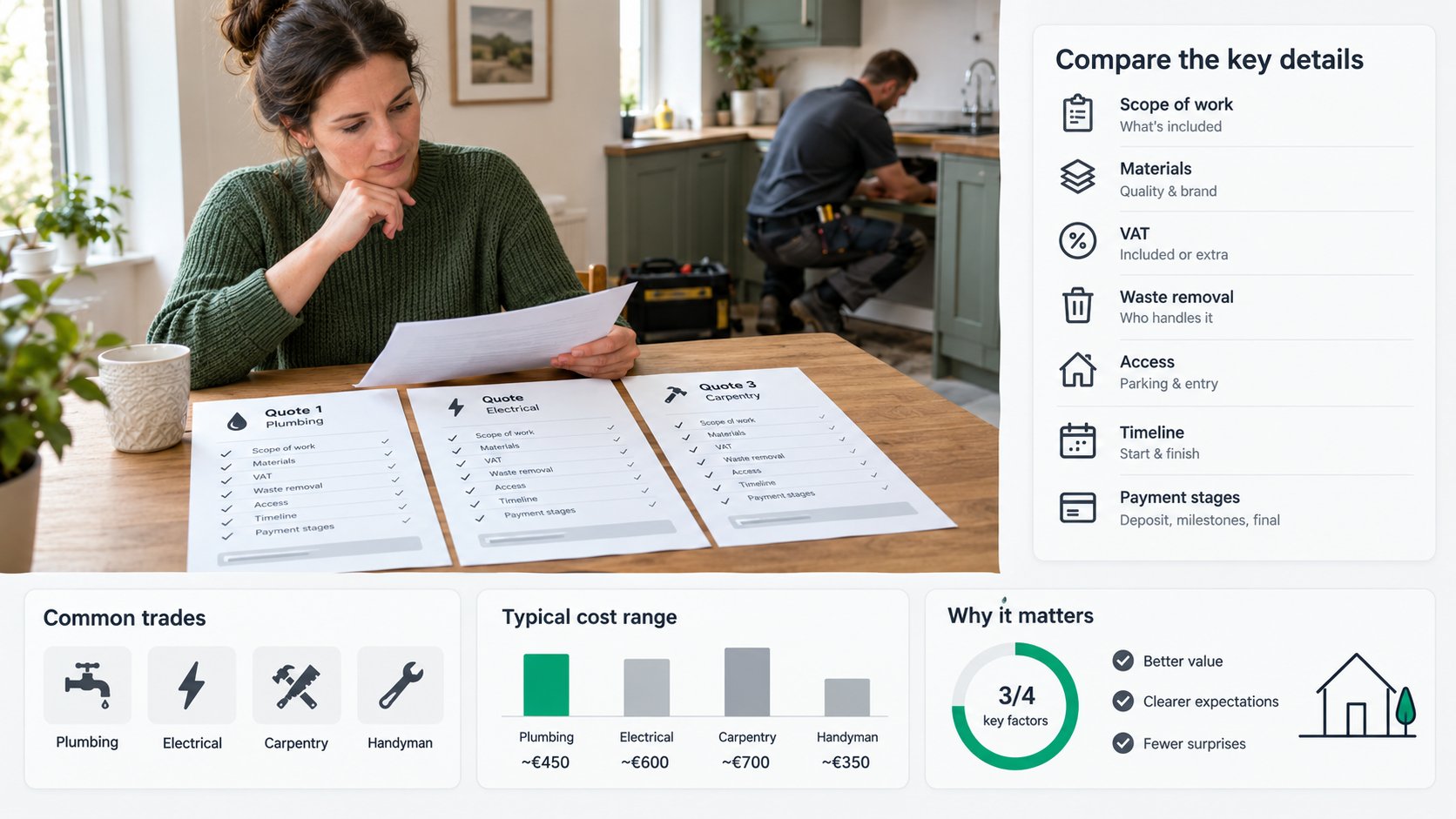
Quotes should state whether they include:
- Materials: Name preferred brands or specifications where they matter, and ask whether alternatives need approval.
- Access: Mention parking, stairs, narrow entrances, occupied rooms, attic access and any need for working at height.
- Preparation: Clarify who removes furniture, lifts flooring, isolates services or protects finished surfaces.
- Waste and making good: Ask whether disposal, plaster repair, painting, resealing and cleaning are included.
- Testing and paperwork: For regulated work, identify what certificates or completion documents will be supplied.
The cheapest headline figure is often incomplete because it excludes one of these items. A labour-only day rate isn't comparable with a fixed price containing materials, disposal and final making good.
Ask identical questions
Each provider should receive the same brief and be asked to confirm the same points. That makes differences easier to identify and reduces the chance that one quote has omitted a major task.
- What exact work is included?
- Which materials, brands and finishes are included?
- What isn't included, including access, waste and making good?
- What payment schedule and deposit apply?
- What start-date assumptions and completion conditions apply?
VAT needs a specific question. Construction, renovation and repair work generally carries 13.5% VAT, while residential solar PV has a 0% rate since May 2023, as set out in the relevant Irish tax treatment. The homeowner should ask whether VAT is included in the quoted total, because a price excluding VAT can look cheaper than an inclusive quote for the same work.
For bigger projects, the written scope should also cover changes. If hidden damage appears after opening a wall or lifting a floor, the provider should explain the extra work and cost before proceeding where practical. A short written variation is safer than an informal verbal agreement remembered differently by each person.
Is it a quote, an estimate or only a partial price?
Many hiring problems start because two prices look comparable when they are not. A quote is usually a price for a defined scope. An estimate is a provisional figure that may move once the job is opened up or measured properly. A partial price covers only one slice of the work, such as labour only, first fix only, or materials only.
| Type | What it means in practice | What to ask for |
|---|---|---|
| Quote | Price for a clearly defined job | Full scope, exclusions, VAT, payment stages |
| Estimate | Best current figure, not final | What could change it, and when the final price will be confirmed |
| Partial price | Only part of the job is priced | The missing items in writing before comparing it with others |
A complete document should show the work included, what is excluded, who supplies materials, whether waste and making good are included, the expected timeline or lead time, and how extra work will be approved. The CCPC says consumers should not settle for the first quote they receive, and the contract should outline the scope, timeline, payment schedule and other critical details.
If a price contains vague lines such as “if required”, “to be confirmed” or “subject to site conditions”, the homeowner should ask what that could add to the bill before accepting.