A typical 3-bed house in Limerick costs €90 to €120 for all carpets, and many cleaners also apply a minimum call-out charge of €50 to €150 before any extras are added. That means the right question isn't just “What's the price?” but “What exactly is included, and who is doing the work?”
A lot of homeowners reach the same point the same way. The stairs look grey no matter how often they're vacuumed. The sitting room has old tea marks, pet smells, or dark traffic lanes near the doorway. A child spills juice, someone tracks in mud, or a rental property needs a proper reset between occupants. Then comes the harder part. Choosing a carpet cleaner in Limerick often feels less straightforward than it should.
That uncertainty catches people out. One cleaner quotes a simple room price. Another mentions stain treatment, deodorising, drying time, and furniture moving. Some sound polished on the phone but say little about insurance. Others promise a deep clean without explaining the method. In the Republic of Ireland, that matters more than many people realise.
The wider cleaning sector is large and established. The cleaning services market in the Republic of Ireland is projected at about €1.8 billion in 2026 and employs an estimated 45,000 to 55,000 workers, which shows that homeowners are dealing with a substantial professional industry rather than a niche sideline (Irish cleaning industry overview from Spotless). But size alone doesn't protect a customer from vague quotes, poor rinsing, or an uninsured operator.
Your Guide to Professional Carpet Cleaning in Limerick
A Limerick homeowner usually doesn't start searching for carpet cleaning because everything is fine. It starts when the carpet no longer lifts the room. The hall looks tired. The landing smells a bit stale in damp weather. The living room carpet has marks that ordinary spray cleaner only seems to spread.
That's where confusion begins. Some carpets need a deep flush and extraction. Others respond better to a lower-moisture maintenance clean. Some marks will lift well. Others improve but won't vanish completely if they've set into the pile, backing, or underlay. The problem isn't just dirt. It's knowing which cleaner is being realistic.
Practical rule: A trustworthy cleaner explains the method, the likely result, and the drying expectations before the machine comes through the door.
For anyone researching carpet cleaning in Limerick, the practical issues are usually the same:
Method: Is the cleaner using hot water extraction or a low-moisture system?
Price: Is the quote for the full job, or is it just the starting point?
Preparation: Should the house be vacuumed and cleared first?
Risk: Is the provider insured if something is damaged?
Aftercare: How long before the carpet is properly dry and ready for normal use?
The strongest position for a homeowner is a simple one. Understand the cleaning method, expect sensible pricing, prepare the room properly, and check insurance before work starts. That doesn't make the process complicated. It makes it safer and far easier to judge whether a quote is fair.
Carpet Cleaning Methods Explained
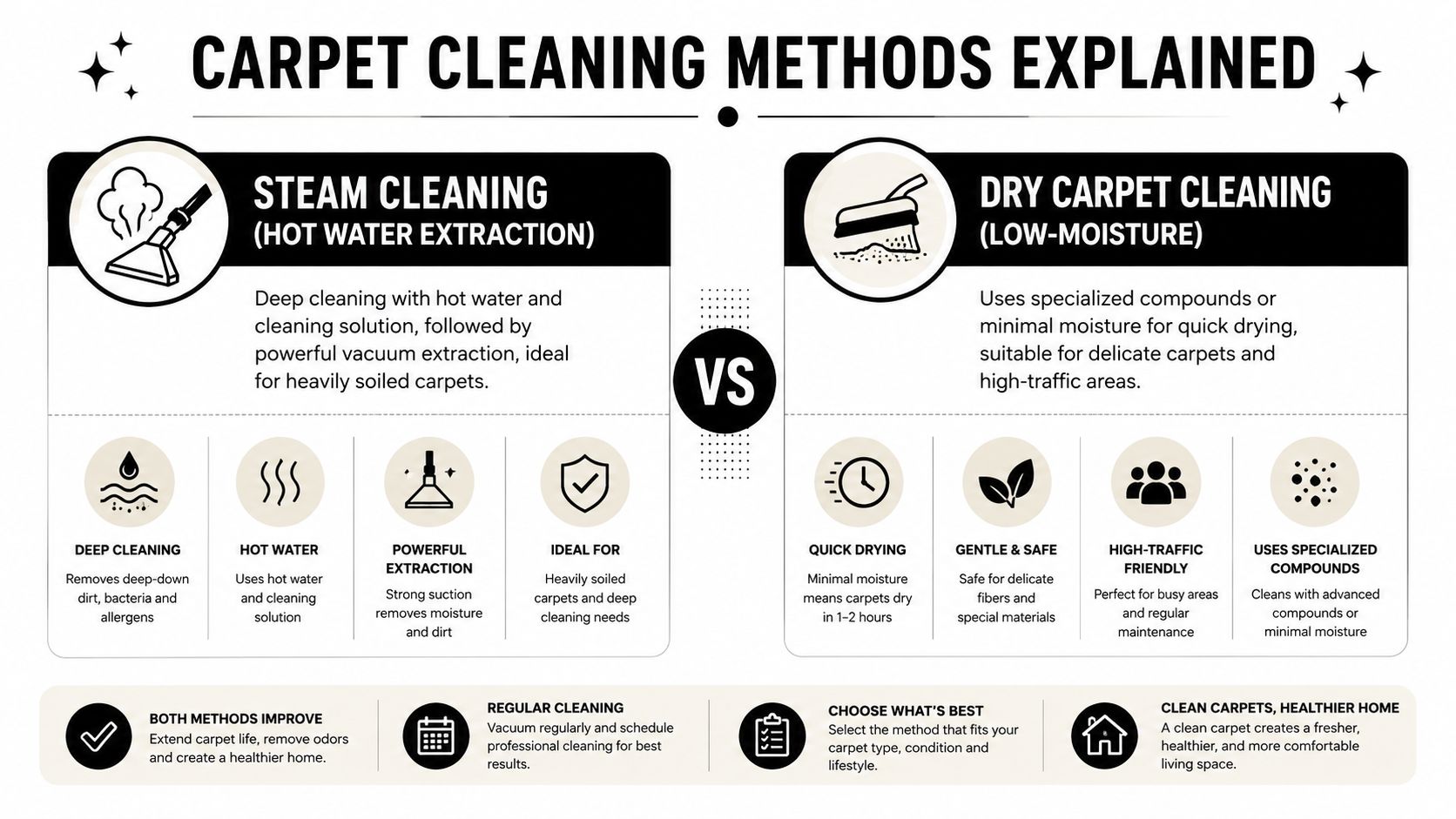
The cleaning method matters because it affects four things at once. How deep the clean goes. How long the carpet stays damp. How suitable the process is for the fibre. And how likely the carpet is to get dirty again quickly.
Hot water extraction and why people call it steam cleaning
Most homeowners call this steam cleaning, even though the machine is really using hot water and cleaning solution followed by strong extraction. It's the method many people expect when the carpet is heavily soiled, smells stale, or has built-up traffic marks.
In plain terms, the cleaner sprays solution into the carpet, agitates where needed, and then pulls dirty water back out with an extraction machine. It is the closest thing most homes get to a full rinse.
For heavily soiled carpets in Ireland's damp climate, a proper professional sequence involves pre-wetting, manual agitation into corners and edges, and a final spray-extraction rinse. If that final rinse is skipped or done badly, alkaline residue can stay trapped in the fibres and attract fresh dirt again soon after.
That point is easy to miss, but it explains a common complaint. A carpet can look brighter on the day and still seem to “go dirty again” soon after. The problem may not be the carpet. It may be residue left behind.
Low-moisture cleaning and when it makes sense
Low-moisture cleaning uses much less water. Depending on the system, the cleaner may use a machine with a special compound, pad, or encapsulation product that lifts and traps soil with limited wetting.
This approach often suits:
Maintenance cleans where the carpet isn't heavily loaded with soil
Delicate carpets that don't respond well to heavy wet cleaning
Busy homes where faster drying is important
Commercial settings where rooms need to return to use sooner
It isn't automatically “better” or “worse” than extraction. It's a different tool. A lightly soiled bedroom carpet and a dog-marked stair runner aren't the same job. A good cleaner should say that clearly.
Homeowners looking for a broader household service can also compare this with other deep cleaning options in Ireland when the carpet issue is part of a wider reset of the home.
What separates a good clean from a disappointing one
The machine alone doesn't decide the outcome. The operator does. Two cleaners can arrive with similar-looking equipment and produce very different results.
A careful cleaner pays attention to:
| Factor | Why it matters |
|---|---|
| Pre-treatment | Old stains and traffic lanes usually need attention before extraction starts |
| Agitation | Soil builds up along edges, corners, stairs, and doorways |
| Rinsing | Leftover detergent can make the carpet resoil quickly |
| Fibre awareness | Thick pile, wool, and delicate carpets need a gentler approach |
| Moisture control | Overwetting slows drying and can create follow-on problems |
Some carpets need restoration. Others need maintenance. Trouble starts when a cleaner treats both jobs the same way.
The easiest way for a homeowner to judge the explanation is to listen for specifics. If the cleaner can explain what happens to the solution after it goes in, how corners are handled, and what drying to expect, that's a useful sign. If the answer is just “we steam clean everything”, that's thin.
Decoding Carpet Cleaning Prices in Limerick
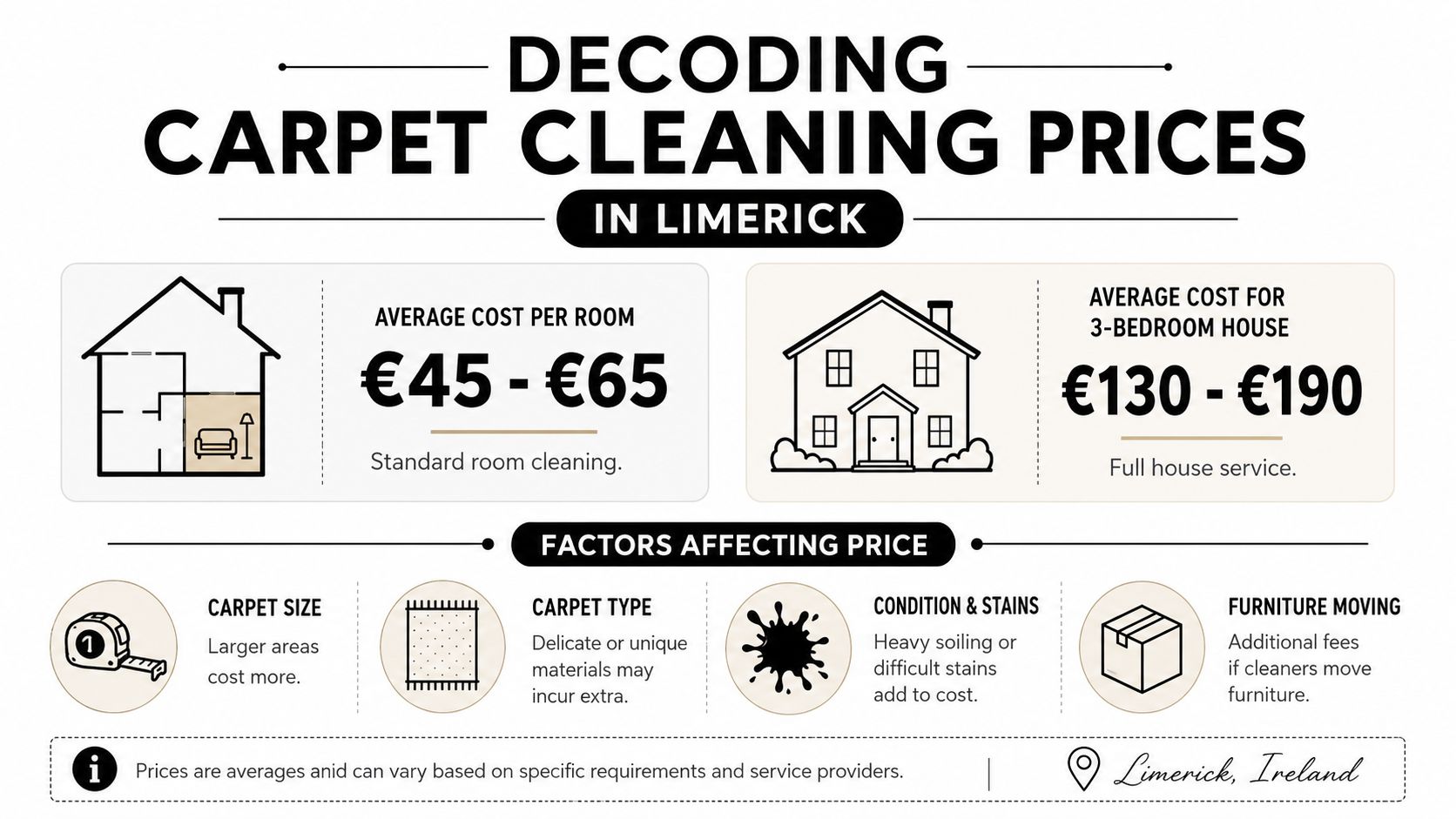
The pricing side of carpet cleaning in Limerick becomes clearer once the job is broken into parts. The total usually reflects the size of the area, the condition of the carpet, the method used, and any extras added after the basic clean.
What a homeowner is usually paying for
A useful local benchmark is this. In Limerick, cleaning all carpets in a typical 3-bed house ranges from €90 to €120, while a minimum call-out charge of €50 to €150 is common (Limerick carpet cleaning pricing from Wanda Carpet Clean).
That minimum charge surprises first-time customers more than anything else. It exists because the cleaner still has travel time, setup time, hoses, solution preparation, and drying equipment to manage even on a small job. A box room or one rug might not qualify for a low total because the area is small.
Most quotes are shaped by a few practical factors:
Room count and size: A full-house clean usually costs more than one room because there is more carpet to pre-treat, wash, rinse, and dry.
Stairs and landings: These take more manual work than open rectangular rooms.
Carpet type and pile: Thick, deep-pile, or delicate fibres often need slower work and more care.
Condition: General dullness is one thing. Ground-in soil, pet marks, grease, and drink spills are another.
Furniture moving: Some cleaners expect rooms to be cleared. Others will move light furniture only.
Common extras that change the final bill
The base cleaning quote often doesn't include every treatment. In Limerick, stain removal is commonly €10 to €30 per stain, deodorising ranges from €15 to €40, and Scotchgard protective coating is typically €20 to €50 per room (Limerick add-on carpet cleaning costs from Superior Carpet Cleaning).
These extras aren't automatically unnecessary. They just need to be understood.
A deodoriser may help where the carpet holds smells from pets, cooking, smoke, or long-term dampness. Stain treatment may involve a separate product and more labour on a single area. Protective coating is a different service again. It aims to make future spills easier to manage, not to clean what's already there.
A low initial quote can stop looking low once stain treatment, odour work, and protection are added one by one.
A simple way to compare quotes
The fairest way to compare one cleaner with another isn't by looking at the final figure alone. It's by matching the quote to the scope.
A homeowner can ask three direct questions:
What rooms, stairs, and landings are included?
Does the price include stain treatment, or is that separate?
Is there a minimum call-out charge even if the job is small?
That last point matters because some Irish carpet cleaning businesses set a specific minimum. A guide from Showpiece notes that most carpet cleaning businesses in Ireland enforce a minimum call-out charge of €50 to €150 because of setup requirements such as hoses, filling solution, and deploying air dryers (Irish carpet cleaning call-out pricing from Showpiece).
A quote also needs context. Two average rooms with light soil are not the same as two rooms with pet staining, heavy pile, furniture to move, and a need for deodorising. The cleaner who asks more detailed questions is often giving the more reliable estimate.
How to Prepare for Your Carpet Cleaner's Visit
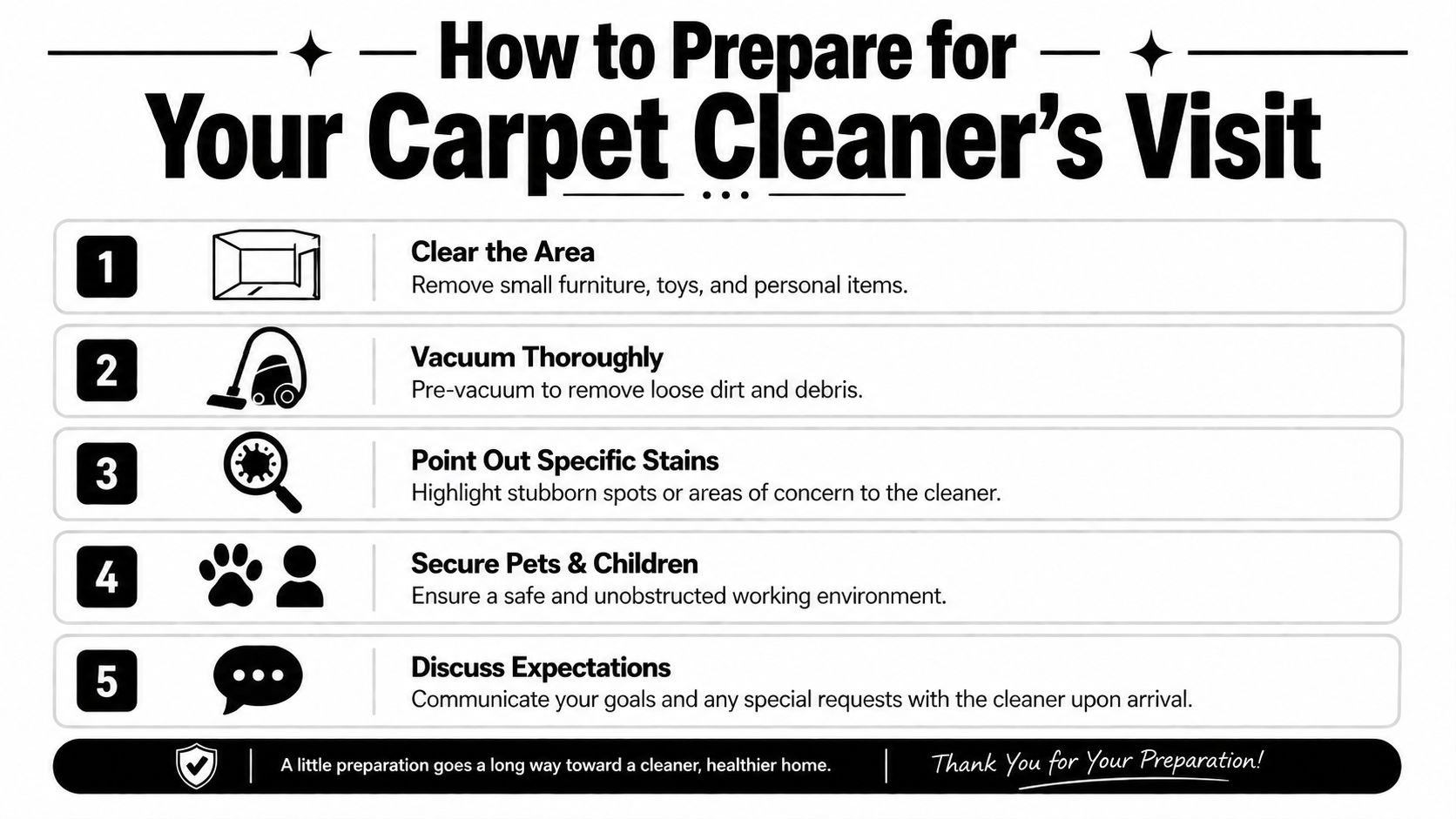
Preparation affects the result more than many households expect. A professional cleaner can do the heavy work, but the carpet performs better when loose dirt is removed before any liquid touches it.
What to do before the van arrives
The most useful step is vacuuming. Homeowners should vacuum high-traffic areas at least twice in the week before the professional clean. That can remove up to 80% of dry soil before liquid solution is applied, which helps stop loose soil turning to mud during cleaning (Irish carpet preparation advice from Smart Cleaning).
That single point answers a common misunderstanding. Some people assume there's no point vacuuming because the cleaner will do everything. In reality, a pre-vacuumed carpet gives the professional a better starting surface.
A practical checklist looks like this:
Clear small items first: Toys, shoes, cables, floor lamps, and fragile pieces should be moved out of the way.
Lift breakables and low décor: Anything sitting on side tables that may need shifting should be secured.
Make access easy: Clear hallways and the route to the room so hoses and machines can come in safely.
Secure pets: Dogs and cats don't mix well with open doors, noise, and trailing hoses.
Decide about furniture early: Ask beforehand whether the cleaner moves light furniture or expects the room cleared.
What to tell the cleaner at the door
A short conversation at the start can make the job better. The cleaner needs to know which stains matter most, whether there are pet accidents, and whether there are areas of damp smell or repeated soiling.
This is also the moment to point out anything that may not respond like ordinary dirt. Old wine stains, rust marks, bleach damage, and wear patterns may improve differently. A cleaner who gives a measured answer is worth listening to.
Surface dirt comes out differently from permanent damage. A good cleaner won't pretend they're the same thing.
Many homes in Limerick have the same problem spots. Hallways, stairs, living rooms, rental properties, and family homes with pets or young children usually carry the hardest wear. The issue isn't the neighbourhood. It's the combination of footfall, spills, and trapped moisture over time.
Hiring a Carpet Cleaner in Limerick Safely
This is the part most directories skip, but it's the part that protects the customer. In Ireland, the carpet cleaning industry is largely unregulated, which means there is no central governing body for licensing or complaints in the way many people assume. Because of that, homeowners should personally verify a provider's public liability insurance certificate before work begins (discussion of regulation and insurance in Irish carpet cleaning).
Why the regulation gap matters
A lot of people hear “professional cleaner” and assume there must be a formal licence, a register, or a body that confirms competence. For carpet cleaning, that assumption can leave a customer exposed.
If a hose marks a wall, a machine leaks, a cleaning product damages a delicate fibre, or a wet carpet causes a problem, the customer needs to know the provider is properly insured. Without that check, trust rests almost entirely on what the cleaner says about themselves.
That's also why it helps to understand how newer Irish home-service platforms present themselves. A marketplace such as ShamFix's guide to its Ireland-only platform is best understood as a way to find local, rated providers, not as a substitute for checking a cleaner's own stated insurance and credentials directly.
Questions worth asking before booking
The safest customer doesn't ask dozens of questions. Just the right few.
Insurance first: Ask for proof of current public liability insurance before the job starts.
Method second: Ask what cleaning method will be used on that specific carpet.
Stain expectations: Ask whether each major stain is likely to lift, improve, or remain.
Drying guidance: Ask how long the carpet is likely to stay damp in current conditions.
Furniture handling: Clarify who moves what before the day of the clean.
Those questions do two jobs at once. They reduce surprises, and they show whether the cleaner is comfortable being specific.
What a careful customer looks for
The best sign is not a flashy promise. It's a clear answer. A careful provider should be willing to say what is included, what isn't, what the risks are, and what proof of insurance can be shown.
A homeowner should be wary when a cleaner:
| Warning sign | Why it matters |
|---|---|
| Avoids insurance questions | That's the first thing that should be easy to answer |
| Promises every stain will vanish | Some staining is permanent or only partly reversible |
| Gives one flat price without seeing the job details | Condition and layout affect the work |
| Can't explain the cleaning method | The customer needs to know how the carpet will be treated |
The unregulated nature of the sector doesn't mean every cleaner is risky. It means the customer needs to act like the final checkpoint. That isn't paranoia. It's basic due diligence.
Your Post-Cleaning Care Guide
A freshly cleaned carpet often looks far drier than it really is. That's where post-clean mistakes happen. People walk on it heavily, put furniture back too early, or assume the surface feel tells the whole story.
Drying myths that cause problems
One common myth is that a carpet cleaned with hot water extraction will be dry and fully usable within an hour. In ordinary home conditions, that's often unrealistic. For two average rooms, the cleaning itself often takes roughly 30 to 60 minutes per room, depending on condition and method. Drying is more variable. Hot water extraction can leave carpets damp for several hours, commonly 4 to 8 or more, while low-moisture methods usually dry faster.
Another myth is that if the carpet feels dry on top, it is dry underneath. That's not always true. The pile can feel nearly normal while the lower fibres or backing still hold moisture.
The safest rule is simple. If the carpet still feels cool and slightly heavy underfoot, it probably isn't fully dry yet.
How to avoid ruining the result
The best aftercare is practical rather than technical:
Ventilate the room: Open windows where weather allows and keep air moving.
Use heat and airflow sensibly: Heating, fans, and general ventilation help moisture leave the carpet.
Avoid heavy foot traffic: Don't treat the room as back to normal too soon.
Wait before replacing heavy furniture: Furniture on damp carpet can leave marks and create transfer problems.
Use clean indoor footwear if access is necessary: That reduces re-soiling while fibres are still settling.
Customers also tend to underestimate weather. Drying in a mild, airy house is different from drying in still, damp conditions. That's one reason cleaners should be careful with promises. Drying depends on the method used, the carpet thickness, the amount of soil flushed out, and the home's ventilation and heating.
Low-moisture cleaning and hot water extraction don't dry on the same timeline. That isn't a flaw. It's just part of choosing the right method for the job. The important thing is that the customer knows which one was used and behaves accordingly once the cleaner leaves.
Find Rated Carpet Cleaners in Limerick with ShamFix
Finding a cleaner is easy. Finding one who explains the method clearly, prices the work fairly, and gives the customer confidence on insurance is harder. That's the core issue behind most searches for carpet cleaning in Limerick.
For homeowners, the platform's role is straightforward. It helps people find local, rated service providers in Ireland, with trust built through two-sided reviews after completed work rather than approval badges or marketplace claims.

For anyone ready to compare local options, the most relevant starting point is the Limerick provider listings on ShamFix. The sensible approach stays the same whichever provider is contacted. Read the reviews carefully, ask what method will be used, confirm what the quote includes, and check public liability insurance before work begins.
A homeowner who wants to compare local, rated providers can start with ShamFix, an Ireland-only marketplace founded in 2025. It connects customers with local home-service providers across the Republic of Ireland, and trust on the platform comes from real two-sided reviews after completed work.